
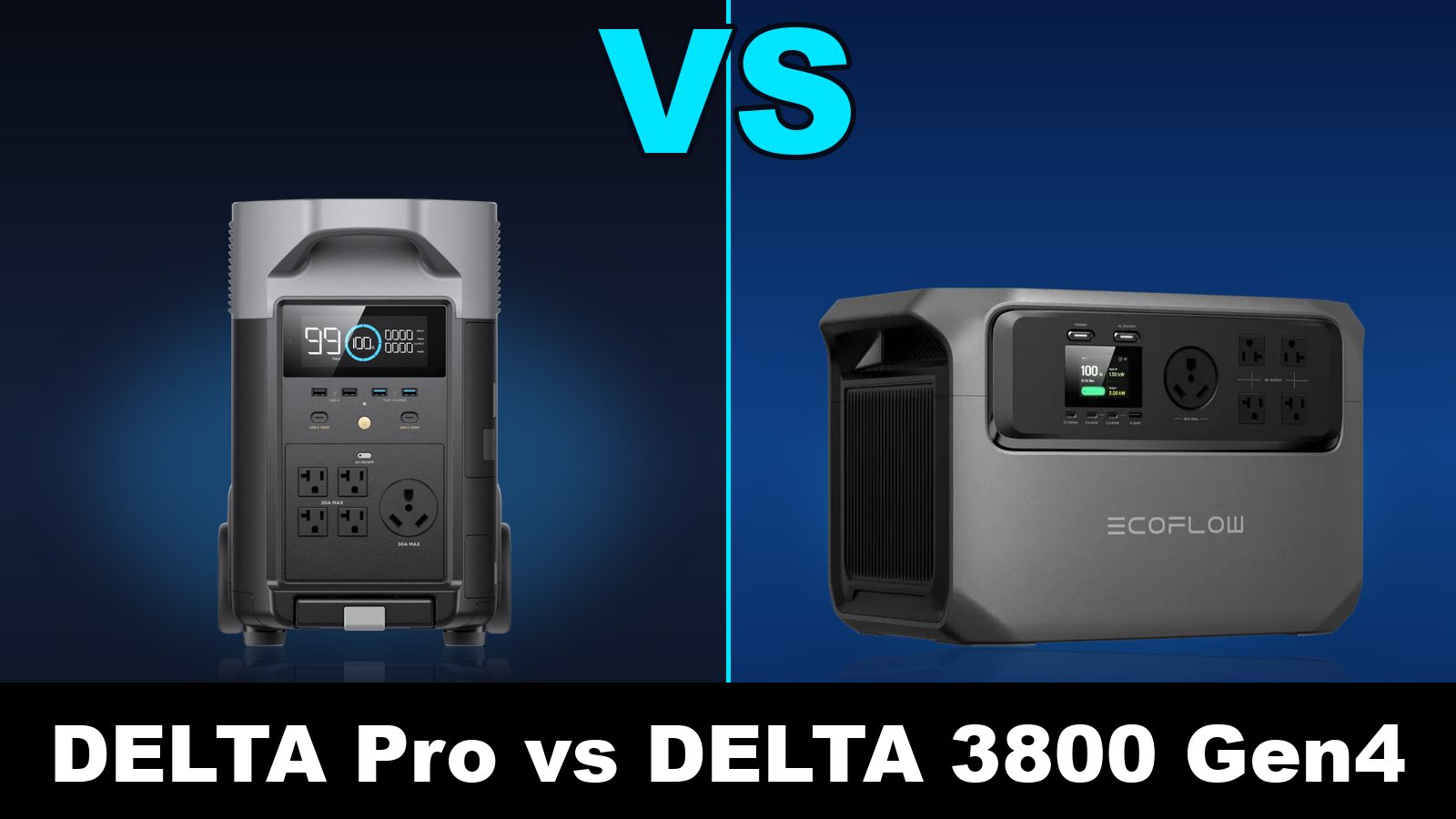

DELTA Pro
- you want the Smart Home Panel 2
- two units on a hub for 240V
- you run 12V gear: Anderson, socket, DC5521
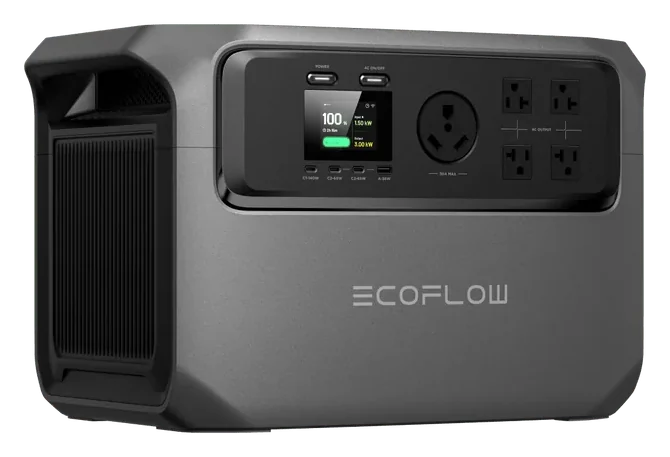
DELTA 3800 Gen4
- you move it yourself: 67.5 lb
- a PC sits on it: under 10ms
- it shares a room: 30dB at 600W
Prices and stock checked by our price engine on November 6, 2026 at 9:00 AM EST. Each product is rechecked several times a day; the time refreshes when you load the page.
A new DELTA Pro only makes sense if it is going to be wired into your house.
The EcoFlow DELTA 3800 Gen4 beats the EcoFlow DELTA Pro on nearly every line of a spec sheet: 3,763Wh against 3,600Wh, 2,000W of solar against 1,600W, under 10ms against under 30ms, and 67.5 lb against 99 lb, with the same 3,600W and 7,200W surge. What the older station still has is plumbing: the Smart Home Panel 2, a 240V route with two units and a hub, 3,000W charging from a 240V outlet, plus 12V ports and wheels. If none of that is on your plan, skip it.
Below: what five years of EcoFlow engineering changed, a 20-second calculator, and eight situations, including whether an existing owner should swap. The DELTA Pro has real reviewer data behind it. The Gen4 has none yet.
Prices sit $100 apart today. Output and surge match. The 3800 Gen4 is 31.5 lb lighter, holds 163Wh more, takes 400W more solar and switches over three times faster on paper. The DELTA Pro alone connects to a home panel, charges from 240V and has 12V outputs.
- it feeds a home panel
- you charge from 240V
- you need 12V ports
- it has to move
- it backs up electronics
- you run 2,000W of solar
What five years changed, and what they didn’t
The inverter story is flat: 3,600W, a 7,200W surge, 120V from four outlets plus a 30A one. The changes are all around it.
Will it run your setup? Check in 20 seconds
Estimates use 85% usable capacity and 70% of rated solar output. Real results vary with temperature, inverter load, shade and appliance cycling. Fridge and freezer watts are daily averages and do not include compressor startup surges.
Runtime by appliance, one at a time
Energy estimates at 85% usable: about 3,060Wh on the DELTA Pro and 3,199Wh on the 3800 Gen4. OutdoorGearLab drew 3,060Wh from a DELTA Pro, which is that same 85%. Nobody has measured the Gen4 yet.
Appliance for appliance, the 3800 Gen4 lasts 5% longer than the DELTA Pro.
Same appliance, same watts: the gap is always the size of the battery.Get our Black Friday alerts for EcoFlow
We track live prices on 40+ models from Jackery, EcoFlow, BLUETTI and Anker SOLIX. When a deal beats the lowest price we've recorded, you'll hear from us. During Black Friday week, one short recap a day at most.
Unsubscribe in one click. We may earn a commission when you buy through our links, at no extra cost to you. Privacy Policy
The price gap, in numbers
The EcoFlow DELTA 3800 Gen4 costs $100 less than the EcoFlow DELTA Pro and still holds 163Wh more.
Prices refresh daily from EcoFlow US.Rated life is 3,500 cycles to 80% on one and 6,000 to 70% on the other. Those are different finish lines, so we skip a cost-per-cycle card. When a price sits under its regular figure, a promotion is running, and each one ends on its own date.
Eight modeled situations, worked out
Energy math uses 85% of the rated capacity. The essentials plan is 140W around the clock, about 3.4kWh a day.
You already own a DELTA Pro
EcoFlow’s Gen4 table names two extra batteries, the DELTA Pro 3’s and the DELTA 3 Max Plus’s. The DELTA Pro battery isn’t one of them, so any you own would not come along. Going by the numbers you gain 163Wh and a quieter fan. We would only swap if you carry it often or need the faster switchover.
Circuits in your panel, not extension cords
This is the DELTA Pro’s reason to exist in 2026. EcoFlow’s Gen4 compatibility table names no Smart Home Panel or transfer switch, so ask EcoFlow before you plan any wiring around a 3800.
A 240V well pump
EcoFlow sells two DELTA Pros with the Double Voltage Hub as a bundle, on our November 5, 2026 check. No Gen4 equivalent is listed. Before buying two, read about the DELTA Pro 3, which does 240V in one box.
Essentials through a two-day storm
One hour apart. Capacity is not why you choose here. For a second day you need a bigger battery on either, or panels.
Running in the room where you sleep
EcoFlow’s range for the DELTA Pro is 48 to 60dB at 1 m, depending on power flow and temperature, though StorageReview found the fans can stop at low loads. The Gen4’s ratings are 30dB at 600W and 40dB at 1,800W. On paper, this is the most comfortable upgrade.
A desktop PC and a NAS on battery backup
OutdoorGearLab doesn’t count the DELTA Pro’s cutover as a real UPS, and StorageReview put a small dedicated one ahead of its server rack. The Gen4’s figure is safer for electronics. It still sends no HID signal, so nothing shuts down by itself.
A long panel string on a roof
More watts on the Gen4, across two ports. More voltage on the DELTA Pro, which lets you wire more panels in series on a single run. Add up your string’s open-circuit voltage before you buy; a 60V limit rules out long strings.
From the shed to the second floor
On concrete the DELTA Pro rolls and the 3800 has to be carried. At the stairs that flips: Android Central’s reviewer said portable should be taken with a grain of salt at this weight.
Eight more differences, the spec sheet and the box
Smaller gaps that rarely decide the purchase, then the full specifications and what ships in the box.
DELTA Pro and DELTA 3800 Gen4 weight, dimensions and full specifications
Weight: 99 lb for the DELTA Pro and 67.5 lb for the DELTA 3800 Gen4. Dimensions: 25 × 11.2 × 16.4 in and 16.77 × 11.36 × 12.09 in. Everything else is in the sheet below.
EcoFlow DELTA Pro and EcoFlow DELTA 3800 Gen4 full specifications
Every published figure for both units, grouped. Green marks the better value.
What’s in the box
DELTA Pro
- DELTA Pro power station3,600Wh, 99 lb
- AC charging cable
- Car charging cable
- Solar charging cable
- DC5521 to DC5525 cable, Smart Generator adapter, handle cover
- User manual and warranty card
DELTA 3800 Gen4
- DELTA 3800 Gen43,763Wh, 67.5 lb
- AC charging cable
- Two solar charging cablesXT60i to LP60
- AC cable retention kit, manuals and warranty card
- Expansion adapter and batteriessold separately
From EcoFlow’s US pages. The Gen4 ships with two solar cables; its expansion adapter and batteries are sold separately.
06 · ChargingHow fast each one refills
Shorter bar, faster refill. Each row is scaled to its slower unit.
DELTA Pro: 1,800W at 120V, 3,000W at 240V, 1,600W solar3800 Gen4: 1,800W at 120V, 2,000W solar over two ports
Our solar times assume panels deliver 70% of their rating; the brands’ figures assume ideal sun.
Every port, side by side
DELTA Pro
DELTA 3800 Gen4
The old station is the better port collection: more USB-A and three kinds of 12V output. The new one trades all of that for a stronger USB-C and a smaller case.
08 · NoiseNoise: DELTA Pro vs 3800 Gen4
The EcoFlow DELTA 3800 Gen4 has the lower figures: 30dB at 600W and 50dB at 3,600W, against 48 to 60dB for the EcoFlow DELTA Pro. Both are EcoFlow’s, at 1 m, and only the DELTA Pro has reviewer reports.
Brand figures; nobody has measured either in decibels independently.Every figure we found, with its source
What reviewers heard: At around 3,000W the cooling fans switched on but the unit kept running (CleanTechnica); fans ramp up under heavy draw and fast charging, then can stop at low loads (StorageReview).
Measured by a tester Brand figure
- Keep charging speed low overnight in the EcoFlow app; heavy charging brings the fans up on either model.
Cold and heat: DELTA Pro vs 3800 Gen4
No difference: the EcoFlow DELTA Pro and the EcoFlow DELTA 3800 Gen4 both charge from 32°F to 113°F and run from 14°F to 113°F.
Figures from the DELTA Pro user manual (120V edition) and the EcoFlow US DELTA 3800 Gen4 page.- Neither belongs in an uninsulated shed in a northern winter if you expect to recharge it there.
App, UPS and smart features
The EcoFlow DELTA Pro reaches into the house: Smart Home Panel 2, and 240V with a second unit and the Double Voltage Hub. The EcoFlow DELTA 3800 Gen4 is the better outage companion: under 10ms, Storm Guard 2.0 and Fridge Runtime Boost.
Same EcoFlow app, over Wi-Fi and Bluetooth.Green zone: a switch under about 16ms, which most desktop PCs ride through without restarting.
Does it connect to a home panel? The EcoFlow DELTA Pro works with the Smart Home Panel 2. EcoFlow’s table for the EcoFlow DELTA 3800 Gen4 names no panel or transfer switch.
Can it deliver 240V? Two EcoFlow DELTA Pros with the Double Voltage Hub deliver 240V. The EcoFlow DELTA 3800 Gen4 is 120V only.
Can it start a generator by itself? The EcoFlow DELTA 3800 Gen4 starts and stops a compatible generator through its extra battery port only, not through AC charging. Our sources don’t confirm auto start on the EcoFlow DELTA Pro.
Does it prepare for storms? Storm Guard 2.0 on the EcoFlow DELTA 3800 Gen4 uses National Weather Service data to recharge ahead of severe weather. We found no storm mode listed for the EcoFlow DELTA Pro.
Does it work as a UPS? The EcoFlow DELTA 3800 Gen4 switches in under 10ms, without HID. The EcoFlow DELTA Pro’s EPS is under 30ms, fine for appliances, borderline for desktop PCs.
Can you add a battery later? The EcoFlow DELTA Pro takes two DELTA Pro batteries, sold out on their own at EcoFlow US on November 5, 2026. The EcoFlow DELTA 3800 Gen4 takes two DELTA 3 Max Plus or DELTA Pro 3 batteries; two need an adapter.
Warranty and support
Both reach 5 years with registration. EcoFlow’s US table gives the EcoFlow DELTA Pro 2 years, plus 3 once registered; the EcoFlow DELTA 3800 Gen4 gets 3 years, plus 2.
A small edge to the Gen4 if you forget to register.Subject to each brand’s warranty terms and eligibility.
EcoFlow rates the DELTA Pro at 3,500 cycles to 80% and the DELTA 3800 Gen4 at 6,000 cycles to 70%, in lab conditions. The end points differ, so the larger number isn’t a like-for-like win.
- Register a new DELTA Pro the day it arrives: EcoFlow’s page and its warranty table disagree on the base term.
- Register the 3800 Gen4 in the EcoFlow app to get the extra 2 years.
What reviewers report
We have not had these two units in hand. As of November 5, 2026, no full independent review of the DELTA 3800 Gen4 had been published. The findings below cover the DELTA Pro only, with source, author and date for each point.
DELTA Pro: OutdoorGearLab (May 2025), CleanTechnica (August 2022), StorageReview (October 2022), Android Central (January 2022)DELTA 3800 Gen4: no verifiable independent test found
Usable capacity
- DELTA ProReviewer Lab test drew 3,060Wh over AC, about 85% of the 3,600Wh rating, which the testers call roughly average for AC output. OutdoorGearLab, Kenji Mowrey, May 2025
- DELTA ProReviewer With a steady 350W load, the testers got 3,000Wh out, and a full recharge drew 4,180Wh from the wall. StorageReview, Kevin OBrien, October 2022
Charging
- DELTA ProReviewer Fastest wall charging of the whole test group, averaging 1,412Wh per hour. OutdoorGearLab, Kenji Mowrey, May 2025
- DELTA ProReviewer From a standard household outlet it went from empty to full in under three hours at up to 1,800W. Android Central, Chris Wedel, January 2022
Noise and heat
- DELTA ProReviewer At around 3,000W of draw, with a microwave added, the cooling fans switched on but the unit kept running. CleanTechnica, Jennifer Sensiba, August 2022
- DELTA ProReviewer Fans ramp up under heavy draw and fast charging, then spin down and can stop completely at low loads. StorageReview, Kevin OBrien, October 2022
UPS and output
- DELTA ProReviewer Only an emergency power supply: its switchover of 30ms or less is too slow to count as a true UPS. OutdoorGearLab, Kenji Mowrey, May 2025
- DELTA ProReviewer Plugged into an RV through its 30A outlet, it ran the camper air conditioner, which pulled about 1,400W once the compressor started. CleanTechnica, Jennifer Sensiba, August 2022
- DELTA ProReviewer For a server rack they kept a small dedicated UPS in front, because power stations often switch in around 30ms. StorageReview, Kevin OBrien, October 2022
- DELTA ProReviewer Ran a 1,400W portable AC, two mini fridges, a coffee maker, a microwave and a water pump all at once. Android Central, Chris Wedel, January 2022
Daily use and issues
- DELTA ProReviewer Measured weight is about 97 lb, so it belongs in a semi-permanent spot despite wheels and handle. OutdoorGearLab, Kenji Mowrey, May 2025
- DELTA ProReviewer Over Bluetooth, the app estimated just over an hour of runtime at that heavy load. CleanTechnica, Jennifer Sensiba, August 2022
- DELTA ProReviewer The reviewers relied on the app often for local and remote monitoring and for firmware updates. StorageReview, Kevin OBrien, October 2022
- DELTA ProReviewer At 99 lb and over two feet long, the reviewer says portable must be taken with a grain of salt. Android Central, Chris Wedel, January 2022
Practical limits before you buy
- Planning to grow a DELTA Pro? On November 5, 2026, its extra battery was sold out on its own at EcoFlow US; one solar bundle still included it.
- The Gen4 takes two batteries only with an adapter. The Smart Extra Battery Expansion Adapter is sold separately.
- DELTA Pro AC outputs switch off after 12 hours if the load is negligible. Turn them back on by hand.
- A second DELTA Pro can’t act as an extra battery. EcoFlow says so on its US page.
- The Gen4’s rated cycles end at 70%. The DELTA Pro’s end at 80%, so 6,000 and 3,500 are not the same measure.
- The Gen4’s solar ports stop at 60V. Long series strings that suit a DELTA Pro can exceed that.
- EcoFlow’s 70-hour fridge figure uses an empty fridge. Its own footnote says no-load, a Samsung 654L, in internal testing.
- Neither one makes 240V alone.
- Five years needs the app. Skip registration and neither model gets there.
Frequently asked questions
Is the EcoFlow DELTA 3800 Gen4 better than the DELTA Pro?
For most buyers, yes: more capacity, 31.5 lb less, more solar, a faster switchover and lower noise figures, with the same 3,600W. The DELTA Pro is still the one that works with a Smart Home Panel 2 and charges from 240V.
Which is cheaper?
The DELTA 3800 Gen4 costs $100 less today: $1,699, against $1,799 for the DELTA Pro. Per Wh, the 3800 Gen4 is cheaper: $0.45, against $0.50. Prices refresh daily.
Should I replace my DELTA Pro with a 3800 Gen4?
Usually not. You would gain 163Wh and lose 12V ports and 240V charging. DELTA Pro batteries aren’t in the Gen4’s compatibility table. Swap only if weight or the slower switchover bothers you.
Can the 3800 Gen4 use DELTA Pro extra batteries?
EcoFlow names only the DELTA Pro 3 Extra Battery and the DELTA 3 Max Plus battery, so assume not.
How much lighter is the 3800 Gen4?
31.5 lb: 67.5 lb against 99 lb. EcoFlow’s FAQ puts it at about 15 kg. The DELTA Pro has wheels; the Gen4 does not, and EcoFlow sells a folding cart separately.
Which works with a home panel?
The DELTA Pro, through the Smart Home Panel 2. EcoFlow’s table for the 3800 Gen4 lists no panel or transfer switch.
Which one is the better UPS?
The 3800 Gen4, at under 10ms against under 30ms. Neither is a 0ms professional UPS.
Has anyone reviewed them?
The DELTA Pro, many times; see the reports section. As of November 5, 2026, no full independent review of the 3800 Gen4 had been published.
Related comparisons and reviews
How we compared and sources
Research-based comparison. We have not had either unit in hand. Specs come from EcoFlow’s US pages; DELTA Pro observations are credited to named reviewers. Prices and availability were checked on November 5, 2026.
- Specs: EcoFlow US, DELTA Pro with its FAQ and user manual (120V edition), and EcoFlow US, DELTA 3800 Gen4 with its FAQ and footnotes, read on November 5, 2026.
- Our math: 85% usable capacity, 140W for the essentials plan, solar at 70% of rating. The 16-minute charging gap is EcoFlow’s published comparison.
- EcoFlow’s DELTA Pro page says 3 years plus 2, its US warranty table 24 months plus 36 with registration; we show the prudent reading. Its US page gives no switchover figure; under 30ms is the EPS figure reviewers quote.
- Reviewer reports on the DELTA Pro: OutdoorGearLab, Kenji Mowrey, May 2025, CleanTechnica, Jennifer Sensiba, August 2022, StorageReview, Kevin OBrien, October 2022, Android Central, Chris Wedel, January 2022.
- Runtime = capacity × 0.85 ÷ watts. Solar harvest = min(panel watts, max input) × sun hours × 0.70. Cost per lifetime kWh = price ÷ (cycles × capacity in kWh).
99 lb with a place in your electrical plan, or 67.5 lb that beats it everywhere else.
Prices checked November 6, 2026 at 9:00 AM EST
Looking at other models? Browse all power station comparisons, or pick any two models on the hub and we point you to the right duel.
Originally published: November 6, 2026