
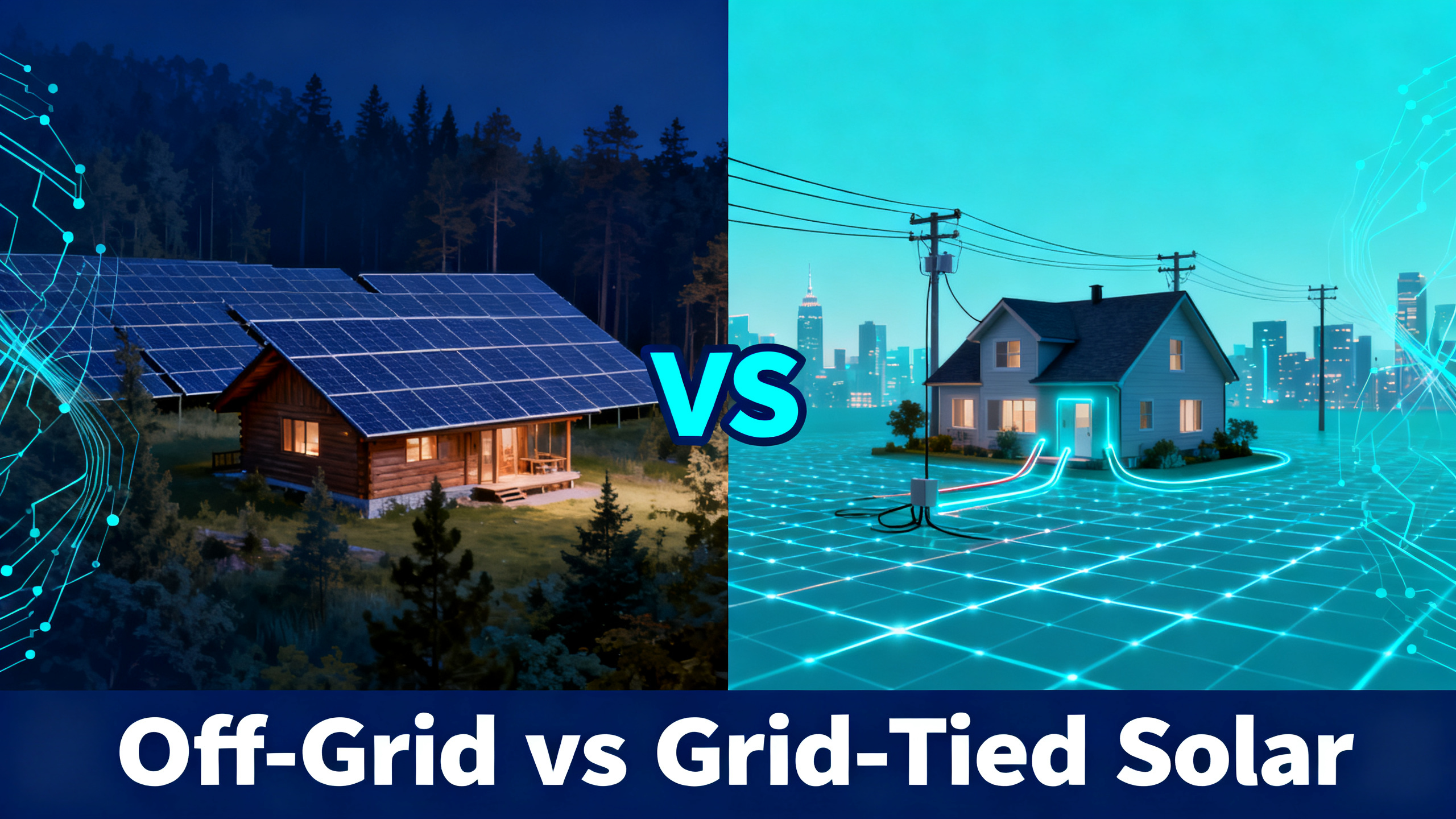
You want to go solar. But then comes the question no one warned you about: should you stay connected to the grid, cut the cord entirely, or skip the permanent installation altogether? The choice between on grid vs off grid solar power shapes everything that follows, your upfront cost, your behavior during outages, your long-term flexibility, and even whether you’ll need permits and an electrician.
Here’s the thing most installers won’t tell you: there’s a third path that suits a surprising number of homeowners better than either fixed system. Portable power stations have evolved into legitimate backup tools that sidestep the entire grid-tied vs off-grid debate. For a full breakdown of system components and installation options, our complete off-grid solar power guide covers every step of the process.
This article breaks down all three options: how each system actually works, what they cost, who they suit, and a five-question framework to identify your best fit. By the end, you’ll know exactly which path makes financial and practical sense for your situation.
Get our Black Friday alerts for power stations
We track live prices on 40+ models from Jackery, EcoFlow, BLUETTI and Anker SOLIX. When a deal beats the lowest price we've recorded, you'll hear from us. During Black Friday week, one short recap a day at most.
Unsubscribe in one click. We may earn a commission when you buy through our links, at no extra cost to you. Privacy Policy
Grid-Tied Solar: How It Works and Who It’s For
A grid-tied solar system is the most common residential setup in the U.S. Solar panels on your roof feed DC electricity into an inverter, which converts it to AC and pushes it directly into your home’s electrical panel. Any surplus flows back to the utility grid through a bidirectional meter. Net Energy Metering (NEM) programs credit you for that exported power, often at retail or near-retail rates depending on your state.
The appeal is straightforward. Installation is simpler because no battery bank is required. The grid itself acts as your “storage,” absorbing surplus during sunny hours and supplying power at night. Performance data for grid-tied setups confirms payback periods between 6 and 12 years for most U.S. homes, with monthly bill reductions of 50% to 90% depending on system sizing and local sun exposure. Permitting is required for grid interconnection, and most utilities follow standardized U.S. grid connection requirements that govern the approval process.

The critical limitation, the one that surprises new owners every storm season, is that standard grid-tied systems shut down during blackouts. This isn’t a bug. Anti-islanding requirements force inverters to disconnect when the grid goes down, protecting utility line workers from energized backfeed. So even though your panels are producing power on a sunny day during an outage, your home stays dark unless you’ve added a battery storage system, functionally similar to whole-home battery backup systems that store excess generation for use during outages.
Grid-tied solar makes sense if you’re already connected to a reliable utility, your priority is reducing electricity bills, your budget falls in the $15,000 to $30,000 range, and you can tolerate occasional short outages without backup power. It’s the right call for the majority of suburban and urban homeowners.
Off-Grid Solar: The Case for Full Energy Independence
Off-grid solar means exactly what it sounds like: zero connection to any utility. Every watt your home consumes must come from your panels, your battery bank, or a backup generator. This is the system you build when grid access doesn’t exist, when extending utility lines would cost more than building your own infrastructure, or when full energy independence is a hard requirement.
The component list is significantly more complex than grid-tied. You need solar panels sized for the worst-case scenario (typically December cloudy days), an MPPT charge controller to optimize panel output, a battery bank large enough to cover 2 to 5 days of autonomy, a pure sine wave inverter, and almost always a backup generator (propane or diesel) for extended cloudy periods. Battery capacity for residential off-grid setups typically runs 10kWh to 30kWh of LiFePO4 storage.
Cost analysis shows residential off-grid systems range from $25,000 to $60,000 or more, depending on home size and energy consumption. The battery bank alone can represent 30% to 50% of total cost, and LiFePO4 batteries require replacement every 10 to 15 years. Owner feedback patterns for off-grid installations reveal that real-world energy use almost always exceeds initial estimates, particularly for households new to load management.

The advantages, when off-grid genuinely fits, are real. No monthly utility bill. Complete immunity to grid outages. Freedom to build on land where utility connection would cost $20,000 or more (often the case for properties more than a mile from existing infrastructure). For rural property owners and full-time off-grid residents, the long-term economics work out even at high upfront cost.
The limitations are equally real. Energy management becomes a daily discipline. Cloudy weeks force generator runs that burn fuel and add maintenance overhead. Permits are still required for permanent installations in most jurisdictions. And if your loads grow unexpectedly, expanding capacity means buying more batteries or more panels, both at significant cost.
Off-grid solar fits the right buyer beautifully. It’s a poor fit for anyone with reliable grid access who’s primarily motivated by cost savings.
Get our Black Friday alerts for power stations
We track live prices on 40+ models from Jackery, EcoFlow, BLUETTI and Anker SOLIX. When a deal beats the lowest price we've recorded, you'll hear from us. During Black Friday week, one short recap a day at most.
Unsubscribe in one click. We may earn a commission when you buy through our links, at no extra cost to you. Privacy Policy
Portable Power Stations vs Fixed Off-Grid Systems: A Third Option
Here’s where the conversation usually stops in solar industry content, and where it shouldn’t. For a significant share of homeowners reading articles like this, neither grid-tied solar nor a full off-grid build is the right answer. The actual fit is a portable power station, used either standalone or as a complement to existing grid service. Portable units have become genuine contenders, see our picks for the best power stations for home backup to understand what modern units can realistically cover.

The Jackery Explorer 2000 Plus exemplifies what a modern portable platform can do. Spec-for-spec, it delivers 2,042Wh of LiFePO4 capacity expandable to 24kWh through additional battery packs, 3,000W continuous AC output (6,000W surge), and 0 to 80% recharge in roughly 2 hours via wall outlet. Solar input tops out at 1,200W, enough to refill the unit in a single sunny day with the right panel kit.
Jackery Explorer 2000 Plus
$899 $1,399
- 2,042Wh expandable up to 24kWh
- 3,000W AC output (6,000W surge)
- LiFePO4, charges to 80% in ~2 hours
The Bluetti AC200L hits the same use case from a slightly different angle. Capacity sits at 2,048Wh, expandable to 7kWh through B300K battery modules, with 2,400W AC output and an aggressive 45-minute 0 to 80% recharge time. The faster recharge is a meaningful differentiator for grid-tied users who want a quick top-off during a brief power restoration window.

Bluetti AC200L
$899 $1,599
- 2,048Wh expandable to 7kWh
- Charges to 80% in 45 minutes


Honest framing matters here. A 2kWh portable cannot run central air conditioning, electric water heaters, or a whole home for days. What it can do, and what fixed systems can’t, is install in five minutes with no permits, no electrician, and no $20,000 commitment. For partial backup, RV use, cabin power, and grid-tied homes wanting outage protection without rewiring, this category genuinely competes with fixed installations on practical merit.
✅ Off-grid solar makes sense if…
- You own remote property with no utility access
- Long-term budget exceeds $30K
- You plan to live there full-time for 10+ years
- Full energy independence is a non-negotiable goal
❌ Off-grid solar is overkill if…
- You’re already grid-connected with reliable power
- Budget is under $15K
- You need power for occasional outages only
- You rent or may move within 5 years
Cost Comparison: Upfront vs Long-Term
Sticker price is the loudest number, but it’s rarely the most important one. A $25,000 grid-tied install that pays back in 8 years and a $40,000 off-grid install that pays back in 18 years sit at very different points on the value curve. According to average solar installation costs tracked across the U.S., grid-tied residential installs cluster around $15,000 to $30,000 after the federal tax credit that applied through 2025, while comparable off-grid systems run roughly twice that.
System Comparison at a Glance
| Feature | Grid-Tied Solar | Off-Grid Solar | Portable Power Station |
|---|---|---|---|
| Installation Cost | $15,000 to $30,000+ | $25,000 to $60,000+ | $900 to $4,000 |
| Permitting Required | Yes (grid interconnect) | Often yes (permanent) | No |
| Grid Independence | Partial (sells back) | Full | Partial (backup) |
| Power During Outage | No (unless battery added) | Yes | Yes |
| Portability | None | None | Full |
| Payback Period | 6 to 12 years | 10 to 20+ years | 1 to 3 years (backup use) |
Hidden costs are where buyers often get surprised. Grid-tied installs require utility-approved permitting, an electrician for service panel work, and sometimes structural engineering for older roofs. Off-grid adds the cost of battery replacement (every 10 to 15 years for LiFePO4), generator fuel, and ongoing maintenance. Portable stations effectively have none of these recurring expenses.

Regardless of which fixed system you choose, grid interconnection or critical-load isolation typically requires licensed electrician work and a dedicated transfer switch installation guide to ensure safe operation during outage transitions. This is a line item that gets quietly excluded from many published installer quotes. Budget at least $1,500 to $4,000 for a properly installed transfer switch on top of the system itself.
The data makes a clear case for the portable category at the entry tier. A $1,500 to $4,000 portable setup that handles 90% of outage scenarios delivers better practical value for most households than a $30,000 fixed install they don’t quite need.
Decision Framework: 5 Questions to Determine Your Best Path
The right system depends less on what’s technically impressive and more on what fits your specific living situation. These five questions cut through the marketing and isolate the variables that actually drive the decision.
5 Questions to Find Your Ideal Power System
Question 1
Is your property grid-connected?
Yes: Grid-tied or hybrid is viable. No: Off-grid or portable is your only option.
Question 2
What’s your available budget?
Under $5K: Portable. $15K to $30K: Grid-tied. $30K+: Full off-grid.
Question 3
Do you want to sell power back to the grid?
Yes: Grid-tied only (NEM programs). No: Off-grid or portable works.
Question 4
How critical is power during outages?
Critical: Off-grid or portable with battery. Grid-tied alone goes dark during outages.
Question 5
Is this a permanent structure or mobile use?
Permanent: Fixed systems make sense. Mobile/temporary: Portable stations only.
Run yourself through these honestly. The pattern that emerges for the majority of readers reaching this article: a grid-tied home that wants outage protection without the price tag of a battery wall, or a part-time off-grid use case (cabin, RV, weekend property) that doesn’t justify a permanent build. Both pattern profiles point to a portable power station, possibly paired with a fold-out solar panel kit, as the right answer.

If budget is the primary driver and you’re not ready for a permanent installation, our roundup of the best solar generators for off-grid use identifies the strongest portable options across every price tier, from entry-level emergency backup to full expandable home-coverage systems.
Not Sure Which System Fits Your Needs?
Compare the top-rated solar generators for every budget and use case in our full roundup.
Frequently Asked Questions
Can a grid-tied solar system power my home during a blackout?
Standard grid-tied systems shut down automatically during outages due to anti-islanding requirements: this protects utility workers on the line. Adding a battery storage system (like a home backup battery) changes this, but adds $8,000 to $15,000 to the total cost.
How much does a complete off-grid solar system cost for a home?
Published cost data for residential off-grid systems ranges from $25,000 to $60,000 or more, depending on home size, location, and energy consumption. This includes panels, charge controllers, a battery bank (typically 10kWh to 30kWh), inverter, and professional installation.
Is off-grid solar worth it if I already have grid access?
Rarely, from a pure financial perspective. Grid-tied solar with battery backup provides most of the independence benefits at a significantly lower upfront cost. Full off-grid makes financial sense primarily when grid connection itself would cost $20,000 or more (common in rural areas more than a mile from the nearest line).
What can a portable power station actually run in my home?
Runtime calculations based on a 2,000Wh unit show it can power a refrigerator for roughly 20 to 24 hours, a CPAP machine for 3+ nights, lighting circuits for 10+ hours, and charge multiple devices. It cannot run central air conditioning or electric water heaters, which require dedicated whole-home systems.
Do I need a permit for a portable power station?
No. Portable power stations require no permits, no electrician, and no grid interconnection approval. This is one of their core advantages over fixed systems. Simply charge via wall outlet, solar panels, or car charger, and plug in your appliances directly.
Can I combine a grid-tied solar system with a portable power station?
Yes, and this hybrid approach is increasingly popular. Grid-tied solar reduces your monthly bill while a portable power station handles outages and off-grid needs. The total cost is typically $16,000 to $32,000, compared to $30,000+ for a full off-grid installation, while covering both priorities.
Originally published: May 7, 2026