
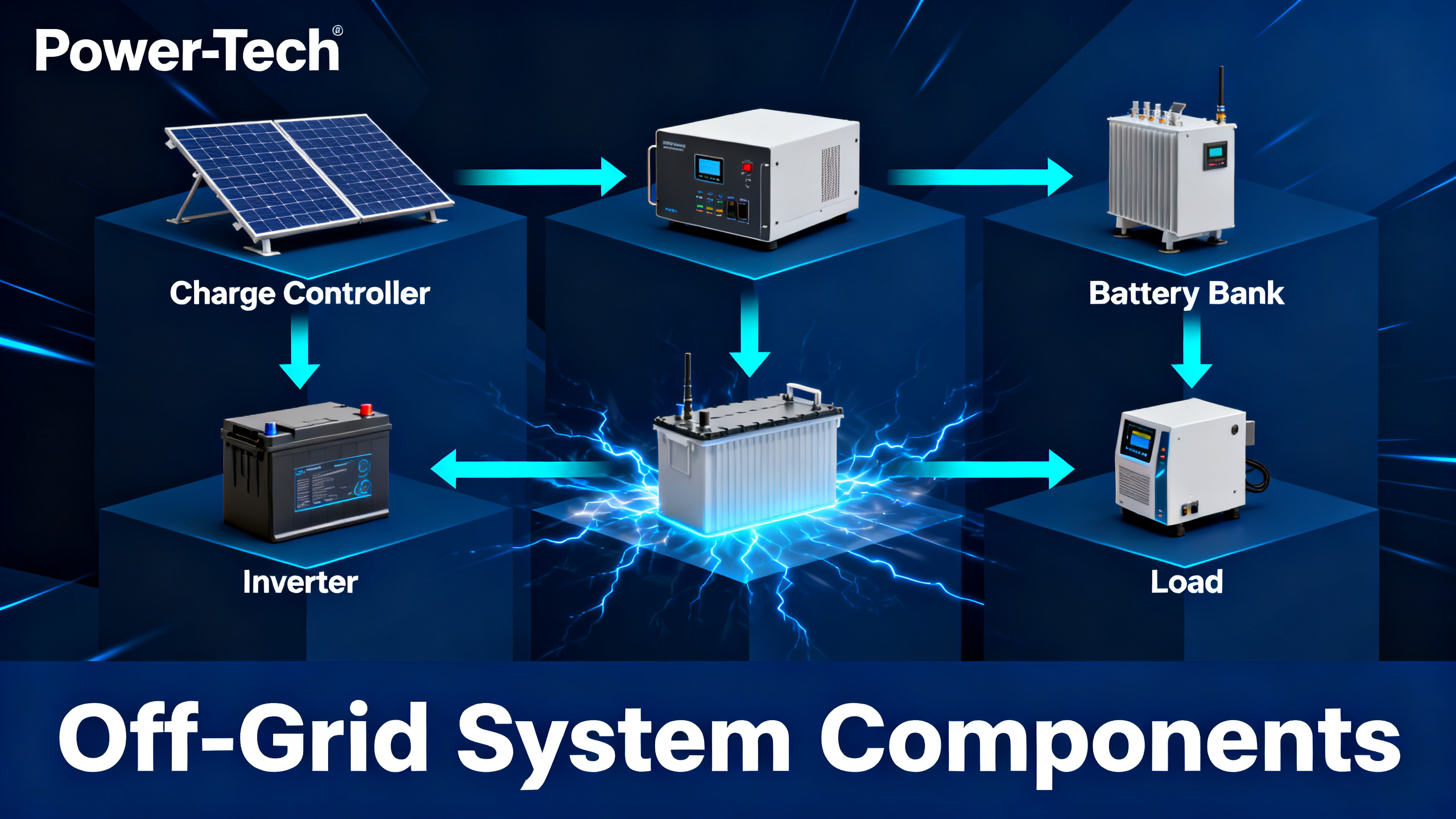
Building an off-grid solar power system sounds intimidating until you understand it’s really just five components working together. Solar panels generate electricity, a controller optimizes it, a battery stores it, a management system protects it, and an inverter converts it to a form your appliances can use. That’s the whole game.
If you’ve been Googling “off grid solar power system components” and wading through diagrams that look like aircraft schematics, this guide cuts through the noise. We’ll walk through each of the five core components, explain what they actually do, and show how modern portable power stations bundle all of them into a single unit you can carry with one hand.

By the end, you’ll know exactly what to look for whether you’re piecing together a DIY system or shopping for an all-in-one solution.
Get our Black Friday alerts for power stations
We track live prices on 40+ models from Jackery, EcoFlow, BLUETTI and Anker SOLIX. When a deal beats the lowest price we've recorded, you'll hear from us. During Black Friday week, one short recap a day at most.
Unsubscribe in one click. We may earn a commission when you buy through our links, at no extra cost to you. Privacy Policy
The 5 Core Components of an Off-Grid Solar System
Every off-grid solar power system, from a 100W weekend camping rig to a 10,000Wh whole-cabin setup, runs on the same five components. The names change, the prices vary wildly, but the architecture stays consistent. According to the U.S. Department of Energy solar resources, these five elements form the standard reference architecture for residential and portable photovoltaic systems.
What’s changed in the last decade is integration. Where you once needed five separate boxes wired together by an electrician, modern power stations now ship with everything pre-wired and pre-tuned inside a single chassis. The components haven’t disappeared, they’ve just been bundled.
The 5 Core Components of an Off-Grid Solar System
☀️
Solar Panels
Capture sunlight, generate DC power
⚡
MPPT Controller
Optimizes solar input for max harvest
🔋
Battery Bank
Stores energy for day and night use
🛡️
BMS
Protects battery cells from damage
🔌
Inverter
Converts DC to AC for household devices
Modern power stations integrate all five components into a single portable unit.
For a complete walkthrough of system sizing, cost, and setup choices, see our complete off-grid solar guide. This article focuses specifically on understanding each individual component.
What Each Component Does (At a Glance)
Before diving into the details, here’s the one-sentence version of each component’s job. Keep this table handy as you read through the rest of the article.
Power Station: The Brain of Your Off-Grid Setup
The power station is where four of the five components live: the battery bank, the BMS, the MPPT charge controller, and the inverter. Plug a solar panel into the input port and you’ve added the fifth piece. That’s why “portable power station” is shorthand for “complete off-grid system minus the panels.”
Performance data on premium portable units shows that the brain of any quality power station is its inverter and battery management system working in tandem. The inverter handles continuous output rated in watts (W), telling you the maximum draw your appliances can pull at any moment. The battery, rated in watt-hours (Wh), tells you how long that draw can last. A 1,000W inverter paired with 1,000Wh of capacity will run a 1,000W load for roughly one hour.
The third spec that matters is maximum solar input. This number tells you how much wattage of panels the unit’s MPPT controller can accept. A station with 400W max solar input can recharge from a 400W panel array (or smaller), but plugging in 600W of panels won’t speed things up. The controller caps the input.
For a deeper look at what separates entry-level from premium units (ports, inverter quality, app control), our guide to understanding power station features covers every spec worth knowing.
How Modern Power Stations Replace Five Separate Components
Picture the old-school off-grid setup: a charge controller bolted to a cabin wall, four lead-acid batteries wired in series, a separate inverter the size of a microwave, and a tangle of fuses, breakers, and copper. It worked, but it required electrical knowledge to assemble and ongoing maintenance to keep running.
The modern portable power station collapses all of that into a sealed unit. The MPPT controller, BMS, battery cells, and pure sine wave inverter share a single chassis with a unified cooling system, a digital display, and increasingly, smartphone control. You connect panels to one port, plug devices into the outlets, and the unit handles every transition between DC and AC, every cell balance check, every thermal cutoff, automatically.
Key Specs to Understand Before Buying
Get our Black Friday alerts for power stations
We track live prices on 40+ models from Jackery, EcoFlow, BLUETTI and Anker SOLIX. When a deal beats the lowest price we've recorded, you'll hear from us. During Black Friday week, one short recap a day at most.
Unsubscribe in one click. We may earn a commission when you buy through our links, at no extra cost to you. Privacy Policy
Solar Panels: Sizing and Pairing Correctly
Solar panels are the only component that lives outside the power station, and they’re where most off-grid setups go wrong. Buy too few watts, and the battery never reaches full charge. Buy too many, and you’ve spent extra money on capacity the controller can’t accept.
For off-grid use, monocrystalline panels are the standard choice. They’re more efficient than polycrystalline (typically 20% to 23% efficiency vs. 15% to 17%), they handle low-light conditions better, and they take up less space for the same wattage output. Polycrystalline panels are cheaper per watt but rarely worth the trade-off in a portable system.
How you connect multiple panels changes the voltage and current your system receives. See our guide on series vs parallel solar panel wiring to determine which configuration fits your setup. As a quick rule, series wiring increases voltage and works better in low-light conditions, while parallel wiring increases current and tolerates partial shading.
How to Calculate the Right Panel Wattage for Your Setup
The formula is simple: (Battery capacity in Wh ÷ peak sun hours per day) × 1.25 safety margin = required panel wattage.
For a 1,070Wh power station like the Jackery Explorer 1000 v2 and an average of 5 peak sun hours per day, the math works out to (1,070 ÷ 5) × 1.25, which equals roughly 268W. That’s why Jackery officially pairs this unit with a 200W or 2 × 200W solar setup. The 1.25 multiplier accounts for inefficiencies: cable losses, suboptimal angle, partial cloud cover, and the controller’s own conversion overhead.
💡 Pro Tip: Beyond wiring, panel placement directly affects harvest. Optimizing solar panel angle and output can improve daily generation by 20% to 40% depending on latitude and season. The same panel can generate dramatically different amounts of energy based on tilt and orientation alone.
Battery Management Systems: LFP vs NMC for Off-Grid
The Battery Management System is the silent guardian of your off-grid setup. Think of it as a chef d’orchestre that monitors every individual cell in the battery, checking voltage, temperature, charge state, and balance hundreds of times per second. If any cell drifts outside safe parameters, the BMS cuts power before damage occurs.
For off-grid use, your BMS choice is really a battery chemistry choice, because the BMS is tuned to the cells it protects. The two contenders are LFP (LiFePO4, lithium iron phosphate) and NMC (nickel manganese cobalt, the standard “lithium-ion” found in most consumer electronics). For serious off-grid applications, the data overwhelmingly favors LFP.


Why LiFePO4 Is the Standard for Serious Off-Grid Use
The headline number is cycle life. Published data and manufacturer specs consistently show LFP cells delivering 3,000 to 6,000 full charge cycles before noticeably degrading, while NMC tops out around 500 to 1,000 cycles. In real terms, that’s 10 to 12 years of service for LFP versus 2 to 4 years for NMC. The LiFePO4 cell chemistry reference from Battery University documents the underlying chemistry that drives this longevity advantage.
Thermal stability is the second factor. LFP chemistry resists thermal runaway, the cascading failure that causes NMC fires when cells are damaged or overheated. For an unattended cabin, an RV in summer heat, or a basement backup setup, that safety margin matters. The Bluetti Elite 200 V2 is a strong example of an LFP unit at the higher capacity tier, with 2073.6Wh and a rated 6,000+ cycles.
MPPT vs PWM: Which Controller Technology Matters
The charge controller sits between your solar panels and your battery, regulating the flow of power. Two technologies dominate the market: MPPT (Maximum Power Point Tracking) and PWM (Pulse Width Modulation). The difference matters more than the cryptic acronyms suggest.
Think of MPPT like a surfer who constantly adjusts to find the best wave. The controller continuously samples voltage and current from the panels, calculates the optimal load point, and adjusts the draw in real time to extract the maximum power available at that moment. PWM is simpler: it just opens and closes a circuit at a fixed voltage, ignoring the panel’s true capability.
Charge Controller Comparison: MPPT vs PWM
⚡ MPPT Controller
- 20% to 30% more efficient than PWM
- Adapts to changing sun conditions in real time
- Works with high-voltage panel arrays
- Ideal for large off-grid systems (400W+)
- Integrated in all premium power stations
Best for: serious off-grid setups, variable weather conditions
🔶 PWM Controller
- Simpler and cheaper hardware
- Adequate for small systems in ideal sun
- Requires panel voltage to match battery voltage
- Wastes energy in suboptimal conditions
- Rarely found in modern power stations
Best for: small DIY systems under 200W, tight budgets
When MPPT Makes a Real Difference
The 20% to 30% efficiency advantage isn’t a marketing claim, it’s measurable in any real-world condition that isn’t perfect noon sun. On a partly cloudy day, when panel voltage swings as cloud cover passes, MPPT controllers continuously rebalance to capture every available watt. PWM controllers stay locked at battery voltage and waste the rest.
For a 400W panel array on an average overcast day, that efficiency gap can mean the difference between a fully charged battery by sundown and one stuck at 80%. Every quality portable power station on the market in 2026 ships with an integrated MPPT controller, which is one less spec to worry about when shopping for an all-in-one unit.
How It All Connects: A Complete System Diagram
Now that you’ve met the five components individually, here’s how they work together as a single system. The flow is one-directional during charging and reverses for output: sunlight enters the panels, gets optimized by the MPPT, charges the battery under BMS supervision, and exits through the inverter as usable AC power.
Off-Grid System Flow
☀️
Solar Panels
DC Power
→
⚡
MPPT
Optimizes Input
→
🔋
Battery + BMS
Stores & Protects
→
🔌
Inverter
DC to AC
→
🏕️
Your Devices
AC + DC Loads
In a modern power station, all five stages are integrated into one unit with a single solar input port.
Premium power stations now support modular battery expansion systems that let you add capacity without replacing the core unit. That’s a major advantage for long-term off-grid setups where energy needs grow over time. You start with a single unit, then bolt on additional battery packs as your usage scales.
DIY vs All-in-One: What’s the Real Difference?
A DIY system gives you maximum flexibility: pick your own panels, your own controller, your own battery chemistry, your own inverter. You can build to spec, repair component by component, and scale incrementally. The trade-off is complexity. You need wiring knowledge, the right fuses and breakers, a place to mount everything, and the patience to troubleshoot when something doesn’t work.
An all-in-one power station trades that flexibility for plug-and-play simplicity. You lose the ability to customize individual components, but you gain a unified warranty, integrated cooling, factory-tuned MPPT, and the freedom to move the entire system anywhere. For roughly 90% of users, especially those new to off-grid power, the all-in-one approach wins on time, cost, and reliability.
Top Power Stations That Bundle All 5 Components
Three units stand out in 2026 as solid examples of integrated off-grid systems at different price points. Each one bundles the battery, BMS, MPPT controller, and inverter into a single chassis, leaving you with just one purchase decision: which capacity tier matches your needs.
Best All-in-One
Jackery Explorer 1000 v2
1070Wh | 1500W | LiFePO4 | 4,000 cycles
$499.00
Largest Capacity
BLUETTI Elite 200 V2
2073.6Wh | 2600W | 6,000 cycles
$799.00 $1,699.00
Best Overall: Jackery Explorer 1000 v2
The Explorer 1000 v2 hits the sweet spot for most off-grid users: 1,070Wh of LFP capacity, 1500W of continuous output, and integrated MPPT for efficient solar charging. With 4,000 charge cycles and ChargeShield 2.0 safety protection, it’s engineered for a decade of regular use. Fast dual 100W USB-C charging and an emergency super charge that refills the battery in about an hour make it a practical, grab-and-go choice for camping and backup alike.
Best for High Capacity: BLUETTI Elite 200 V2
For users who need more headroom, the Elite 200 V2 delivers 2,073.6Wh and 2,600W output (3,900W peak), enough to run high-draw appliances simultaneously. Its 6,000+ cycle LFP cells push the lifespan ceiling above 16 years of typical use. At its current $799 price (down from $1,699), it’s one of the strongest dollars-per-watt-hour values in the high-capacity portable category.
Budget Entry Point: Anker SOLIX C1000 Gen 2

For first-time off-grid buyers who want to test the waters without committing to a four-figure spend, the Anker SOLIX C1000 Gen 2 at $499.99 is a strong entry point. It packs 1,024Wh of LFP capacity, 2,000W of output, and recharges from empty to full in 49 minutes via AC. The trade-off is lower max solar input and no expandability, but for short trips and emergency backup, it covers the basics.
Frequently Asked Questions
What are the main components of an off-grid solar power system?
An off-grid solar power system consists of five core components: solar panels (which generate DC electricity from sunlight), an MPPT charge controller (which optimizes solar input), a battery bank (which stores the energy), a Battery Management System or BMS (which protects the cells), and an inverter (which converts stored DC power to AC for household appliances). Modern portable power stations integrate all five into a single unit.
What size solar panel do I need for an off-grid system?
The general formula is: (Battery capacity in Wh ÷ peak sun hours per day) × 1.25 safety margin. For a 1,070Wh battery like the Jackery Explorer 1000 v2 with 5 peak sun hours, spec analysis indicates approximately 268W of solar input, which aligns with Jackery’s recommended pairing of 2 × 200W panels. Actual harvest varies with panel angle, weather, and efficiency losses.
What is an MPPT controller and do I need one?
An MPPT (Maximum Power Point Tracking) controller is a device that continuously adjusts the voltage it draws from your solar panels to extract the maximum available power at any given moment. Published efficiency data shows MPPT controllers deliver 20% to 30% more energy than older PWM controllers, especially in cloudy or low-angle sun conditions. All quality portable power stations include an integrated MPPT controller, so for most users, this component is already handled.
Is LiFePO4 really better than standard lithium-ion for off-grid use?
For frequent off-grid use, the data strongly supports LiFePO4. LFP cells deliver 3,000 to 6,000 cycles versus 500 to 1,000 for standard NMC lithium-ion, translating to 10 to 12 years of service versus 2 to 4 years. LFP cells also operate safely at higher temperatures without thermal runaway risk. The higher upfront cost is offset by a substantially lower cost per cycle over the system’s lifetime.
Can I run an air conditioner off an off-grid solar setup?
Runtime calculations based on capacity show that a 10,000 BTU window AC (approximately 1,000W to 1,200W) would drain a 1,070Wh battery in roughly 1 hour at full draw. Solar panels can offset some of this, but running AC continuously off-grid requires a high-capacity system: 3,600Wh or more, paired with 800W+ of solar. Most portable power stations are better suited to refrigerators, lighting, fans, and electronics rather than sustained HVAC loads.
What is the difference between a DIY off-grid system and a portable power station?
A DIY off-grid system uses separate components (panels, a standalone MPPT controller, a separate battery bank, a separate inverter) wired together. This offers maximum flexibility and scalability, but requires technical knowledge, installation work, and ongoing maintenance. A portable power station integrates all five components into one pre-configured, plug-and-play unit with a single warranty. For cabins, RVs, camping, and emergency backup, the all-in-one approach is more practical for the vast majority of users.
Final Thoughts
Off-grid solar isn’t five mysterious technologies, it’s five well-understood components that have been refined for decades. Solar panels generate, MPPT controllers optimize, batteries store, BMS protects, and inverters convert. Once you see the architecture, every spec sheet starts making sense.
For most users in 2026, the smart move is an all-in-one portable power station that bundles four of these five components into a single unit. You save the wiring time, the troubleshooting, and the maintenance, while still gaining the energy independence that off-grid promises. The Jackery Explorer 1000 v2 remains the most balanced option for new buyers: enough capacity for real off-grid use, LFP longevity for the long haul, and fast charging for when you need power back in a hurry.
Jackery Explorer 1000 v2
$499.00
Best all-in-one off-grid system under $500
Price verified July 2026. Free shipping available.
Originally published: May 7, 2026