
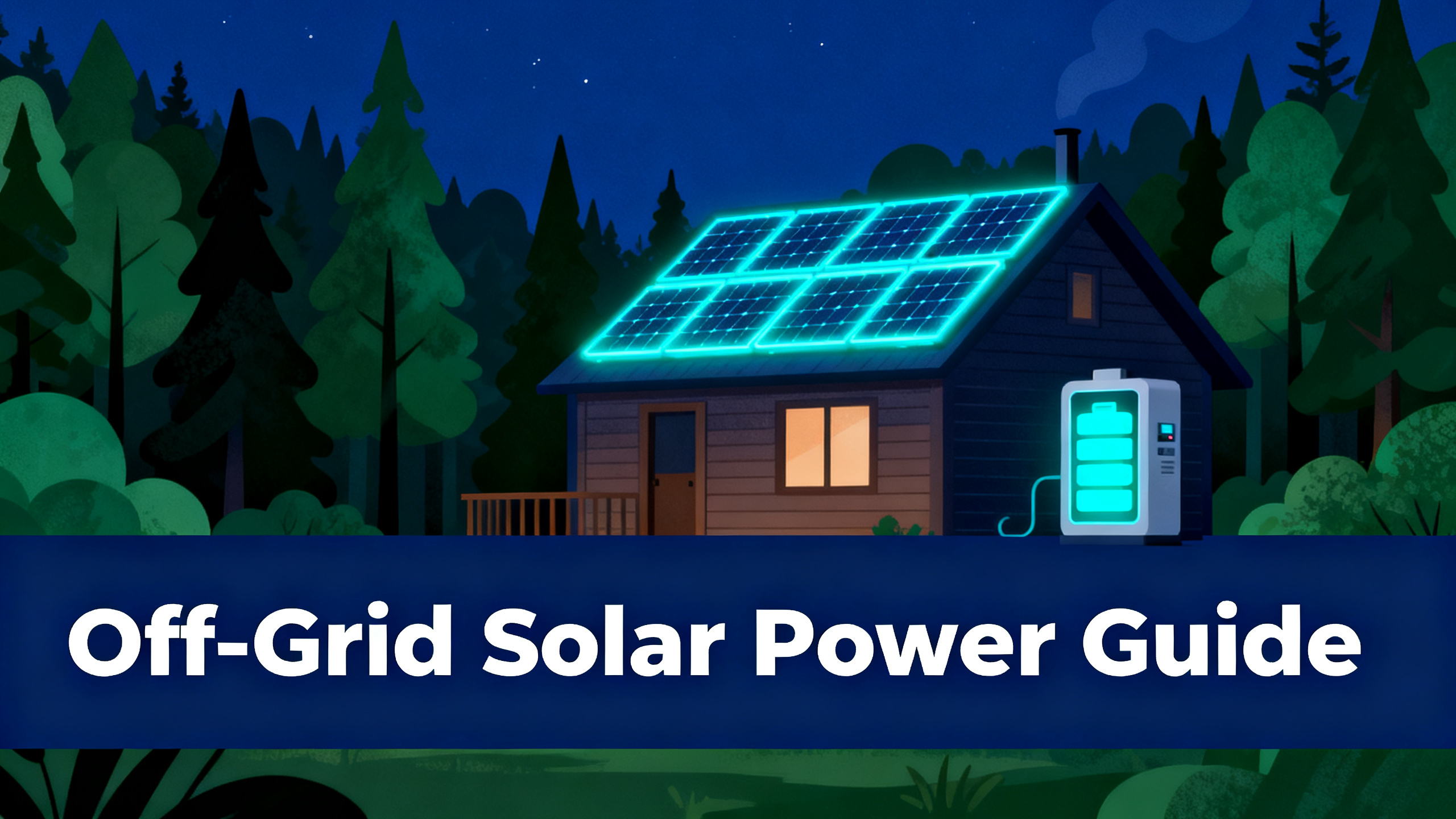
Off-grid solar power has shifted from a niche pursuit to a mainstream option for cabins, RVs, vans, and even whole homes. Battery prices have dropped sharply over the last five years, lithium iron phosphate (LiFePO4) chemistry now dominates the consumer category, and a single all-in-one unit can deliver what used to require a permitted rooftop installation.
This guide walks you through what an off-grid solar power system actually is, how the modern portable approach differs from traditional fixed installations, how much capacity you genuinely need, and which four brands lead the 2026 market. By the end, you will have a clear sense of which setup matches your situation, whether that is weekend camping, full-time RV life, a remote cabin, or a homestead running entirely off the grid.

Jackery HomePower 3000
$1,299
- 3,072Wh LiFePO4 battery, 3,600W AC output (7,200W surge)
- Multiple recharge options: wall, solar, car, hybrid, or gas
- Full wall recharge in as fast as 1.7 hours, 5-year warranty
Get our Black Friday alerts for power stations
We track live prices on 40+ models from Jackery, EcoFlow, BLUETTI and Anker SOLIX. When a deal beats the lowest price we've recorded, you'll hear from us. During Black Friday week, one short recap a day at most.
Unsubscribe in one click. We may earn a commission when you buy through our links, at no extra cost to you. Privacy Policy
What Is an Off-Grid Solar Power System?
An off-grid solar power system is a self-contained electrical setup that generates, stores, and delivers power without any connection to the utility grid. Think of it as your own miniature power plant: sunlight comes in, electricity goes out, and a battery stores whatever you do not use immediately. The defining feature is independence. No utility bill, no grid outages affecting you, and no infrastructure required beyond what fits in a closet or the back of a vehicle.
Every off-grid solar system, from a $400 weekend kit to a $30,000 whole-home installation, comes down to four core components working together. Solar panels capture sunlight. A charge controller regulates how that energy enters the battery. The battery stores it. An inverter converts it to the AC power your appliances expect.
The 4 Core Components of Any Off-Grid Solar System
☀️
Solar Panels
Capture sunlight and convert it to DC electricity. Typically 100W to 400W per panel.
🔋
Battery Storage
Stores solar energy for use at night or cloudy days. Measured in Watt-hours (Wh).
⚡
Inverter/BMS
Converts DC battery power to AC (110V/120V) for standard appliances. Built into power stations.
🔌
Charge Controller
Regulates solar input to protect batteries from overcharge. MPPT controllers maximize efficiency.
What changed the consumer landscape over the last few years is integration. Modern portable power stations from Jackery, BLUETTI, EcoFlow, and Anker SOLIX bundle the battery, inverter, charge controller, and battery management system (BMS) into a single chassis. You plug a solar panel into one port and your appliances into another. The complexity that used to demand a licensed electrician now ships in a single box.

Power Stations vs Traditional Solar Setups: The Key Difference
The off-grid market splits cleanly into two camps. Portable power stations represent the all-in-one approach: a self-contained unit you can buy today, plug into a panel tomorrow, and move between locations as needed. Traditional fixed solar installations follow the older model with separate components (panels, batteries, inverter, charge controller, wiring) installed permanently into a structure by a licensed contractor.
The trade-off comes down to scale, cost, and commitment. A fixed installation makes sense for a homestead where the system stays put for decades and absolute capacity matters more than flexibility.
A portable system makes sense almost everywhere else: cabins, RVs, vans, weekend properties, emergency backup, and any situation where mobility, modularity, or speed of deployment is valuable.
⚡ Portable Power Stations
- All-in-one: battery, inverter, BMS, charge controller
- No installation required, plug-and-play ready
- Move between locations: cabin, RV, campsite
- Scales from 300Wh to 25kWh+ with expansion packs
- Typical cost: $300 to $4,000 depending on capacity
🏠 Fixed Solar Installations
- Separate components: panels, batteries, inverter, wiring
- Requires professional installation and permits
- Permanent: tied to one structure
- Higher capacity ceiling (50kWh+), larger homes
- Typical cost: $15,000 to $50,000 installed
The performance gap that used to separate these categories has narrowed dramatically. Top-tier portable systems now match the output of mid-sized residential battery banks while remaining moveable and code-exempt in most jurisdictions. If you are comparing models, our buying guide on how to choose the right power station walks through every spec that matters.
Get our Black Friday alerts for power stations
We track live prices on 40+ models from Jackery, EcoFlow, BLUETTI and Anker SOLIX. When a deal beats the lowest price we've recorded, you'll hear from us. During Black Friday week, one short recap a day at most.
Unsubscribe in one click. We may earn a commission when you buy through our links, at no extra cost to you. Privacy Policy
How Much Power Do You Actually Need?
This is the question that derails most first-time buyers. People either dramatically over-buy (a 5kWh system to charge a phone and run LED lights) or under-buy (a 500Wh unit asked to run a refrigerator overnight). The fix is simple math, not guesswork. Before choosing a system, use our tool to calculate your off-grid power needs based on your actual appliances.
Sizing follows three steps. First, list every appliance you intend to run off-grid. Second, note the wattage of each (printed on the device or its power brick). Third, estimate how many hours per day each device runs. Multiply watts by hours, sum the results, and you have your daily Wh requirement.
Once you know your daily Wh need, apply the 3x buffer rule. Multiply your daily figure by three to determine the appropriate battery capacity. The reasoning: you need one day of usable storage, plus reserve for cloudy days, plus headroom for inefficiency losses. A household consuming 1,800Wh per day should target a 5,000-6,000Wh system. For deeper sizing methodology, the Department of Energy publishes solar system sizing guidelines that complement this approach.
The 4 Best Brands for Off-Grid Solar Power
The portable off-grid market is dominated by four manufacturers, each with a distinct strength. They all use LiFePO4 chemistry across their flagship lines, all offer expandable architectures, and all sit within the same general price-per-watt-hour band. The difference comes in design priorities: one optimizes for portability, one for value, one for whole-home scale, one for pure performance. For a full ranked comparison, see our guide to the best solar generators for off-grid use.
Jackery: Best for Portability and Outdoor Use
Jackery built the modern portable power station category and still leads on outdoor positioning. The lineup runs from a 300Wh unit you can carry by the handle to the HomePower 3000 covered earlier in this guide. Form factor matters in this brand: every unit is designed first as a piece of outdoor equipment, with carry handles, weather-resistant materials, and intuitive controls.
The HomePower 3000 sits at the top of the lineup at $1,299, billed as the world’s smallest 3kWh LFP generator. It recharges from empty in as fast as 1.7 hours from the wall and accepts wall, solar, car, hybrid, or gas charging. The 3,072Wh LFP capacity and 3,600W AC output (7,200W surge) cover roughly 99% of common appliances, including high-draw items like coffee makers and induction cooktops.
Jackery is the brand to choose when the unit needs to move with you. Owner feedback consistently highlights the durability and ease of use across rough outdoor environments. If your priority is grab-and-go reliability for camping, overlanding, or van life, the Jackery HomePower 3000 covers the upper end of that segment.
BLUETTI: Best Expandable Systems Under $2,000
BLUETTI takes a different positioning angle: maximum capacity per dollar, with aggressive expandability built into mid-range units. The AC200L at $899 is the standout entry point. It delivers 2,048Wh and 2,400W AC output natively, expandable to 7kWh with additional battery modules. That capacity-per-dollar ratio is hard to beat in the under-$1,000 segment.

What sets the AC200L apart is its charging flexibility. The unit supports six recharge methods including AC, solar, car, generator, dual AC, and AC+solar simultaneously. Charge data confirms 0-80% in 45 minutes via fast AC input. The BLUETTI app provides remote monitoring and configuration, which matters more than it sounds: dialing in charge speed limits to preserve battery longevity is a useful feature for daily-cycle use cases.
For a detailed comparison across the BLUETTI lineup, our guide to the best Bluetti models for off-grid living covers all the key options. The BLUETTI AC200L remains the value benchmark in the 2kWh class.
Anker SOLIX: Best for Whole-Home Off-Grid
Anker SOLIX targets the upper end of the portable category with the F3800. At $1,799 starting price, the unit delivers 3,840Wh and 6,000W AC output, expandable up to 53.8kWh with additional battery packs. That ceiling is the highest in the portable category, putting whole-home off-grid scenarios genuinely within reach.

The F3800 distinguishes itself with two specs that competitors struggle to match. Solar input reaches 2,400W via dual 60V channels, allowing a full recharge in under 2 hours under optimal sunlight. Dual voltage output (120V/240V) means the F3800 can power 240V appliances directly, including central air conditioning, electric dryers, and well pumps that other units cannot reach without external transformers.
The F3800 architecture is one of the most scalable on the market: see our full breakdown of expandable off-grid power systems from Anker SOLIX. For homestead or full off-grid home applications, the Anker SOLIX F3800 is the most credible single-purchase entry point.
EcoFlow: Best Home Backup Performance
EcoFlow positions the DELTA Pro as the first portable home battery designed specifically for whole-home backup, and the spec sheet supports that framing. At $1,599 the unit delivers 3,600Wh natively, 3,600W AC output (7,200W with a second unit linked), and expandability up to 25kWh. LFP chemistry, X-Stream fast charging (0-80% in 1.8 hours), and a plug-and-play home backup integration with the EcoFlow Smart Home Panel round out the package.

What the data shows about the DELTA Pro is consistency. Charge speed, runtime under load, and inverter efficiency all measure within tight tolerances of the published specs, which is not always the case in this category. The unit pairs well with rooftop solar arrays via 1,600W of solar input capacity, making it a credible bridge between portable and fixed system thinking.
If your priority is integration with a home electrical panel for whole-home or essential-circuits backup, EcoFlow’s ecosystem is the most polished in the category. The EcoFlow DELTA Pro remains a benchmark for home backup applications.

Getting Started: Which Setup Is Right for You?
Off-grid solar is not a single product category. The right setup depends on what you intend to power, where, and for how long. The four profiles below cover the vast majority of buyer scenarios. Match your situation to the closest profile, and the capacity range narrows quickly.
Match Your Situation to the Right Setup
🏕️ Camping / Van Life
Start at 500-1,000Wh. A single portable unit handles lighting, phone charging, and a small cooler.
Recommended: 500-1,000Wh unit
🚐 RV / Full-Time Living
2-5kWh covers refrigeration, CPAP, lighting, and device charging through a full day.
Recommended: 2,000-5,000Wh unit
🏡 Cabin / Remote Property
5-15kWh handles essential circuits: fridge, lights, water pump, and basic cooking.
Recommended: Expandable system 5kWh+
🏚️ Homestead / Off-Grid Home
15kWh+ with 1,000W+ solar input. Multiple expandable units or a dedicated home battery system.
Recommended: 15-25kWh expandable system
Two patterns cut across all four profiles. First, expandability matters more than initial capacity for anyone who plans to use the system for more than weekend trips. Buying a unit you can grow into beats buying twice. Second, solar input ceiling matters as much as battery size: a 10kWh battery refilling at 200W is a 50-hour recharge, while the same battery refilling at 2,000W is 5 hours. According to NREL solar resource data, peak sun hours vary from 3 to 6 across the continental US, which directly impacts how much panel wattage you actually need.
For a broader look across all budgets and use cases, our roundup of top-rated power stations for 2026 is the logical next step. The four profiles here are a starting framework, but the right specific model depends on the appliances on your list and the climate you live in.
Frequently Asked Questions
How much does an off-grid solar power system cost?
Entry-level portable setups (500-1,000Wh power station + 200W panel) start around $400-800. Mid-range cabin systems (2-5kWh) typically run $1,500-4,000. Whole-home expandable systems from Anker SOLIX or EcoFlow scale from $3,000 to $10,000+ depending on capacity and solar array size.
How many solar panels do I need for off-grid living?
The calculation depends on two factors: your daily Wh consumption and your local solar irradiance (peak sun hours per day). As a baseline, a 2,000Wh system in a location with 5 peak sun hours needs approximately 400W of solar panels to replenish a full discharge in one day. Sizing up by 25-30% accounts for efficiency losses and cloudy days.
Can a portable power station run a refrigerator off-grid?
Yes. A standard refrigerator draws 100-150W and runs intermittently (about 8 hours per day in practice), consuming roughly 800-1,200Wh per 24 hours. A 2,000Wh power station paired with 400W of solar panels sustains refrigerator operation indefinitely in adequate sun.
What is the difference between a solar generator and a portable power station?
The terms are largely interchangeable in consumer marketing. Technically, a solar generator refers to the complete kit (power station plus solar panels), while a power station is the battery-inverter unit on its own. Both center on the same core technology: a lithium battery with a built-in MPPT charge controller and AC inverter.
How long do off-grid power station batteries last?
LiFePO4 (LFP) batteries, the current standard in this category, are rated for 2,500 to 3,500+ charge cycles at 80% capacity retention. At one cycle per day, that represents 7-10 years of daily use. Jackery, BLUETTI, Anker SOLIX, and EcoFlow all use LFP chemistry across their flagship lines.
Can I power my whole house with a portable power station?
Partially, yes. Systems like the Anker SOLIX F3800 (3,840Wh, expandable to 53.8kWh) or EcoFlow DELTA Pro (3,600Wh, expandable to 25kWh) can power essential circuits: lighting, refrigerator, CPAP, device charging, and small appliances. High-draw items (central HVAC, electric dryer, water heater) require larger dedicated systems or usage management.
Is off-grid solar worth it for a cabin?
Spec analysis and owner feedback consistently support the case for cabins 50+ miles from utility lines. The break-even compared to diesel generator costs typically falls within 2-4 years at average fuel prices. For cabins closer to the grid, the calculus depends on connection costs versus the upfront system investment.
Do I need permits for a portable off-grid solar setup?
Portable power stations and panel arrays require no permits in the vast majority of jurisdictions, as they are not permanently wired into structures. Permanent installations wired into a cabin’s electrical panel may require permits and an electrical inspection. Always verify local codes for any hardwired connection.

The Bottom Line
Off-grid solar in 2026 is more accessible, more capable, and less expensive per watt-hour than at any point in the technology’s history. The four brands covered above (Jackery, BLUETTI, Anker SOLIX, EcoFlow) all deliver credible products built around LFP chemistry and intelligent power management. The right choice depends entirely on your use case: portability for outdoor users, value-per-Wh for cabin starters, scalable architecture for whole-home aspirations.
Start with your daily Wh number, apply the 3x buffer rule, and pick the brand whose strengths match your priorities. The technology has matured to the point where buying mistakes are mostly recoverable, but matching capacity to actual need is still the difference between a system you love and one you outgrow in six months.
BLUETTI AC200L
$899
Best value entry point for off-grid solar
Price verified May 2026. Free shipping available
Originally published: May 7, 2026