


TITAN 5000 Plus
- you’ll run 8,000W of solar
- you want existing rooftop solar coupled in
- it stays in one dry indoor spot
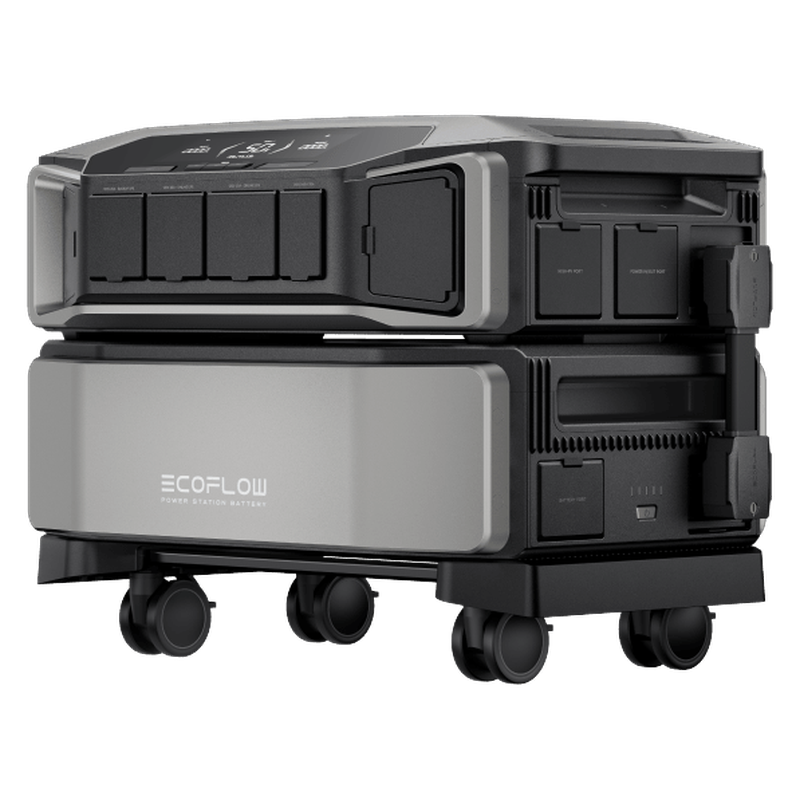
DELTA Pro Ultra
- it sits in a cold garage: charges to −4°F, IP54
- you want 6,144Wh per battery
- you may grow past 30kWh
Prices and stock checked by our price engine on November 5, 2026 at 6:01 AM EST. Each product is rechecked several times a day; the time refreshes when you load the page.
Same brand, same 7,200W. The TITAN is built to save on the bill; the DELTA Pro Ultra to ride out the outage.
The EcoFlow TITAN 5000 Plus is a fixed indoor home battery: 5,017.6Wh in one 121.3 lb box, 8,000W of solar, IP20, no wheels, a 10-circuit Smart Home Panel 10 that can couple existing rooftop solar, and up to 30kWh. The EcoFlow DELTA Pro Ultra is an inverter plus a 6,144Wh battery, 70 lb and 111.8 lb on a rolling cart: 5,600W of solar, IP54, charging down to −4°F, a TT-30 and a 12V output, and up to 90kWh with three inverters. EcoFlow itself pitches the TITAN for everyday savings and the Pro Ultra for homes with frequent outages.
Below: every difference with numbers, a 20-second calculator for your own gear, seven modeled situations, and what published reviews found. As of November 1, 2026, no independent review of the TITAN had been published, so every TITAN figure on this page comes from EcoFlow’s US product page.
Same 7,200W at 120V and 240V. The DELTA Pro Ultra stores 1,126Wh more per battery, is IP54, charges down to −4°F, has a TT-30 and 12V and scales to 90kWh. The TITAN 5000 Plus takes 8,000W of solar in one lighter box and couples existing rooftop solar.
- you’ll run more than 5,600W of solar
- you want rooftop solar coupled in
- you want one box indoors
- it lives in a cold garage
- you want more battery per unit
- you need a TT-30 or 12V
The five differences that decide it
Both deliver 7,200W at 120V and 240V, use LFP cells, pair with an EcoFlow home panel, use the EcoFlow app and carry a 5-year warranty. These five gaps decide it.
Watch the full comparison
Will it run your setup? Check in 20 seconds
Estimates use 85% usable capacity and 70% of rated solar output. Real results vary with temperature, inverter load, shade and appliance cycling. Fridge and freezer watts are daily averages and do not include compressor startup surges.
Runtime by appliance, one at a time
Simple energy estimates, not measured runtimes. About 4,265Wh usable on the TITAN 5000 Plus and 5,222Wh on the DELTA Pro Ultra with one battery.
Appliance for appliance, the Pro Ultra lasts 22% longer than the TITAN 5000 Plus.
Same appliance, same watts: the gap is always the size of the battery.Get our Black Friday alerts for EcoFlow
We track live prices on 40+ models from Jackery, EcoFlow, BLUETTI and Anker SOLIX. When a deal beats the lowest price we've recorded, you'll hear from us. During Black Friday week, one short recap a day at most.
Unsubscribe in one click. We may earn a commission when you buy through our links, at no extra cost to you. Privacy Policy
What each one costs today
The EcoFlow DELTA Pro Ultra (1 battery) costs $500 more than the EcoFlow TITAN 5000 Plus and adds 1,126Wh: that is $0.44 per extra Wh, against $0.74 per Wh for the TITAN 5000 Plus.
Prices refresh daily from EcoFlow US.What the $500 buys: 1,126Wh more battery (6,144Wh vs 5,017.6Wh), charging and running down to −4°F, and an IP54 rating.
The DELTA Pro Ultra holds 1,126Wh more per battery, so compare price per Wh as well as the sticker price. We skip cost per cycle: EcoFlow publishes no cycle rating for the TITAN. For whole-home backup, add the panel and an electrician to either: the Smart Home Panel 10 for the TITAN, the Smart Home Panel 2 for the DELTA Pro Ultra.
Seven modeled situations, worked out
Same formula as the calculator above, with one battery each. The DELTA Pro Ultra carries 1,126Wh more, so it runs about 22% longer on every load; the TITAN answers with solar.
24-hour outage, essentials only
Two days on either, about 10 hours more on the DELTA Pro Ultra. Digital Trends kept a house warm with a 3,100W heat pump on the Pro Ultra and its panel.
Refill from solar, each at its maximum
The TITAN refills in under an hour of strong sun at full input, and with its panel and a CT sensor it can also store surplus from existing rooftop solar.
A garage at 20°F in January
The DELTA Pro Ultra charges and discharges down to −4°F and is IP54. The TITAN won’t charge below 32°F, runs down to 14°F, and EcoFlow places it in a dry, ventilated indoor spot.
A 3-ton central AC
EcoFlow says the TITAN starts a compatible 3-ton AC without a soft starter, with no surge figure published; the DELTA Pro Ultra lists 10,800W of surge. The TITAN can also put up to 5kW on one 120V leg.
An RV or 12V gear
Only the DELTA Pro Ultra has a TT-30 and a 30A 12V output. The TITAN’s outlets are two 5-20R and an L14-50R twist-lock.
Home office through an outage
More than two workdays on both. The DELTA Pro Ultra’s online UPS gives 0ms on three outlets; EcoFlow says the TITAN’s EPS switches within 10ms with gear plugged in directly.
Growing the system later
Both take five extra batteries per unit, about 30kWh. The DELTA Pro Ultra goes further: 90kWh and 21.6kW with three inverters, per EcoFlow.
Nine more differences, the spec sheet and the box
Smaller gaps that rarely decide the purchase, then the full specifications and what ships in the box.
TITAN 5000 Plus and DELTA Pro Ultra weight, dimensions and full specifications
Weight: 121.3 lb for the EcoFlow TITAN 5000 Plus; 70 lb for the EcoFlow DELTA Pro Ultra inverter and 111.8 lb per battery. Dimensions: 24.5 × 13.2 × 16.9 in; 27.2 × 18.9 × 8.4 in and 26 × 18 × 8 in. Everything else is in the sheet below.
EcoFlow TITAN 5000 Plus and EcoFlow DELTA Pro Ultra full specifications
Every published figure for both units, grouped. Green marks the better value.
What’s in the box
TITAN 5000 Plus
- TITAN 5000 Plus5,017.6Wh, 121.3 lb
- AC charging cable (C20)
- Solar to HP500 charging cable
- Quick start guide
- Smart Home Panel 10 sold separatelywired in by a licensed electrician
DELTA Pro Ultra, 1 battery
- Inverter + 1 × 6,144Wh battery70 lb + 111.8 lb
- Smart Home Panel 2 sold separatelyneeded for whole-home backup
- Electrician needed for the panelDigital Trends: three electricians, one day
TITAN 5000 Plus: EcoFlow US page, unit alone. DELTA Pro Ultra: EcoFlow US page; Digital Trends reported the panel install.
06 · ChargingHow fast each one refills
Shorter bar, faster refill. Each row is scaled to its slower unit. EcoFlow hasn’t published charging times for the TITAN 5000 Plus, only a 7,660W maximum AC input.
TITAN 5000 Plus: generator charging through the included AC cable, per EcoFlowDELTA Pro Ultra: Storm Guard charges ahead of severe weather
Our times divide capacity by input power, with solar at 70% of panel rating; real charging slows near full.
Every port, side by side
TITAN 5000 Plus
DELTA Pro Ultra
Practical consequence: the DELTA Pro Ultra has the outlets of a station, four 20A outlets, a TT-30, an L14-30, a 6-20R, USB and 12V. The TITAN 5000 Plus has two 20A outlets and an L14-50R twist-lock, and feeds the rest of the house through its panel.
08 · NoiseNoise: TITAN 5000 Plus vs Pro Ultra
EcoFlow rates both as quiet, at different loads: the EcoFlow TITAN 5000 Plus under 39dB at 5,000W, at 1 m, and the EcoFlow DELTA Pro Ultra (1 battery) fanless, at 0dB, under 2,000W for up to 30 minutes. Yahoo Tech never heard the Pro Ultra’s fan during whole-home outage tests.
Brand figures. No independent dB measurement exists for either.Every figure we found, with its source
What reviewers heard: Never heard a fan during whole-home outage tests (Yahoo Tech); silent running under a 2,000W load (Trusted Reviews, UK unit); very quiet after a month (SlashGear).
Measured by a tester Brand figure
- Both usually live in a garage or utility room; the noise ratings matter most if yours sits next to a bedroom wall.
Cold and heat: TITAN 5000 Plus vs Pro Ultra
The EcoFlow DELTA Pro Ultra (1 battery) is rated for garages and covered outdoor spots: IP54, charging and running down to −4°F. The EcoFlow TITAN 5000 Plus stops charging at freezing, runs down to 14°F and is IP20, for a dry, ventilated indoor spot.
Figures from the EcoFlow US TITAN 5000 Plus and DELTA Pro Ultra pages.- Put the TITAN in a dry, ventilated indoor spot and charge it above 32°F.
- For a garage or covered outdoor spot, the DELTA Pro Ultra is the one: IP54, and it charges down to −4°F.
App, UPS and smart features
Same app, different strengths. The EcoFlow TITAN 5000 Plus couples existing rooftop solar and has a storm mode; the EcoFlow DELTA Pro Ultra (1 battery) adds 4G, generator auto start and a 0ms online UPS on three outlets.
Both pair with an EcoFlow home panel and schedule charging by rates.Does it work with existing rooftop solar? With the Smart Home Panel 10 and a CT sensor, the EcoFlow TITAN 5000 Plus stores surplus from an existing grid-tied solar system. We found no such feature listed for the EcoFlow DELTA Pro Ultra.
Can it start a generator by itself? The EcoFlow DELTA Pro Ultra can start and stop a generator on its own; EcoFlow lists generator charging for the EcoFlow TITAN 5000 Plus through its AC cable, but no auto start.
Does it work as a UPS? EcoFlow says the EcoFlow TITAN 5000 Plus’s EPS switches within 10ms with appliances plugged in directly, and within 20ms through the Smart Home Panel 10; its spec table leaves the field blank. The EcoFlow DELTA Pro Ultra switches in under 20ms, and its online UPS covers three outlets at 0ms.
Does it connect to a home panel? The EcoFlow TITAN 5000 Plus pairs with the Smart Home Panel 10, 10 circuits; EcoFlow lists 12 smart circuits for the EcoFlow DELTA Pro Ultra with the Smart Home Panel 2. SlashGear found the Pro Ultra took about four seconds to take over house circuits through the panel unless EPS mode was on.
Can it charge off-peak? Both follow time-of-use rates in the EcoFlow app; EcoFlow lists habit learning and 3-day solar forecasting on the EcoFlow TITAN 5000 Plus as a subscription feature.
Can you add a battery later? The EcoFlow TITAN 5000 Plus takes up to five TITAN 5kWh Battery, 30kWh; the EcoFlow DELTA Pro Ultra up to five 6,144Wh batteries per inverter, 30.7kWh, and 90kWh with three inverters.
How does the app connect? Both use the EcoFlow app; the EcoFlow DELTA Pro Ultra adds 4G.
Warranty and support
Both carry 5 years with no registration condition stated. EcoFlow covers the EcoFlow TITAN 5000 Plus main unit, its extra batteries and the Smart Home Panel 10 for 5 years each, and the EcoFlow DELTA Pro Ultra (1 battery)‘s inverter and battery for 5 years each.
Same brand, same term.Subject to each brand’s warranty terms and eligibility.
EcoFlow rates the DELTA Pro Ultra at 3,500 cycles to 80%. EcoFlow US doesn’t publish a cycle rating for the TITAN 5000 Plus.
- Keep the receipt and the electrician’s paperwork for whichever panel you install.
What reviewers report
We have not lab-tested these two units. As of November 1, 2026, no independent review of the TITAN had been published, so every TITAN figure on this page comes from EcoFlow’s US product page. The DELTA Pro Ultra side draws on five published tests. Each point gives the source, author and date; UK and EU units are flagged, since their charge times and outlets differ from US units.
TITAN 5000 Plus: no verifiable independent test foundDELTA Pro Ultra: Digital Trends (January 2024), SlashGear (February 2024), Yahoo Tech (March 2024), The Gadgeteer (June 2024), Trusted Reviews (September 2025, UK unit)
Usable capacity
- Pro UltraReviewer System caps usable energy at about 90% of the 6.14kWh battery; the reviewer bases his savings math on that. Digital Trends, Nick Mokey, January 2024
- Pro UltraReviewer Reviewer observed self-discharge of about 4% of the charge every 24 hours. SlashGear, Adam Doud, February 2024
- Pro UltraReviewer Delivered 89.29% of rated capacity over AC at 2,000W, and 92.55% at its best, a 500W load. Trusted Reviews, Harry Duncton, September 2025, UK unit
Charging
- Pro UltraReviewer Recharged from 20% back to 90% on AC in about 90 minutes. Yahoo Tech, Rick Broida, March 2024
- Pro UltraReviewer Full mains charge at maximum speed drew 6,663Wh, 92.21% efficient; over 95% at 600W input. UK 230V input, not comparable to US charging. Trusted Reviews, Harry Duncton, September 2025, UK unit
Noise and heat
- Pro UltraReviewer The reviewer never heard a fan during his whole-home outage tests. Yahoo Tech, Rick Broida, March 2024
- Pro UltraReviewer Lists silent running under a 2,000W load among the pros. Trusted Reviews, Harry Duncton, September 2025, UK unit
UPS and output
- Pro UltraReviewer With Smart Home Panel 2 it ran a 3,100W heat pump and kept the house at 71 degrees F in 30 degree weather. Digital Trends, Nick Mokey, January 2024
- Pro UltraReviewer Through the Smart Home Panel 2, enabling EPS mode in the app brings the switchover down to roughly 20ms. SlashGear, Adam Doud, February 2024
- Pro UltraReviewer Via the panel, switchover takes a few seconds unless EPS is enabled, which cuts it to 20ms but uses more idle power. Yahoo Tech, Rick Broida, March 2024
- Pro UltraReviewer Runs a home studio and network rack with a constant draw near 250W; the app estimated about 20 hours from one battery. The Gadgeteer, Julian Perry, June 2024
Daily use and issues
- Pro UltraReviewer App shows per-circuit use in real time and history, and can cut kitchen circuits when the battery hits a set level. Digital Trends, Nick Mokey, January 2024
- Pro UltraReviewer Main complaint: the app feels technical and complicated, throwing raw numbers at the user. SlashGear, Adam Doud, February 2024
- Pro UltraReviewer Inverter and battery together weigh just under 200 lb. SlashGear, Adam Doud, February 2024
- Pro UltraReviewer Runtime estimate in the app proved unreliable during the test day; panel setup in the app was confusing in places. Yahoo Tech, Rick Broida, March 2024
- Pro UltraReviewer Adding the unit to the EcoFlow app was simple and gives the same data as other EcoFlow stations. The Gadgeteer, Julian Perry, June 2024
Practical limits before you buy
- The TITAN 5000 Plus is for a dry indoor spot. IP20, no wheels, and no charging below 32°F.
- The TITAN has no USB, no 12V and no TT-30. Two 5-20R outlets and an L14-50R twist-lock.
- EcoFlow hasn’t published a surge or cycle rating for the TITAN 5000 Plus.
- Whole-home use of either needs an electrician: Digital Trends’ DELTA Pro Ultra panel install took three electricians a day; EcoFlow requires a licensed electrician for the Smart Home Panel 10.
- The DELTA Pro Ultra is two heavy pieces. 70 lb and 111.8 lb on a rolling cart; it’s meant to stay put too.
- TITAN 5000 Plus, per its US documentation: IP20: EcoFlow places it in a dry, ventilated indoor location within its temperature range, in a home or garage that meets those requirements.
- TITAN 5000 Plus, per its US documentation: Rated output is 7,200W; the 10,000W figure needs solar and battery supplying power together.
- TITAN 5000 Plus, per its US documentation: Installing and wiring the Smart Home Panel 10 requires a qualified, licensed electrician.
- TITAN 5000 Plus, per its US documentation: In an outage, grid-tied rooftop solar shuts down; only panels wired directly to the TITAN’s solar inputs recharge it.
- DELTA Pro Ultra, per its US documentation: Silent 0 dB operation applies only to loads under 2,000W and for at most 30 minutes.
- DELTA Pro Ultra, per its US documentation: Only some outlets are online UPS (0 ms); the others are backup UPS (<20 ms).
- DELTA Pro Ultra, per its US documentation: Rated discharge, charge and storage temperature -20 to 45°C (-4 to 113°F); IP54 rating.
Frequently asked questions
What is the difference between the EcoFlow TITAN and the DELTA Pro Ultra?
Both deliver 7,200W at 120/240V. The TITAN 5000 Plus stores 5,017.6Wh in one indoor box and takes 8,000W of solar. The DELTA Pro Ultra stores 6,144Wh per battery, takes 5,600W of solar, is IP54 and charges down to −4°F, and scales to 90kWh.
Which is cheaper?
The EcoFlow TITAN 5000 Plus costs $500 less today: $3,699, against $4,199 for the EcoFlow DELTA Pro Ultra (1 battery). Prices refresh daily; the price section above has the full breakdown.
Does the TITAN replace the DELTA Pro Ultra?
No. EcoFlow sells both and pitches the TITAN for everyday savings with solar, and the DELTA Pro Ultra for homes with frequent outages or in higher-risk areas.
Which lasts longer?
The DELTA Pro Ultra: about 57 hours against 47 on an essentials-only outage day, with one battery each.
Can they sit in a cold garage?
The DELTA Pro Ultra, yes: it charges and discharges down to −4°F and is IP54. The TITAN is IP20, for a dry, ventilated indoor spot, and doesn’t charge below 32°F.
Which takes more solar?
The TITAN 5000 Plus: 8,000W against 5,600W.
Which grows further?
Both take five extra batteries per unit, about 30kWh. The DELTA Pro Ultra reaches 90kWh with three inverters.
How much do they weigh?
121.3 lb for the TITAN 5000 Plus in one box; 70 lb for the DELTA Pro Ultra inverter plus 111.8 lb per battery.
Related comparisons and reviews
How we compared and sources
Research-based comparison. We have not physically tested these two units. Specs come from EcoFlow US documentation; usage observations are attributed to named reviewers. Specs were read on November 1, 2026.
- Specs: EcoFlow US, TITAN 5000 Plus with its tech specs and FAQ, read on November 1, 2026, and EcoFlow US, DELTA Pro Ultra with its spec sheet and FAQ.
- Like-for-like: the TITAN 5000 Plus unit alone against the DELTA Pro Ultra with one inverter and one battery, both tracked daily by our price engine.
- The TITAN’s spec table leaves the UPS field blank; we use the 10ms and 20ms figures from EcoFlow’s FAQ. Its FAQ also lists a TT-30 that the spec tables don’t show; we follow the tables. EcoFlow’s positioning of the two systems comes from the TITAN FAQ.
- As of November 1, 2026, no independent review of the TITAN had been published, so every TITAN figure on this page comes from EcoFlow’s US product page.
- Reviewer reports on the DELTA Pro Ultra: Digital Trends, Nick Mokey, January 2024, SlashGear, Adam Doud, February 2024, Yahoo Tech, Rick Broida, March 2024, The Gadgeteer, Julian Perry, June 2024, Trusted Reviews, Harry Duncton, September 2025, UK unit.
- Runtime = capacity × 0.85 ÷ watts. Solar harvest = min(panel watts, max input) × sun hours × 0.70.
Same 7,200W at 120/240V. The TITAN 5000 Plus takes 8,000W of solar in one indoor box; the DELTA Pro Ultra stores 6,144Wh, is IP54 and scales to 90kWh.
Prices checked November 5, 2026 at 6:01 AM EST
Looking at other models? Browse all power station comparisons, or pick any two models on the hub and we point you to the right duel.
Originally published: November 3, 2026