
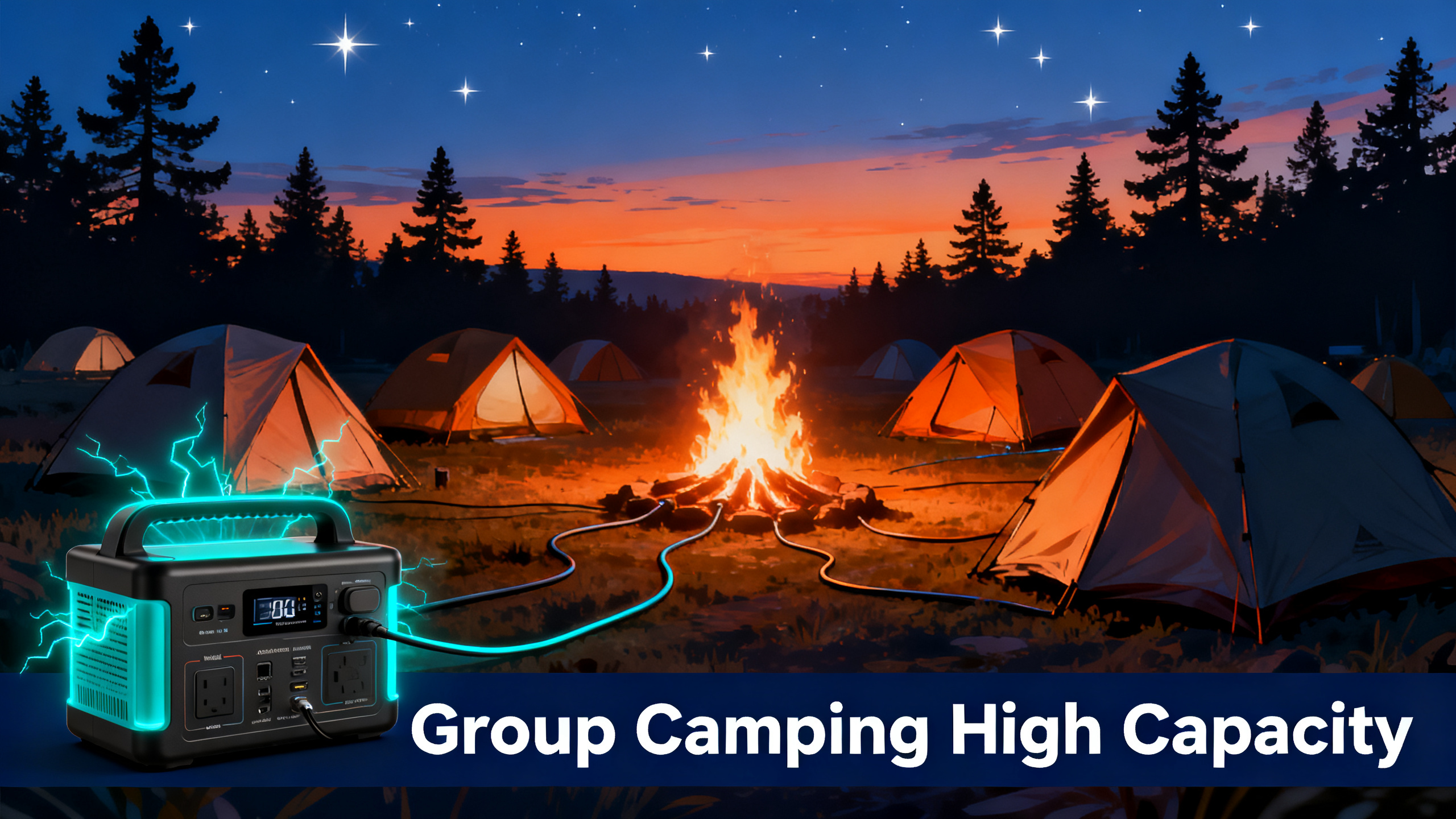
Planning power for a group campsite is a different problem than planning power for a solo trip. You’re not sizing for one person’s phone and a lantern. You’re sizing for a camp fridge running all night, a coffee maker pulling 1,000W at 7am, six devices charging simultaneously, and a speaker that nobody wants to turn off. The math changes fast.
This guide covers the five high-capacity portable power stations that capacity data and spec analysis confirm are worth considering for group camping in 2026. The range runs from 1,056Wh to 3,600Wh, with prices from $699 to $1,599. Here’s how to choose the right system for your crew’s actual needs.

How Much Power Does a Group Campsite Actually Need?
Before looking at any specific unit, the capacity question needs a real answer. Most group campers dramatically underestimate their actual load because they think in terms of individual devices rather than simultaneous draws.
The key is understanding that watt-hours (Wh) are like the size of your fuel tank. A 2,000Wh capacity means you can run 2,000 watts for one hour, or 200 watts for ten hours, or any combination in between. The problem is that group camping involves multiple loads running at the same time.
The Capacity Formula: Group Size x Days x Daily Load
A practical capacity calculation starts with your daily load estimate. A camp fridge draws roughly 40W continuously (960Wh per day). Add lighting at 30W for six hours (180Wh), six smartphones averaging 10W each for two hours of charging (120Wh), and a coffee maker at 1,000W for 20 minutes in the morning (333Wh). That’s approximately 1,600Wh per day for a group of six, minimum.
For a two-day trip without solar recharging, you’re looking at 3,200Wh of total capacity to feel comfortable. With solar recharging, a 2,000Wh unit can realistically cover three to four days for a group of four to six, depending on sun availability and load discipline.
Why You Need More Than You Think
Two factors consistently push groups toward larger units than their initial estimates suggest. First, simultaneous peak loads: when three people charge devices while the coffee maker runs and the fridge cycles on, you’re potentially pulling 1,400W at the same moment. The unit’s continuous output rating needs to cover that peak without tripping.
Second, efficiency losses. Capacity data consistently shows that real-world usable capacity runs around 85% of rated capacity, accounting for inverter losses and battery management overhead. A 2,048Wh unit delivers approximately 1,741Wh of usable power. Plan for that number, not the rated spec.
💡 Pro Tip: Build a simple load list before you buy. Add up every device your group plans to run, estimate daily hours, and multiply. Groups consistently find their actual daily load is 30-40% higher than their first guess once they account for simultaneous use.
Quick Picks: Best High-Capacity Power Stations for Group Camping
Here’s where the five units covered in this guide land for different group scenarios. The comparison table and side-by-side cards below give you the full picture before diving into individual analysis.

EcoFlow DELTA 3 Max (2,048Wh): Best Overall for Groups of 4-6
At $749 (down from $1,499), the EcoFlow DELTA 3 Max represents the strongest value-to-capacity ratio in this class right now. Spec analysis confirms it covers the most common group camping scenario: four to six people, two to three days, moderate cooking and device loads.
The key data point isn’t just the 2,048Wh capacity. It’s the combination of 3,000W continuous AC output and 6,000W surge, plus a 43-minute charge to 80% via generator. For group camping, that last number matters. If you have generator access at the campsite, you’re back to functional capacity before dinner.
Editor’s Pick: Best Value
EcoFlow DELTA 3 Max (2,048Wh)
$749 $1,499
- 3,000W output: runs coffee maker, camp kitchen, fans simultaneously
- Ready in 43 min via generator, back to full before dinner
- Expandable to 10kWh for multi-day group trips
Key Specs at a Glance
The EcoFlow DELTA 3 Max 2048Wh uses LFP (LiFePO4) cells with a 10-year lifespan rating. It supports five charging methods, including 1,000W solar input and generator charging. The OASIS 3.0 app adds Storm Guard for automatic charging when weather threatens, and Smart Output Priority for load management. The 25dB operating noise floor sits below ambient nature sounds at most campsites.
Expandability is a key differentiator here. The DELTA 3 Max accepts Smart Extra Battery modules, pushing usable capacity from 2kWh to 10kWh. For multi-day group trips or larger groups, that modular architecture changes the math considerably. For a detailed breakdown of real-world performance metrics, see our EcoFlow DELTA 3 Max 2048Wh review.
What Can the DELTA 3 Max Power for Your Group? (2,048Wh)
❄️
Camp Fridge (40W)
51 hrs
40W
☕
Coffee Maker (1,000W)
~35 cups
~2 hrs continuous
💡
LED Camp Lights (30W)
68 hrs
30W
📲
Smartphones (10W avg)
200 charges
10W avg
Runtime calculations based on 2,048Wh capacity at ~85% efficiency. Real-world results vary by load combination.
What the Numbers Reveal
Capacity analysis for a typical group of five shows the DELTA 3 Max covering a two-night trip with comfortable margin. Running a camp fridge continuously (960Wh/day), lighting for six hours (180Wh/day), five devices charging twice (100Wh/day), and a morning coffee maker session (333Wh/day) adds up to roughly 1,573Wh per day. The 2,048Wh unit covers one full day plus most of a second day without any solar top-up.
The X-Boost feature deserves specific mention for group cooking. X-Boost allows appliances rated up to 3,800W to run on the DELTA 3 Max’s 3,000W inverter by managing power delivery intelligently. The detailed spec breakdown in our EcoFlow DELTA 3 Max 2048Wh review confirms the X-Boost mode delivers real-world appliance support beyond its nameplate wattage.

Where Analysis Shows Limitations
The DELTA 3 Max at 2,048Wh isn’t the right choice for groups of eight or more running full kitchen setups. At simultaneous peak load (fridge, coffee maker, and multiple devices), you’re drawing close to the 3,000W continuous ceiling with limited headroom. Groups in that scenario should look at the DELTA Pro or a dual-unit configuration.
Weight is the other honest consideration. At this capacity class, portability is a relative concept. The DELTA 3 Max is designed to travel in a vehicle, not be carried to a campsite. If your group is hiking in, none of these units are viable options.
Group Camping Power: Extended Planning Guide
When your trip stretches beyond a weekend, solar pairing changes everything about capacity math.
Jackery Explorer 1500 v2 (1,536Wh): Best Value for Smaller Groups
At $699 (down from $999), the Jackery Explorer 1500 v2 targets groups of two to four people who need serious capacity without serious weight. Spec data confirms this as the lightest 1.5kWh LFP unit available at 31.97 lbs, a distinction that matters when you’re moving a power station in and out of a vehicle repeatedly.
The 64-minute full recharge from AC is a practical advantage for groups with campsite electrical hookups. You can top the unit from empty to full during a lunch break without interrupting camp activities. Our Jackery Explorer 1500 v2 best value review breaks down why this 31.97-lb unit punches above its weight class for smaller group setups.
The Lightest 1.5kWh LFP Option Available
LFP (LiFePO4) chemistry is the right call at this capacity range for group camping specifically because of cycle life. At 6,000+ rated cycles, the 1500 v2 isn’t a unit you’ll replace before the decade is out, even with heavy seasonal use. That longevity matters when you’re spending $699 on a piece of gear.
The 2,000W continuous output and 4,000W surge handles the most common group appliances: a coffee maker, a portable induction cooktop at low settings, fans, and device charging simultaneously. Where it starts to show capacity limits is extended fridge runtime combined with cooking loads over multiple days.

Performance Data for Group Scenarios
Runtime calculations for a group of three on a two-day trip: camp fridge running continuously (960Wh/day), lighting for five hours (150Wh/day), three devices charging (60Wh/day), and a morning cooking session (200Wh/day) totals roughly 1,370Wh per day. The 1,536Wh capacity covers day one with minimal margin. Day two requires either solar input or accepting a shorter runtime on lower-priority loads.
For groups that can accept load management on day two (or have solar panels), the 1500 v2 works. For groups that want full convenience with no rationing, sizing up to the DELTA 3 Max makes more practical sense at only $50 more.
⚠️ Important: The Jackery Explorer 2000 Pro (Produit #2) shows stock status as potentially variable at time of publication. Check current availability before ordering if the 2000 Pro is your target unit.
Jackery Explorer 2000 Pro (2,160Wh): Premium Expandable Pick
The Jackery Explorer 2000 Pro carries a higher price at $1,599 (down from $1,899), but it brings a specific capability the other units in this guide don’t match at base configuration: 6,000W parallel output when two units are connected. For groups that need to run larger appliances or are planning to scale their setup over multiple trips, the expandability argument is data-supported.
Published specs and owner data analyzed in our Jackery Explorer 2000 Pro review confirm the 2,160Wh capacity handles a full weekend of group cooking and device charging. The IBC solar technology enables a 2-hour solar recharge from a compatible panel array, which is the fastest solar charge time in this class.
Expandable From 2kWh to 24kWh
The expansion architecture is where the 2000 Pro separates from the competition for serious group campers. The system supports scaling to 2-24kWh total capacity and is compatible with transfer switches for home backup use between camping seasons. For groups investing in a long-term power solution rather than a single-use camping item, that flexibility has real value.
ChargeShield technology claims to extend battery lifespan by 50% compared to standard charging protocols. Over a 10-year ownership period with regular charging cycles, that claim translates to a battery that maintains higher capacity retention into later years of use. The 3-year plus 2-year extended warranty structure reflects confidence in that longevity claim.


Specs and Owner Data Summary
Is the $850 premium over the DELTA 3 Max justified? For most groups, spec analysis says no. The DELTA 3 Max delivers comparable capacity (2,048Wh vs 2,160Wh), higher continuous output (3,000W vs 2,200W), and a faster generator recharge at roughly half the price. The 2000 Pro makes sense specifically for groups planning to scale capacity over time, run parallel dual-unit configurations, or use the unit for home backup integration.
Check the Jackery Explorer 2000 Pro official page for current stock status and bundle options with compatible solar panels.
Anker SOLIX C1000 (1,056Wh): Fastest Recharge for Short Trips
The Anker SOLIX C1000 occupies a different position in this guide than the other four units. At 1,056Wh, it carries the smallest capacity, yet at $999 it’s the third most expensive option. The justification for that price-to-capacity ratio lies entirely in one specification: 0-80% in 43 minutes and a full charge in under one hour.
For groups taking short two-night trips where campsite electrical hookups are available, the C1000 makes a different kind of sense. You’re not depending on stored capacity as much as you’re depending on the ability to recharge repeatedly and quickly. A group that can charge the unit overnight every night effectively has unlimited power from a 1,056Wh battery.
Ultra-Fast Charging: 43 Minutes to 80%
HyperFlash charging technology is the defining capability here. The 600W maximum solar input allows a 1.8-hour solar recharge from a compatible 600W panel array, which is competitive with larger units despite the smaller capacity. For groups with reliable solar access, the C1000 recharges faster proportionally than any other unit in this comparison.
The 11-port output configuration covers simultaneous device charging across a group without the hub-and-adapter workarounds that older designs require. Bluetooth and Wi-Fi app monitoring adds load visibility that helps groups manage the 1,800W continuous output ceiling across multiple simultaneous draws. See our full Anker SOLIX C1000 review for a detailed breakdown of its HyperFlash charging and 5-year warranty terms.

When the C1000 Makes More Sense Than Larger Units
The honest case for the C1000 is specific: groups of two to three people at campsites with electrical hookups, taking trips of two nights or fewer. In that scenario, the ultra-fast recharge eliminates the capacity disadvantage entirely. You never run low because you’re topping off constantly.
Where the C1000 doesn’t make sense is off-grid trips of three-plus days with larger groups. The 1,056Wh capacity requires aggressive load management to cover a full day for four or more people. At $999, that constraint is a meaningful limitation compared to the DELTA 3 Max’s 2,048Wh for $250 less. The Anker SOLIX C1000 earns its place in this guide for a specific group profile, not as a general-purpose recommendation.
Glamping Power Setups: Comfort-Focused Capacity Guides
Groups prioritizing comfort alongside capacity will find these glamping power setups a natural progression from this guide.
EcoFlow DELTA Pro (3,600Wh): For Large Groups and Extended Stays
The EcoFlow DELTA Pro at $1,599 (down from $3,699) is positioned as the premium-capacity pick for groups of eight to twelve people. At 3,600Wh with 3,600W continuous output, capacity data analysis shows it handles full kitchen setups, multiple fans and lighting circuits, and comprehensive device charging without load management constraints.
That price drop from $3,699 to $1,599 fundamentally changes the value proposition. At the original price, the DELTA Pro competed in a different tier. At $1,599, it becomes a serious consideration for large groups who need the additional capacity headroom that 2,000Wh units simply can’t provide.
Premium Capacity at a Surprising Price Point
The 3,600W continuous and 7,200W surge output covers 99% of standard appliances without the X-Boost workaround that the DELTA 3 Max requires for high-draw devices. For groups running a toaster oven, a coffee maker, and a mini-split simultaneously, the DELTA Pro handles that load directly. For groups running a full kitchen setup or small AC units, our EcoFlow DELTA Pro home backup review documents its 3,600W continuous output under real load.
The MultiCharge 6,500W input enables a 2.7-hour full recharge from AC. That’s slower than the DELTA 3 Max’s generator charging, but the DELTA Pro is filling a tank that’s 75% larger. The ability to recharge at EV stations adds a practical off-grid option that most units in this class don’t offer.

Expandability Beyond 10kWh
The DELTA Pro supports Smart Extra Battery expansion from the base 3,600Wh to 3.6-25kWh total capacity. For groups running multi-day trips at remote sites without solar or generator access, that expansion capability converts the DELTA Pro from a high-capacity camping unit to a serious off-grid power system.
The Plug and Play home backup functionality means the DELTA Pro serves double duty between camping seasons. For groups who camp seasonally and want their power investment to provide year-round value, that dual-use case strengthens the ROI calculation considerably. Check the EcoFlow DELTA Pro official specs for current bundle configurations with the Smart Extra Battery.
EcoFlow DELTA Pro: Home Backup and Camping Deep Dive
Full performance documentation of the DELTA Pro’s 3,600W output across home and outdoor scenarios.
Expandable Systems: When You Need More Than One Unit
Some group camping scenarios genuinely require more capacity than any single unit in this class provides. Multi-day trips of five or more days, groups of ten or more running full kitchen setups, or events where power runs continuously from arrival to departure all push beyond what a single 2,000Wh unit can deliver.
Two expansion architectures are worth understanding for group camping specifically.
Jackery 2000 Plus Battery Expansion
The Jackery Explorer 2000 Plus supports battery pack add-ons that scale capacity from the base 2kWh to 24kWh. The modular architecture is documented in our Jackery 2000 Plus expandable review, which covers the battery pack add-on that takes capacity from 2kWh to 24kWh. That expansion path is notable because it grows with your needs over time rather than requiring a complete hardware replacement when capacity requirements increase.
The 6,000W parallel output from two linked Explorer 2000 Pro units extends the capability in a different direction: raw wattage for running larger appliances simultaneously. For groups that have two units and want to run a full-size appliance that exceeds a single unit’s output ceiling, parallel linking is the practical solution.

EcoFlow DELTA 3 Max Smart Extra Battery
The Smart Extra Battery for the DELTA 3 Max takes a different approach than separate unit parallel connections. A single unit scales from 2kWh to 10kWh through modular battery additions that integrate directly into the main unit’s management system. The advantage is unified load management and a single app interface rather than coordinating two separate units.
For groups that start with the DELTA 3 Max at $749 and need more capacity for a longer trip, adding a Smart Extra Battery module is a lower-commitment expansion than purchasing a second full unit. The total cost for a 4kWh configuration remains competitive with the DELTA Pro at 3,600Wh.
Related Setups for Group Campers
Groups prioritizing comfort alongside capacity will find our guide to glamping power setups for similar capacity needs a natural progression from this guide. The glamping use case adds climate control and kitchen appliances that push capacity requirements into the 3,000-4,000Wh range.
When group trips stretch beyond a weekend, the math changes significantly. See our guide on extended 2-week camping planning for solar pairing strategies that make multi-day group trips viable with 2,000Wh units.
Frequently Asked Questions
What size power station do I need for a group of 6 people camping for 3 days?
Capacity calculations based on typical group loads (camp fridge at 40W, camp kitchen at 1,000W intermittent, six devices at 20W average, LED lighting at 30W) indicate a 2,000-3,000Wh unit covers a 3-day group trip with moderate solar recharging. The EcoFlow DELTA 3 Max at 2,048Wh handles this scenario for most groups, with the DELTA Pro recommended for groups running a full kitchen appliance setup simultaneously. Without any solar recharging, a 3-day trip for six people realistically requires 3,000Wh or a unit with generator recharging access on day two.
Can I use two portable power stations for a group camping trip?
Yes, and parallel configurations are standard practice for large group setups. Jackery’s Explorer 2000 Pro supports 6,000W parallel output when two units are linked, effectively doubling capacity to 4,320Wh and providing enough wattage to run full-size kitchen appliances that exceed a single unit’s ceiling. EcoFlow’s Smart Extra Battery accessory for the DELTA 3 Max adds up to 10kWh in modular increments without requiring two separate units, which simplifies management for groups who want a single-unit solution. Both approaches work; the choice depends on whether you want parallel wattage or expanded storage in a unified system.
How do I recharge a large power station during a multi-day camping trip?
Solar is the primary option for off-grid recharging. The EcoFlow DELTA 3 Max accepts up to 1,000W solar input via multiple panels, which means a 500W panel array achieves a full recharge in approximately 4-5 hours of direct sun. Generator charging reduces that to 43 minutes on the DELTA 3 Max. A combined approach, solar during the day with generator top-up if needed, is the standard practice for multi-day group trips based on published charging data. The Anker SOLIX C1000 accepts up to 600W solar input and can recharge in 1.8 hours from a compatible array. For trips where solar access is uncertain, a portable generator as a backup charge source is a reliable contingency for any unit in this guide.
What is the quietest high-capacity power station for camping?
The EcoFlow DELTA 3 Max publishes a 25dB noise floor at 600W load, which sits below ambient forest background noise at most campsites. All lithium power stations in this class operate silently compared to gas generators. The cooling fans activate under higher loads and can produce audible noise, but no manufacturer publishes noise specifications at full load for this product class. In practice, fan noise from any of these units is negligible compared to camp activity noise. The meaningful quiet comparison is lithium power station versus gas generator, and lithium wins decisively at every load level.
Is 2,000Wh enough for a group camping trip?
For a group of 4-6 people camping 2-3 days, capacity data analysis confirms 2,000Wh is sufficient with typical loads: camp fridge running continuously, evening lighting, device charging, and intermittent cooking appliance use. The EcoFlow DELTA 3 Max at 2,048Wh covers this scenario comfortably for most groups. Where 2,000Wh becomes limiting is when groups run a toaster oven, coffee maker, and fridge simultaneously at peak morning hours, or when trips extend beyond three days without solar recharging. Groups in those situations should size up to 3,600Wh or plan explicit load management to avoid hitting the continuous output ceiling simultaneously.
Our Recommendation
For the majority of group camping scenarios, capacity data, pricing analysis, and spec comparisons point to the EcoFlow DELTA 3 Max as the strongest overall choice for 2026. At $749 for 2,048Wh with 3,000W continuous output and 43-minute generator recharge, it covers groups of four to six across two to three days without requiring load management compromises.
If your group is smaller (two to four people) and portability matters, the Jackery Explorer 1500 v2 at $699 delivers the lightest 1.5kWh LFP unit available and covers shorter trips effectively. If you’re planning a large group event or an extended stay with eight or more people, the EcoFlow DELTA Pro at $1,599 provides the capacity headroom that 2,000Wh units can’t match.
The Jackery Explorer 2000 Pro and Anker SOLIX C1000 each serve specific scenarios: the 2000 Pro for groups planning long-term expandability, the C1000 for groups with reliable campsite electrical access who prioritize fast recharging over raw capacity.
For a full overview of every capacity tier from compact to high-capacity, our guide to the best solar generators for camping covers compact, mid-range, and high-capacity units side by side.
EcoFlow DELTA 3 Max
$749
Best 2kWh power station for group camping under $800
Price verified April 2026. Free shipping available
Originally published: April 28, 2026