
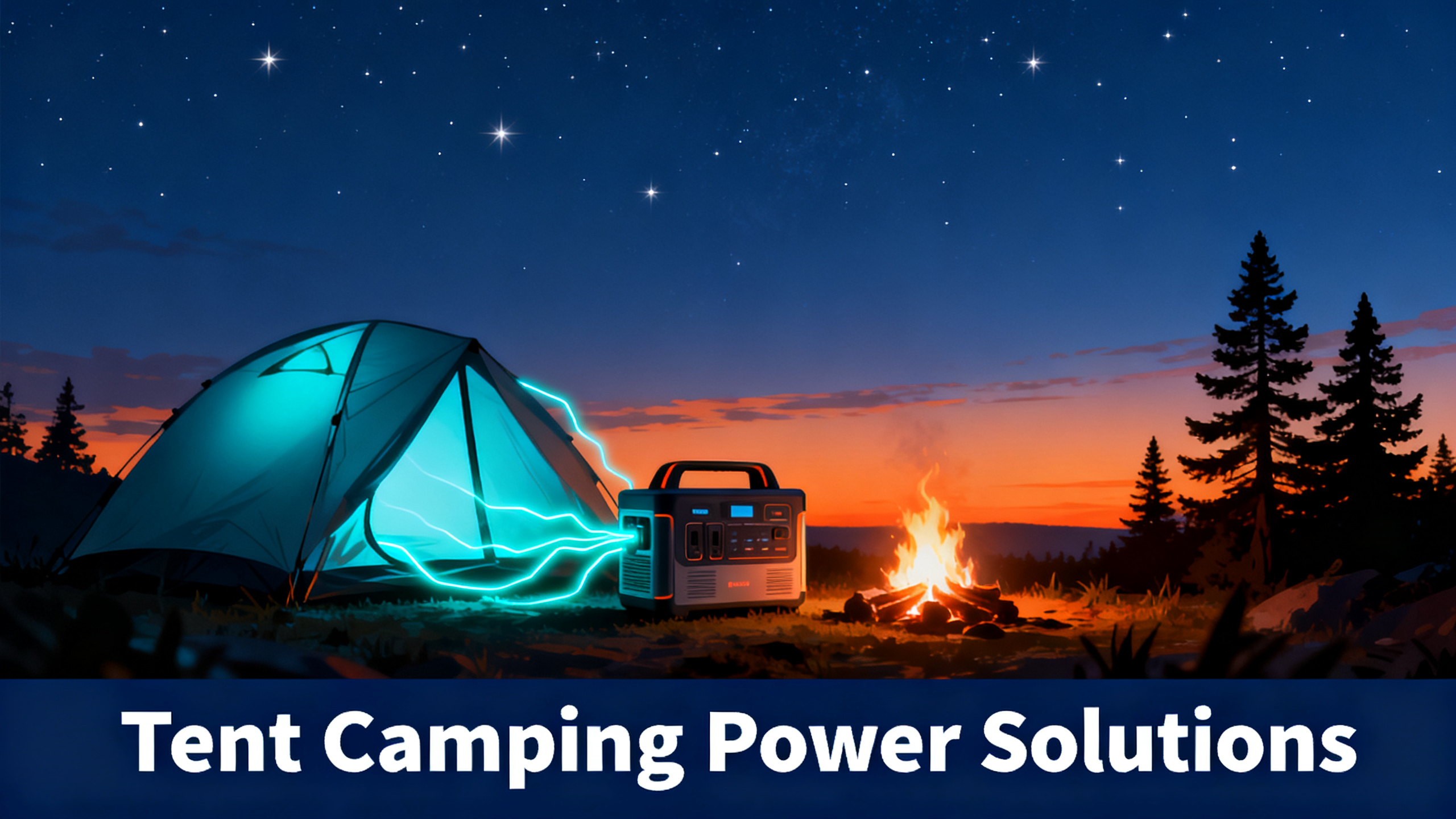
Tent camping strips the experience down to essentials. No shore power. No generator hookup. No extension cord running from a nearby outlet. What you bring is what you have, and that constraint makes choosing the right power solution more consequential than for RV owners or car campers with a trunk full of space.
The good news: portable power stations have reached a point where tent campers can genuinely solve their power needs without hauling around a fuel-burning generator or relying on a 12V car outlet that drains the vehicle battery. The right unit charges at the trailhead, runs silently through the night, and fits in a gear bag alongside your sleeping kit.

Common Power Challenges in Tent Camping Scenarios
Tent campers face a specific set of constraints that RV owners and car campers don’t. Weight and packed volume matter. Noise matters (especially in campgrounds with close neighbors). Running time matters when there’s no electrical hookup to fall back on at midnight.
The most common friction points: keeping a CPAP machine running through a full night, maintaining a 12V cooler for multi-day trips, and keeping phones and cameras charged without burning through a car battery. A dedicated portable power station addresses all three without the noise, fumes, or fire risk of a conventional generator.
Capacity data also shows a clear pattern: tent campers consistently underestimate how much they’ll use a power station once they have one. A unit purchased for “just charging phones” quickly becomes the hub for lanterns, a portable speaker, a camp stove fan, and a CPAP. Sizing up slightly from your estimated needs is rarely a decision people regret.
How Portable Power Stations Compare to Generators and Car Charging
Car charging (USB-A from a 12V outlet) is the default fallback for most tent campers. It works for phones but delivers limited wattage, risks draining the vehicle battery overnight, and can’t power anything that requires standard AC. Portable power stations replace that limitation entirely.
Conventional generators produce far more power but introduce significant trade-offs for tent camping: noise levels that violate campground quiet hours, fuel logistics, exhaust fumes, and weight that makes them impractical for anything beyond drive-up sites. Many national parks and campgrounds have banned or restricted generator use during certain hours.
Portable power stations occupy the practical middle ground. They’re quiet (no moving parts), safe for tent use (LFP chemistry produces no combustion gases), and rechargeable via solar during the day. For trips of one to five nights, capacity analysis confirms they cover the realistic power needs of most tent camping setups without the downsides of either alternative.
✅ Choose a 500-800Wh station if…
- Weekend trips, 1-2 nights
- Charging phones, camera, headlamp
- Light cooking (no full-size appliances)
- Solo or couple camping
🔵 Choose 1,000-1,500Wh if…
- 3-5 night trips or CPAP dependency
- Small group (3-4 people)
- Mini fridge or electric kettle
- Solar recharge planned during trip
❌ Skip tent-sized units if…
- Running AC or large appliances
- Extended off-grid trips (7+ nights)
- Group of 5+ with heavy device load
- You need car camping capacity
How Much Power Do You Actually Need for Tent Camping?
Watt-hours (Wh) measure total stored energy, the way gallons measure a fuel tank. A 768Wh unit can deliver 768 watts for one hour, or 76 watts for ten hours, or any combination that reaches that total. Understanding this makes sizing decisions straightforward.
Most tent campers don’t need to run power-hungry appliances. The realistic load is smaller than you’d expect. What drives capacity needs is duration (how many nights without a recharge opportunity) and whether a CPAP machine is part of the equation.
Typical Tent Camping Power Consumption (by scenario)
Published draw data for common camping devices gives a clear baseline. LED camp lights run 5-20W depending on brightness. A smartphone charges at roughly 15W average. A laptop draws 45-65W. A 12V portable cooler runs continuously at around 45-55W. A CPAP without humidifier draws approximately 30-60W depending on pressure settings.
Running all of those simultaneously for a typical evening at camp (4-6 hours active use, cooler running overnight) lands most solo or couple setups in the 300-600Wh range per night. A 768Wh unit covers a full weekend comfortably for that profile without any solar top-up.
Size Your Capacity Accurately
The portable power station calculator helps you match capacity to your exact device list and trip length.
Light Use vs. CPAP-Dependent vs. Full-Comfort Camping
Three distinct tent camping profiles emerge from capacity analysis, and each requires a different approach to sizing.
Light use (phones, lights, camera): A 500Wh unit handles this profile easily for a weekend. The EcoFlow RIVER 2 Pro at 768Wh gives meaningful headroom for this scenario, making it the practical minimum for campers who want some buffer.
CPAP-dependent: This is the profile where sizing matters most. A CPAP at 50W runs for roughly 15 hours on 768Wh (accounting for efficiency losses). For a two-night trip, that’s exactly enough without solar recharging during the day. Three-night CPAP users benefit significantly from moving to the 1,000-1,440Wh tier or adding a solar panel for daytime top-up.
Full-comfort camping: A 12V cooler running overnight plus morning coffee from a portable kettle plus standard electronics pushes nightly consumption above 600Wh. For this profile, the Jackery Explorer 1000 v2 at 1,070Wh or the Bluetti AC180P at 1,440Wh become the practical options for multi-night trips.
Best Power Stations for Tent Camping in 2026
Capacity-to-weight ratio, solar compatibility, and charge speed are the three variables that matter most for tent campers. The units below cover three distinct price and capacity tiers, with data-backed context on which profile each one fits.
EcoFlow RIVER 2 Pro
$339 $599
- 768Wh: runs a CPAP all night
- Charges 0-100% in 70 minutes
- Only 18.2 lbs: true carry-in weight
EcoFlow RIVER 2 Pro: Best Overall for Tent Camping
The RIVER 2 Pro hits the sweet spot that tent campers need: enough capacity at 768Wh to cover a realistic weekend load, light enough at 18.2 lbs to carry into a site, and fast enough to fully recharge in 70 minutes before you leave for the trailhead.
Quick Specs: 768Wh capacity, 800W AC output (1,600W with X-Boost), LFP (LiFePO4) battery rated for 10 years of use, 4 charging methods including solar, 70-minute AC recharge, 18.2 lbs.
The LFP chemistry is worth noting. LiFePO4 (lithium iron phosphate) cells have a fundamentally more stable chemistry than standard lithium-ion, which translates to a longer cycle life and significantly lower risk of thermal runaway. For a device you’re running in an enclosed tent, that safety margin matters.

Why It’s Ideal for Tent Camping: At $339 (down from $599), the value proposition becomes hard to argue with. The 70-minute AC charge means you can top it off at home or at a campground outlet before breaking camp. Solar input via the EcoFlow 220W panel brings it from empty to full in approximately 4 hours under good conditions, giving multi-night campers a viable recharge path.
The X-Boost feature extends the practical output to 1,600W for high-draw appliances like electric kettles. In practice, this means the RIVER 2 Pro can run a wider range of camp kitchen equipment than the rated 800W output would suggest.
What Can the RIVER 2 Pro Power? (768Wh Capacity)
💡
LED Camp Lights
~76 hrs
10W
💻
Laptop
~10 hrs
65W
😴
CPAP (no heat)
~15 hrs
50W
📱
Smartphone
~50 charges
15W avg
❄️
12V Cooler
~15 hrs
~50W avg
Runtime estimates based on 768Wh capacity at ~85% efficiency. Actual results vary with temperature and usage patterns.
Full spec analysis and runtime breakdowns are available in the EcoFlow RIVER 2 Pro 768Wh review. Official specs are on the EcoFlow RIVER 2 Pro official page.
Jackery Explorer 1000 v2: Best Mid-Range Pick

The Explorer 1000 v2 steps up to 1,070Wh and 1,500W continuous output, which opens up appliances that the RIVER 2 Pro’s base 800W output won’t handle without X-Boost assistance. For campers who run a 12V cooler overnight, a CPAP, and still want capacity to spare for three to four nights, the 1,070Wh figure provides that margin.
Quick Specs: 1,070Wh capacity, 1,500W output (50% power boost over original Explorer 1000), LiFePO4 cells rated for 4,000 cycles and 10+ years, 5-year warranty, emergency charge via dual 100W USB-C in 1 hour, ChargeShield 2.0 with 62-layer protection system.
The 4,000-cycle rating is significant for tent campers who use a power station frequently across camping seasons. Capacity data at that cycle count remains above 80% of original, meaning the unit delivers reliable performance over a decade of regular use. For a $499 investment, that longevity profile makes sound financial sense.
Jackery loyalists will want to consult the ranked list of best Jackery models for camping before finalizing a choice. Detailed spec data is on the Jackery Explorer 1000 v2 specifications page.
Performance data for the 500 v2 is covered in depth in the Jackery Explorer 500 v2 review for campers considering a lighter-capacity Jackery option.
Bluetti AC180P: Best for Comfort Camping or Groups

The Bluetti AC180P brings 1,440Wh capacity and 1,800W output to the tent camping context. At $649 (down from $999), it occupies a different use case than the RIVER 2 Pro or Explorer 1000 v2: extended trips, group setups, or comfort-first campers who aren’t prioritizing minimum weight.
Quick Specs: 1,440Wh capacity, 1,800W AC output, LiFePO4 battery, approximately 45-minute AC recharge, compatible with solar panels up to 500W input.
The AC180P’s weight puts it firmly in the drive-up or car-to-site carry scenario. For group tent camping where multiple people are sharing power across a 4-5 night trip, the capacity buffer the AC180P provides is meaningful. The 500W solar input ceiling also means faster daytime recharge than units limited to 200-220W solar input.
Capacity-to-price data for this unit is detailed in the Bluetti AC180P review.
Quick Comparison: Which One Should You Choose?

Essential Features for Tent Camping Power Stations
Not every feature that matters for RV or home backup use translates to tent camping. Some specs are more relevant than others, and the trade-offs are different when you’re prioritizing portability over maximum output.
Battery Capacity and Weight Trade-Off
Every additional watt-hour you add to a portable power station adds weight. The relationship isn’t perfectly linear, but as a rough guide, moving from 768Wh to 1,070Wh typically adds 4-6 lbs. Moving from 1,070Wh to 1,440Wh adds another 4-8 lbs.
For tent campers who park the car and walk a short distance to the site, 22-28 lbs is manageable. For campers with a longer carry, or those doing dispersed camping where weight matters more, the RIVER 2 Pro’s 18.2 lbs becomes a more meaningful advantage.
💡 Pro Tip: If you’re unsure whether to size up or down, err toward more capacity. Owner reports consistently indicate that tent campers use their power stations more than they initially expect, particularly once they add a cooler or CPAP to the mix.
LFP battery chemistry (LiFePO4) is now standard across all three units reviewed here. It’s worth understanding why this matters specifically for tent campers: LFP operates safely at higher temperatures, has no thermal runaway risk under normal conditions, and retains more usable capacity over its lifespan compared to standard lithium-ion. Running an LFP unit inside a tent vestibule or tent footprint is a reasonable practice with appropriate ventilation.
Solar Charging Compatibility
Solar charging transforms a power station from a finite resource into a renewable one for multi-night tent camping. The math is straightforward: a 220W panel in 5 hours of useful sun generates approximately 1,100Wh of raw energy, enough to fully recharge the RIVER 2 Pro and top off the Explorer 1000 v2 in a single day.
All three units reviewed here support solar input. The RIVER 2 Pro accepts up to 220W solar input. The Explorer 1000 v2 is compatible with Jackery’s bifacial 200W SolarSaga panels. The AC180P supports up to 500W solar input, making it the fastest to recharge from panels when capacity matters on longer trips.


A practical note on solar for tent campers: most campsite setups don’t provide optimal panel placement throughout the day. Capacity data accounts for this by assuming approximately 4-5 effective sun hours rather than peak theoretical output. On a partly cloudy day, that figure drops further. Planning solar recharge with a conservative efficiency estimate keeps expectations realistic.
Compact Options Worth Considering
For tent campers prioritizing minimum footprint, the ranked list of best compact portable power stations narrows the field further. Units below 500Wh exist in a category where weight drops significantly but capacity becomes limiting for anything beyond one-night device charging.
Jackery loyalists will want to consult the ranked list of best Jackery models for camping before finalizing a choice. Jackery’s lineup spans from sub-500Wh options to units well above the capacity needed for typical tent camping, and the right fit depends on trip duration and group size.
Best Jackery for Camping: Full Rankings
Every Jackery model ranked by camping use case, weight, and value.
Tent Lighting, Electronics, and What You Can Actually Run
Understanding the realistic power draw of common tent camping gear helps you confirm whether your chosen unit fits your actual use case, not a hypothetical one.
Tent Lighting Power Needs
LED technology has transformed the lighting side of the equation. A quality LED lantern running at medium brightness draws 5-15W. A set of string lights for a campsite perimeter runs 10-25W total. At those draw levels, a 768Wh unit running lights for 6 hours per night barely makes a dent in available capacity: 90Wh consumed out of 768Wh available.
The practical implication is that lighting alone should never drive your capacity decision. Lighting is cheap in watt-hours. The capacity drivers are CPAP machines, coolers, and cooking devices.
A dedicated breakdown of camping lighting solutions with power stations covers LEDs, lanterns, and string lights by wattage for campers who want to plan their lighting setup specifically.
Charging Electronics While Camping
The typical electronics load for a tent camper is smaller than people expect. Two smartphones, a camera battery, a drone battery, a pair of Bluetooth earbuds, and a tablet: charge all of them each evening and you’re looking at roughly 150-250Wh total. Even on a 500Wh unit, that’s manageable for a weekend without a recharge.
Where consumption increases meaningfully: laptops (45-65W per charge cycle), portable gaming devices running extended sessions, and professional camera setups with multiple large batteries. If your electronics load falls into this category, the 768Wh tier becomes the practical minimum for a two-night trip.
⚠️ Important: Pass-through charging, which means using devices while the power station is simultaneously being charged from solar, is supported on all three units reviewed here. Keep in mind that efficiency drops slightly during pass-through operation, and prioritize solar input during peak sun hours rather than running high-draw appliances simultaneously.
The EcoFlow RIVER 2 Pro 768Wh review includes a breakdown of USB-C and USB-A port performance for device charging, including fast-charge compatibility across common devices.
Going Lighter: When Backpacking Makes More Sense
Tent campers with weight as the primary constraint will find more targeted recommendations in the ultralight backpacking power options guide. Units purpose-built for carry-in backpacking prioritize weight above all else, which means capacity trade-offs that don’t make sense for drive-to or short-carry tent camping.
The practical threshold: if you’re carrying your kit more than a quarter mile from the parking area, the weight of even an 18.2-lb power station becomes a meaningful consideration. For campers below that threshold, weight is manageable and capacity should be the primary sizing driver.
Ultralight Backpacking Power Options
For campers where every ounce counts: power options under 5 lbs reviewed and ranked.
FAQ: Tent Camping Power Questions Answered
How many watts does tent camping typically need?
Spec data and typical tent camping device lists show most solo or couple campers fall between 300Wh and 800Wh per night. LED lights run 10-20W, a smartphone charges at 15W, and a laptop draws 45-65W. Campers who rely on a CPAP machine add roughly 50W continuous. A 768Wh unit like the RIVER 2 Pro covers a full weekend for most tent setups without solar recharging.
Can I use a power station inside my tent?
LFP (lithium iron phosphate) power stations produce no combustion emissions, making them safe for enclosed spaces unlike gas generators. Published safety guidelines and manufacturer documentation confirm this for all three units reviewed here. Keep the station on a stable, flat surface and avoid blocking the cooling vents. Operating temperatures vary by unit: check your model’s specs for cold-weather lower limits.
How long does it take to charge with solar while camping?
Solar recharge time depends on panel wattage and available sun hours. Efficiency data for the RIVER 2 Pro with a 220W panel shows 0-100% in approximately 4 hours under direct sun. The Jackery 1000 v2 achieves similar results with compatible SolarSaga panels. A realistic expectation for most campers is 5-7 hours with a 100-160W panel in typical conditions.
Is a 500Wh power station enough for tent camping?
Capacity calculations confirm that 500Wh is sufficient for weekend trips focused on charging phones, running LED lights, and keeping a camera battery topped off. It becomes limiting with CPAP dependence or three-plus night trips without solar access. For those use cases, the 768Wh or 1,000Wh tier provides meaningful headroom.
What is the lightest power station worth buying for tent camping?
Weight-to-capacity data shows the EcoFlow RIVER 2 Pro at 18.2 lbs offers the best ratio in the 768Wh class. Below 500Wh, compact units like the Anker SOLIX C300X drop under 10 lbs but sacrifice capacity. For tent campers willing to accept lower capacity, the backpacking-oriented options covered in the ultralight guide are a better fit.
Final Verdict: The Right Power Station for Your Tent Trip
Tent camping power solutions have reached a point where the right unit genuinely solves the problem without introducing new ones. No noise. No fumes. No generator logistics. Just stored energy that charges at home, tops up from solar, and runs silently through the night.


The data points to three clear fits based on camping profile. Weekend campers, solo travelers, and CPAP users on shorter trips: the EcoFlow RIVER 2 Pro at $339 delivers the right capacity-to-weight-to-price ratio for most tent camping scenarios. It’s the unit to start with if you’re unsure.
Three to five night trips, group setups of three to four people, or campers running a cooler overnight: the Jackery Explorer 1000 v2 at $499 provides the capacity buffer that prevents you from rationing power mid-trip. The 4,000-cycle LiFePO4 battery also means you won’t be replacing it anytime soon.
Extended stays, large groups, or comfort-first campers who want maximum capacity and the fastest solar recharge: the Bluetti AC180P at $649 delivers 1,440Wh with 1,800W output and 500W solar input ceiling. It’s more than most tent setups require, but it’s the right answer when you want to never think about power management again.
For a complete overview of all camping power options by style and budget, the full solar generator camping guide covers every use case.
EcoFlow RIVER 2 Pro
$339
Best compact power station for tent camping
Price verified April 2026. Free shipping available
Originally published: April 28, 2026