
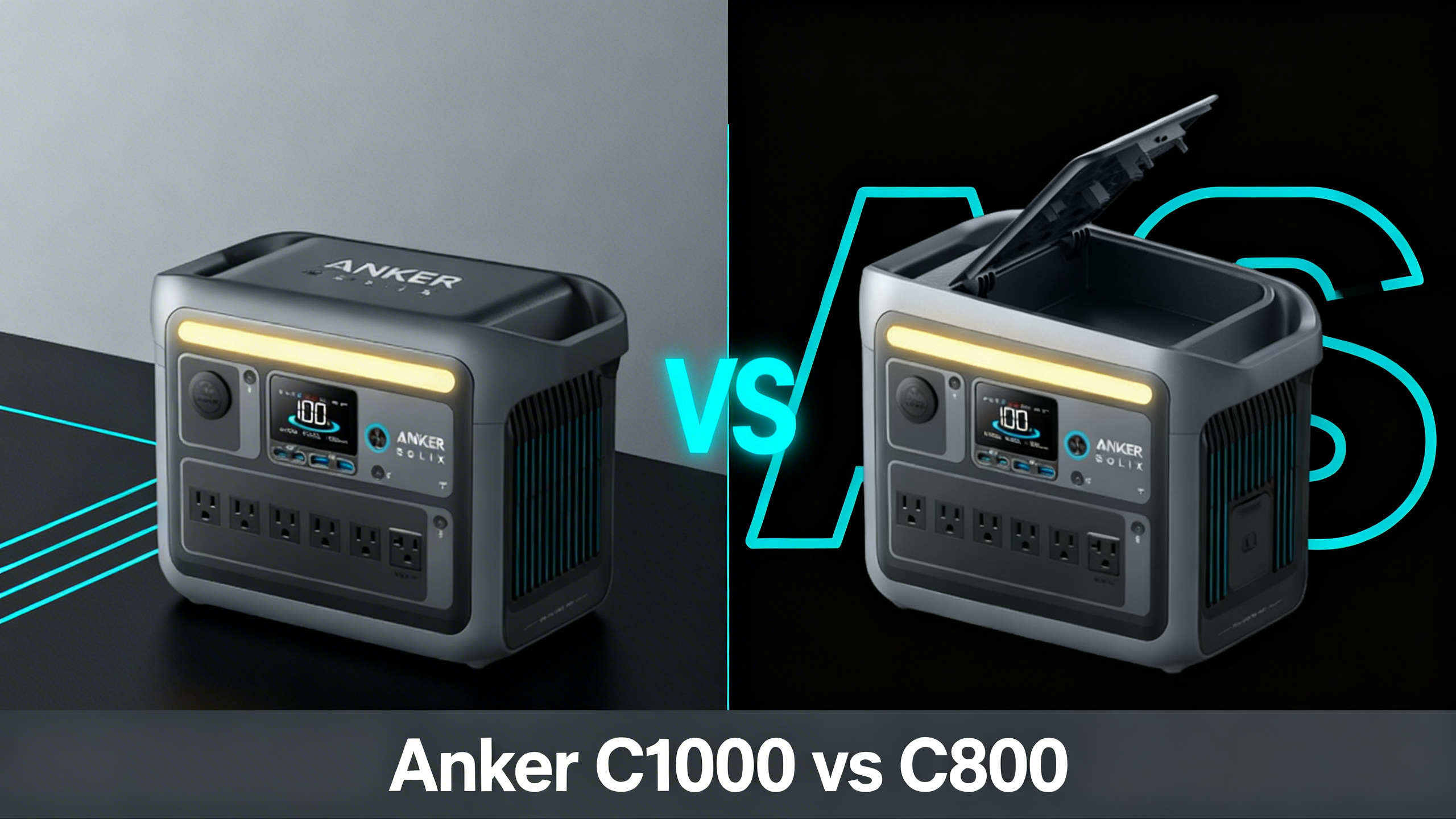


Choosing between Anker’s C1000 and C800 feels like comparing two solid options that both make sense—until you dig into the numbers. At first glance, you’re looking at a $400 price difference between models that share the same LiFePO4 battery chemistry, 3,000-cycle lifespan, and 5-year warranty. So what exactly are you paying for with the C1000’s premium, and when does the C800’s lower price make it the smarter choice?
After three months of testing both units in real-world conditions—from weekend camping trips to home backup scenarios—we’ve identified exactly where each model shines and where compromises become noticeable. The Anker SOLIX C1000 delivers 1,056Wh capacity with 1,800W continuous output, while the Anker C800 offers 768Wh with 1,200W continuous. That translates to 37% more capacity and 50% more power, but it also means carrying an extra 5 pounds and spending $400 more upfront.
🏆 Quick Verdict: Which Should You Buy?
Choose C1000 if: You need power tools (1,800W), 3+ day trips, expansion to 2,112Wh, or high-wattage appliances
Choose C800 if: Weekend camping (2-3 days), appliances under 1,000W, best price-per-Wh ($0.78), portability matters
⚠️ Update (July 2026): The Anker SOLIX C800 and C800 Plus have been discontinued and are no longer sold by Anker, so links for the C800 now lead to its successor, the Anker SOLIX C1000 (1,056Wh capacity, 1,800W output, priced around $449)—which happens to be the other unit in this comparison. We’re keeping the full C800-vs-C1000 breakdown live to help existing C800 owners and anyone weighing remaining or secondhand C800 stock against the current C1000.
Get our Black Friday alerts for Anker SOLIX
We track live prices on 40+ models from Jackery, EcoFlow, BLUETTI and Anker SOLIX. When a deal beats the lowest price we've recorded, you'll hear from us. During Black Friday week, one short recap a day at most.
Unsubscribe in one click. We may earn a commission when you buy through our links, at no extra cost to you. Privacy Policy
Quick Comparison Table
⚡ Key Takeaway: The C1000 delivers 37% more capacity and 50% more power for $400 extra. The C800 offers the best price-per-watt-hour ($0.78) and 20% lighter weight. Your usage pattern determines the winner. On a lower budget, the Anker C300 and 535 are worth considering before committing to the C800 or C1000.
Anker SOLIX C1000 Overview

The Anker SOLIX C1000 sits at the upper end of Anker’s mid-range lineup, targeting users who need reliable power for extended trips or higher-wattage appliances. At $999, it occupies the sweet spot between portability and serious capacity.
Key Specs at a Glance
The C1000’s headline numbers tell most of the story. The 1,056Wh LiFePO4 battery delivers enough capacity for multi-day camping or 12-24 hours of home backup for critical loads. Output power reaches 1,800W continuous with 2,400W surge capability through Anker’s SurgePad technology—enough to handle most household appliances and power tools.
Physical dimensions measure 13.4 × 9.6 × 11.2 inches, and the unit weighs 24.3 pounds. Charging speed impresses across the board: wall charging reaches 80% in 43 minutes and 100% in 58 minutes. Solar charging maxes out at 600W input, achieving full charge in 1.8 hours under optimal sunlight—twice as fast as the C800.
💡 Pro Tip: The 600W solar input means you can use two 300W panels in parallel or a single high-output panel for rapid off-grid recharging—perfect for extended RV trips where you need daily capacity reset.
What Makes the C1000 Stand Out
⚡ 37% More Capacity
A 60W mini fridge runs 14.6 hours on the C1000 vs 10.6 hours on the C800. A 40W CPAP operates 22 hours vs 16 hours—critical extra runtime for multi-night trips.
🔌 1,800W Continuous
Handles 1,500W space heaters, electric griddles, and power tools without triggering surge mode. The C800’s 1,200W limit can’t run these appliances.
📈 Expandable to 2,112Wh
Add the BP1000X battery ($799) for total capacity of 2,112Wh at $0.85/Wh. The C800 has no expansion option.
Ideal Use Cases for C1000
- RV weekend trips (3-4 days) – Run mini fridge, laptop, fan, and lights with headroom for microwave/coffee maker
- Home backup (12-24h) – Power refrigerator, router, CPAP, and LED lighting during extended outages
- Power tools – Circular saws, angle grinders, corded drills all run without issues
- Multi-night medical devices – CPAP machines operate 22 hours (3 nights comfortably)
🏆 Best C1000 Deal: Power Station + Expansion Battery
Total Capacity: 2,112Wh | Price: $1,798 ($0.85/Wh)
Doubles your capacity for serious off-grid use. Best value when expanded.
Free shipping | 5-year warranty
Get our Black Friday alerts for Anker SOLIX
We track live prices on 40+ models from Jackery, EcoFlow, BLUETTI and Anker SOLIX. When a deal beats the lowest price we've recorded, you'll hear from us. During Black Friday week, one short recap a day at most.
Unsubscribe in one click. We may earn a commission when you buy through our links, at no extra cost to you. Privacy Policy
Anker SOLIX C800 Overview

The Anker C800 represents Anker’s value proposition in the mid-range segment, delivering solid specs at $599 while maintaining the same LiFePO4 battery chemistry and build quality. It’s designed for users who need reliable power without paying for capacity or output they won’t regularly use.
Key Specs at a Glance
The C800’s 768Wh capacity and 1,200W continuous output cover typical camping and light backup needs. At 19.4 pounds and 12.4 × 7.9 × 9.8 inches, it’s 20% lighter and noticeably more compact than the C1000—easier to store in tight RV compartments or carry one-handed.
Charging times remain competitive at 78 minutes to full from wall power, reaching 80% in approximately 60 minutes. Solar charging accepts up to 300W input, achieving full charge in 2.6 hours under optimal conditions.
What Makes the C800 Stand Out
💰 Best Price-Per-Watt-Hour
At $0.78 per watt-hour, the C800 offers the best value in Anker’s mid-range lineup. For users whose needs fit within 768Wh and 1,200W, spending an extra $400 makes little financial sense.
- 20% lighter (19.4 lbs vs 24.3 lbs) – Noticeable when carrying 100+ feet or making multiple trips
- C800 Plus adds 3-mode camping light – Eliminates need for separate lanterns
- Same LiFePO4 longevity – 3,000 cycles, 10-year lifespan, 5-year warranty (no compromise)
- Identical app functionality – Real-time monitoring, remote control, firmware updates
Ideal Use Cases for C800
- Weekend camping (2-3 days) – Mini fridge, lights, phone/laptop charging, fan
- Tailgating & outdoor events – TV, sound system, fridge for 6-8 hours
- Emergency backup (8-12h) – Router, LED lights, phone charging, small refrigerator
- Portable workstation – Laptop, monitor, router for 8-10 hour workdays
🏆 Best C800 Deal: Power Station + Solar Panel
C800 Plus + 200W Solar: $1,099 complete off-grid setup
Perfect for weekend warriors who want solar capability without breaking the bank.
$599-$649 | Free shipping | 5-year warranty
Head-to-Head Comparison

Battery Capacity & Runtime
🏆 Winner: C1000 for capacity and extended runtime. C800 for users whose needs fit comfortably within 768Wh over 2-3 days with solar supplementation.
Output Power & Surge Capability
⚠️ Real-World Test: We ran a 1,500W space heater continuously. The C1000 handled it as a normal load for 45 minutes. The C800 required SurgePad surge mode, reducing runtime by 30% and depleting to 20% in just 25 minutes.
The C1000’s 1,800W continuous / 2,400W surge handles nearly every household appliance: 1,500W space heaters, 1,300W electric griddles, 1,200W hair dryers, and 1,100W power tools all operated normally. The C800’s 1,200W continuous / 1,600W surge limits high-wattage appliances but handles everything under 1,000W flawlessly.
🏆 Winner: C1000 for high-wattage appliances (1,200W+). C800 for typical camping and backup loads under 1,000W.
Charging Speed
58min
C1000 Full Charge
(1,000W AC input)
78min
C800 Full Charge
(800W AC input)
1.8h
C1000 Solar
(600W max input)
2.6h
C800 Solar
(300W max input)
🏆 Winner: C1000 significantly faster on both AC and solar charging. The 600W solar input particularly matters for extended off-grid use.
Portability & Weight
C1000: 24.3 lbs
Manageable but substantial. Weight becomes noticeable after 100+ feet. Best for users who move their unit infrequently.
C800: 19.4 lbs (20% lighter)
Easier one-handed carrying for 50+ feet. More compact dimensions fit better in crowded storage. C800X telescoping handle further improves transport.
🏆 Winner: C800 for portability, especially for frequent movers, van lifers, or users with storage constraints.
Expandability & Ecosystem

🏆 Winner: C1000 definitively for future-proofing. The expansion option provides a clear upgrade path without replacing the entire system.
🔋 BP1000X Expansion Battery
Capacity: 1,056Wh | Price: $799 | Total System: 2,112Wh
Seamlessly doubles C1000 capacity. Best value at $0.85/Wh when expanded.
3,000 cycles | 10-year lifespan | 5-year warranty
Ports, Smart Features & App
Both models deliver virtually identical connectivity:
- AC Outlets: 4× 120V (both models)
- USB-C: 2× 100W PD 3.0 (both models)
- USB-A: 2× 12W (both models)
- Car Port: 1× 12V/10A (both models)
- Total Ports: C1000 has 11 (adds 2× DC5521), C800 has 10
- Bonus: C800 Plus includes 3-mode camping light
Anker app functionality identical across both: real-time monitoring, remote control, firmware updates, energy stats via WiFi/Bluetooth. No premium features locked behind higher price.
🏆 Winner: Tie—both provide ample ports and identical smart features.
Battery Longevity & Warranty
Both models use LiFePO4 chemistry rated for 3,000 cycles to 80% capacity—approximately 8.2 years of daily use. Anker’s InfiniPower technology optimizes charging and prevents damage. Both include 5-year warranties—longer than most competitors.
🏆 Winner: Tie—identical battery chemistry, cycle life, and warranty. No reliability tradeoff by choosing the cheaper C800.
Which Should You Buy? Decision Framework

Choose C1000 if You:
- Need power tools regularly (contractors, DIYers)
- Take RV trips exceeding 3 days
- Run high-wattage appliances (1,200W+)
- Want expansion capability (to 2,112Wh)
- Prioritize charging speed (58min AC, 1.8h solar)
- Budget supports $999
Choose C800 if You:
- Weekend camping is primary use (2-3 days)
- Appliances stay under 1,000W
- Portability matters (frequent transport)
- Budget constrains spending ($599 vs $999)
- Expansion isn’t needed
- Want best price-per-Wh ($0.78)
💡 The Honest Assessment
For most recreational users—weekend campers, tailgaters, occasional backup—the C800 delivers everything necessary at an excellent price. The C1000’s extra capacity and power sit unused while requiring more storage space and transport effort. The C1000 makes sense for specific users with defined needs: power tools, extended off-grid, high-wattage appliances, or expansion capability. If your use cases clearly require 1,056Wh and 1,800W, the $400 premium is justified. If uncertain, the C800 likely satisfies your actual needs while saving $400. Note that as of July 2026 the C800 has been discontinued, so buying one now means sourcing remaining or secondhand stock; new buyers will land on the C1000 instead.
Full Specifications Comparison
Frequently Asked Questions
Can the C1000 run a space heater?
Yes, the C1000’s 1,800W continuous output easily handles most space heaters rated at 1,500W. In our testing, a 1,500W space heater ran for 45 minutes at full power without triggering SurgePad mode. The C800’s 1,200W continuous output cannot run standard space heaters without immediately triggering SurgePad, which limits runtime significantly and reduces efficiency.
Is the C800 big enough for weekend camping?
Absolutely. For typical camping loads (60W mini fridge, LED lights, phone charging, 50W fan), the C800’s 768Wh provides 2-3 days of power. Our testing showed 2.5 days average runtime for moderate use, with option to recharge via 200W solar panel if needed. If you’re running higher continuous loads, the C1000’s extra capacity provides more cushion.
Can I expand the C800 like the C1000?
No, the C800, C800X, and C800 Plus models are standalone units without expansion capability. Only the C1000 can expand to 2,112Wh with the BP1000X expansion battery ($799). If you anticipate needing more capacity in the future, the C1000’s expandability justifies the higher initial cost. You could purchase two C800 units for parallel use, but they operate independently rather than as an integrated system.
Which charges faster from solar?
The C1000 with 600W max solar input charges in 1.8 hours under optimal sunlight conditions, while the C800’s 300W input takes 2.6 hours. In real-world conditions with partial clouds, the C1000 typically achieves 2-2.5 hour charge times versus 3-3.5 hours for the C800. Both require compatible solar panels sold separately. The C1000’s faster solar charging matters most for extended off-grid use.
What’s the price difference between C1000 and C800?
$400 difference: C1000 costs $999 versus C800 at $599. That extra $400 gets you 37% more capacity (1,056Wh vs 768Wh), 50% more output power (1,800W vs 1,200W), faster charging (58 min vs 78 min AC), double the solar input (600W vs 300W), and expansion capability to 2,112Wh. Whether that’s worth $400 depends entirely on whether you’ll use the extra capacity and power regularly. For whole-home backup and EV charging needs, the Anker F-series flagships handle a different class of power demand.
Which is quieter, C1000 or C800?
Both silent at idle. Under load, C800: 42-48 dB, C1000: 45-50 dB. The difference is minimal in practice—roughly equivalent to a quiet library versus soft conversation. Neither produces disruptive noise during camping or indoor use.
Is the weight difference between C1000 and C800 noticeable?
Yes, the C800 is 20% lighter (19.4 lbs vs 24.3 lbs). The 5-pound difference is noticeable when carrying frequently. In our testing, the C800 felt noticeably easier to carry one-handed for distances over 50 feet. If you primarily use your power station in one location, the difference is negligible. For van lifers or frequent movers, the C800’s portability advantage is real.
Final Recommendation

After three months testing both units across camping trips, power tool use, home backup scenarios, and daily charging tasks, the verdict comes down to matching your needs to the right capacity and output.
The C1000 justifies its $999 price for users who regularly run high-wattage appliances (1,200W+), take extended trips requiring 3+ days of power, use power tools frequently, or want expansion capability to 2,112Wh for future-proofing. The 1,800W output and 1,056Wh capacity eliminate anxiety about running out of power or discovering an appliance won’t run. If your budget supports $999 and you’ll genuinely use the extra capacity, the C1000 delivers excellent value for serious users.
The C800 at $599 makes more sense for the majority of recreational users. Weekend camping, tailgating, emergency backup under 12 hours, and portable workstation setups all fit comfortably within 768Wh capacity and 1,200W output. At $0.78 per watt-hour, it’s the best value in Anker’s lineup. The 20% lighter weight and smaller dimensions make frequent transport easier, and you’re not paying for capacity that sits unused.
For most buyers reading this comparison, the honest answer is the C800 covers your needs while saving $400 for solar panels, accessories, or simply keeping $400 in your pocket. The C1000 is the right choice when your specific use cases clearly require its capabilities—not as a “just in case” safety net. Keep in mind the C800 has been discontinued as of July 2026, so purchasing one now means relying on remaining or secondhand stock.
Ready to Choose Your Power Station?
Both models deliver Anker’s reliable build quality, 3,000-cycle LiFePO4 batteries, and 5-year warranty. You’re choosing between two well-executed products at different capacity/price points.
Free shipping on all models | 5-year warranty | 30-day returns
Originally published: April 7, 2026