
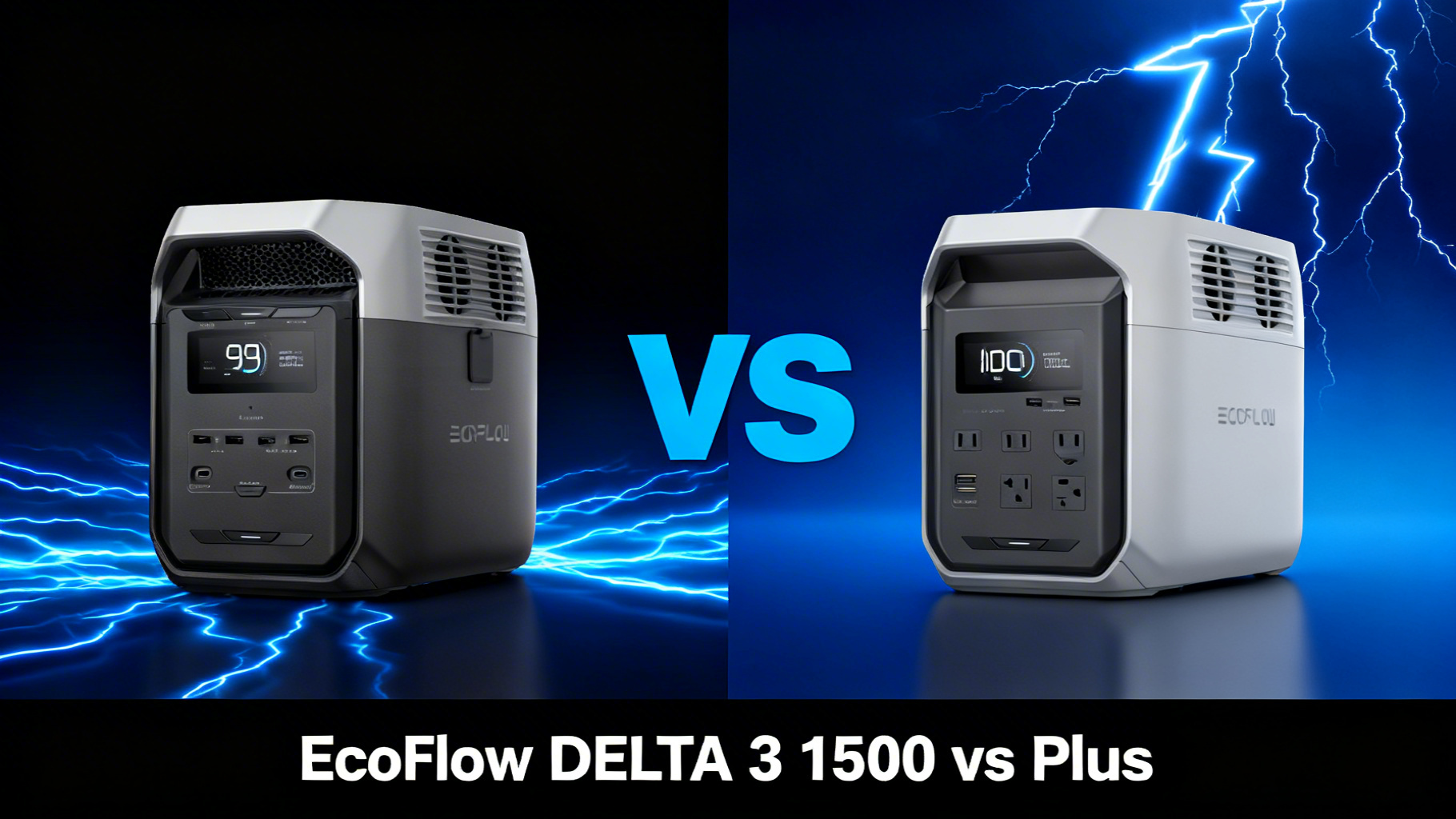
Choosing between the EcoFlow DELTA 3 1500 and the DELTA 3 Plus feels confusing at first. Both cost $599, both use LiFePO4 (LFP) battery chemistry, and both sit in EcoFlow’s mid-range DELTA 3 lineup. Yet they target very different priorities.
The DELTA 3 1500 packs 1,500Wh of capacity into a unit that weighs about 35.3 lbs (16 kg). The DELTA 3 Plus holds 1,024Wh but compensates with higher output power, a stronger surge rating, and dual solar inputs. Same price tag, different strengths.

Both of these units rank among the best portable power stations for 2026, but they serve different priorities. This comparison breaks down every spec that matters, from battery runtime and output power to charging speed and expandability, so you can pick the right one for your needs.
Spoiler: there’s no universal winner here. The right choice depends entirely on whether you value more stored energy or more raw output power.
EcoFlow DELTA 3 1500
$599 $1,099
- 1,500Wh LFP capacity, expandable to 5.5kWh
- 1800W output, 0-80% in 60 minutes
- IP54-rated with 10-year lifespan
Update (July 2026): EcoFlow has discontinued the DELTA 3 1500, and it is no longer sold by EcoFlow. Links for the DELTA 3 1500 now lead to its successor, the EcoFlow DELTA 3 Plus (1,024Wh capacity, 1,800W AC output rising to 2,200W with X-Boost and a 3,600W surge, priced at $569) — which happens to be the other unit compared here. This comparison stays live to help existing DELTA 3 1500 owners and anyone weighing remaining or secondhand stock.
At a Glance: Key Differences
Before diving into the details, here is a side-by-side snapshot of the specs that matter most. The numbers tell a clear story: the DELTA 3 1500 wins on capacity and protection, while the DELTA 3 Plus wins on output power and surge capability.

The key takeaway from this table is straightforward. At the same $599 price point, the DELTA 3 1500 gives you 46% more stored energy (1,500Wh vs 1,024Wh), an IP54 dust and water resistance rating, and a faster 15ms UPS switchover. The DELTA 3 Plus counters with X-Boost technology pushing effective output to 2,200W, a stronger 3,600W surge rating, and dual solar input ports for faster off-grid recharging.
For full specification details, you can check the official DELTA 3 1500 specifications and official DELTA 3 Plus specifications on EcoFlow’s website.
Battery Capacity and Runtime
This is where the DELTA 3 1500 pulls ahead decisively. With 1,500Wh of usable capacity compared to the DELTA 3 Plus’s 1,024Wh, you get roughly 46% more energy per charge cycle. At the same price, that’s a significant difference in value per watt-hour.
What does that mean for everyday use? Runtime calculations based on capacity show the gap clearly. A mini-fridge drawing 50W would run for approximately 25 hours on the DELTA 3 1500, compared to about 17 hours on the DELTA 3 Plus. A CPAP machine at 40W gets roughly 37 hours versus 25 hours. For weekend camping, that extra capacity can mean the difference between recharging once and not needing to recharge at all.
What Can the DELTA 3 1500 Power? (1,500Wh)
🔌
Mini Fridge
~25 hrs
50W
💡
LED Lights (5x)
~125 hrs
10W each
❄️
CPAP Machine
~37 hrs
40W
📱
Phone Charges
~100x
15Wh each
Both units use LiFePO4 chemistry with a rated 10-year lifespan and 5-year warranty. Battery longevity is essentially identical, so the deciding factor here is purely how much energy you get per charge.
Category winner: DELTA 3 1500. The 46% capacity advantage at the same price is hard to argue against.
To estimate runtime for your specific appliances, try our portable power station calculator.
Output Power and Ports
Both power stations share a base 1,800W continuous AC output rating. The difference shows up when you look beyond that base number.
The DELTA 3 Plus features EcoFlow’s X-Boost technology, which pushes effective continuous output to 2,200W for resistive loads. That means appliances like space heaters, hair dryers, and electric kettles that would trip the DELTA 3 1500’s inverter can run comfortably on the Plus. The surge rating tells a similar story: 3,600W on the Plus versus 2,700W on the 1500. High-inrush appliances like compressor-based refrigerators and power tools benefit from that extra headroom.

Keep in mind that X-Boost works best with resistive appliances. Motor-driven devices may not benefit as much. If your typical load stays under 1,800W, this advantage becomes less relevant.
Category winner: DELTA 3 Plus. The X-Boost to 2,200W and 3,600W surge give it a clear edge for powering demanding appliances.
Charging Speed Comparison
Charging speed data confirms these two units are closely matched, though the approach differs slightly. The DELTA 3 1500 reaches 0-80% in about 60 minutes via AC wall charging, which is impressive for a 1,500Wh battery. The DELTA 3 Plus hits 0-80% in roughly 56 minutes, but with a smaller 1,024Wh pack to fill.
Solar charging is where the DELTA 3 Plus has a structural advantage. It supports dual 500W MPPT inputs (up to 1,000W total solar), while the DELTA 3 1500 has a single 500W solar input. In practice, the Plus can charge significantly faster from solar panels alone. Both units also support alternator charging via the 800W EcoFlow Alternator Charger and multicharging (AC + solar simultaneously).
Category winner: Tie on AC charging, DELTA 3 Plus on solar. If solar charging speed matters to you, the Plus has a meaningful advantage with its dual MPPT ports.
Build Quality, Design, and Portability
The DELTA 3 1500 weighs approximately 35.3 lbs (16 kg), while the DELTA 3 Plus comes in at about 27.6 lbs (12.5 kg). That’s nearly 8 lbs of difference, which is noticeable when loading gear into a vehicle or carrying a unit to a campsite.
The more significant distinction is the DELTA 3 1500’s IP54 rating, which provides certified protection against dust ingress and water splashes. The DELTA 3 Plus does not carry an official IP rating. For outdoor use, especially in dusty or rainy conditions, that IP54 certification adds a layer of confidence the Plus cannot match.
Both units feature EcoFlow’s current design language with clean lines and integrated handles. The DELTA 3 Plus has a slightly more compact footprint thanks to its smaller battery pack, making it easier to fit in tight spaces like under a van seat or on a narrow shelf.
Category winner: DELTA 3 1500. The IP54 rating is a tangible advantage for anyone using their power station outdoors regularly. The weight penalty is the trade-off.
Expandability and Smart Features
Both power stations integrate with EcoFlow’s broader battery ecosystem, but the maximum expanded capacity differs. The DELTA 3 1500 expands up to 5.5kWh, while the DELTA 3 Plus tops out at 5kWh. Both are compatible with the DELTA 3 Extra Battery, DELTA 2 Extra Battery, DELTA 2 Max Extra Battery, and DELTA Pro 3 Extra Battery.
The DELTA 3 Plus adds compatibility with the 800W Alternator Charger via an XT150 output cable and the Smart Generator 3000 (Dual Fuel), giving it five distinct recharging methods. Both units support EcoFlow’s app for remote monitoring, time-of-use scheduling, and firmware updates.
On UPS performance, the DELTA 3 1500 switches to battery power in 15ms, compared to 20ms for the Plus. Both are fast enough for most electronics, but the 15ms switchover provides extra assurance for sensitive equipment like NAS drives or desktop computers.
Category winner: Close call, slight edge to DELTA 3 1500. Higher expanded capacity ceiling and faster UPS switchover tip the balance, though the Plus offers more charging method flexibility.
Winner by Use Case: Which Should You Buy?
Since the price is identical, the decision comes down to what you plan to power and where you plan to use it. If you are still unsure which specs matter most, our guide on how to choose a portable power station covers every key factor.
✅ Pick the DELTA 3 1500 if…
- You need maximum runtime per dollar (46% more Wh for the same price)
- Home backup and extended outage protection are your priority
- You want IP54 dust and water resistance for outdoor use
- Faster UPS switchover (15ms) matters for sensitive electronics
✅ Pick the DELTA 3 Plus if…
- You need higher surge power (3,600W vs 2,700W) for heavy appliances
- X-Boost to 2,200W gives you headroom for power-hungry tools
- You plan to expand via Alternator Charger or Smart Generator
- The more compact form factor suits your vehicle or storage
For Camping and Outdoor Adventures
Winner: DELTA 3 1500. The combination of 46% more capacity and IP54 weather protection makes this the stronger camping companion. You can run a mini-fridge, charge devices, and power LED lighting for a full weekend without worrying about recharging. The dust and splash resistance adds peace of mind in unpredictable weather.
Campers can also explore our ranked list of best power stations for camping for alternatives across every budget.
For Home Backup and Emergency Prep
Winner: DELTA 3 1500. More stored energy means longer runtime during outages. The 15ms UPS switchover keeps computers, routers, and medical equipment running without interruption. For a deeper look at whole-home solutions, see our roundup of home backup power stations.
For Van Life and RV Living
Winner: DELTA 3 Plus. Van lifers and RV owners often need to run high-draw appliances like induction cooktops, hair dryers, or space heaters. The 3,600W surge and X-Boost to 2,200W handle those loads more comfortably. The dual solar input ports are also a practical advantage when you rely heavily on solar charging. Plus, the lighter weight (27.6 lbs vs 35.3 lbs) matters in a space where every pound counts.
For Power Tools and Job Sites
Winner: DELTA 3 Plus. Power tools often have high startup surges that can trip an undersized inverter. The 3,600W surge rating and X-Boost capability provide the headroom needed for circular saws, compressors, and other demanding equipment.
For Best Overall Value
Winner: DELTA 3 1500. At $599 for 1,500Wh versus $599 for 1,024Wh, the math is simple. The DELTA 3 1500 delivers roughly $0.40 per Wh compared to $0.58 per Wh for the Plus. That is a 46% better energy-per-dollar ratio, making the DELTA 3 1500 the stronger value proposition for users who prioritize capacity over peak output power.

Final Verdict
The EcoFlow DELTA 3 1500 and DELTA 3 Plus are both capable, well-built power stations at an identical $599 price point. The data points to a clear pattern: if runtime, capacity, and weather resistance are your top priorities, the DELTA 3 1500 is the better buy. If you need to run high-wattage appliances, want faster solar recharging with dual inputs, or prefer a lighter unit, the DELTA 3 Plus makes more sense.
For most users, especially campers, home backup buyers, and anyone who values energy-per-dollar, our analysis leans toward the DELTA 3 1500. Getting 46% more capacity at the same price is a hard advantage to overlook. Note that the DELTA 3 1500 has been discontinued as of July 2026, so buying one now means sourcing remaining or secondhand stock; new purchases through the links above go to the DELTA 3 Plus instead. Both units belong in any discussion of the best portable power stations for 2026, but they belong there for different reasons.
EcoFlow DELTA 3 1500
$599
Best overall value: more capacity at the same price
See DELTA 3 Plus (successor) →
Price verified March 2026. Free shipping available
Frequently Asked Questions
Is the EcoFlow DELTA 3 1500 the same as the DELTA 3 Plus?
No. Despite costing the same ($599), the DELTA 3 1500 has a larger 1,500Wh battery, while the DELTA 3 Plus offers higher output power (2,200W with X-Boost) and a stronger 3,600W surge rating. They share LiFePO4 battery chemistry and a 5-year warranty, but they target different use cases. The DELTA 3 1500 prioritizes capacity and runtime, while the DELTA 3 Plus prioritizes output power and charging flexibility.
Which has better battery life, the DELTA 3 1500 or DELTA 3 Plus?
Both use LiFePO4 chemistry with a 10-year rated lifespan and 5-year warranty. In terms of cycle count and longevity, they are comparable. The key difference is capacity per charge: the DELTA 3 1500 holds 46% more energy (1,500Wh vs 1,024Wh), which means significantly longer runtime before you need to recharge.
Can I expand both the DELTA 3 1500 and DELTA 3 Plus with extra batteries?
Yes. The DELTA 3 1500 expands up to 5.5kWh, while the DELTA 3 Plus expands up to 5kWh. Both are compatible with the DELTA 3 Extra Battery, DELTA 2 Extra Battery, DELTA 2 Max Extra Battery, and DELTA Pro 3 Extra Battery. The DELTA 3 Plus also supports expansion via the Alternator Charger XT150 Output Cable for on-the-road charging flexibility.
Which EcoFlow DELTA 3 model is better for home backup?
The DELTA 3 1500 is the stronger home backup choice. Its larger 1,500Wh capacity provides more runtime during outages, and its faster 15ms UPS switchover offers better protection for sensitive electronics like computers, networking equipment, and medical devices compared to the Plus’s 20ms switchover.
Does the DELTA 3 1500 have X-Boost like the DELTA 3 Plus?
Based on available specifications, the DELTA 3 Plus supports X-Boost technology that pushes effective output to 2,200W, while the DELTA 3 1500 is rated at 1,800W continuous without X-Boost. If you regularly need to run appliances between 1,800W and 2,200W (such as hair dryers, space heaters, or electric kettles), the DELTA 3 Plus has the advantage in this specific area.
Related Reads
Originally published: March 22, 2026