
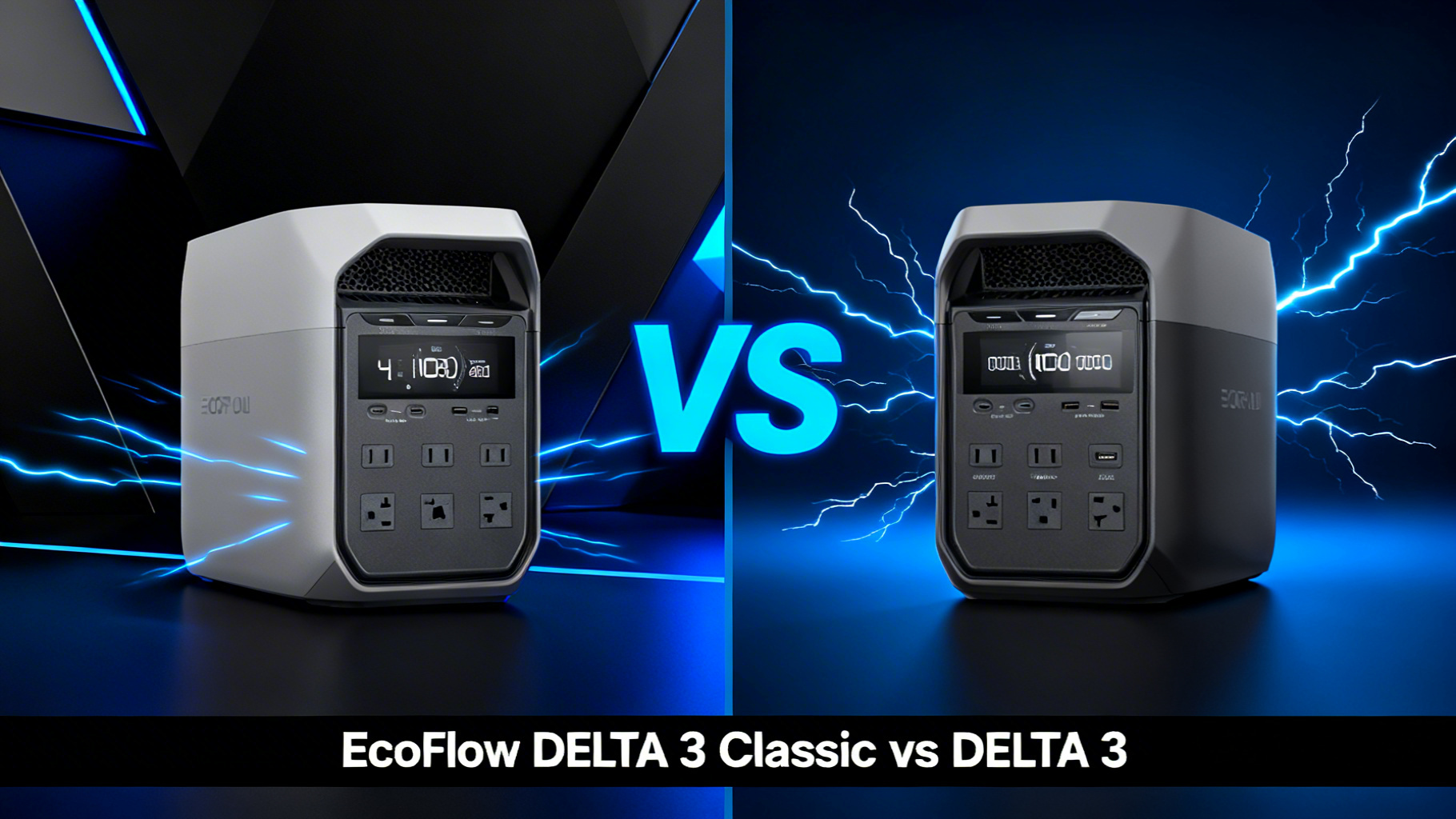
Choosing between two EcoFlow power stations that share the same 1,024Wh LiFePO4 battery and identical 1,800W AC output sounds like it should be simple. It isn’t. The EcoFlow DELTA 3 Classic launched on March 22, 2026 at $449, while the EcoFlow DELTA 3 sits at $499. That’s only a $50 gap, but the differences under the hood point these two models in very different directions.
The DELTA 3 Classic prioritizes value, raw output power, and the newest smart app features. The DELTA 3 bets on expandability and charging versatility. Which approach fits your needs better? That depends entirely on how you plan to use it, and whether your power demands might grow over time.


Spoiler: there’s no universal winner here. Our analysis breaks down every meaningful difference so you can pick the right one with confidence. Let’s get into it.
⚡ EcoFlow DELTA 3 Classic (1024Wh)
$449 $599 -25% OFF
- ✅ 1,800W output (3,600W surge) with X-Boost to 2,600W
- ✅ 0-80% AC recharge in just 45 minutes
- ✅ 10ms UPS auto-switch for critical devices
💡 Price checked March 2026 | Free shipping available
Comparing prices for Black Friday? Our EcoFlow Black Friday deals page tracks the live price of the DELTA 3 Classic, the DELTA 3 and every other EcoFlow model.
At a Glance: Key Differences
Before diving deeper, here’s what the spec sheets reveal side by side. These are the numbers that matter most when deciding between these two 1,024Wh siblings.
For full specifications, visit the official EcoFlow DELTA 3 Classic specs page and the official EcoFlow DELTA 3 product page.


The key takeaways from this table: both models deliver identical raw power output and battery capacity. The Classic wins on price, X-Boost ceiling, AC charge speed, and app features. The DELTA 3 wins on expandability and charging versatility. Everything else is a near-tie. The question is which advantages matter more for your specific use case.
Capacity and Battery Technology
Spec-for-spec, the DELTA 3 Classic and DELTA 3 share the same 1,024Wh LiFePO4 foundation. Both use lithium iron phosphate chemistry, which means longer cycle life and better thermal stability compared to standard lithium-ion cells. You’re looking at thousands of charge cycles before meaningful degradation, which is a significant upgrade over older NMC-based power stations.
Where they diverge slightly is in the cell architecture. The DELTA 3 Classic uses what EcoFlow calls automotive-grade full-tab LFP cells paired with an EV-grade CTC (cell-to-chassis) structure. This design, borrowed from electric vehicle manufacturing, offers improved protection against condensation and vibration during transport. EcoFlow rates the Classic for 10 years of reliable power.
The DELTA 3 uses standard LiFePO4 cells without the full-tab or CTC designations. In practice, both should deliver excellent longevity. The Classic’s upgraded cell construction may offer a small edge in durability for users who frequently transport their unit over rough terrain or store it in environments with temperature swings.
The bottom line on capacity: identical watt-hours, identical runtime. The Classic’s newer cell technology is a nice bonus, not a dealbreaker.
Ports, Output, and X-Boost Compared
Both models deliver 1,800W continuous AC output with a 3,600W surge capacity. That’s enough to handle most household appliances, from blenders to hair dryers. The surge rating means motor-driven devices like refrigerators and power tools can start up without tripping the system.

Here’s where it gets interesting. The DELTA 3 Classic supports X-Boost up to 2,600W, while the DELTA 3 caps out at 2,200W. X-Boost is EcoFlow’s technology that lets the power station run devices above its rated output by intelligently reducing voltage. With 2,600W of X-Boost headroom, the Classic can handle heavier appliances like microwaves and larger space heaters that the DELTA 3 might struggle with.

Is the 400W X-Boost difference a big deal? For most users, probably not. Both models handle laptops, mini-fridges, CPAP machines, and standard kitchen appliances without issue. But if you plan to run high-draw devices regularly, the Classic’s higher ceiling provides a meaningful safety margin.
Charging Speed and Methods
This is one of the clearest areas of differentiation between these two models. The DELTA 3 Classic charges from 0-80% in just 45 minutes via AC wall outlet. That’s among the fastest charge times in the 1kWh category, and it means you can top off the unit during a lunch break before heading out.

The Classic offers 4 charging methods: AC, solar, car charger, and USB-C. Solid, and sufficient for most use cases. The DELTA 3, however, steps up to 5 charging methods: AC, solar, an 800W alternator charger, Smart Generator 3000 (dual fuel) compatibility, and multicharging (simultaneous sources). That alternator charging option is a standout feature for RV owners and van lifers who want to charge while driving. Multicharging lets you combine sources for faster recharge times in the field.
The short answer: the Classic charges faster from a wall outlet. The DELTA 3 gives you more ways to charge, especially off-grid. If you’re primarily charging at home or at campsites with power hookups, the Classic’s speed advantage is more relevant. If you’re frequently on the road or far from outlets, the DELTA 3’s versatility wins.
EcoFlow DELTA 3 (1024Wh)
$499 $699
Expandable 1-5kWh, 5 charging methods, 5-year warranty
Expandability and Future-Proofing
This is the single biggest differentiator between these two models, and it’s not close.

The DELTA 3 Classic is a standalone unit. No expansion port, no extra battery compatibility. What you buy is what you get: 1,024Wh, period. For many users, that’s perfectly fine. Weekend campers and occasional backup users rarely need more than 1kWh.
The DELTA 3 expands from 1kWh to 5kWh using compatible extra batteries: the DELTA 3 Extra Battery, DELTA Pro 3 Extra Battery, DELTA 2 Extra Battery, or DELTA 2 Max Extra Battery. That’s a massive range. If your power needs grow over time (moving from weekend camping to full-time van life, for example), you can scale up without replacing your base unit.
Analysis shows the $50 price difference essentially buys one critical upgrade: the ability to scale. If there’s any chance you’ll need more than 1,024Wh down the road, the DELTA 3’s expansion ecosystem is worth the premium.
Smart Features and App Control
The DELTA 3 Classic ships with EcoFlow’s newest platform: OASIS 3.0. This app connects via WiFi and Bluetooth and offers a dashboard to monitor real-time battery status, electricity prices, and energy savings. Two standout features: Storm Guard Mode automatically activates backup power before extreme weather hits, and Self-Powered Mode with Scheduled Tasks helps optimize daily energy costs.
The DELTA 3 uses the standard EcoFlow App with WiFi and Bluetooth connectivity. It handles the basics well (monitoring, firmware updates, power management), but it doesn’t include the newer Storm Guard or Self-Powered features.
For home backup users in particular, Storm Guard Mode is a compelling addition. It turns the Classic into a proactive backup system rather than a reactive one. If smart home integration matters to you, the Classic has the edge here.
Runtime and Real-World Performance
Since both models share the same 1,024Wh capacity, runtime is identical. The power station doesn’t care whether it’s a Classic or standard DELTA 3; watts in, watts out. Here’s what the capacity data translates to in practical terms.
What Can Both Models Power? (1,024Wh Shared Capacity)
🔌
Mini Fridge
~17 hrs
60W avg
💡
LED Lights (5x)
~85 hrs
12W each
💻
Laptop
~14 charges
70Wh battery
📱
Phone Charges
~65 charges
~15Wh each
Use our power station calculator tool to estimate exactly how long either model will power your specific appliances. These numbers assume typical inverter efficiency around 85-90%, so real-world results may vary slightly depending on ambient temperature and load patterns.
One area where the Classic has a confirmed advantage: noise levels at or below 30dB at 600W output. That’s whisper-quiet, comparable to a library. EcoFlow hasn’t published a specific dB figure for the DELTA 3 at 600W, though it’s expected to perform similarly. If silent operation matters (think: CPAP use while sleeping, or indoor home backup), the Classic’s verified spec provides more certainty.
Who Should Buy Which?
If you’re still unsure about which capacity tier fits your lifestyle, our guide on how to choose a portable power station breaks down the key decision factors. For this comparison, here’s how each model fits specific scenarios.
🏷️ DELTA 3 Classic ($449)
✅ Buy this if…
- You want the lowest price for 1,024Wh capacity
- You need 2,600W X-Boost for high-draw appliances
- Ultra-quiet operation (≤30dB) matters to you
- You want the latest OASIS 3.0 app with Storm Guard
- You do not need capacity expansion beyond 1kWh
❌ Skip this if…
- You may need more than 1,024Wh in the future
- You want alternator or smart generator charging
- Multi-day off-grid trips require expandable capacity
⚡ DELTA 3 ($499)
✅ Buy this if…
- You want the option to expand to 5kWh later
- 800W alternator charging matters (RV, van life)
- You need Smart Generator 3000 compatibility
- Multi-charging (simultaneous sources) is important
- Future-proofing justifies the $50 premium
❌ Skip this if…
- Budget is your top priority and 1kWh is enough
- You do not plan to buy extra batteries
- You prefer the newer OASIS 3.0 app features
Best for Budget-Conscious Buyers: DELTA 3 Classic
At $449 (down from $599), the Classic delivers one of the best price-to-capacity ratios in the 1kWh segment. You’re getting the same core performance as the DELTA 3 for $50 less, with a higher X-Boost ceiling and a newer app platform. If 1,024Wh covers your needs and you don’t anticipate expansion, there’s no reason to pay more.
Best for RV and Van Life: DELTA 3
The 800W alternator charger compatibility is the standout feature for mobile users. Charge your power station while driving, and combine it with solar for truly self-sufficient road trips. The expansion to 5kWh also matters here: van lifers often discover their power needs grow after a few months on the road.
Best for Home Backup Starter: DELTA 3 Classic
The Classic’s 10ms UPS auto-switch keeps NAS systems, servers, and modems running during outages. Combined with Storm Guard Mode (which automatically activates backup before severe weather), it’s a strong entry point for home backup. For heavier home backup needs beyond 1,024Wh, explore our dedicated home backup power solutions guide.
Best for Future Expansion: DELTA 3
This is the DELTA 3’s strongest selling point. If you think there’s even a moderate chance you’ll want more capacity in the next 2-3 years, the $50 premium is easy to justify. Starting at 1kWh and scaling to 5kWh as needs grow is far more cost-effective than replacing your entire unit later.
Best for Camping Weekends: DELTA 3 Classic
For 2-3 day camping trips, 1,024Wh is typically plenty. The Classic’s faster AC charge speed means you can top off quickly before leaving, and the whisper-quiet operation (≤30dB) won’t disturb your campsite or tent neighbors. Campers looking for lighter alternatives can also check our list of the best power stations for camping.
Final Verdict
The data reveals a clear pattern: the DELTA 3 Classic prioritizes value, raw output, and cutting-edge software, while the DELTA 3 bets on expandability and charging flexibility. There’s no wrong choice here, only a choice that’s more or less aligned with your specific needs.
Choose the DELTA 3 Classic ($449) if you want the best price-to-performance ratio, the newest OASIS 3.0 app, higher X-Boost output (2,600W), and you’re confident that 1,024Wh is enough for your use cases.
Choose the DELTA 3 ($499) if you value the option to expand to 5kWh, need alternator or smart generator charging for mobile use, or simply want the peace of mind that comes with a scalable system.
The $50 gap is small. The expandability gap is not. That’s what your decision should hinge on. Both models also rank among our picks for the best portable power stations of 2026.
Frequently Asked Questions
Is the EcoFlow DELTA 3 Classic the same as the DELTA 3?
No. While both share a 1,024Wh LiFePO4 battery and 1,800W AC output, the DELTA 3 Classic is a newer, more affordable model ($449 vs $499) with a higher X-Boost ceiling (2,600W vs 2,200W) and the newer OASIS 3.0 app. However, the DELTA 3 supports expandability up to 5kWh and offers five charging methods compared to four on the Classic.
Can the DELTA 3 Classic be expanded with extra batteries?
No. The DELTA 3 Classic is a standalone unit with no expansion port. If you anticipate needing more than 1,024Wh in the future, the DELTA 3 ($499) supports expansion to 5kWh using DELTA 3 Extra Battery, DELTA Pro 3 Extra Battery, DELTA 2 Extra Battery, or DELTA 2 Max Extra Battery.
Which EcoFlow DELTA 3 model charges faster?
The DELTA 3 Classic charges from 0-80% in approximately 45 minutes via AC, making it the faster option. The DELTA 3 offers more charging methods (including 800W alternator and Smart Generator 3000 compatibility) but does not match the Classic’s confirmed 45-minute AC charge speed.
Is the DELTA 3 Classic worth the $50 savings over the DELTA 3?
It depends on your needs. The Classic saves $50 and delivers a higher X-Boost ceiling (2,600W), faster AC charging, and the newer OASIS 3.0 app. The DELTA 3 justifies its $50 premium if you value expandability (up to 5kWh), alternator charging for RV or van life, or multicharging capability.
Does the DELTA 3 Classic support solar charging?
Yes. The DELTA 3 Classic supports solar charging as one of its four charging methods (AC, Solar, Car, USB-C). Pair it with EcoFlow’s compatible solar panels for off-grid use.
Related Reads
Originally published: March 22, 2026