
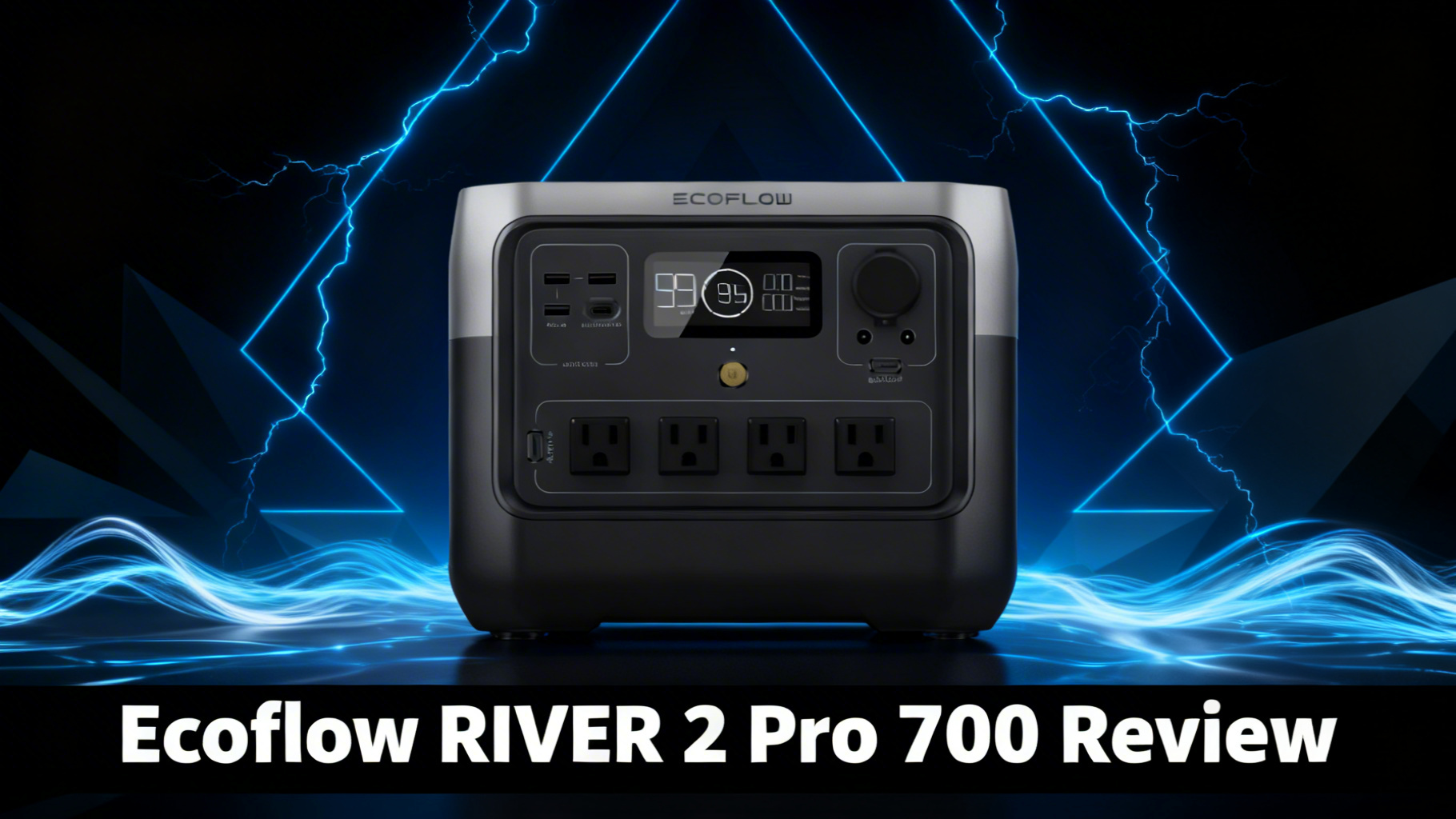
Looking for a mid-range portable power station with fast charging and long-term reliability? The EcoFlow RIVER 2 Pro 700 sits quietly alongside the standard RIVER 2 Pro, and most buyers don’t even know it exists. That’s a problem, because this “700” variant brings a few subtle changes that could tip the scales for certain users.
Priced at $379 (down from $549 MSRP), the RIVER 2 Pro 700 packs a 716Wh LFP battery, 800W continuous output with X-Boost to 1,600W, and a headline-grabbing 70-minute full recharge. It’s lighter than the standard Pro by a full pound, carries a TUV Rheinland safety certification, and includes smart app control via Bluetooth and Wi-Fi.

Our analysis covers every angle: capacity, charging speeds, real-world runtime estimates, build quality, and a head-to-head comparison with the standard RIVER 2 Pro (768Wh). For a broader look at where the RIVER 2 Pro 700 sits in the EcoFlow ecosystem, see our best EcoFlow power stations ranked guide. Here’s what the data reveals.
⚡ Current Best Price
EcoFlow RIVER 2 Pro (700)
$379 $549 -31% OFF
- 716Wh LFP battery, 10-year lifespan
- 800W output (1600W X-Boost surge)
- Full recharge in just 70 minutes
Price verified March 2026 | Free shipping available
Quick Specs & Key Features
Before diving into performance analysis, here’s a complete look at what the EcoFlow RIVER 2 Pro 700 brings to the table. The spec sheet tells a clear story: this is a mid-range unit built for speed and longevity rather than raw capacity.
A few features stand out immediately. The LFP (LiFePO4) battery chemistry rated for 3,000+ cycles means this unit should retain 80% of its original capacity after roughly 10 years of daily use. The 70-minute AC recharge is among the fastest in the mid-range segment. And EcoFlow’s X-Boost technology lets the 800W inverter handle appliances drawing up to 1,600W by intelligently reducing voltage, covering about 80% of typical household devices.

For full specifications directly from the manufacturer, visit the official EcoFlow RIVER 2 Pro 700 specs page.
What We Love About the RIVER 2 Pro 700
Blazing-Fast 70-Minute AC Recharge
Charging speed is where the RIVER 2 Pro 700 genuinely impresses. Charge time data confirms a 0-100% fill in approximately 70 minutes via a standard AC wall outlet. In the mid-range power station category (500-800Wh), that’s one of the fastest recharge times available. For context, many competitors in this price range take 3-5 hours to reach full capacity.
What does this mean in practice? You can plug in the RIVER 2 Pro 700 during a lunch break and head out with a full battery. For road trippers stopping at a campsite with shore power, it goes from empty to fully charged faster than most people can set up their tent.
LFP Battery With 10-Year Rated Lifespan
The LFP (lithium iron phosphate) battery chemistry is the real story here. With a rated lifespan of 3,000+ cycles to 80% capacity, the math works out to roughly a decade of daily charging. That’s a significant upgrade over the older lithium-ion NMC cells found in budget models, which typically last 500-800 cycles before noticeable degradation.
The RIVER 2 Pro 700 also holds the distinction of being the first power station in its class to earn a TUV Rheinland safety certification. That third-party verification adds a layer of confidence, particularly for buyers who plan to use this unit indoors or near sleeping areas.
X-Boost Technology Extends Reach to 1,600W
On paper, 800W of continuous output might sound limiting. But EcoFlow’s X-Boost mode intelligently manages voltage to let the RIVER 2 Pro 700 handle appliances with rated wattages up to 1,600W. According to EcoFlow’s data, that covers roughly 80% of common home appliances.
Keep in mind that X-Boost works by slightly reducing voltage, so appliances may run a bit slower (a hair dryer on lower heat, for example). It won’t turn this into a 1,600W powerhouse, but it dramatically widens the range of devices you can plug in during an emergency or camping trip.
Smart App Control (Bluetooth + Wi-Fi)
The EcoFlow app provides real-time monitoring of input/output wattage, battery percentage, and estimated remaining runtime. You can also adjust charging speeds, set custom AC output frequencies, and update firmware, all from your phone. Bluetooth handles nearby connections, while Wi-Fi allows remote monitoring when the unit is plugged in at home as a backup.

What Could Be Better
716Wh Is Slightly Less Than the Standard Pro (768Wh)
Here’s the thing: the “700” variant actually has 52Wh less capacity than the standard RIVER 2 Pro (768Wh). That’s roughly a 7% difference. In practical terms, it translates to maybe 30-45 minutes less runtime on a mini-fridge, or one fewer full laptop charge. Not dramatic, but worth noting, especially since the 700 costs $40 more.
800W Continuous Output Caps High-Draw Devices
Even with X-Boost, the RIVER 2 Pro 700 can’t comfortably run space heaters, large microwaves (above 1,600W), or full-size hair dryers at maximum settings. If your use case involves powering high-wattage appliances regularly, the 800W continuous rating will feel restrictive. Units in the 1,200-2,000W range (like the EcoFlow DELTA series) are better suited for those demands.
No Expansion Battery Option
Unlike the DELTA series, the RIVER 2 Pro line does not support expansion batteries. What you see is what you get: 716Wh, no more. If you anticipate your power needs growing over time, this lack of expandability could become a limitation. A recurring pattern in owner feedback highlights this as the single biggest frustration for users who later wished they had more capacity.

Real-World Runtime Estimates
Runtime calculations based on the 716Wh capacity and typical inverter efficiency (around 85%) give a clear picture of what this unit can handle. For personalized estimates based on your exact appliances, try our runtime calculator tool.
What Can It Power? (716Wh)
❄️
Mini-Fridge
~10 hrs
60W avg
💻
Laptop
~10 charges
65W avg
📱
Smartphones
~50 charges
~14Wh each
💡
LED Lights
~60 hrs
10W avg
These numbers assume standard operating conditions and account for the inverter’s conversion losses. Actual runtime will vary depending on ambient temperature, device efficiency, and whether you’re running multiple appliances simultaneously. The key takeaway: 716Wh is solidly in “weekend trip” territory for most users, but falls short for multi-day off-grid excursions without a solar panel to top up.


RIVER 2 Pro 700 vs RIVER 2 Pro (768Wh): What Changed?
The existence of two RIVER 2 Pro models creates understandable confusion. Spec-for-spec comparison shows that the differences are real but modest. Let’s break them down.

The data paints a nuanced picture. The 700 variant is 1 pound lighter (17.2 lbs vs 18.2 lbs) but has 52Wh less capacity and costs $40 more. Everything else, the 800W output, 70-minute recharge, LFP chemistry, EPS auto-switch, and app control, is identical between both models.
So is the 700 an upgrade or a sidegrade? Analysis points to the latter for most buyers. The weight savings is nice but marginal. The capacity reduction is small but measurable. And the $40 price premium only makes sense if you catch the 700 on a deeper discount or genuinely value every ounce shaved off your pack weight. Buyers torn between generations should check our full RIVER 2 vs RIVER 3 comparison for a deeper analysis. Also see our RIVER 2 vs RIVER 2 Pro breakdown.
Who Should Buy the RIVER 2 Pro 700
✅ Buy this if…
- You need a reliable mid-range power station for weekend camping
- Fast 70-minute AC recharge is a priority over raw capacity
- You want LFP battery longevity (3,000+ cycles) for long-term value
- App control and EPS auto-switch matter for your home office setup
❌ Skip this if…
- You need 1,000W+ sustained output for high-draw appliances
- Battery expandability is important (no expansion battery option)
- The standard RIVER 2 Pro (768Wh, $339) already meets your needs at $40 less
Weekend Campers & Road Trippers
If your typical trip lasts 1-2 days, the 716Wh capacity handles the essentials comfortably: phone charging, LED lighting, a portable fan, and even a mini-fridge overnight. The fast 70-minute AC recharge means you can top up quickly between stops or at a campsite with shore power. At 17.2 lbs, it’s manageable for car camping, though backpackers will want something lighter. Campers who want to compare more options can explore our best power stations for camping roundup.
Home Office Backup Users
The <30ms EPS (Emergency Power Supply) auto-switch is the standout feature for this use case. When utility power drops, the RIVER 2 Pro 700 seamlessly switches to battery power fast enough that your desktop computer, monitor, and router won’t skip a beat. Based on typical home office power draws (150-250W for a full desktop setup), the 716Wh capacity provides roughly 2.5-4 hours of backup, enough to save your work and ride out most outages.
Buyers Who Prioritize Safety Certifications
The TUV Rheinland certification and LFP battery chemistry combine to make this one of the safer portable power stations in its class. LFP cells are inherently more thermally stable than NMC alternatives, and the third-party safety certification adds verification that the internal battery management system meets rigorous standards. For buyers who plan to keep this unit near their bed (CPAP users) or in enclosed spaces (van life), that matters.

Who Should Skip It
Full-Time Off-Grid or Van Life Users
If you’re living off-grid or spending weeks at a time in a van, 716Wh won’t sustain your daily power consumption without frequent recharging. Even with a 220W solar panel, you’re limited to roughly 1.8kWh per day of solar generation in ideal conditions. Full-time van lifers typically need 1,000Wh or more of battery capacity, ideally with expansion options. Our best EcoFlow for van life guide covers higher-capacity options.
Buyers Who Need High-Wattage Output (1,000W+)
The 800W continuous output, even with X-Boost extending the effective range to 1,600W, won’t reliably handle sustained high-draw appliances like space heaters, full-size microwaves, or large power tools. If those are in your regular use case, look at the EcoFlow DELTA 3 (1,024Wh, 1,800W output) or similar units with higher inverter ratings.
Budget Shoppers Eyeing the Standard RIVER 2 Pro
This is the most important consideration. The standard RIVER 2 Pro at $339 gives you 52Wh more capacity for $40 less. Unless the 1-pound weight savings is critical for you, or the 700 variant is available at a steeper promotional discount, the standard Pro represents better overall value for most buyers.
Frequently Asked Questions
What is the difference between the EcoFlow RIVER 2 Pro 700 and the standard RIVER 2 Pro?
The RIVER 2 Pro 700 has a slightly smaller 716Wh battery compared to 768Wh in the standard model. It is also about 1 pound lighter (17.2 lbs vs 18.2 lbs). The 700 variant is priced at $379 versus $339 for the standard. Core features like 800W output, 70-minute recharge, LFP chemistry, and app control are identical across both models.
How long does the RIVER 2 Pro 700 take to fully charge?
The RIVER 2 Pro 700 reaches a full charge from 0% in approximately 70 minutes via AC wall outlet. Solar charging depends on panel wattage: with a 220W panel in ideal conditions, expect around 3.5 to 4 hours. Car charging takes approximately 8 hours.
Can the RIVER 2 Pro 700 power a CPAP machine?
Yes. Based on typical CPAP power consumption of 30-60W, the 716Wh battery can sustain a CPAP machine for approximately 10-20 hours on a single charge. The <30ms EPS auto-switch also provides uninterrupted power during a utility outage, so your therapy won’t be interrupted if the grid goes down overnight.
What solar panels are compatible with the RIVER 2 Pro 700?
The RIVER 2 Pro 700 supports up to 220W of solar input. Compatible panels include the EcoFlow 220W Portable Solar Panel, the 160W panel, and most third-party solar panels with XT60 or MC4 connectors (with adapter). For optimal efficiency, a single 200-220W panel is recommended. To understand panel wiring options, read our series vs parallel solar panel guide.
Does the RIVER 2 Pro 700 have an expansion battery?
No. Unlike the DELTA series, the RIVER 2 Pro line does not support expansion batteries. If you anticipate needing more than 716Wh, consider the EcoFlow DELTA 3 (1,024Wh) or the DELTA 2 Max (2,048Wh) for significantly more capacity.
Is the EcoFlow RIVER 2 Pro 700 worth the $40 premium over the standard RIVER 2 Pro?
For most users, the standard RIVER 2 Pro at $339 offers better value with 52Wh more capacity and a lower price. The 700 variant makes sense primarily if you prioritize the 1-pound weight savings or if it is available at a promotional price that closes the gap. Both units share the same core technology and performance characteristics.
Final Verdict: Is the RIVER 2 Pro 700 Worth $379?
EcoFlow RIVER 2 Pro (700): Overall Rating
8.0/10
“A solid mid-range LFP power station with blazing-fast recharge”
Capacity & Output 7.5/10
Charging Speed 9.5/10
Portability 8.0/10
Build Quality 8.5/10
Value for Money 7.5/10
Features & App 8.0/10
The EcoFlow RIVER 2 Pro 700 is a capable, well-built mid-range portable power station. Its strengths are clear: the 70-minute AC recharge is class-leading, the LFP battery with 3,000+ cycles offers genuine long-term value, and the TUV Rheinland certification provides peace of mind that few competitors can match at this price point.
Where it falls short is equally clear. The 716Wh capacity is slightly less than the standard RIVER 2 Pro (768Wh), the 800W continuous output limits high-draw applications, and the lack of an expansion battery means you can’t grow with this unit. At $379, it also sits $40 above its sibling that offers more capacity.
Based on our analysis, the RIVER 2 Pro 700 is best suited for weekend campers, road trippers, and home office backup users who value fast recharging and battery longevity above raw capacity. If you need expandability or high-wattage output, look at the DELTA series instead. And if the standard RIVER 2 Pro at $339 meets your needs, that remains the better value proposition for most buyers.
EcoFlow RIVER 2 Pro (700)
$379
Best mid-range portable power station under $400
Price verified March 2026 | Free shipping available
Originally published: March 22, 2026