
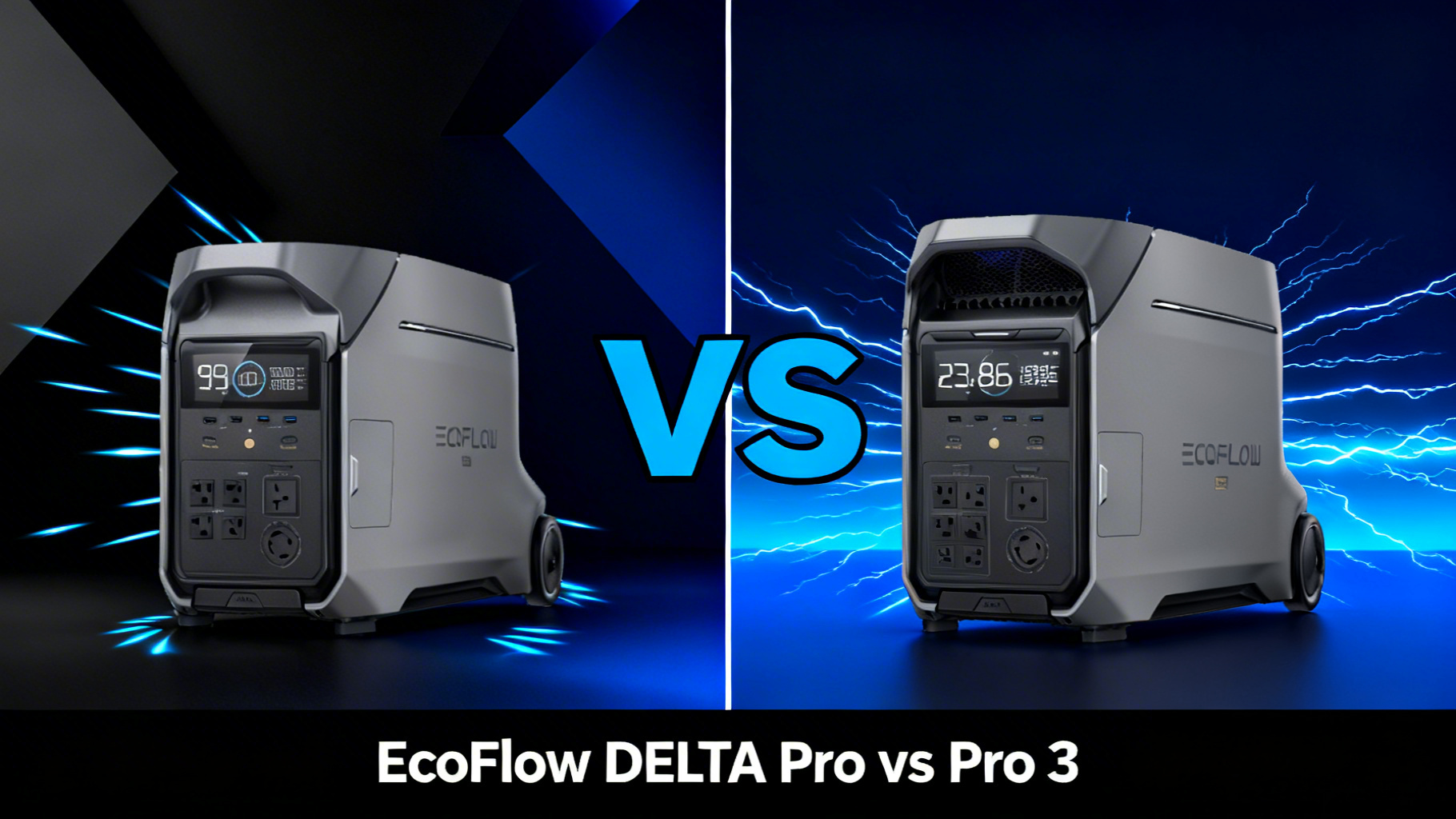
Choosing between the EcoFlow DELTA Pro and the DELTA Pro 3 can feel overwhelming. Both are flagship-level home backup power stations from the same brand, both use LFP battery chemistry, and both promise expandable whole-home coverage. So what actually separates a $1,599 proven workhorse from a $1,999 next-gen contender?
The short answer: more than you might expect. The EcoFlow DELTA Pro 3 brings built-in 240V output, drastically faster charging, and a higher cycle count. The original DELTA Pro counters with a lower price tag, exclusive EV station charging, and years of proven reliability data. Neither is universally “better,” and the right pick depends entirely on your use case.


In this EcoFlow DELTA Pro vs DELTA Pro 3 comparison, we’ll break down battery capacity, output power, charging speed, lifespan, home integration, and value. By the end, you’ll know exactly which EcoFlow power station fits your situation.
EcoFlow DELTA Pro 3
$1,999 $3,699
- 4,000W output (6,000W X-Boost), 120V/240V
- 4-48kWh expandable capacity, UL9540 certified
- 0-80% in 50 minutes, 4,000 cycle LFP battery
At a Glance: DELTA Pro vs DELTA Pro 3
Before diving into the details, here’s a side-by-side snapshot of every EcoFlow DELTA Pro 3 spec compared to the original. The checkmarks highlight where each model holds an advantage.
A few key takeaways jump out immediately. The DELTA Pro 3 wins on raw performance across most categories: more capacity, higher continuous output, built-in 240V, faster charging, and a longer-lasting battery. The DELTA Pro fights back on price ($400 less), exclusive EV station charging, and a mature ecosystem with years of real-world owner data behind it.
Is the EcoFlow DELTA Pro worth it at $400 less, or does the DELTA Pro 3 price justify the upgrade? That depends on which specs actually matter to your setup. Let’s break it down category by category.
Battery Capacity & Runtime
The DELTA Pro packs 3,600Wh of usable capacity. The DELTA Pro 3 bumps that to 4,000Wh, an 11% increase. On paper, the difference looks modest. In practice, that extra 400Wh translates to several additional hours of runtime for lower-draw appliances.
Where the gap widens is expandability. The DELTA Pro scales from 3.6kWh up to 25kWh using DELTA Pro Smart Extra Batteries. The DELTA Pro 3 starts at 4kWh and can reach a massive 48kWh, nearly double the original’s ceiling. If you’re planning a multi-day EcoFlow DELTA Pro whole home backup system, that difference is significant.
Runtime calculations based on the DELTA Pro 3’s 4,000Wh capacity paint a clear picture of what you can expect.
What Can the DELTA Pro 3 Power? (4,000Wh)
🔌
Mini Fridge
~50 hrs
60W
💡
LED Lights (10x)
~333 hrs
12W each
❄️
Window AC
~3.3 hrs
1,200W
📱
Phone Charges
~266x
15Wh each
For the DELTA Pro at 3,600Wh, reduce those numbers by roughly 10%. The runtime difference is noticeable but not dramatic for single-appliance scenarios. It becomes more meaningful when you’re powering multiple devices simultaneously during an outage.
Want exact runtime numbers for your specific appliances? Try our portable power station runtime calculator.
Output Power & 240V Capability
This is where the EcoFlow Pro vs Pro 3 comparison diverges sharply. The DELTA Pro delivers 3,600W continuous output with a 7,200W surge when two units are paired together. It runs on 120V only. If you need 240V (required for central AC, electric dryers, and well pumps), you’ll need two DELTA Pro units plus EcoFlow’s Double Voltage Hub, an additional $139 accessory.
The DELTA Pro 3 simplifies this entirely. A single unit delivers 4,000W continuous output with X-Boost technology pushing up to 6,000W. More importantly, it outputs both 120V and 240V from one unit, no accessories required. That means a single DELTA Pro 3 can power a 3-ton central AC system, something the original DELTA Pro simply cannot do alone.


For homeowners whose primary concern is running central air during a power outage, the DELTA Pro 3 is the clear choice for EcoFlow DELTA Pro home backup. You save the cost of a second unit ($1,599) and the Double Voltage Hub ($139), making the $400 premium essentially irrelevant in that scenario.
Charging Speed Comparison
Charging speed is one of the starkest differences between these two models. The DELTA Pro reaches full charge in approximately 2.7 hours via standard AC wall outlet, using EcoFlow’s MultiCharge technology that peaks at 6,500W input. That’s fast by industry standards, but the DELTA Pro 3 makes it look slow.
The DELTA Pro 3 charges from 0 to 80% in just 50 minutes via AC. For time-sensitive scenarios (storm rolling in, outage expected), that speed difference is substantial. Getting to 80% capacity in under an hour means you can prepare for an outage with very little lead time.

However, the DELTA Pro has an exclusive trick: EV station charging. With the optional EV X-Stream Adapter ($99), you can recharge at thousands of Level 2 EV charging stations worldwide, reaching full in about 1.7 hours. For RV travelers and overlanders, this is a genuine advantage. The DELTA Pro 3 does not support EV station charging.
Both units support solar charging, though exact solar input rates depend on panel configuration and conditions.
Battery Lifespan & Long-Term Value
Both models use LFP (lithium ferro-phosphate) battery chemistry, the gold standard for longevity in portable power stations. Unlike older lithium-ion NMC cells that degrade faster under heavy cycling, LFP chemistry prioritizes lifespan and thermal stability over energy density. The DELTA Pro is rated for 3,000+ cycles to 80% capacity, which EcoFlow translates to roughly 10 years of typical use. That’s a solid number.
The DELTA Pro 3 pushes further with EV-grade LFP cells rated for 4,000 cycles to 80% capacity. That’s a 33% improvement in total lifespan, meaning more years of reliable service before noticeable degradation.
From a cost-per-cycle perspective, the EcoFlow DELTA Pro 3 price of $1,999 across 4,000 cycles comes to approximately $0.50 per cycle. The DELTA Pro at $1,599 across 3,000 cycles works out to roughly $0.53 per cycle. Over the full lifespan of each battery, the DELTA Pro 3 actually delivers slightly better value despite the higher upfront cost.
On a price-per-Wh basis, the DELTA Pro comes in at $0.44/Wh ($1,599 / 3,600Wh), while the DELTA Pro 3 sits at $0.50/Wh ($1,999 / 4,000Wh). The original DELTA Pro wins on initial cost efficiency, but the longer cycle life of the DELTA Pro 3 narrows that gap over time.
Home Integration & Smart Features
Both power stations integrate with EcoFlow’s Smart Home Panel, allowing you to connect directly to your home’s electrical circuits for automatic backup during outages. Both also support transfer switch connections for automatic failover. Our transfer switch installation guide walks through the entire process.

The DELTA Pro 3 holds two important advantages here. First, it carries UL9540 certification, a safety standard for energy storage systems that some municipalities and insurance providers are beginning to require for indoor residential installations. The original DELTA Pro does not have this certification.
Second, the DELTA Pro 3 supports pass-through charging at 4,000W continuous output, meaning it can charge and deliver full power simultaneously without throttling. The DELTA Pro also supports pass-through charging, but owner reports suggest output can fluctuate under heavy simultaneous loads.
For the full EcoFlow DELTA Pro 3 specs breakdown, you can review the official DELTA Pro 3 specifications and the official DELTA Pro product page on EcoFlow’s website.
Portability & Design
Neither of these units qualifies as “portable” in the traditional sense. Both are large, heavy power stations designed primarily for stationary or semi-stationary use. The DELTA Pro weighs in at approximately 99 lbs, while the DELTA Pro 3 is similarly hefty.

Both models feature wheels and telescoping handles for transport, a practical necessity at this weight class. The DELTA Pro 3 features a slightly updated handle design with improved ergonomics. Keep in mind that “portable” here means “movable,” not “carry in one hand.” These are serious power stations designed to sit in your garage, RV bay, or utility closet.
For permanent or semi-permanent installations (garage, RV, home backup closet), weight is essentially irrelevant. For occasional transport between a home and a cabin, or loading into a truck bed, expect a two-person lift or a sturdy cart. The wheels help on flat surfaces, but stairs are a challenge with either model.
Who Should Buy Which? Winner by Use Case
There’s no universal winner in this EcoFlow DELTA Pro vs Pro 3 matchup, and that’s actually good news. It means both products serve distinct audiences well. Both units qualify as serious home backup candidates, and our home backup power station guide covers all the essentials.
✅ Buy the DELTA Pro 3 if…
- You need built-in 240V for central AC or large appliances
- Fast recharge matters (0-80% in 50 min vs 2.7 hours)
- You want UL9540 safety certification for home integration
- Maximum expandability (up to 48kWh) is a priority
💰 Buy the DELTA Pro if…
- Budget is your primary concern (save $400)
- You want EV station charging capability (exclusive feature)
- The proven 3+ year track record matters to you
- 3,600Wh base capacity meets your needs already
Home Backup (Full House)
Winner: DELTA Pro 3. Built-in 240V from a single unit is a decisive advantage for EcoFlow DELTA Pro whole home backup. Running central air conditioning, electric dryers, and other 240V appliances without buying a second unit and a Double Voltage Hub changes the cost equation entirely.
Home Backup (Essentials Only)
Winner: DELTA Pro (value). If you’re powering a fridge, lights, phone chargers, and a Wi-Fi router during outages, the DELTA Pro’s 3,600Wh capacity and 3,600W output handle all of that comfortably. The $400 savings make more sense when you don’t need 240V capability.
RV & Overlanding
Winner: DELTA Pro. The exclusive EV station charging feature is a practical advantage on the road. Being able to top up at any Level 2 charging station adds flexibility that the DELTA Pro 3 simply can’t match in this scenario. The DELTA Pro’s proven track record also provides peace of mind for remote travel.
Budget-Conscious Buyers
Winner: DELTA Pro. At $1,599, the DELTA Pro delivers serious home backup capability at a lower entry point. The cost per Wh ($0.44/Wh) is better than the DELTA Pro 3’s $0.50/Wh, making it the more accessible choice.
Maximum Expandability
Winner: DELTA Pro 3. A ceiling of 48kWh nearly doubles the DELTA Pro’s maximum 25kWh. If you’re building a long-duration backup system designed to last days (not hours), the DELTA Pro 3’s scalability is hard to match.
Fastest Recharge Between Outages
Winner: DELTA Pro 3. At 50 minutes to 80% capacity, the DELTA Pro 3 is ready for the next outage far faster than the DELTA Pro’s 2.7-hour full charge. In areas with frequent rolling blackouts or intermittent storm outages, this speed advantage matters.
For a detailed breakdown of every viable option, see our guide to the best EcoFlow for home backup.
Final Verdict: DELTA Pro or DELTA Pro 3?
The data points to a clear pattern: the DELTA Pro 3 is the stronger performer in almost every technical category. More capacity, higher output, built-in 240V, faster charging, longer cycle life, and UL9540 certification. For homeowners building a serious backup system, the $400 premium is well justified, especially when you factor in the cost of accessories the original DELTA Pro needs to match the DELTA Pro 3’s single-unit 240V capability.

But the original DELTA Pro isn’t obsolete. At $1,599, it remains an excellent value for budget-conscious buyers, RV travelers who benefit from EV station charging, and users whose 120V essentials-only backup needs don’t demand the DELTA Pro 3’s premium features. Its 3+ year track record and mature ecosystem are worth something, too.
The bottom line: if you can stretch to $1,999 and your use case involves 240V appliances or whole-home backup, the DELTA Pro 3 is the smarter long-term investment. If $1,599 is your ceiling and you don’t need 240V from a single unit, the DELTA Pro still delivers outstanding value.
For a wider look at the complete EcoFlow power station lineup, our full ranking covers every model from RIVER to DELTA Pro Ultra.
EcoFlow DELTA Pro 3
$1,999
Best next-gen home backup under $2,000
Price verified March 2026. Free shipping available
Frequently Asked Questions
Is the EcoFlow DELTA Pro 3 worth the $400 premium over the DELTA Pro?
For homeowners prioritizing whole-home backup, the DELTA Pro 3 justifies the premium through built-in 240V output, 33% faster recharging (50 min to 80%), UL9540 safety certification, and 4,000 battery cycles vs 3,000+. The savings on not needing a Double Voltage Hub ($139) narrows the real gap to about $260. If you only need 120V essentials backup, the original DELTA Pro at $1,599 may be the better value.
Can the EcoFlow DELTA Pro power a central air conditioner?
The DELTA Pro can deliver 3,600W continuously, but central AC units typically require 240V. You would need two DELTA Pro units plus a Double Voltage Hub ($139) to achieve 240V output, bringing the total cost above $3,300. The DELTA Pro 3 handles this with a single unit through its built-in 240V output at $1,999.
Which charges faster, the DELTA Pro or DELTA Pro 3?
The DELTA Pro 3 charges significantly faster: 0-80% in approximately 50 minutes via AC wall outlet. The DELTA Pro reaches full charge in about 2.7 hours via standard AC. However, the DELTA Pro offers exclusive EV station charging capability (with the $99 EV X-Stream Adapter), reaching full in 1.7 hours at Level 2 stations, a useful option for road travelers.
Can I expand both the DELTA Pro and DELTA Pro 3 with extra batteries?
Yes. The DELTA Pro expands from 3.6kWh to 25kWh using Smart Extra Batteries ($1,199 each). The DELTA Pro 3 expands from 4kWh to 48kWh with its own extra battery system, offering nearly double the maximum capacity ceiling. Both systems are modular, so you can add batteries over time as your needs grow.
Is the original EcoFlow DELTA Pro still worth buying in 2026?
The DELTA Pro remains an excellent value at $1,599, especially for users who prioritize budget, need EV station charging on the road, or prefer a proven platform with years of real-world reliability data. Its 3,600Wh capacity and 3,600W output still handle the majority of home backup and outdoor scenarios. It’s less ideal if you need 240V from a single unit or plan to expand beyond 25kWh.
Related Reads
Originally published: March 22, 2026