
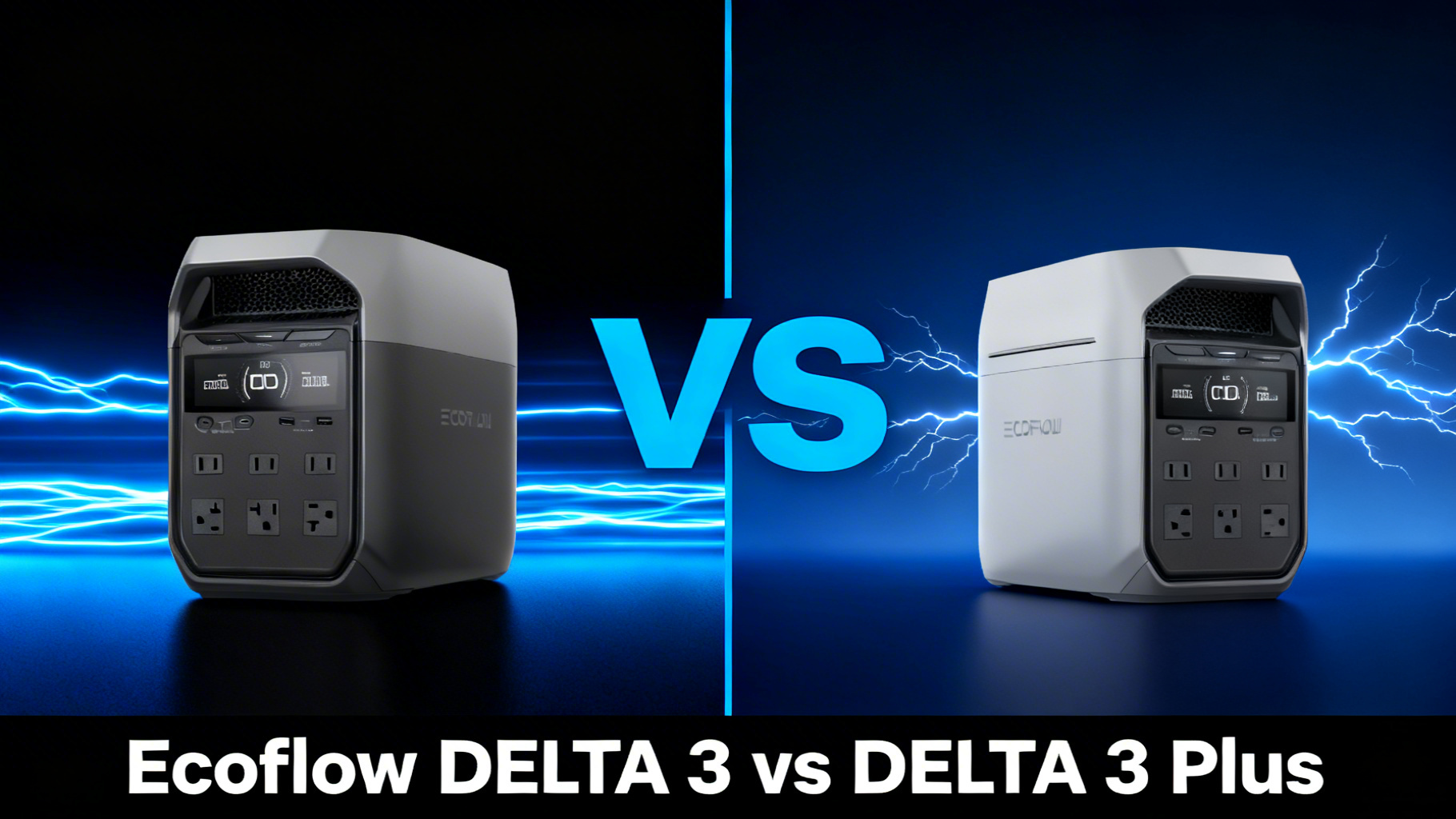
Choosing between the EcoFlow DELTA 3 and DELTA 3 Plus feels like a trick question. Both pack a 1,024Wh LiFePO4 battery, both deliver 1,800W of continuous AC output, and both charge from zero to full in under an hour via a wall outlet. So what exactly does the extra $100 buy you?
The short answer: faster solar charging, stronger USB-C ports, and advanced UPS support. For most users, the standard DELTA 3 at $499 is the smarter buy. But there are three specific scenarios where the DELTA 3 Plus at $599 justifies its premium. Let’s break down every difference so you can decide with confidence.
For a broader look at the complete lineup, check our guide to the best EcoFlow power stations.

Best Value
EcoFlow DELTA 3
$499 $699
- 1,024Wh LFP, 1,800W output
- 56-min full charge
- 27.6 lbs, IP65 battery

Best for Solar & USB-C
EcoFlow DELTA 3 Plus
$599 $799
- 1,024Wh LFP, 1,800W output
- Dual 500W solar input
- 140W USB-C, NAS/HID UPS
Comparing prices for Black Friday? Our EcoFlow Black Friday deals page tracks the live price of the DELTA 3, the DELTA 3 Plus and every other EcoFlow model.
At a Glance: Key Differences
On paper, these two power stations share more than they differ. The real separation comes down to solar input, USB-C wattage, and UPS capabilities. Here’s the full spec-by-spec breakdown.
Three key takeaways from this table. First, the core power specs are identical: same battery, same AC output, same charge time from a wall outlet. Second, every advantage the Plus holds relates to input speed (solar) or output power (USB-C/A). Third, that extra capability comes with a 9-pound weight penalty.


EcoFlow DELTA 3 Overview
The EcoFlow DELTA 3 is a 1,024Wh LiFePO4 (lithium iron phosphate) portable power station priced at $499 (down from $699). It delivers 1,800W continuous AC output with a 3,600W surge, boosted to 2,200W via EcoFlow’s X-Boost technology. That’s enough to run most household appliances, from mini-fridges to power tools.
Spec data shows a 56-minute AC charge time (0-100%), one of the fastest in the 1kWh class. The battery is rated for 4,000 cycles to 80% capacity, which translates to roughly a decade of daily use. At 27.6 lbs, it’s light enough for one person to carry comfortably. The unit also features an IP65-rated battery pack, WiFi and Bluetooth connectivity, and supports expansion up to 5kWh with compatible extra batteries.
For a deeper dive into this model, see our full EcoFlow DELTA 3 review.
EcoFlow DELTA 3 Plus Overview
The EcoFlow DELTA 3 Plus shares the same 1,024Wh LiFePO4 battery and 1,800W AC output foundation as its sibling, but adds several targeted upgrades at $599 (down from $799). The headline feature is dual 500W MPPT solar inputs, which cuts solar charge time nearly in half. USB-C ports jump from 100W to 140W per port, and USB-A doubles from 18W to 36W.
The Plus also introduces advanced UPS support with NAS and HID device compatibility, keeping your network-attached storage and essential peripherals protected during power outages. Like the standard model, it features a 5-year warranty, EcoFlow app integration, and expandability up to 5kWh.
Read our detailed DELTA 3 Plus review for a complete breakdown of performance and features.
Battery and Runtime Comparison
This is where the comparison gets simple. Both models use the exact same 1,024Wh LiFePO4 battery with 4,000 cycles to 80% capacity. That means identical runtime, identical longevity, and identical expansion options. There is no difference here.
What Can Both Models Power? (1,024Wh)
🔌
Mini Fridge
~17 hrs
60W avg
💡
LED Lights (10W)
~90 hrs
10W
💻
Laptop Charges
~14x
70Wh battery
📱
Phone Charges
~70x
15Wh battery
Runtime calculations based on the shared 1,024Wh capacity show both units powering a mini-fridge for approximately 17 hours, charging a laptop around 14 times, or keeping LED lights running for nearly 4 days straight. Use our runtime calculator tool to estimate exactly how long either unit will power your specific appliances.
Verdict on this section: complete tie. Your money buys the same amount of stored energy regardless of which model you choose.
Charging Speed: AC, Solar, and More
AC Charging
Both the DELTA 3 and DELTA 3 Plus charge from a standard wall outlet in 56 minutes (0-100%) using EcoFlow’s X-Stream technology at 1,500W input. This is among the fastest AC charge times in the 1kWh portable power station category. No difference here.
Solar Charging: The Biggest Difference
This is where the $100 gap starts to make sense. The standard DELTA 3 accepts a single 500W MPPT (Maximum Power Point Tracking) solar input, achieving a full charge in approximately 130 minutes under optimal conditions. The DELTA 3 Plus doubles that with dual 500W MPPT inputs (1,000W total), cutting solar charge time to roughly 70 minutes.
What does that mean in practice? If you’re camping and need to recharge during a window of good sunlight, the Plus gives you almost twice the solar harvesting speed. For users who pair their power station with multiple panels, the dual MPPT controller is a meaningful upgrade. If solar charging is your priority, compare the DELTA 3 Plus setup against competing solar generator kit options from other brands.


USB and Port Comparison
The port differences are subtle but worth understanding if you’re charging power-hungry devices. The DELTA 3 offers 2 × 100W USB-C ports and 2 × 18W USB-A ports. The DELTA 3 Plus bumps those to 2 × 140W USB-C and 2 × 36W USB-A.

Does that matter? For most laptops, 100W USB-C is more than sufficient. But if you’re running a MacBook Pro 16″ (which can draw up to 140W under heavy load) or similar high-performance laptops, the Plus ensures full-speed charging without throttling. The doubled USB-A speed also means faster phone charging, though most modern phones cap their own charging speeds below 36W anyway.
The Plus also adds advanced UPS (Uninterruptible Power Supply) support for NAS drives and HID (Human Interface Devices). If you run a home NAS for file storage or media, the Plus can keep it running seamlessly during outages with a 10ms switchover time. The standard DELTA 3 offers the same 10ms UPS, but without the dedicated NAS/HID protocol support. For full specs, see the official EcoFlow DELTA 3 specifications and the EcoFlow DELTA 3 Plus product page.
Portability and Weight
Here’s a trade-off that the spec sheet makes very clear. The DELTA 3 weighs 27.6 lbs (12.5 kg). The DELTA 3 Plus weighs 36.4 lbs (16.5 kg). That’s a 9-pound difference, which is significant when you’re loading gear into your car, carrying it across a campsite, or stowing it in an RV.

The extra weight on the Plus comes from the dual MPPT charge controller hardware and enhanced USB-C power delivery circuitry. If you plan to move your power station frequently, the standard DELTA 3 is noticeably easier to handle. If your unit mostly stays in one place (a van, a home office, a stationary campsite), the weight difference matters less.
Value Analysis: Cost per Feature
Let’s put the $100 price gap in perspective. The DELTA 3 costs $0.49 per Wh. The DELTA 3 Plus costs $0.59 per Wh. Since the battery capacity is identical, that extra $100 buys you exactly four upgrades: dual MPPT solar input, 40W more per USB-C port, 18W more per USB-A port, and NAS/HID UPS support.
Is that worth it? If you use solar panels regularly, the dual MPPT alone could justify the premium. Cutting your solar charge time from 130 minutes to 70 minutes means less time waiting and more flexibility during limited sunlight hours. Over months of use, that time savings adds up.
If you don’t use solar panels (or only charge from wall outlets), the remaining upgrades are harder to justify. The USB-C bump from 100W to 140W only matters for specific high-draw laptops. The USB-A improvement from 18W to 36W is nice but not transformative. And NAS/HID UPS support is a niche feature most users won’t need.
Which Should You Buy? Winner by Use Case
✅ Get the DELTA 3 ($499) if…
- You want the best value per Wh in the 1kWh class
- Portability matters (9 lbs lighter than the Plus)
- You charge primarily from AC wall outlets
- USB-C 100W is sufficient for your laptops
- You use it for weekend camping or emergency backup
⚡ Get the DELTA 3 Plus ($599) if…
- Solar charging is important (2x the solar input)
- You need 140W USB-C for MacBook Pro or similar
- You rely on NAS or HID devices during outages
- You plan to pair with multiple solar panels
- You use it frequently (van life, work from RV)
Weekend Camping: Winner, DELTA 3
For occasional weekend trips where you charge up at home before heading out, the standard DELTA 3 gives you the same 1,024Wh capacity at a lower price and lighter weight. You’ll appreciate the 9-pound difference when loading your car.
Van Life and Full-Time Off-Grid: Winner, DELTA 3 Plus
If you rely on solar panels daily, the dual MPPT input on the Plus is a significant advantage. Halving your solar charge time means you spend less of your day tethered to panels and more time with usable power. The stronger USB-C output is also practical for powering work laptops on the road.
Home Emergency Backup: Winner, DELTA 3
For power outages at home, you’ll almost always be charging from a wall outlet before or after the outage. The Plus’s solar advantage doesn’t come into play as often here, and the $100 savings can go toward an extra battery for more total capacity instead.
Remote Work and Digital Nomad: Winner, DELTA 3 Plus
The combination of 140W USB-C (for fast laptop charging), dual solar input (for off-grid recharging), and NAS UPS support (for protecting your work setup) makes the Plus the stronger choice for anyone working remotely from a van, cabin, or campsite.
Budget-Conscious Buyer: Winner, DELTA 3
If your main goal is getting a reliable 1kWh LFP power station at the best possible price, the DELTA 3 at $499 is hard to beat. It delivers the same core performance as the Plus without the niche upgrades most casual users won’t miss.
Final Verdict
The EcoFlow DELTA 3 and DELTA 3 Plus share an exceptional foundation: fast-charging LiFePO4 battery, strong 1,800W output, 5-year warranty, and expandability up to 5kWh. The differences are targeted and specific.
Based on a spec-by-spec analysis, the DELTA 3 at $499 is the right call for the majority of buyers. You get the same battery, the same AC power, and the same build quality at a lower price and lighter weight. The DELTA 3 Plus at $599 earns its premium only if solar charging speed and high-wattage USB-C are priorities in your setup.
The data points clearly: choose the Plus for solar and USB-C power. Choose the standard for everything else.
EcoFlow DELTA 3 Plus
$599
Best for solar users and USB-C power
Free shipping available
Frequently Asked Questions
Is the EcoFlow DELTA 3 Plus worth $100 more than the DELTA 3?
It depends on your priorities. The Plus adds dual 500W solar input (halving solar charge time), 140W USB-C ports, and advanced NAS/HID UPS support. If you rely on solar charging or need higher USB-C output for laptops like the MacBook Pro 16″, the $100 premium is justified. For users who primarily charge from wall outlets and use standard USB devices, the standard DELTA 3 delivers the same core performance for less.
Do the DELTA 3 and DELTA 3 Plus have the same battery capacity?
Yes. Both models share an identical 1,024Wh LiFePO4 battery with 4,000 cycles to 80% capacity, providing approximately 10 years of daily use. Runtime and battery longevity are identical between the two models.
How much faster is solar charging on the DELTA 3 Plus?
The DELTA 3 Plus charges roughly twice as fast via solar, thanks to its dual 500W MPPT inputs (1,000W total) compared to the DELTA 3’s single 500W input. With optimal solar panel setups, the Plus achieves a full charge in approximately 70 minutes versus 130 minutes for the standard model.
Can both the DELTA 3 and DELTA 3 Plus expand to 5kWh?
Yes. Both models support one Smart Extra Battery, compatible with the DELTA 3 (1,024Wh), DELTA 2 (1,024Wh), DELTA 2 Max (2,048Wh), or DELTA Pro 3 (4,096Wh) expansion batteries. Maximum expanded capacity reaches approximately 5kWh with a DELTA Pro 3 battery.
Why is the DELTA 3 Plus 9 lbs heavier than the DELTA 3?
The additional weight comes primarily from the dual MPPT solar charge controller hardware and enhanced USB-C power delivery circuitry. At 36.4 lbs versus 27.6 lbs, the difference is noticeable when carrying the unit, making the standard DELTA 3 the better option for frequent transport.
Related Reads
Originally published: March 22, 2026