
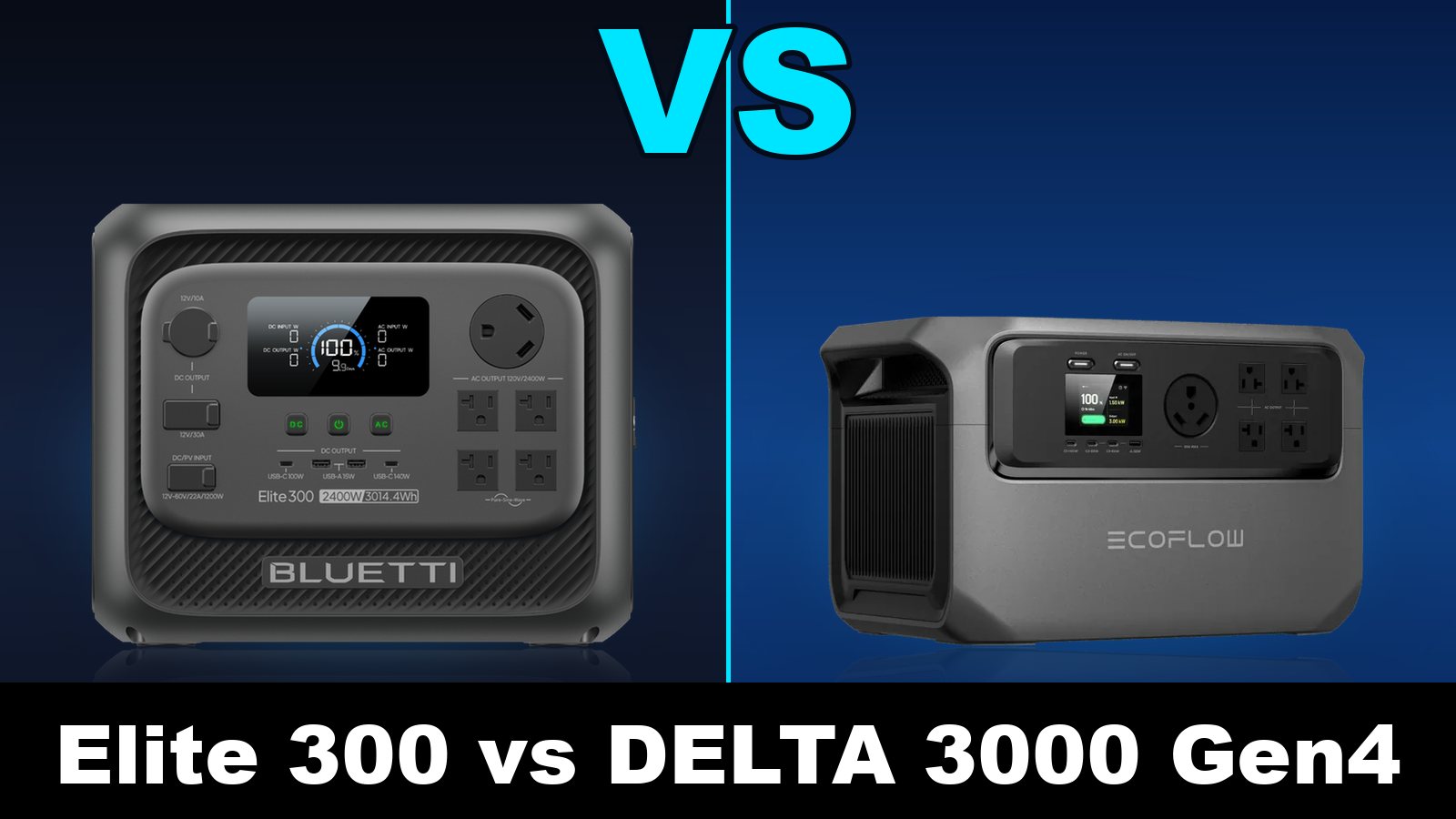
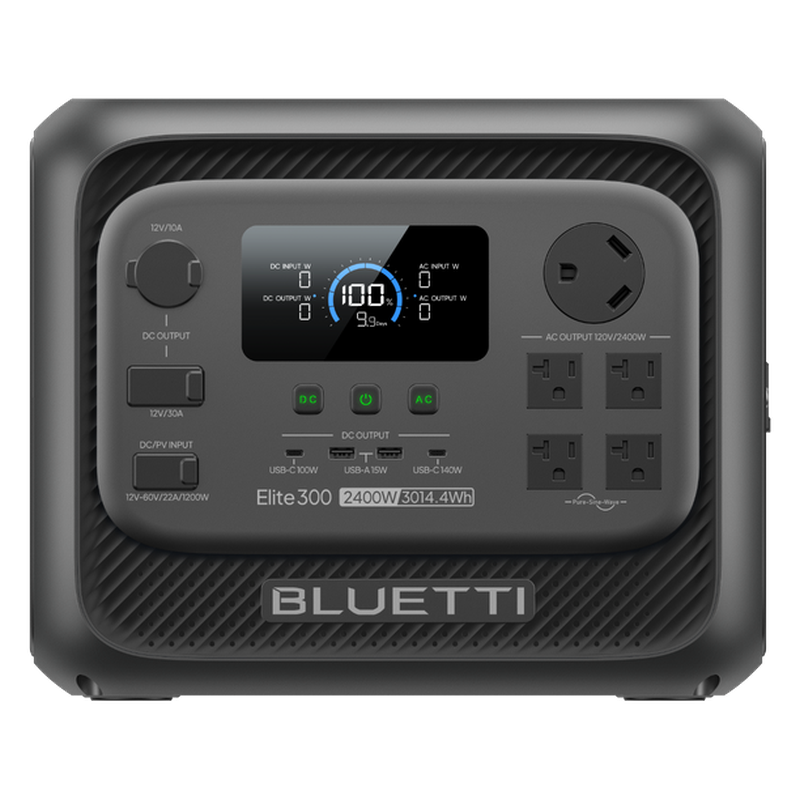
Elite 300
- your peak load stays under 2,400W
- you want measured results, not claims
- you run 12V gear
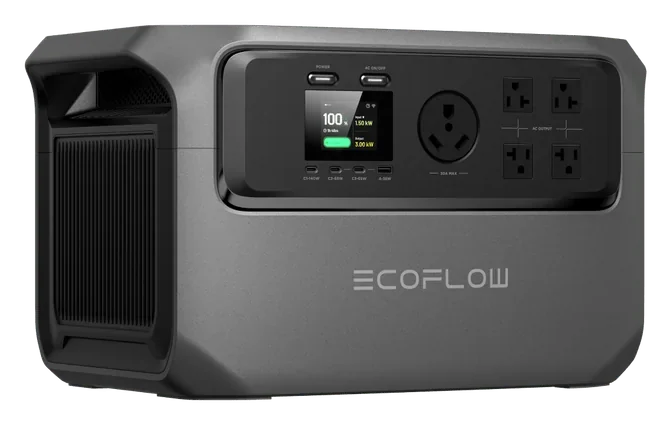
DELTA 3000 Gen4
- you run 2,400W to 3,600W at once
- you start motors
- it stays plugged in under heavy loads
Prices and stock checked by our price engine on November 13, 2026 at 6:29 AM EST. Each product is rechecked several times a day; the time refreshes when you load the page.
Same weight, same 3kWh. If your worst moment stays under 2,400W, take the one reviewers have already measured.
The BLUETTI Elite 300 and the EcoFlow DELTA 3000 Gen4 are 0.7 lb and 58Wh apart, and neither takes an extra battery. So capacity won’t decide this. The DELTA 3000 Gen4 delivers 3,600W with a 7,200W surge rating, and it can add battery power to the grid’s when plugged in; every figure so far is EcoFlow’s. The Elite 300 delivers 2,400W, 1,800W while on the wall, but reviewers have put it through real load runs and measured an 8ms switchover. It also adds a 12V side, 200W more solar and a warranty that needs no app step.
Below: where 2,400W runs out, a 20-second calculator for your own gear, eight situations, and what published reviews found on the Elite 300. Nobody independent has reported on the DELTA 3000 Gen4 yet.
Prices $100 apart today. Weight and energy are a wash, and neither expands. The DELTA 3000 Gen4 adds 1,200W of output and a published motor surge. The Elite 300 adds a 12V socket and port, 200W of solar and a cycle rating that stops at 80% instead of 70%.
- 2,400W is your ceiling
- you need 12V outputs
- you want 5 years, no app step
- you need 3,600W
- you start pumps or compressors
- you want the fridge mode
Five gaps once weight and capacity cancel out
Both weigh about 58 lb, store about 3kWh, have four 20A outlets and a 30A RV outlet, stay at 120V and have no battery port. What is left comes down to these.
Will it run your setup? Check in 20 seconds
Estimates use 85% usable capacity and 70% of rated solar output. Real results vary with temperature, inverter load, shade and appliance cycling. Fridge and freezer watts are daily averages and do not include compressor startup surges.
Runtime by appliance, one at a time
Same 85% rule on both: about 2,562Wh and 2,611Wh, too close to matter. StorageReview measured 2.67kWh out of an Elite 300, a little above that estimate; the 3000 Gen4 has no outside figure yet.
Practically a tie: the 3000 Gen4 holds only 2% more than the Elite 300.
Same appliance, same watts: the gap is always the size of the battery.Get our Black Friday alerts for power stations
We track live prices on 40+ models from Jackery, EcoFlow, BLUETTI and Anker SOLIX. When a deal beats the lowest price we've recorded, you'll hear from us. During Black Friday week, one short recap a day at most.
Unsubscribe in one click. We may earn a commission when you buy through our links, at no extra cost to you. Privacy Policy
The price gap, in numbers
The EcoFlow DELTA 3000 Gen4 costs $100 more than the BLUETTI Elite 300 and adds 58Wh: that is $1.72 per extra Wh, against $0.40 per Wh for the Elite 300.
Prices refresh daily from BLUETTI US and EcoFlow US.BLUETTI’s 6,000+ cycles run to 80% of capacity and EcoFlow’s 6,000 to 70%, so we skip a cost-per-cycle card. With the batteries this close, the gap is really a price on output. Prices move often; our engine refreshes them daily.
Eight modeled situations, worked out
Energy figures use 85% of rated capacity. The essentials plan draws 140W, about 3.4kWh a day, or about 18 to 19 hours on either. Load examples are illustrations; check your own.
The one bad minute
This is the line between them. The Elite 300 trips on a load any kitchen can make; Power Lifting won’t rescue it, because the microwave isn’t a pure heating load. If you can run those one at a time, the Elite 300’s lower ceiling never bites.
Left on the wall with a heavy load
The Elite 300 delivers 2,400W on battery but 1,800W while plugged in. EcoFlow’s X-Fusion feeds the load from the grid and battery together once it passes the input limit. For a station that lives on a shop or office circuit, that matters more than the peak rating.
A compressor that needs a shove
The Elite 300’s sheet lists 4,800W, but that is Power Lifting. Its US manual warns that motors can overload it and says to stay under 2,400W. EcoFlow lists 7,200W, unmeasured and with no duration. It is still the only margin on offer.
A stocked fridge through an outage
About the same. EcoFlow’s Fridge Runtime Boost claims up to 58 hours, but that came from an empty Samsung drawing about 53W, with no other AC load. Treat the mode as a bonus you may see, not a number to plan on. BLUETTI lists no fridge mode.
A van on 12V
The Elite 300 runs them directly, though the 12V/30A port is an XT90 and an Anderson cable isn’t in the box. On the 3000 Gen4, 12V gear needs an adapter on AC, and EcoFlow’s 14W idle figure works out to about 336Wh a day. In a van, that decides it.
A switchover you can trust
On paper it’s a tie. StorageReview clocked the Elite 300 at about 8ms both ways; no one has timed the Gen4. EcoFlow says there is no HID link and that this isn’t a 0ms professional UPS. BLUETTI rules out data servers and workstations.
Two portable panels on the porch
No difference at this size. The Elite 300’s 200W edge only shows above 1,000W of panels: 3.6 hours at its maximum, by our math, against 4.4 for the EcoFlow. BLUETTI itself says 4.1 hours. Both inputs top out at 60V.
A garage in January, a shed in July
Cold climates favor the Elite 300, which keeps running 18°F lower. Hot ones favor the EcoFlow, 9°F higher. Neither takes a charge below 32°F, so a frozen garage means bringing either one inside first.
Nine more differences, the spec sheet and the box
Smaller gaps that rarely decide the purchase, then the full specifications and what ships in the box.
Elite 300 and DELTA 3000 Gen4 weight, dimensions and full specifications
Weight: 58 lb for the Elite 300 and 57.3 lb for the DELTA 3000 Gen4. Dimensions: 14.4 × 12.0 × 11.7 in and 16.77 × 11.36 × 12.09 in. Everything else is in the sheet below.
BLUETTI Elite 300 and EcoFlow DELTA 3000 Gen4 full specifications
Every published figure for both units, grouped. Green marks the better value.
What’s in the box
Elite 300
- Elite 3003,014Wh, 58 lb
- AC charging cable
- Manual, grounding screw
- No car cable
DELTA 3000 Gen4
- DELTA 3000 Gen43,072Wh, 57.3 lb
- AC charging cable
- Solar charging cableXT60i to LP60
- AC cable retention kit, manuals and warranty card
From BLUETTI’s US manual and EcoFlow’s US page. Panels, the Charger 2, the XT90 to Anderson cable and the folding cart are extras.
06 · ChargingHow fast each one refills
Shorter bar, faster refill. Each row is scaled to its slower unit.
Elite 300: wall and solar together cap at 2,400W; one line on BLUETTI’s page says 80% in 45 minutes, which 1,800W can’t do, so we follow the US manualDELTA 3000 Gen4: 118 minutes is EcoFlow’s figure; it can’t charge while switched off
Our solar times assume panels deliver 70% of their rating; the brands’ figures assume ideal sun.
Every port, side by side
Elite 300
DELTA 3000 Gen4
What that means in use: the AC side matches, with four 20A outlets and a 30A RV outlet on each. USB is close too. The real split is DC: the Elite 300 has a car socket and an XT90 12V/30A port; the 3000 Gen4 lists neither.
08 · NoiseNoise: Elite 300 vs 3000 Gen4
The EcoFlow DELTA 3000 Gen4 has the friendlier numbers: up to 30dB at 600W and 50dB at 3,600W, all EcoFlow’s. The BLUETTI Elite 300 has reviewer data instead, with over 50dB at 1 m under load on an EU unit.
A brand’s rating against a reviewer’s meter, so we name no winner.Every figure we found, with its source
What reviewers heard: StorageReview heard the fans ramp up while charging at full speed under about 900W of load; Reviewed could still hold a normal conversation beside it.
Measured by a tester Brand figure
- Near a bedroom, refill the Elite 300 in Silent mode and keep the EcoFlow’s load low.
Cold and heat: Elite 300 vs 3000 Gen4
The BLUETTI Elite 300 goes colder, to −4°F against 14°F. The EcoFlow DELTA 3000 Gen4 goes hotter, to 113°F against 104°F. Both are IP20.
Figures from the BLUETTI US manual and the EcoFlow US page.- Bring either unit above 32°F before you refill it.
- Pick the Elite 300 for an unheated space in a hard winter, the EcoFlow for a hot one.
App, UPS and smart features
The EcoFlow DELTA 3000 Gen4 has more automation: a fridge mode and storm prep from NWS data. It also keeps feeding heavy loads on the wall. The BLUETTI Elite 300 answers with off-peak charging and a switchover that someone has actually timed.
Both switch in about 10ms; only one of those numbers has been checked.Green zone: a switch under about 16ms, which most desktop PCs ride through without restarting.
Does it have a fridge mode? The EcoFlow DELTA 3000 Gen4 matches its output to one compressor appliance, with no other AC loads. BLUETTI lists no such mode on the BLUETTI Elite 300.
Does it prepare for storms? Using NWS data, the EcoFlow DELTA 3000 Gen4 can refill itself before a storm. BLUETTI lists nothing similar for the BLUETTI Elite 300.
Can it charge off-peak? The BLUETTI Elite 300 schedules charging with Time Control. EcoFlow’s page doesn’t list a schedule for the EcoFlow DELTA 3000 Gen4.
Does it work as a UPS? StorageReview measured 8ms on the BLUETTI Elite 300, rated 10ms. EcoFlow lists under 10ms for the EcoFlow DELTA 3000 Gen4, unmeasured so far.
Can it run a heater or kettle above its rating? Power Lifting on the BLUETTI Elite 300 is off by default, for pure resistive loads; real output stays 2,400W. EcoFlow gives no X-Boost figure for the EcoFlow DELTA 3000 Gen4, and it is off while plugged in.
Can you add a battery later? No on both: the BLUETTI Elite 300 and the EcoFlow DELTA 3000 Gen4 stay at about 3kWh.
Warranty and support
The BLUETTI Elite 300 has the better terms: 5 years with no app step, and a cycle rating that stops at 80%. The EcoFlow DELTA 3000 Gen4 reaches 5 years after registration, with 6,000 cycles to 70%.
Same headline numbers, different fine print.Subject to each brand’s warranty terms and eligibility.
BLUETTI and EcoFlow both write 6,000, but BLUETTI’s count ends at 80% of capacity and EcoFlow’s at 70%, in lab conditions. Heat and calendar age still matter on both.
- Buy the Elite 300 from BLUETTI or an authorized seller; other sources void the warranty.
- Register the DELTA 3000 Gen4 in the EcoFlow app for the final 2 years.
What reviewers report
We have not lab-tested these two units. As of November 5, 2026, no full independent review of the DELTA 3000 Gen4 had been published. What follows is the Elite 300’s record only, with the source, author and date for each point. UK and EU units charge from 230V outlets and differ from US units.
Elite 300: StorageReview (August 2026), Trusted Reviews (June 2026, UK unit), Notebookcheck (March 2026, EU unit), Reviewed (March 2026), CGMagazine (April 2026)DELTA 3000 Gen4: no verifiable independent test found
Usable capacity
- Elite 300Reviewer A full discharge measured 2.67kWh at the AC output, against a 3,014.4Wh rating. StorageReview, Dylan Bryan, August 2026
- Elite 300Reviewer Best usable output was 2,781Wh at a 1,000W load, about 92% of rated capacity. Trusted Reviews, Simon Handby, June 2026, UK unit
- Elite 300Reviewer At a steady load just over 200W it delivered about 2,650Wh (just under 88%); at 1,800W over 92%. Notebookcheck, Marcus Schwarten, March 2026, EU unit
- Elite 300Reviewer A half-hour rice cooker run used 9% of the battery; a 90-minute lasagna in an air fryer oven used 55%. Reviewed, Jessica Kanzler, March 2026
- Elite 300Reviewer A full-size refrigerator ran for two hours using about 2% of the battery per hour. Reviewed, Jessica Kanzler, March 2026
Charging
- Elite 300Reviewer A 0 to 100% recharge drew 3.49kWh from the wall on a Kill-A-Watt meter. StorageReview, Dylan Bryan, August 2026
- Elite 300Reviewer Turbo charging at 2,300W took 1 h 47 min (UK 230V; the US wall limit is 1,800W). Trusted Reviews, Simon Handby, June 2026, UK unit
- Elite 300Reviewer A standard-speed (1,200W) recharge drew 3,450Wh from the mains, about 87% efficiency. Notebookcheck, Marcus Schwarten, March 2026, EU unit
Noise and heat
- Elite 300Reviewer Fans ramped up noticeably while charging at full speed and powering about 900W at the same time. StorageReview, Dylan Bryan, August 2026
- Elite 300Reviewer Measured over 50 dB at 1 meter under load. Notebookcheck, Marcus Schwarten, March 2026, EU unit
- Elite 300Reviewer Even under heavier loads the fan stayed quiet enough for normal conversation beside it. Reviewed, Jessica Kanzler, March 2026
UPS and output
- Elite 300Reviewer A Quarch power analyzer measured an 8ms switch to battery and 8.25ms back to grid. StorageReview, Dylan Bryan, August 2026
- Elite 300Reviewer With Power Lifting on, a 1,600W kettle and 2,200W toaster ran together, both heating more slowly. Trusted Reviews, Simon Handby, June 2026, UK unit
- Elite 300Reviewer The UPS function worked reliably and quickly in practical tests. Notebookcheck, Marcus Schwarten, March 2026, EU unit
- Elite 300Reviewer Two 3D printers kept printing when wall power was pulled; the switch went unnoticed. CGMagazine, Brendan Frye, April 2026
- Elite 300Reviewer A gaming PC drew around 380W and the unit estimated about seven and a half hours of runtime. CGMagazine, Brendan Frye, April 2026
Daily use and issues
- Elite 300Reviewer At the full 2,400W rated output, AC shut off after over an hour with 7% still indicated. Trusted Reviews, Simon Handby, June 2026, UK unit
- Elite 300Reviewer A near-140W USB-C load ran over three hours, then DC ports shut down on an over-current fault. Trusted Reviews, Simon Handby, June 2026, UK unit
Practical limits before you buy
- Neither takes a battery, ever. If 3kWh might not be enough, this is the wrong duel: look at models with a battery port.
- The Elite 300’s Power Lifting is narrow. It is off by default, for pure heating loads, and real output stays at 2,400W.
- Its 2,400W shrinks on the wall. Bypass stops at 1,800W, so a plugged-in setup has a lower ceiling than the rating suggests.
- One review hit a limit. At the full 2,400W, Trusted Reviews saw AC shut off on a UK Elite 300 after more than an hour, with 7% still showing. It is a single-unit finding, but leave some margin.
- The 12V/30A port wants an adapter. It is an XT90, the Anderson cable isn’t in the box, and the car socket shares the same 30A.
- The DELTA 3000 Gen4 has one solar input. 11 to 60V and 20A, so series wiring runs out of room quickly.
- X-Boost is off whenever it is plugged in. EcoFlow also gives no wattage for it on this model’s page.
- It can’t charge while switched off. It turns itself on when you connect a source, and automatic generator start isn’t available on this model.
- Lift with care. BLUETTI’s US manual recommends two people for the Elite 300, and the EcoFlow weighs about the same with two handles and no wheels.
Frequently asked questions
What is the difference between the BLUETTI Elite 300 and the EcoFlow DELTA 3000 Gen4?
Output and proof. The DELTA 3000 Gen4 delivers 3,600W with a 7,200W surge rating but has no independent results yet. The Elite 300 delivers 2,400W, has a 12V side and takes 1,200W of solar, and reviewers have measured it. Weight and capacity are nearly identical.
Which is cheaper?
The BLUETTI Elite 300 costs $100 less today: $1,199, against $1,299 for the EcoFlow DELTA 3000 Gen4. Per Wh, the Elite 300 is cheaper: $0.40, against $0.42. Prices refresh daily.
What can the DELTA 3000 Gen4 run that the Elite 300 can’t?
Anything from 2,400W to 3,600W at once, such as a space heater plus a microwave, and motors whose start exceeds 2,400W.
Is 2,400W enough for most homes?
For essentials, yes: a fridge, internet, lights and one kitchen appliance at a time. It runs out when two heating appliances overlap.
Which one is better on 12V?
The Elite 300, with a car socket and a 12V/30A XT90 port. EcoFlow’s spec list shows neither on its model.
Does either one take extra batteries?
No. BLUETTI calls the Elite 300 a standalone unit, and the DELTA 3000 Gen4 has no battery port.
Do 6,000 cycles mean the same thing on both?
No. BLUETTI counts to 80% of capacity and EcoFlow to 70%, under lab conditions.
Which is quieter?
We can’t say yet. EcoFlow rates up to 30dB at 600W. Notebookcheck measured an EU Elite 300 at over 50dB under load, at 1 m, which is a different test.
Has anyone reviewed them?
The Elite 300, yes, and each source is credited in the reports section. As of November 5, 2026, no full independent review of the DELTA 3000 Gen4 had been published.
Related comparisons and reviews
How we compared and sources
Research-based comparison. We have not had either unit in hand, and no full independent review of the DELTA 3000 Gen4 existed on November 5, 2026. Specs come from BLUETTI’s US page and manual and EcoFlow’s US page, FAQ and compatibility table. Reviewer observations on the Elite 300 are attributed; UK and EU units are flagged. Prices and availability were checked on November 5, 2026.
- Specs: BLUETTI US, Elite 300 with its US user manual, read on November 3, 2026, and EcoFlow US, DELTA 3000 Gen4 with its FAQ and compatibility table, read on November 5, 2026.
- Weight, capacity and solar gaps are our math from the brands’ figures. Runtimes use rated capacity × 0.85.
- BLUETTI’s Elite 300 spec table lists 4,800W of surge, the same figure as Power Lifting. Its FAQ limits that mode to pure resistive loads and its US manual says to stay under 2,400W with motors, so we don’t count it as motor headroom. EcoFlow gives no duration for the DELTA 3000 Gen4’s 7,200W.
- Reviewer reports on the Elite 300: StorageReview, Dylan Bryan, August 2026, Trusted Reviews, Simon Handby, June 2026, UK unit, Notebookcheck, Marcus Schwarten, March 2026, EU unit, Reviewed, Jessica Kanzler, March 2026, CGMagazine, Brendan Frye, April 2026.
- Runtime = capacity × 0.85 ÷ watts. Solar harvest = min(panel watts, max input) × sun hours × 0.70.
Weight and capacity cancel out. Your peak load in watts is what’s left to decide.
Prices checked November 13, 2026 at 6:29 AM EST
Looking at other models? Browse all power station comparisons, or pick any two models on the hub and we point you to the right duel.
Originally published: November 7, 2026