
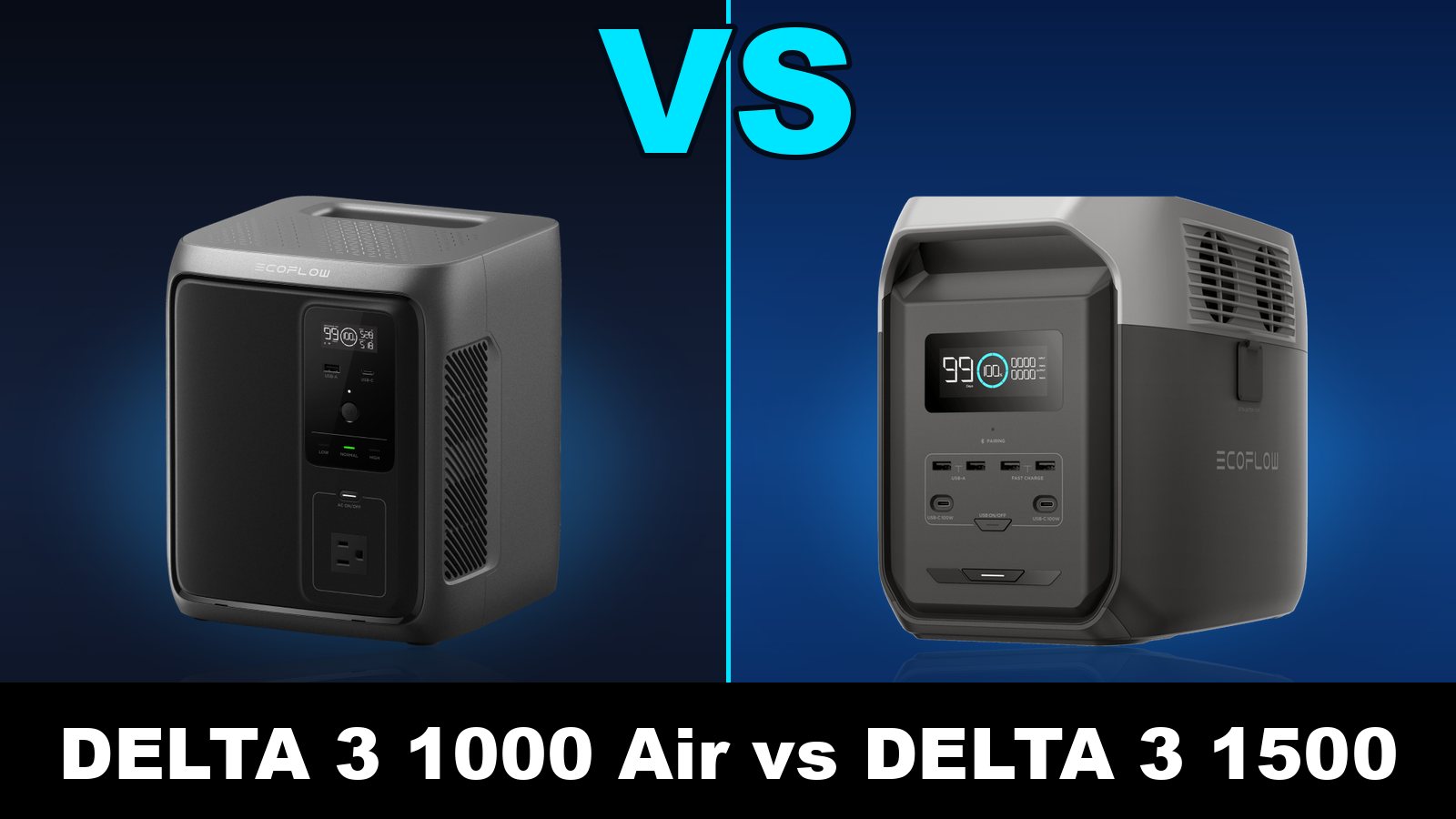

DELTA 3 1000 Air
- it guards a router, CPAP or PC under 500W
- you want the faster UPS: 10ms
- you carry it: 22 lb

DELTA 3 1500
- you run 1,800W kitchen loads
- you plug in six devices and 12V gear
- you’ll add a battery later
Prices and stock checked by our price engine on November 13, 2026 at 9:29 AM EST. Each product is rechecked several times a day; the time refreshes when you load the page.
One is a UPS for your router. The other is a full station that happens to switch more slowly.
The EcoFlow DELTA 3 1000 Air stores 960Wh and delivers 500W from a single AC outlet in a 22 lb cube, with a 10ms UPS; EcoFlow US no longer sells it and redirects its page to the DELTA 3 Classic. The EcoFlow DELTA 3 1500 stores 1,536Wh and delivers 1,800W from six outlets, adds four USB-A ports, a car socket, two DC barrels and a battery port for about 5.5kWh, at 36 lb, but switches in 15ms; EcoFlow US sells it only as a solar kit, sold out when we checked. If you own one, this page tells you what it does better than the other; buying new, look at their replacements, the DELTA 3 Classic and the DELTA 3 Max.
Below: the five differences with numbers, a 20-second calculator for your own gear, eight modeled situations, what each replacement costs today, and what published tests found.
Neither is sold on its own by EcoFlow US today, so this is a choice between units you may already own or find secondhand. The 1500 stores 60 percent more, delivers more than three times the wattage from six outlets, adds 12V outputs, a battery port and 5 years of warranty. The Air weighs 14 lb less and switches in 10ms instead of 15ms.
- a PC needs a 10ms switch
- you carry it: 22 lb
- your loads stay under 500W
- you run 1,800W
- you want 1,536Wh
- you’ll grow to 5.5kWh
The five differences that decide it
Both use LFP cells, take 500W of solar on one port and use the EcoFlow app over Wi-Fi and Bluetooth. These five gaps decide it.
Will it run your setup? Check in 20 seconds
Estimates use 85% usable capacity and 70% of rated solar output. Real results vary with temperature, inverter load, shade and appliance cycling. Fridge and freezer watts are daily averages and do not include compressor startup surges.
Runtime by appliance, one at a time
Simple energy estimates, not measured runtimes: about 816Wh usable on the 1000 Air and 1,306Wh on the DELTA 3 1500. A load above 500W does not run on the Air at all.
Appliance for appliance, the DELTA 3 1500 lasts 60% longer than the 1000 Air.
Same appliance, same watts: the gap is always the size of the battery.Get our Black Friday alerts for EcoFlow
We track live prices on 40+ models from Jackery, EcoFlow, BLUETTI and Anker SOLIX. When a deal beats the lowest price we've recorded, you'll hear from us. During Black Friday week, one short recap a day at most.
Unsubscribe in one click. We may earn a commission when you buy through our links, at no extra cost to you. Privacy Policy
What their replacements cost today
EcoFlow US sends 1000 Air shoppers to the DELTA 3 Classic, which keeps the 10ms UPS and adds 1,800W from three outlets. For the 1500’s role, the DELTA 3 Max puts 2,048Wh in one box, and the DELTA 3 keeps its six outlets and battery port. All three switch in 10ms.
Eight modeled situations, worked out
Same formula as the calculator above, with no extra battery. The fridge averages 60W, about 525kWh a year.
24-hour outage, essentials only
The Air gets you through the evening on a power strip kept under 500W; the 1500 through the evening and most of the night.
CPAP, every night
Two nights and a half on the Air, four on the 1500.
A microwave during an outage
1,100W is more than twice the Air’s rating, and X-Boost only helps heating elements. The 1500 runs it.
Six plugs at once
The 1500 takes all six. On the Air, add a power strip and keep the total under 500W.
A desktop PC through a grid drop
Many desktop power supplies ride through roughly 16ms. The Air’s 10ms leaves margin for a PC that stays under 500W; the 1500’s 15ms leaves almost none.
Refill from solar, 500W of panels
Same 500W limit, so the 1500’s bigger battery takes about 1.7 hours more sun.
A 1,500W space heater on high
Beyond the Air’s 800W X-Boost. The 1500 runs it for under an hour: treat it as a bridge.
Growing the system
Only the 1500 takes an extra battery, through its XT150 port.
Nine more differences, the spec sheet and the box
Smaller gaps that rarely decide the purchase, then the full specifications and what ships in the box.
DELTA 3 1000 Air and DELTA 3 1500 weight, dimensions and full specifications
Weight: 22 lb for the DELTA 3 1000 Air and 36 lb for the DELTA 3 1500. Dimensions: 8.7 × 8.8 × 10.4 in and 15.7 × 8.3 × 11.1 in. 1000 Air figures come from EcoFlow’s archived US page; 1500 figures from its US kit page and user manual.
EcoFlow DELTA 3 1000 Air and EcoFlow DELTA 3 1500 full specifications
Every published figure for both units, grouped. Green marks the better value.
What’s in the box
DELTA 3 1000 Air
- DELTA 3 1000 Air960Wh, 22 lb
- AC charging cable
- Quick start guide, safety instructions and warranty card
DELTA 3 1500
- DELTA 3 1500 power station1,536Wh, 36 lb
- AC charging cable
- Car charging cableprovided, per the manual
- User manual and warranty card
- Solar cable sold separatelyEcoFlow Solar to XT60i cable
1000 Air box contents from EcoFlow Canada’s page for the same 120V model; DELTA 3 1500 from its user manual. In the US the 1500 was sold only as a kit, which adds a solar panel.
06 · ChargingHow fast each one refills
Shorter bar, faster refill. Each row is scaled to its slower unit.
1000 Air: X-Stream AC charging, input watts not publishedDELTA 3 1500: GladiatorUp saw about 97W from a truck’s 12V socket
Our solar times assume panels deliver 70% of their rating; the brands’ figures assume ideal sun.
Every port, side by side
DELTA 3 1000 Air
DELTA 3 1500
Practical consequence: the Air has one AC outlet and two small USB ports, enough for a router and a phone. The 1500 adds five more outlets, two 100W USB-C, three more USB-A, a car socket, two DC barrels and a battery port.
08 · NoiseNoise: 1000 Air vs DELTA 3 1500
EcoFlow rates the EcoFlow DELTA 3 1000 Air at Under 39dB load not stated and the EcoFlow DELTA 3 1500 at no published rating.
EcoFlow’s figures first; reviewer reports where we found one.Every figure we found, with its source
No decibel figure published.
Measured by a tester Brand figure
- Lower the AC charging speed in the EcoFlow app overnight: the fans run hardest while fast charging.
Cold, heat and storage: 1000 Air vs DELTA 3 1500
The EcoFlow DELTA 3 1000 Air and the EcoFlow DELTA 3 1500 share the same limits: charging from 32°F to 113°F, running from 14°F to 113°F. Only the DELTA 3 1500’s battery pack carries an IP54 rating.
Figures from EcoFlow’s archived 1000 Air page and the DELTA 3 1500 manual.- Charge either one indoors in winter: neither charges below 32°F.
- For storage, keep it between 68°F and 86°F with some charge left, and cycle it every three months.
App, UPS and smart features
The EcoFlow DELTA 3 1000 Air adds a faster UPS; the EcoFlow DELTA 3 1500 adds expansion and a Smart Generator link.
Same EcoFlow app over Wi-Fi and Bluetooth.Green zone: a switch under about 16ms, which most desktop PCs ride through without restarting.
Can you add a battery later? The EcoFlow DELTA 3 1000 Air has no extra battery port; the EcoFlow DELTA 3 1500 takes one extra battery on its XT150 port, to about 5.5kWh.
Does it work with EcoFlow’s Smart Generator? The EcoFlow DELTA 3 1000 Air has no Smart Generator link listed; the EcoFlow DELTA 3 1500 is topped up automatically by EcoFlow’s Smart Generator 3000 (Dual Fuel).
Does it work as a UPS? The EcoFlow DELTA 3 1000 Air switches in 10ms, at up to 500W; the EcoFlow DELTA 3 1500 is a standby UPS with a 15ms transfer, which leaves little margin for a desktop PC.
How does the app connect? Both use the EcoFlow app over Wi-Fi and Bluetooth for monitoring, charge limits and output control.
Warranty and support
EcoFlow gives the EcoFlow DELTA 3 1000 Air 2 years, as listed when it was sold, and the EcoFlow DELTA 3 1500 5 years with nothing to register, per its US warranty listing. A DELTA 3 1000 Air you already own keeps the term it was sold with.
The DELTA 3 1500 has the longer term without registering.Subject to each brand’s warranty terms and eligibility.
For the DELTA 3 1000 Air, no cycle count; EcoFlow cited 3,219.84kWh delivered over 10 years in its own lab, roughly 3,350 full charges of 960Wh. For the DELTA 3 1500, 3,000 cycles to 70%, about 8 years at one full cycle a day. Heat and calendar age also wear a battery, so read any rating as a ceiling.
- The DELTA 3 1500’s manual voids coverage if it sits more than six months without a charge and discharge: cycle it every three months in storage.
What reviewers report
We have not lab-tested these two units, and we found no independent test of the 1000 Air. Here is what 2 published reviews found, with the source, author and date for each point. Reviews of UK and EU units are flagged: those models charge from 230V outlets and have different sockets, so their charge times and outlet findings don’t carry over to US units.
DELTA 3 1000 Air: no verifiable independent test foundDELTA 3 1500: GladiatorUp (October 2026), mybest (Japan) (July 2026, Japanese unit)
Usable capacity
- DELTA 3 1500Reviewer mybest measured 1,310Wh of usable energy from the 1,536Wh pack, about 85 percent. mybest (Japan), Asuka Fukuda, July 2026, Japanese unit
- DELTA 3 1500Reviewer Its conversion-efficiency score was 4.27, ranking 44th of 84 power stations mybest tested against a 90 percent target. mybest (Japan), Asuka Fukuda, July 2026, Japanese unit
Charging
- DELTA 3 1500Reviewer Charging from the truck’s factory 12V socket gave only about 97W of input, so the car outlet is a slow way to refill it. GladiatorUp, Doug Stokes, October 2026
- DELTA 3 1500Reviewer On one long drive the 12V socket added only about 20 percent of charge in roughly four hours while also running his travel setup. GladiatorUp, Doug Stokes, October 2026
UPS and output
- DELTA 3 1500Reviewer In daily use it runs his 26-quart car fridge, CPAP, fans, lights and device charging during weekend overlanding trips. GladiatorUp, Doug Stokes, October 2026
- DELTA 3 1500Reviewer Enough output and capacity for an electric blanket, rice cooker or portable fridge during an outage, in their assessment. mybest (Japan), Asuka Fukuda, July 2026, Japanese unit
Daily use and issues
- DELTA 3 1500Reviewer Relying on the cigarette-lighter circuit blew the Jeep’s 20A accessory fuse more than once; he does not blame the EcoFlow itself. GladiatorUp, Doug Stokes, October 2026
- DELTA 3 1500Reviewer He found the app genuinely useful for watching input, output and battery state without climbing into the vehicle. GladiatorUp, Doug Stokes, October 2026
- DELTA 3 1500Reviewer At around 36 lbs he treats it as semi-permanent vehicle equipment rather than something to carry far. GladiatorUp, Doug Stokes, October 2026
- DELTA 3 1500Reviewer The reviewers flag that it has no wheels and weighs about 16.1kg, so they see it mainly as home backup kept in one place. mybest (Japan), Asuka Fukuda, July 2026, Japanese unit
Practical limits before you buy
- EcoFlow US sells neither on its own. The Air’s page redirects to the DELTA 3 Classic, and the 1500 is listed only as a solar kit, sold out on October 31, 2026; check any seller’s warranty terms.
- 500W is the Air’s hard limit. Microwaves, kettles, coffee makers, hair dryers and space heaters overload it.
- 15ms is borderline for desktop PCs on the 1500.
- X-Boost is for heating loads only and, on the 1500, switches off while it is plugged into the wall.
- The Air has one AC outlet and no 12V output. Plan a power strip, and keep the total under 500W.
- The 1500 weighs 36 lb, 14 lb more than the Air.
- Neither ships with a solar cable. Only the 1500 includes a car charging cable.
Frequently asked questions
What is the difference between the DELTA 3 1000 Air and the DELTA 3 1500?
The 1500 stores 1,536Wh against 960Wh, delivers 1,800W against 500W, has six AC outlets against one, adds 12V outputs and a battery port. The Air weighs 22 lb against 36 lb and switches in 10ms against 15ms.
Can I still buy either in the US?
Not on its own from EcoFlow US: the Air’s page redirects to the DELTA 3 Classic, and the 1500 is listed only as a solar kit, sold out when we checked on October 31, 2026.
Which is better as a UPS?
The Air switches faster, 10ms against 15ms, but only up to 500W. The 1500 carries up to 1,800W through its standby UPS.
Can the 1000 Air run a microwave?
No. A typical microwave draws over 1,000W, twice its 500W rating. The 1500 runs a 1,100W microwave for about 71 minutes.
How long will each run a refrigerator?
At a 60W average: about 13.6 hours on the Air and 21.8 hours on the 1500.
Can I add a battery to either?
Only to the 1500, through one XT150 port, to about 5.5kWh.
How much do they weigh?
22 lb for the 1000 Air and 36 lb for the 1500.
What should I buy instead?
For the Air’s role, the DELTA 3 Classic: same 10ms UPS, 1,800W from three outlets. For the 1500’s, the DELTA 3 Max for 2,048Wh in one box, or the DELTA 3 for six outlets and a battery port.
Related comparisons and reviews
How we compared and sources
Research-based comparison. We have not physically tested these two units. EcoFlow US no longer sells the DELTA 3 1000 Air, so its specs come from its US page as archived on March 19, 2026; DELTA 3 1500 specs come from EcoFlow’s US kit page and its user manual. Usage observations are attributed to named reviewers. Checked on October 31, 2026.
- Specs: EcoFlow US, DELTA 3 1000 Air (archived March 19, 2026), and EcoFlow US, DELTA 3 1500 Solar Generator and its user manual (EF-DL-H15-3), read on October 31, 2026; warranty terms from the EcoFlow US warranty policy.
- 1000 Air outlet count and box contents: EcoFlow’s official product photos and EcoFlow Canada’s page for the same 120V model; EcoFlow’s spec table lists no AC outlet count.
- DELTA 3 1500 ports, UPS type, temperatures and box contents: its user manual (EF-DL-H15-3); AC outlet count derived from the 15 outputs on EcoFlow Canada’s page. Availability: all three US solar kit versions were sold out on October 31, 2026.
- Reviewer reports on the DELTA 3 1500: GladiatorUp, Doug Stokes, October 2026, mybest (Japan), Asuka Fukuda, July 2026, Japanese unit.
- Runtime = capacity × 0.85 ÷ watts. Solar harvest = min(panel watts, max input) × sun hours × 0.70. Cost per lifetime kWh = price ÷ (cycles × capacity in kWh).
The 1500 runs 1,800W from six outlets with 12V and a battery port; the 1000 Air is a 22 lb 500W UPS that switches in 10ms. EcoFlow US sells neither on its own: see their replacements.
Prices checked November 13, 2026 at 9:29 AM EST
Looking at other models? Browse all power station comparisons, or pick any two models on the hub and we point you to the right duel.
Originally published: November 9, 2026