


DELTA 3 Classic
- you’ll carry it: 26.6 lb
- 1kWh covers your evening
- you want a one-hour wall refill

DELTA 3 Ultra
- you need a full day of backup: 3,072Wh
- your RV takes a TT-30 plug
- you run 3,600W at once
Prices and stock checked by our price engine on November 13, 2026 at 6:29 AM EST. Each product is rechecked several times a day; the time refreshes when you load the page.
One you carry to the car. The other you park next to the fridge and leave there.
The EcoFlow DELTA 3 Classic stores 1,024Wh and delivers 1,800W from three outlets at 26.6 lb, with a 10ms UPS and a one-hour wall refill, but no 12V socket. The EcoFlow DELTA 3 Ultra stores 3,072Wh and delivers 3,600W with a 7,200W surge from four 20A outlets and a TT-30 RV outlet, adds a car socket and 800W of solar, at 72.1 lb. Neither takes an extra battery. Prices sit $820 apart today. If 1kWh gets you through an evening, the Classic is the whole answer; for a full day of outage, an RV with a 30A cord or a kitchen running at once, the Ultra.
Below: the five differences with numbers, a 20-second calculator for your own gear, eight modeled situations, the price per Wh, a middle option that can grow, and what published tests found.
The Ultra stores three times the energy, delivers twice the output with four times the surge rating, and adds a TT-30 RV outlet, a 12V car socket, 300W more solar and Smart Generator charging. The Classic weighs 45.5 lb less and reaches 80% from the wall in half the time. Prices sit $820 apart today.
- you carry it: 26.6 lb
- 1kWh is enough
- you refill in about an hour
- you need 3kWh in one box
- your RV uses a TT-30
- you run 3,600W
The five differences that decide it
Both use LFP cells, the EcoFlow app over Wi-Fi and Bluetooth, Storm Guard, X-Boost for heating loads, a 10ms UPS and the same 3-year warranty that becomes 5 after app registration. Neither takes an extra battery. These five gaps decide it.
Will it run your setup? Check in 20 seconds
Estimates use 85% usable capacity and 70% of rated solar output. Real results vary with temperature, inverter load, shade and appliance cycling. Fridge and freezer watts are daily averages and do not include compressor startup surges.
Runtime by appliance, one at a time
Simple energy estimates, not measured runtimes. About 870Wh usable on the Classic and 2,611Wh on the Ultra. Neither takes an extra battery.
Appliance for appliance, the Ultra lasts 3.0 times as long as the Classic.
Same appliance, same watts: the gap is always the size of the battery.Get our Black Friday alerts for EcoFlow
We track live prices on 40+ models from Jackery, EcoFlow, BLUETTI and Anker SOLIX. When a deal beats the lowest price we've recorded, you'll hear from us. During Black Friday week, one short recap a day at most.
Unsubscribe in one click. We may earn a commission when you buy through our links, at no extra cost to you. Privacy Policy
The price gap, in numbers
The EcoFlow DELTA 3 Ultra costs $820 more than the EcoFlow DELTA 3 Classic and adds 2,048Wh: that is $0.40 per extra Wh, against $0.47 per Wh for the Classic.
Prices refresh daily from EcoFlow US.What the $820 buys: three times the battery (3,072Wh vs 1,024Wh), 3,600W instead of 1,800W, a TT-30 RV outlet and a 12V car socket.
Three Classics match the Ultra’s 3kWh in three 26.6 lb boxes, but each stays at 1,800W and none has a TT-30 or a 12V socket. The Max Plus sits between the two at 2,048Wh and is the only one of the three that takes extra batteries. EcoFlow US prices move often; the figures here are refreshed daily by our price engine.
The third option: the DELTA 3 Max Plus at $1,149
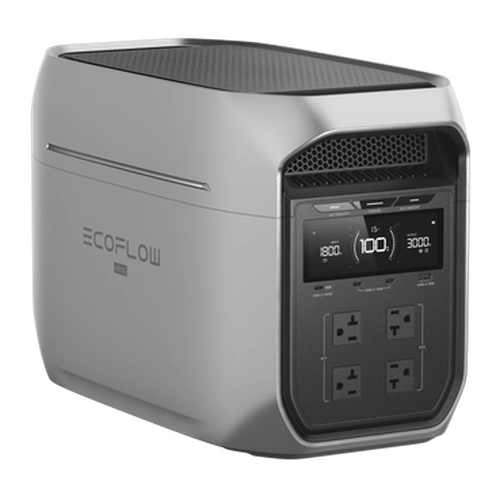
EcoFlow DELTA 3 Max Plus: $1,149 today
Between the two, and the one of the three that grows: 2,048Wh and 3,000W from four 20A outlets, a 12V car socket and a 30A Anderson port, 1,000W of solar on two ports, 2,600W of Smart Generator charging and up to two Max Plus extra batteries for about 10kWh, at 48.7 lb. It has no TT-30, and the same 3-plus-2-year warranty. StorageReview measured an 8ms switchover and 1.64kWh out of it. See the DELTA 3 Max Plus at EcoFlow.
Eight modeled situations, worked out
Same formula as the calculator above: 85% of the rated capacity. Neither takes an extra battery. The fridge averages 60W, about 525kWh a year.
24-hour outage, essentials only
The Classic gets you through the evening and part of the night. The Ultra covers the whole day and then some.
A full-size fridge, nothing else
About 14 hours on the Classic, close to two days on the Ultra.
Microwave and coffee maker at once
Only the Ultra runs both. On the Classic, one at a time: X-Boost helps heating loads, not a microwave’s electronics.
CPAP, every night
Two to three nights on the Classic, about eight on the Ultra.
An RV on a 30A cord
The Ultra’s TT-30 takes the RV’s shore cord directly. The Classic has household outlets only, so the RV needs a 30A-to-15A adapter and stays under 1,800W.
Refill from solar, each at its maximum
The Classic refills in one good afternoon; the Ultra needs most of a sunny day even at 800W. EcoFlow says the Classic fills in about 2.5 hours at 500W.
Refill from the wall before a storm
The Classic reaches 80% in half the time; the Ultra puts three times as much energy back in 89 minutes.
Moving it
The Classic is a one-hand carry. The Ultra is a two-person lift, or a station that lives on a cart.
Nine more differences, the spec sheet and the box
Smaller gaps that rarely decide the purchase, then the full specifications and what ships in the box.
DELTA 3 Classic and DELTA 3 Ultra weight, dimensions and full specifications
Weight: 26.6 lb for the DELTA 3 Classic and 72.1 lb for the DELTA 3 Ultra. Dimensions: 15.7 × 7.9 × 11.1 in and 24.6 × 12.9 × 15.5 in. Everything else is in the sheet below.
EcoFlow DELTA 3 Classic and EcoFlow DELTA 3 Ultra full specifications
Every published figure for both units, grouped. Green marks the better value.
What’s in the box
DELTA 3 Classic
- DELTA 3 Classic power station1,024Wh, 26.6 lb
- AC charging cable
- Manuals and warranty card
- Solar cable sold separatelyEcoFlow Solar to XT60i cable
- No car charging cablesold separately, per the manual
DELTA 3 Ultra
- DELTA 3 Ultra3,072Wh, 72.1 lb
- AC charging cable
- Manuals and warranty card
- No solar or car cablesold separately
From the EcoFlow US product pages and the Classic’s manual; bundles add the matching cables.
07 · ChargingHow fast each one refills
Shorter bar, faster refill. Each row is scaled to its slower unit.
Classic: Basic Tutorials needed just under 55 minutes for a full charge on a 230V EU unitUltra: EcoFlow US gives 0 to 80% in 1.48 hours at 1,800W
Our solar times assume panels deliver 70% of their rating; the brands’ figures assume ideal sun.
Every port, side by side
DELTA 3 Classic
DELTA 3 Ultra
Practical consequence: the Ultra adds a fourth outlet, a TT-30 for an RV, a 12V car socket, a 140W USB-C and Smart Generator charging. The Classic has AC and USB only.
09 · NoiseNoise and heat: Classic vs Ultra
EcoFlow rates the EcoFlow DELTA 3 Classic at 30dB or less at 600W and the EcoFlow DELTA 3 Ultra at 25dB or less at 600W.
EcoFlow’s figures first; reviewer reports where we found one.Every figure we found, with its source
What reviewers heard: During a high-load grill test, battery temperature in the app climbed from 35 to 53°C, with audible fans (Basic Tutorials, EU unit).
Measured by a tester Brand figure
- Lower the AC charging speed in the EcoFlow app overnight: the fans run hardest while fast charging.
Cold and heat: Classic vs Ultra
The EcoFlow DELTA 3 Classic and the EcoFlow DELTA 3 Ultra share the same limits: charging from 32°F to 113°F, running from 14°F to 113°F. Neither carries a water rating.
Figures from the DELTA 3 Classic manual and EcoFlow US for the DELTA 3 Ultra.- Charge either one indoors in winter: neither charges below 32°F.
- Run it between 68°F and 86°F when you can: EcoFlow’s optimal operating range.
App, UPS and smart features
The EcoFlow DELTA 3 Ultra does more: a Smart Generator link.
Same EcoFlow app over Wi-Fi and Bluetooth.Green zone: a switch under about 16ms, which most desktop PCs ride through without restarting.
Does it work with EcoFlow’s Smart Generator? The EcoFlow DELTA 3 Classic doesn’t work with the Smart Generator 3000’s automatic start-stop, per EcoFlow; the EcoFlow DELTA 3 Ultra charges from an EcoFlow Smart Generator at up to 1,600W.
Does it work as a UPS? The EcoFlow DELTA 3 Classic switches in 10ms; the EcoFlow DELTA 3 Ultra switches in under 10ms.
Can you add a battery later? The EcoFlow DELTA 3 Classic has no extra battery port; the EcoFlow DELTA 3 Ultra can’t be expanded: EcoFlow lists its max scalability as 0.
Does it prepare for storms? Both charge ahead of severe weather once Storm Guard is turned on in the EcoFlow app.
How does the app connect? Both use the EcoFlow app over Wi-Fi and Bluetooth for monitoring, charge limits and output control.
Warranty and support
EcoFlow gives the EcoFlow DELTA 3 Classic and the EcoFlow DELTA 3 Ultra the same deal: 3 years, plus 2 more once registered in the EcoFlow app.
Same term on both.Subject to each brand’s warranty terms and eligibility.
For the DELTA 3 Classic, no cycle count on its US page; EcoFlow quotes 10 years of reliable power. For the DELTA 3 Ultra, no cycle count on its US page; EcoFlow quotes 10 years of reliable power. Heat and calendar age also wear a battery, so read any rating as a ceiling.
- If you choose the EcoFlow DELTA 3 Classic, register it in the EcoFlow app the day it arrives: without registration, the warranty stops at 3 years.
- If you choose the EcoFlow DELTA 3 Ultra, register it in the EcoFlow app the day it arrives: without registration, the warranty stops at 3 years.
What reviewers report
We have not lab-tested these two units. Here is what the one published review we found reports, with the source, author and date for each point. Reviews of UK and EU units are flagged: those models charge from 230V outlets and have different sockets, so their charge times and outlet findings don’t carry over to US units.
DELTA 3 Classic: Basic Tutorials (March 2026, EU unit)DELTA 3 Ultra: no verifiable independent test found
Usable capacity
- ClassicReviewer At over 1,800W the battery ran from full to 0 percent in just over 30 minutes. Basic Tutorials, Simon Lüthje, March 2026, EU unit
Charging
- ClassicReviewer A full wall charge took just under 55 minutes on the European unit (1,400W AC input). Flag: 230V charging. Basic Tutorials, Simon Lüthje, March 2026, EU unit
Noise and heat
- ClassicReviewer Battery temperature in the app climbed from 35 to 53 degrees C during the high-load grill test, with audible fans. Basic Tutorials, Simon Lüthje, March 2026, EU unit
UPS and output
- ClassicReviewer It held about 1.83kW of output on an electric grill from full down to empty, with no drop in power. Basic Tutorials, Simon Lüthje, March 2026, EU unit
Daily use and issues
- ClassicReviewer There is no 12-volt car socket for DC devices like cool boxes. Basic Tutorials, Simon Lüthje, March 2026, EU unit
Practical limits before you buy
- Neither can be expanded. The Classic has no battery port and EcoFlow lists the Ultra’s max scalability as 0. For 3kWh that grows, look at the Ultra Plus.
- The Classic has no 12V socket. Basic Tutorials flagged it for cool boxes and other DC gear.
- The Ultra has no Anderson port, only a 126W car socket. The Ultra Plus adds it.
- The Classic’s surge figure differs: 3,000W in its manual, 3,600W on its product page. Plan on the lower one.
- The Ultra weighs 72.1 lb. Plan where it lives before an outage.
- The Ultra’s TT-30 is 120V. It runs an RV’s 30A system, not a 240V well pump.
- X-Boost is for heating loads only. Motors need the continuous rating: 1,800W or 3,600W.
- Register either one in the app for the full 5 years; without it, 3.
Frequently asked questions
What is the difference between the EcoFlow DELTA 3 Classic and the DELTA 3 Ultra?
The Ultra stores 3,072Wh against 1,024Wh, delivers 3,600W against 1,800W, adds a TT-30 RV outlet, a 12V car socket and 300W more solar input. The Classic weighs 26.6 lb against 72.1 lb and reaches 80% from the wall in 45 minutes.
Can either one be expanded?
No. The Classic has no extra battery port, and EcoFlow lists the Ultra’s max scalability as 0. The DELTA 3 Ultra Plus and the DELTA 3 Max Plus take extra batteries.
Does the DELTA 3 Classic have a 12V car outlet?
No. 12V devices run from its AC outlets through their own adapters. The Ultra has a 126W car socket.
How long will each run a refrigerator?
At a 60W average: about 14.5 hours on the Classic and 43.5 hours on the Ultra.
Can the Ultra power an RV?
Yes, its TT-30 outlet takes a 30A RV cord directly, at 120V and up to 3,600W. The Classic needs an adapter and stays under 1,800W.
Which charges faster from the wall?
The Classic reaches 80% in 45 minutes at 1,400W; the Ultra reaches 80% in 89 minutes at 1,800W, with three times the energy to put back.
Can the Classic run a microwave?
Yes, a 1,100W microwave runs on its 1,800W inverter, for about 47 minutes on a full battery. A microwave and a coffee maker together need the Ultra.
Do they have the same warranty?
Yes: 3 years, extended to 5 when registered in the EcoFlow app.
Is there a middle option?
The DELTA 3 Max Plus: 2,048Wh and 3,000W at 48.7 lb, with a car socket, a 30A Anderson port, 1,000W of solar and extra batteries up to about 10kWh.
Related comparisons and reviews
How we compared and sources
Research-based comparison. We have not physically tested these two units. Specs come from the EcoFlow US product pages, the DELTA 3 Classic user manual and the EcoFlow US warranty table; usage observations are attributed to named reviewers. Prices and availability were checked on October 31, 2026.
- Specs: EcoFlow US, DELTA 3 Classic and its user manual (EF-DL3-C), and EcoFlow US, DELTA 3 Ultra, read on October 31, 2026; warranty terms from the EcoFlow US warranty policy.
- Reviewer reports on the DELTA 3 Classic: Basic Tutorials, Simon Lüthje, March 2026, EU unit.
- Runtime = capacity × 0.85 ÷ watts. Solar harvest = min(panel watts, max input) × sun hours × 0.70. Cost per lifetime kWh = price ÷ (cycles × capacity in kWh).
The Ultra triples the battery, doubles the output and adds a TT-30; the Classic is 45.5 lb lighter. Prices sit $820 apart.
Prices checked November 13, 2026 at 6:29 AM EST
Looking at other models? Browse all power station comparisons, or pick any two models on the hub and we point you to the right duel.
Originally published: November 9, 2026