
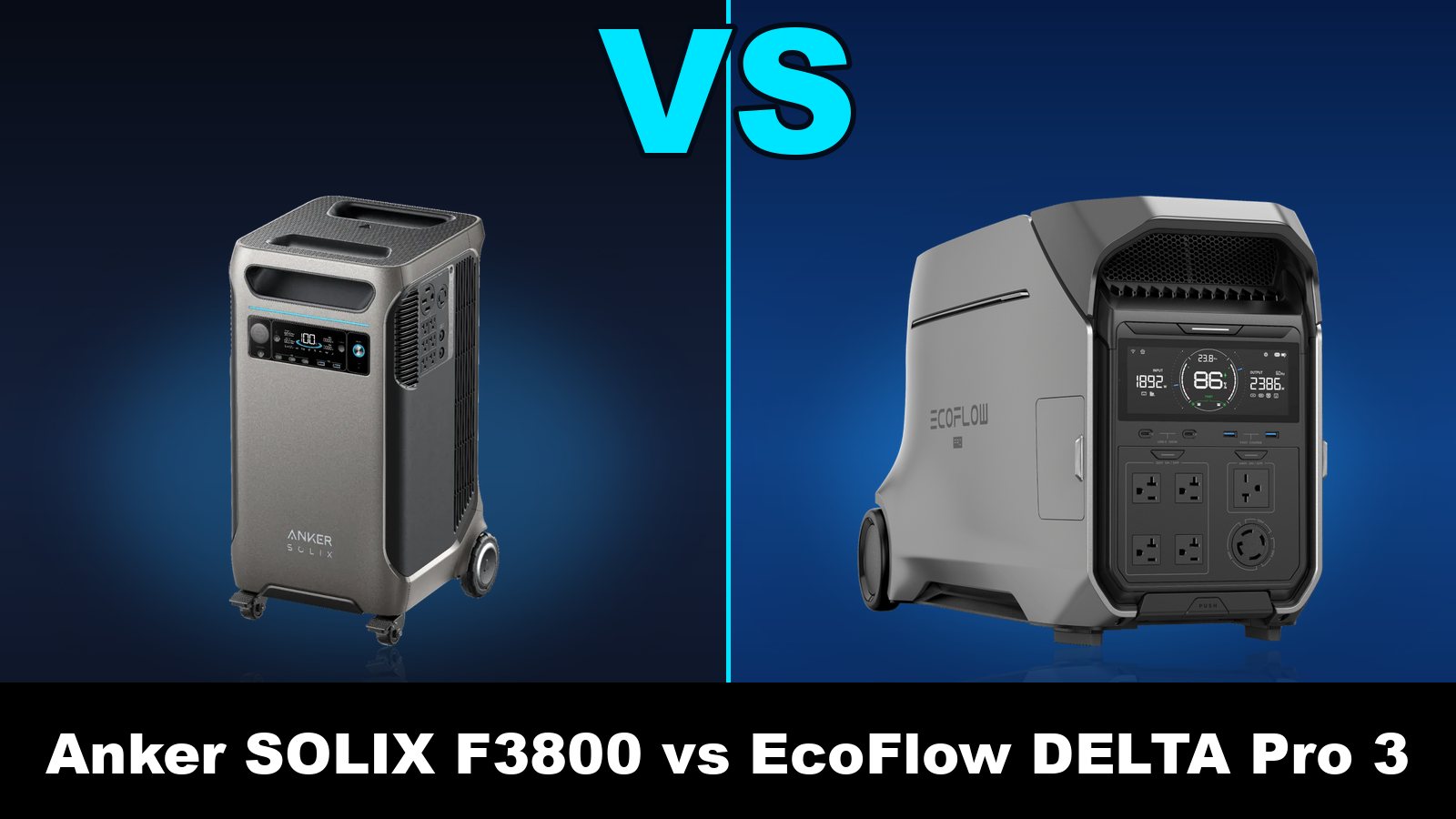
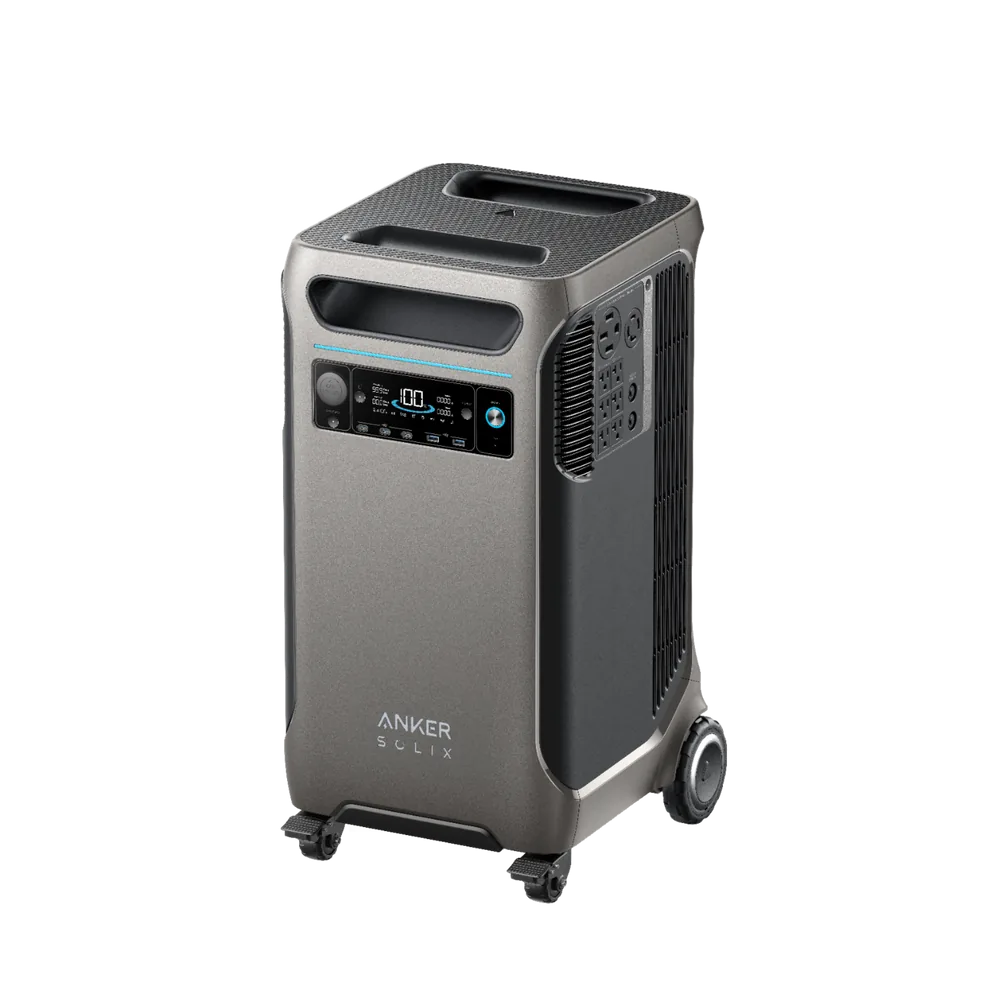
F3800
- you already own one: 6,000W at 240V still beats the Pro 3
- your EV charger or 50A RV cord needs a NEMA 14-50
- you want more capacity: a BP3800 battery fits it

DELTA Pro 3
- you want 4,096Wh and room to about 12kWh
- you’ll charge from a 240V outlet: 3,600W
- a PC or a CPAP needs the 10ms UPS
Prices and stock checked by our price engine on November 13, 2026 at 6:59 AM EST. Each product is rechecked several times a day; the time refreshes when you load the page.
Two 240V home-backup stations on wheels. One has more inverter; the other charges faster and is the one still sold.
Anker US no longer sells the F3800: its page redirects to the F3800 Plus. The F3800 stored 3,840Wh and delivered 6,000W at 120V and 240V at once, with a NEMA 14-50 and an L14-30, at 132.2 lb. The EcoFlow DELTA Pro 3 stores 4,096Wh and delivers 4,000W at 120/240V, with a TT-30, an L14-30 and a 6-20R, charges at 3,600W from a 240V outlet, switches to battery in 10ms and weighs 113.5 lb.
Below: what changed with numbers, a 20-second calculator for your own gear, eight modeled situations, a third option, and what published tests found on each.
If you’re buying today, the DELTA Pro 3 or the F3800 Plus: Anker US no longer sells the F3800. Against it, the DELTA Pro 3 adds 256Wh, 240V wall charging, a 10ms UPS and 19 lb less, but delivers 4,000W instead of 6,000W.
- you run more than 4,000W
- you use its NEMA 14-50
- you’ll grow past 12kWh
- you charge at 3,600W from 240V
- you protect a PC: 10ms
- you’ll move it: 113.5 lb
The five differences that decide it
Both deliver 120V and 240V from an L14-30, take expansion batteries, roll on wheels, have a 12V output and work with a home panel or transfer switch. These five gaps decide it.
Will it run your setup? Check in 20 seconds
Estimates use 85% usable capacity and 70% of rated solar output. Real results vary with temperature, inverter load, shade and appliance cycling. Fridge and freezer watts are daily averages and do not include compressor startup surges.
Runtime by appliance, one at a time
Simple energy estimates, not measured runtimes. About 3,264Wh usable on the F3800 and 3,482Wh on the DELTA Pro 3.
Appliance for appliance, the DELTA Pro 3 lasts 7% longer than the F3800.
Same appliance, same watts: the gap is always the size of the battery.Get our Black Friday alerts for power stations
We track live prices on 40+ models from Jackery, EcoFlow, BLUETTI and Anker SOLIX. When a deal beats the lowest price we've recorded, you'll hear from us. During Black Friday week, one short recap a day at most.
Unsubscribe in one click. We may earn a commission when you buy through our links, at no extra cost to you. Privacy Policy
What the current options cost today
Two ways to a new 240V system today: the DELTA Pro 3 with its faster charging and 10ms UPS, or the F3800 Plus with the F3800’s 6,000W inverter. For an F3800 owner, a BP3800 is still the simplest way to more runtime.
The third option: the F3800 Plus at $2,399.99

Anker SOLIX F3800 Plus: $2,399.99 today
The F3800’s successor at Anker US: the same 3,840Wh and 6,000W at 120V and 240V at once, 3,200W of solar at up to 165V, 240V generator charging, a TT-30 and an L14-30, and up to six BP3800 batteries, at 135.6 lb. Pick it over the DELTA Pro 3 if you need more than 4,000W or expansion past 12kWh. Our F3800 vs F3800 Plus comparison goes deeper. See the F3800 Plus at Anker.
Eight modeled situations, worked out
Same formula as the calculator above. Both carry 3,840Wh, so runtimes are identical; the differences show up when you recharge or plug in something special.
24-hour outage, essentials only
Both cover a day and a half; the DELTA Pro 3 runs about 2 hours longer. Each grows with its own batteries.
Several big 240V loads at once
Only the F3800 has the headroom. X-Boost on the DELTA Pro 3 helps heating loads only.
Recharging from a 240V outlet
The DELTA Pro 3 refills from a 240V outlet at 3,600W; TechRadar confirmed EcoFlow’s 50 minutes to 80%. The F3800 takes 1,800W from a 120V outlet only.
Charging an EV at 240V
The F3800’s NEMA 14-50 fits most mobile EV chargers directly; the DELTA Pro 3 needs an L14-30 adapter and stops at 4,000W.
Refill from solar, each at its maximum
About the same time. The DELTA Pro 3’s high-voltage input takes up to 150V; the F3800 stops at 60V.
Home office through an outage
Both carry two workdays. The DELTA Pro 3 switches in 10ms; the F3800’s UPS covers three outlets at 20ms.
An RV with a 30A inlet
The DELTA Pro 3’s TT-30 takes a 30A RV cord directly; the F3800’s 14-50 suits a 50A cord.
Moving it
Both roll on wheels; plan on two people for stairs.
Nine more differences, the spec sheet and the box
Smaller gaps that rarely decide the purchase, then the full specifications and what ships in the box.
F3800 and DELTA Pro 3 weight, dimensions and full specifications
Weight: 132.2 lb for the F3800 and 113.5 lb for the DELTA Pro 3. Dimensions: 27.6 × 15.3 × 15.6 in and 16.2 × 13.4 × 27.3 in, wheels included. Everything else is in the sheet below.
Anker SOLIX F3800 and EcoFlow DELTA Pro 3 full specifications
Every published figure for both units, grouped. Green marks the better value.
What’s in the box
F3800
- F3800 power station3,840Wh, 132.2 lb
- AC charging cable
- User guide
- No car charging cablenot included, per the guide
DELTA Pro 3
- DELTA Pro 34,096Wh, 113.5 lb
- AC charging cable
- Manuals and warranty card
- Extra battery sold separately
F3800: its user guide. DELTA Pro 3: EcoFlow US page.
07 · ChargingHow fast each one refills
Shorter bar, faster refill. Each row is scaled to its slower unit.
F3800: Home Power Panel input up to 3,800WDELTA Pro 3: Smart Home Panel 2 and generator auto start
Our times divide capacity by input power, with solar at 70% of panel rating; real charging slows near full.
Every port, side by side
F3800
DELTA Pro 3
Practical consequence: the F3800’s 14-50 takes most EV mobile chargers and 50A RV cords directly. The DELTA Pro 3’s TT-30 takes 30A RV cords directly and its Anderson port 12V gear.
09 · NoiseNoise: F3800 vs DELTA Pro 3
Both stay quiet in daily use. Notebookcheck found the Anker SOLIX F3800 silent at low load and about 42dB at 1 m during a long 3,000W draw; OutdoorGearLab only noticed the EcoFlow DELTA Pro 3‘s fan near its 4,000W maximum.
Neither brand publishes a full noise rating; EcoFlow’s 30dB claim gives no load.Every figure we found, with its source
What reviewers heard: Drawing 3,000W for a long time, noise was only about 42dB at 1 m (Notebookcheck, EU unit).
What reviewers heard: Ran overnight with CPAP machines and heaters without the fan being noticed; louder only near its 4,000W maximum (OutdoorGearLab).
Measured by a tester Brand figure
- Lower the AC charging power in the app when the unit sits in a living space overnight.
Cold, heat and storage: F3800 vs DELTA Pro 3
For a cold garage, the Anker SOLIX F3800 keeps running down to −4°F; for a hot shed, the EcoFlow DELTA Pro 3 is rated to 113°F and its battery pack to IP65. Neither charges below freezing.
Figures from the F3800 user guide (A1790) and the EcoFlow US DELTA Pro 3 page.- Charge either one indoors in winter: neither charges below 32°F.
- For long-term storage, keep the DELTA Pro 3 between 68°F and 86°F, the range its US documentation gives.
- Only the DELTA Pro 3’s battery pack is sealed to IP65: keep the main unit dry too.
App, UPS and smart features
The Anker SOLIX F3800 grows much further, up to 26.9kWh. The EcoFlow DELTA Pro 3 switches faster as a UPS and starts an EcoFlow generator by itself.
Both use their brand’s app over Wi-Fi and Bluetooth and work with a home panel.Green zone: a switch under about 16ms, which most desktop PCs ride through without restarting.
Can it start a generator by itself? The EcoFlow DELTA Pro 3 starts an EcoFlow Smart Generator automatically; Anker lists no such feature for the Anker SOLIX F3800.
Can it charge off-peak? The Anker SOLIX F3800 has time-of-day and peak shaving modes in the app; EcoFlow lists no such mode for the DELTA Pro 3.
Does it work as a UPS? The EcoFlow DELTA Pro 3 switches to battery in 10ms. On the Anker SOLIX F3800, only the three left 120V outlets switch, in 20ms, with pass-through capped at 1,440W; StorageReview measured 13ms.
Does it connect to a home panel? The Anker SOLIX F3800 works with Anker’s Home Power Panel, Double Power Hub and Transfer Switch. The EcoFlow DELTA Pro 3 pairs with the Smart Home Panel 2 and feeds a transfer switch from its L14-30.
Can you add a battery later? The Anker SOLIX F3800 takes up to six BP3800 for 26.9kWh; the EcoFlow DELTA Pro 3 takes up to two Extra Batteries, about 12kWh.
Warranty and support
Anker listed the Anker SOLIX F3800 at 5 years, and an existing unit keeps the term it was sold with. EcoFlow’s pages disagree on the EcoFlow DELTA Pro 3: 3 years plus 2 on app registration on its product page, 5 years with no condition in its US table, so count on 3 until you register it.
Both reach 5 years at best.Subject to each brand’s warranty terms and eligibility.
Anker rates the F3800 at 3,000+ cycles without stating the capacity left at the end. EcoFlow rates the DELTA Pro 3 at 4,000 cycles to 80% capacity.
- Buying a leftover or used F3800? Check its warranty date first: Anker US no longer sells it.
- Register the DELTA Pro 3 in the EcoFlow app the day it arrives: its product page ties years 4 and 5 to registration, even though EcoFlow’s US warranty table lists 5 years with no condition.
What reviewers report
We have not lab-tested these two units. Here is what 10 published reviews found, with the source, author and date for each point. Reviews of UK and EU units are flagged: those models charge from 230V outlets and have different sockets, so their charge times and outlet findings don’t carry over to US units.
F3800: StorageReview (June 2024), Notebookcheck (August 2024, EU unit), Trusted Reviews (July 2024, UK unit), TechRadar (January 2024)DELTA Pro 3: Digital Trends (June 2024), OutdoorGearLab (January 2026), TechRadar (March 2025), RV.com (July 2024), The Gadgeteer (October 2024), Techspective (July 2025)
Usable capacity
- F3800Reviewer Took 4,930Wh to charge from 0 to 100% and delivered 2,980Wh before the inverter cut off. StorageReview, Kevin OBrien, June 2024
- F3800Reviewer At about 260W for roughly 11 hours it supplied 2,905Wh, a good 75% of rated capacity. Notebookcheck, Marcus Schwarten, August 2024, EU unit
- F3800Reviewer At a 2,000W load it delivered 3,269Wh (85.13%), falling to 71.61% at 1,000W and 65.23% at 200W. Trusted Reviews, David Ludlow, July 2024, UK unit
- DELTA Pro 3Reviewer Averaged 3.7kWh of discharge over several cycles, a little under the 4kWh rating. Digital Trends, Simon Sage, June 2024
- DELTA Pro 3Reviewer Test jig measured 3,790Wh from the 4,096Wh battery, over 93%, well above average for power stations. OutdoorGearLab, Kenji Mowrey, January 2026
Charging
- F3800Reviewer A full charge from 1 to 100% drew 4,669Wh, about 82% efficient. EU 230V version, flag. Notebookcheck, Marcus Schwarten, August 2024, EU unit
- F3800Reviewer Charging at the default 2,990W consumed 4,388Wh, 87.51% efficient. UK 13A mains, flag. Trusted Reviews, David Ludlow, July 2024, UK unit
- DELTA Pro 3Reviewer A full charge from empty drew close to 5kWh from the wall and took about three hours. Digital Trends, Simon Sage, June 2024
- DELTA Pro 3Reviewer Never reached the full 1,800W input on a 15A outlet: peak near 1,600W, average 1,293Wh per hour, full charge within 3 hours. OutdoorGearLab, Kenji Mowrey, January 2026
- DELTA Pro 3Reviewer Wall charging routinely took half the three to four hours the reviewer expected, or less. RV.com, Kraig Becker, July 2024
Noise and heat
- F3800Reviewer Drawing 3,000W for a long time, noise was only about 42dB at 1m. Notebookcheck, Marcus Schwarten, August 2024, EU unit
- DELTA Pro 3Reviewer Used through an East Coast heat wave, routinely above 90 degrees F, which let the reviewer test its operating limits. Digital Trends, Simon Sage, June 2024
- DELTA Pro 3Reviewer Ran overnight with CPAP machines and heaters without the fan being noticed; fan gets louder only near its 4,000W maximum. OutdoorGearLab, Kenji Mowrey, January 2026
UPS and output
- F3800Reviewer Lab test with a Quarch analyzer measured 13ms on transfer to battery and 14ms when power returned. StorageReview, Kevin OBrien, June 2024
- F3800Reviewer Only the 120V ports support UPS; 120V in with 240V split-phase out at once is not supported. StorageReview, Kevin OBrien, June 2024
- DELTA Pro 3Reviewer Reviewer pushed it to add charge to a Tesla, and says it can run an industrial popcorn machine for hours. TechRadar, Collin Probst, March 2025
- DELTA Pro 3Reviewer Used as a UPS and home backup; the reviewer cites EcoFlow’s 10ms switchover for critical appliances. TechRadar, Collin Probst, March 2025
- DELTA Pro 3Reviewer Powers a garage gym circuit including a 12,000 BTU air conditioner, TV, treadmill and other gear, kept topped up from a 120V 20A outlet. The Gadgeteer, Julian Perry, October 2024
Daily use and issues
- F3800Reviewer Too heavy to throw in a car like smaller stations; 132.3 lb. TechRadar, Collin Probst, January 2024
- F3800Reviewer The app ran a firmware update, joined Wi-Fi for remote status and set charging power. TechRadar, Collin Probst, January 2024
- DELTA Pro 3Reviewer At 115 lb, the reviewer says it barely counts as portable. Digital Trends, Simon Sage, June 2024
- DELTA Pro 3Reviewer Measured weight 114.1 lb, versus 97.5 lb for the original DELTA Pro. OutdoorGearLab, Kenji Mowrey, January 2026
- DELTA Pro 3Reviewer Weight listed as the main drawback alongside price. TechRadar, Collin Probst, March 2025
- DELTA Pro 3Reviewer At 114 lb it is hard to move around a campsite or job site, fine if left plugged in at home or in an RV. RV.com, Kraig Becker, July 2024
Practical limits before you buy
- The F3800 is discontinued. Anker US redirects its page to the F3800 Plus. Leftover or used units exist; check the warranty date before buying one.
- The DELTA Pro 3 stops at 4,000W. Several big 240V loads together can overload it.
- The DELTA Pro 3 has no NEMA 14-50. A 50A RV cord or a 14-50 EV charger needs an L14-30 adapter.
- The F3800 can’t charge from 240V. Its AC input is 1,800W at 120V; the DELTA Pro 3 takes 3,600W at 240V.
- Keep the F3800 under 60V of solar. The DELTA Pro 3’s high-voltage input takes up to 150V.
- Only the DELTA Pro 3’s battery pack is IP65. The main unit is IP20.
- Both are heavy. 132.2 lb and 113.5 lb: wheels help on flat floors, plan on two people for stairs.
- Register the DELTA Pro 3 in the EcoFlow app for its 5-year warranty.
- F3800, per its US documentation: While recharging on AC, only the 120V UPS outlets can power other devices.
- F3800, per its US documentation: Each solar input max open-circuit voltage is 60V, including panels in series.
- DELTA Pro 3, per its US documentation: Only the battery pack is sealed to IP65; the main unit is IP20 with no water or dust rating.
- DELTA Pro 3, per its US documentation: Charging 0 to 45°C (32-113°F), discharging -10 to 45°C (14-113°F); optimal operation and long-term storage 20 to 30°C.
Frequently asked questions
Is the Anker F3800 discontinued?
Yes, at Anker US: its page redirects to the F3800 Plus, which keeps the same battery and 6,000W inverter.
Which has more power?
The F3800: 6,000W at 120V and 240V at once, against 4,000W on the DELTA Pro 3.
Which lasts longer?
The DELTA Pro 3, slightly: 4,096Wh against 3,840Wh, about 2 hours more on an essentials-only day.
Which charges faster?
The DELTA Pro 3 with a 240V outlet: 3,600W, 0 to 80% in 50 minutes. From a 120V outlet both take 1,800W.
Which is better as a UPS?
The DELTA Pro 3: 10ms. The F3800’s UPS covers three outlets at 20ms, 13ms in StorageReview’s test.
Which grows further?
The F3800, to 26.9kWh with six BP3800 batteries; the DELTA Pro 3 to about 12kWh with two extra batteries.
Can either charge an EV?
Both, at 240V. The F3800’s NEMA 14-50 fits most mobile EV chargers directly at up to 6,000W; the DELTA Pro 3 needs an L14-30 adapter and stops at 4,000W.
How much do they weigh?
132.2 lb for the F3800 and 113.5 lb for the DELTA Pro 3, both on wheels.
Is there a third option?
Yes: the F3800 Plus, the F3800’s successor, with the same 3,840Wh and 6,000W at 120/240V, 3,200W of solar and BP3800 expansion.
Related comparisons and reviews
How we compared and sources
Research-based comparison. We have not physically tested these two units. F3800 specs come from its US user guide, because Anker US now redirects its page to the F3800 Plus; DELTA Pro 3 specs from EcoFlow US. Usage observations are attributed to named reviewers. Checked on October 30, 2026.
- Specs: Anker SOLIX F3800 user guide (A1790, US) and EcoFlow US, DELTA Pro 3, read on October 30, 2026.
- The F3800’s 9,000W surge comes from Anker’s original listing.
- Reviewer reports on the F3800: StorageReview, Kevin OBrien, June 2024, Notebookcheck, Marcus Schwarten, August 2024, EU unit, Trusted Reviews, David Ludlow, July 2024, UK unit, TechRadar, Collin Probst, January 2024; on the DELTA Pro 3: Digital Trends, Simon Sage, June 2024, OutdoorGearLab, Kenji Mowrey, January 2026, TechRadar, Collin Probst, March 2025, RV.com, Kraig Becker, July 2024, The Gadgeteer, Julian Perry, October 2024, Techspective, Tony Bradley, July 2025.
- Runtime = capacity × 0.85 ÷ watts. Solar harvest = min(panel watts, max input) × sun hours × 0.70.
The DELTA Pro 3 adds 256Wh, 240V charging and a 10ms UPS, 19 lb lighter; the F3800, replaced by the F3800 Plus, had 6,000W at 120/240V.
Prices checked November 13, 2026 at 6:59 AM EST
Looking at other models? Browse all power station comparisons, or pick any two models on the hub and we point you to the right duel.
Originally published: November 7, 2026