
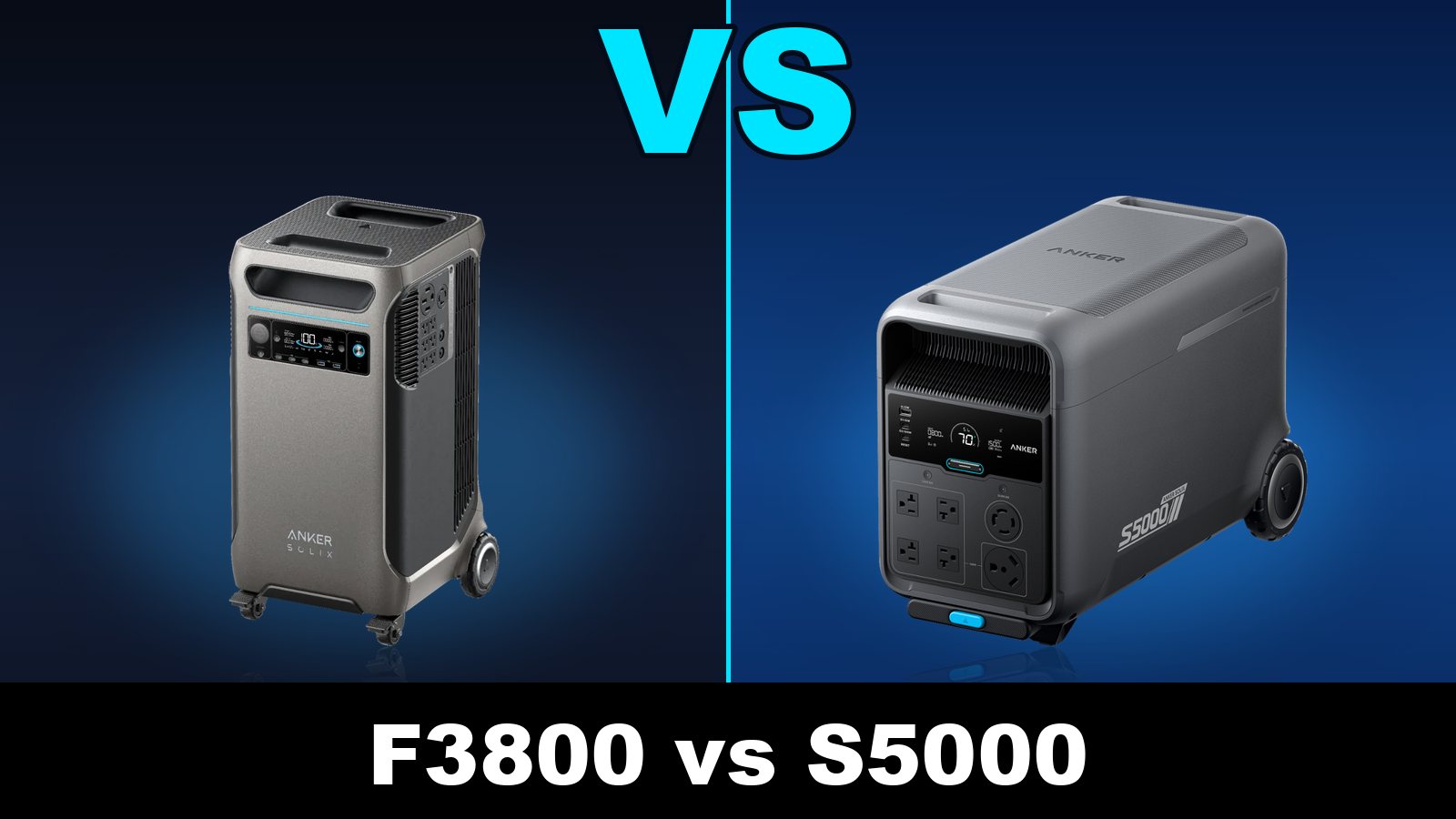
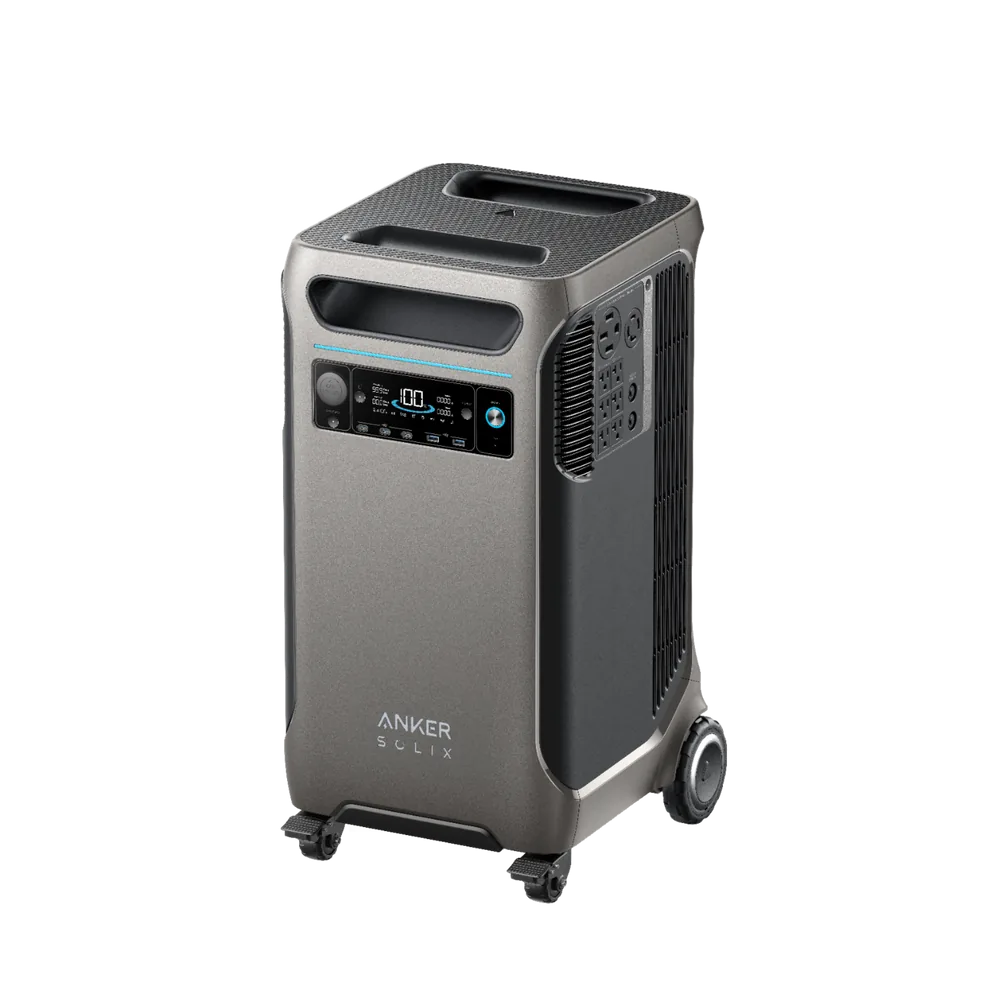
F3800
- you already own one: 6,000W at 240V still beats the S5000
- your EV charger or 50A RV cord needs a NEMA 14-50
- you want more capacity: a BP3800 battery fits it

S5000
- you want 5,024Wh in one box
- you’ll move it: 97 lb, 35 lb less
- a PC or a CPAP needs the 10ms UPS
Prices and stock checked by our price engine on November 5, 2026 at 2:59 AM EST. Each product is rechecked several times a day; the time refreshes when you load the page.
More battery and less weight on one side, more power on the other.
Anker US no longer sells the F3800: its page redirects to the F3800 Plus. The F3800 stored 3,840Wh and delivered 6,000W at 120/240V, with a NEMA 14-50 and an L14-30, at 132.2 lb. The S5000, on sale since October 2026, stores 5,024Wh and delivers 4,500W at 120V or 240V, with a TT-30 and an L14-30, takes 3,000W of solar and switches to battery in 10ms instead of 20ms, at 97 lb. Both take expansion batteries and roll on wheels.
Below: what changed with numbers, a 20-second calculator for your own gear, eight modeled situations, a third option, and what published tests found on each.
If you’re buying today, the S5000 or the F3800 Plus: Anker US no longer sells the F3800. Against it, the S5000 adds 1,184Wh and a 10ms UPS in a box 35 lb lighter, but delivers 4,500W instead of 6,000W, and 120V or 240V, not both at once.
- you run more than 4,500W at once
- you use its NEMA 14-50
- you’ll add BP3800 batteries
- you want 5,024Wh now
- you’ll move it: 97 lb
- you protect a PC: 10ms
The five differences that decide it
Both use LFP cells, deliver 240V through an L14-30, take expansion batteries, roll on wheels and carry a 5-year Anker warranty. These five gaps decide it.
Will it run your setup? Check in 20 seconds
Estimates use 85% usable capacity and 70% of rated solar output. Real results vary with temperature, inverter load, shade and appliance cycling. Fridge and freezer watts are daily averages and do not include compressor startup surges.
Runtime by appliance, one at a time
Simple energy estimates, not measured runtimes. About 3,264Wh usable on the F3800 and 4,270Wh on the S5000.
Appliance for appliance, the S5000 lasts 31% longer than the F3800.
Same appliance, same watts: the gap is always the size of the battery.Get our Black Friday alerts for Anker SOLIX
We track live prices on 40+ models from Jackery, EcoFlow, BLUETTI and Anker SOLIX. When a deal beats the lowest price we've recorded, you'll hear from us. During Black Friday week, one short recap a day at most.
Unsubscribe in one click. We may earn a commission when you buy through our links, at no extra cost to you. Privacy Policy
What the current options cost today
The S5000 is the lighter of the two current options; the F3800 Plus keeps the F3800’s 6,000W split-phase inverter. For an F3800 owner, a BP3800 expansion battery adds runtime without replacing the unit. Anker US prices move often; the figures here are refreshed daily by our price engine.
The third option: the F3800 Plus at $2,599.99

Anker SOLIX F3800 Plus: $2,599.99 today
The F3800’s successor at Anker US: the same 3,840Wh and 6,000W at 120V and 240V at once, 3,200W of solar at up to 165V, 240V generator charging, a TT-30 and an L14-30, and up to six BP3800 batteries, at 135.6 lb. Pick it over the S5000 if you need more than 4,500W or 120V and 240V together. Our F3800 vs F3800 Plus comparison goes deeper. See the F3800 Plus at Anker.
Eight modeled situations, worked out
Same formula as the calculator above. Both carry 3,840Wh, so runtimes are identical; the differences show up when you recharge or plug in something special.
24-hour outage, essentials only
The S5000 runs about 11 hours longer. ESS News ran a large fridge and phones for 61.5 hours through a real PG&E outage on an S5000.
A full-size fridge, nothing else
Bob Vila kept a fridge running about 86 hours on an S5000.
Several big 240V loads at once
Only the F3800 has the headroom. The S5000 also can’t serve 120V and 240V loads at the same time.
Charging an EV at 240V
The F3800’s NEMA 14-50 fits most mobile EV chargers directly; the S5000 needs an L14-30 adapter. A full S5000 gives more energy, the F3800 more power.
Refill from solar, each at its maximum
About the same time, for 1,184Wh more on the S5000. Its high-voltage input takes 16 to 165V; the F3800 stops at 60V.
Recharging from a 120V wall outlet
Same 1,800W at first; the S5000 drops to 12A after about three hours and has more to fill. Bob Vila measured about 3.5 hours; on 240V, Anker says 99 minutes.
Home office through an outage
Both carry two workdays. The S5000 switches in 10ms; Bob Vila’s PC didn’t cut out. The F3800’s UPS covers three outlets at 20ms.
Moving it
Both roll on wheels. Bob Vila still needed two people for stairs with the S5000; ESS News found it tippy on grass.
Nine more differences, the spec sheet and the box
Smaller gaps that rarely decide the purchase, then the full specifications and what ships in the box.
F3800 and S5000 weight, dimensions and full specifications
Weight: 132.2 lb for the F3800 and 97 lb for the S5000. Dimensions: 27.6 × 15.3 × 15.6 in and 10.6 × 22.0 × 15.2 in, wheels included. Everything else is in the sheet below.
Anker SOLIX F3800 and S5000 full specifications
Every published figure for both units, grouped. Green marks the better value.
What’s in the box
F3800
- F3800 power station3,840Wh, 132.2 lb
- AC charging cable
- User guide
- No car charging cablenot included, per the guide
S5000
- S5000 power station5,024Wh, 97 lb
- AC charging cable
- User guide
- Solar cables sold separately
F3800: its user guide. S5000: Anker US page and user guide.
07 · ChargingHow fast each one refills
Shorter bar, faster refill. Each row is scaled to its slower unit.
F3800: Home Power Panel input up to 3,800WS5000: up to 4,500W at 240V on a single unit (Anker AS510 manual); ESS News saw 1.79kW for 2 h 49 at 120V
Our times divide capacity by input power, with solar at 70% of panel rating; real charging slows near full.
Every port, side by side
F3800
S5000
Practical consequence: the F3800’s 14-50 takes most EV mobile chargers and 50A RV cords directly, and it has a 12V socket. The S5000’s TT-30 takes 30A RV cords directly; it has no 12V output at all.
09 · NoiseNoise: F3800 vs S5000
Both are quiet. Anker rates the Anker SOLIX S5000 under 30dB at 2,000W; Notebookcheck measured the Anker SOLIX F3800 at about 42dB during a long 3,000W draw.
The two figures come from different loads. Anker published no rating for the F3800.Every figure we found, with its source
What reviewers heard: Silent at low load (Notebookcheck, EU unit).
What reviewers heard: Charging very quiet, even quieter than the S2000 (ESS News); nearly silent running a portable AC, but the fans hum noticeably as the load rises (Bob Vila).
Measured by a tester Brand figure
- Lower the AC charging power in the Anker app when the unit sits in a living space overnight.
Cold and heat: F3800 vs S5000
The Anker SOLIX F3800 and the Anker SOLIX S5000 share the same limits: charging from 32°F to 104°F, running from −4°F to 104°F. Neither has a water rating.
Figures from the F3800 (A1790) and S5000 (AS510) user guides.- In a garage in winter, charge either one indoors or wait for the battery to warm up: neither charges below 32°F.
App, UPS and smart features
The Anker SOLIX S5000 switches faster, 10ms against 20ms, and adds Storm Guard. The Anker SOLIX F3800 delivers 120V and 240V at once and works with Anker’s Home Power Panel.
Both use the Anker app over Wi-Fi and Bluetooth, with off-peak modes.Green zone: a switch under about 16ms, which most desktop PCs ride through without restarting.
Can it deliver 120V and 240V at once? The Anker SOLIX F3800 delivers 120V and 240V at the same time; the Anker SOLIX S5000 delivers one or the other, never both at once, per its guide.
Does it prepare for storms? The Anker SOLIX S5000’s Storm Guard uses local weather alerts to recharge at full speed before severe weather, ignoring preset limits; Anker lists no such mode for the Anker SOLIX F3800.
Does it connect to a home panel? The Anker SOLIX F3800 works with Anker’s Home Power Panel, Double Power Hub and Transfer Switch. The Anker SOLIX S5000 feeds a transfer switch or an inlet box from its L14-30R, but not the Home Power Panel, and doesn’t work with the E10 system.
Does it work as a UPS? The Anker SOLIX S5000 switches in 10ms, and Bob Vila’s PC kept running. On the Anker SOLIX F3800, the three left 120V outlets switch in 20ms with pass-through capped at 1,440W; StorageReview measured 13ms.
Can you add a battery later? The Anker SOLIX F3800 takes up to six BP3800; the Anker SOLIX S5000 up to five BP5000. BP3800 and BP3000 batteries don’t fit the S5000.
Can it charge off-peak? Both have off-peak modes in the Anker app: time-of-day and peak shaving on the F3800, Time-of-Use with four rate periods on the S5000.
How does the app connect? Both use the Anker app over Wi-Fi or Bluetooth, with adjustable charging power.
Warranty and support
Anker lists both the Anker SOLIX F3800 and the Anker SOLIX S5000 at 5 years. The F3800 is no longer sold by Anker US; an existing unit keeps the term it was sold with.
Same term. Only the S5000 has a full cycle rating.Subject to each brand’s warranty terms and eligibility.
Anker rates the S5000 at 6,000 cycles to 80%, or 10,000 to 60%, about 16 years at one full cycle a day. For the F3800 it gives 3,000+ cycles without the capacity left at that point. Calendar aging and heat also reduce capacity.
- If you find an F3800 from another seller, check what’s left of its warranty before buying: Anker US no longer sells it.
- Anker states no registration condition for the S5000’s 5 years.
What reviewers report
We have not lab-tested these two units. Here is what 6 published reviews found, with the source, author and date for each point. Reviews of UK and EU units are flagged: those models charge from 230V outlets and have different sockets, so their charge times and outlet findings don’t carry over to US units.
F3800: StorageReview (June 2024), Notebookcheck (August 2024, EU unit), Trusted Reviews (July 2024, UK unit), TechRadar (January 2024)S5000: ESS News (October 2026), Bob Vila (October 2026)
Usable capacity
- F3800Reviewer Took 4,930Wh to charge from 0 to 100% and delivered 2,980Wh before the inverter cut off. StorageReview, Kevin OBrien, June 2024
- F3800Reviewer At about 260W for roughly 11 hours it supplied 2,905Wh, a good 75% of rated capacity. Notebookcheck, Marcus Schwarten, August 2024, EU unit
- F3800Reviewer At a 2,000W load it delivered 3,269Wh (85.13%), falling to 71.61% at 1,000W and 65.23% at 200W. Trusted Reviews, David Ludlow, July 2024, UK unit
- S5000Reviewer On a full discharge the app reported 4.87kWh delivered, about 97% of the 5,024Wh nameplate; output was not independently metered. ESS News (pv magazine group), Andrew Riha, October 2026
- S5000Reviewer During a real PG&E shutoff it ran a large fridge plus phones for 61.5 hours, from 100% down to 18%. ESS News (pv magazine group), Andrew Riha, October 2026
Charging
- F3800Reviewer A full charge from 1 to 100% drew 4,669Wh, about 82% efficient. EU 230V version, flag. Notebookcheck, Marcus Schwarten, August 2024, EU unit
- F3800Reviewer Charging at the default 2,990W consumed 4,388Wh, 87.51% efficient. UK 13A mains, flag. Trusted Reviews, David Ludlow, July 2024, UK unit
- S5000Reviewer Charging at the 1,800W setting from 120V, wall draw held near 1.79kW for 2 h 49 min, then dropped to about 1.43kW for the last 50 minutes. ESS News (pv magazine group), Andrew Riha, October 2026
- S5000Reviewer A full charge pulled 6.24kWh from the wall, giving roughly a 78% round trip based on the app’s discharge reading. ESS News (pv magazine group), Andrew Riha, October 2026
- S5000Reviewer At the 1,000W setting the charge took 65% longer but used only 1.7% less wall energy. ESS News (pv magazine group), Andrew Riha, October 2026
Noise and heat
- F3800Reviewer Drawing 3,000W for a long time, noise was only about 42dB at 1m. Notebookcheck, Marcus Schwarten, August 2024, EU unit
- S5000Reviewer Charging was very quiet, even quieter than the smaller S2000; the reviewer did not measure decibels. ESS News (pv magazine group), Andrew Riha, October 2026
- S5000Reviewer Nearly silent running a portable AC, but the cooling fans hum noticeably as the load rises. Bob Vila, Paul Rankin, October 2026
UPS and output
- F3800Reviewer Lab test with a Quarch analyzer measured 13ms on transfer to battery and 14ms when power returned. StorageReview, Kevin OBrien, June 2024
- F3800Reviewer Only the 120V ports support UPS; 120V in with 240V split-phase out at once is not supported. StorageReview, Kevin OBrien, June 2024
- F3800Reviewer Powered a rental RV including its rooftop air conditioner during an eclipse trip. StorageReview, Kevin OBrien, June 2024
- S5000Reviewer A portable air conditioner ran for more than four hours at about 1kW with no problem. ESS News (pv magazine group), Andrew Riha, October 2026
- S5000Reviewer There is no 12V DC output, which RV and van setups often expect. ESS News (pv magazine group), Andrew Riha, October 2026
Daily use and issues
- F3800Reviewer Too heavy to throw in a car like smaller stations; 132.3 lb. TechRadar, Collin Probst, January 2024
- F3800Reviewer The app ran a firmware update, joined Wi-Fi for remote status and set charging power. TechRadar, Collin Probst, January 2024
- S5000Reviewer With 120V output on and nothing plugged in, it lost 5% charge in 24 hours, about 10W, in line with Anker’s 8.8W idle rating. ESS News (pv magazine group), Andrew Riha, October 2026
- S5000Reviewer Plugged in and full, it kept drawing about 7W from the wall, roughly 60kWh a year. ESS News (pv magazine group), Andrew Riha, October 2026
- S5000Reviewer The E10 Smart Generator cable would not fully seat in this pre-release unit, so generator charging was not tested. ESS News (pv magazine group), Andrew Riha, October 2026
- S5000Reviewer Easy to wheel on flat floors, but wobbly and prone to tipping on grass or rough ground. ESS News (pv magazine group), Andrew Riha, October 2026
Practical limits before you buy
- The F3800 is discontinued. Anker US redirects its page to the F3800 Plus. Leftover or used units exist; check the warranty date before buying one.
- The S5000 stops at 4,500W, and delivers 120V or 240V, not both at once.
- The S5000 has no NEMA 14-50 and no 12V output. A 50A RV cord or a 14-50 EV charger needs an L14-30 adapter.
- BP3800 batteries don’t fit the S5000. It takes BP5000 batteries only.
- The S5000 slows to 12A on a 120V outlet after about three hours; full charging speed needs 240V.
- Keep the F3800 under 60V of solar. Its XT-60 inputs stop at 60V; the S5000’s high-voltage input takes up to 165V.
- Both are heavy. 132.2 lb and 97 lb: wheels help on flat floors, plan on two people for stairs.
- The S5000 doesn’t work with Anker’s Home Power Panel, which the F3800 does.
- F3800, per its US documentation: While recharging on AC, only the 120V UPS outlets can power other devices.
- F3800, per its US documentation: Each solar input max open-circuit voltage is 60V, including panels in series.
- S5000, per its US documentation: 120V AC charging: 1,800W max for under 3 hours, 12A (about 1,440W) continuous; 240V AC charging up to 4,500W.
- S5000, per its US documentation: The outputs do not support simultaneous 120V and 240V output.
Frequently asked questions
Is the S5000 the replacement for the F3800?
No. Anker US redirects its F3800 page to the F3800 Plus, which keeps the 6,000W split-phase inverter. The S5000 is a different design: a bigger battery with a smaller inverter, in a lighter box.
Which has more power?
The F3800: 6,000W at 120V and 240V at once. The S5000 delivers 4,500W, at 120V or 240V but not both at the same time.
Which lasts longer?
The S5000: 5,024Wh against 3,840Wh, about 30% more runtime on the same load. ESS News ran a large fridge and phones for 61.5 hours on it.
Can I use my BP3800 batteries with the S5000?
No. The S5000 takes BP5000 batteries only; BP3800 and BP3000 don’t fit, per Anker.
Which is better as a UPS?
The S5000: 10ms on its outlets. The F3800’s UPS covers three outlets at 20ms, 13ms in StorageReview’s test.
Can either charge an EV?
Both, at 240V. The F3800’s NEMA 14-50 fits most mobile EV chargers directly at up to 6,000W; the S5000 needs an L14-30 adapter and stops at 4,500W.
How fast does the S5000 charge?
On a 240V outlet, full in 99 minutes per Anker. On 120V, Bob Vila measured about 3.5 hours; ESS News saw 1.79kW for 2 h 49 min, then about 1.43kW.
How much do they weigh?
132.2 lb for the F3800 and 97 lb for the S5000, both on wheels.
Is there a third option?
Yes: the F3800 Plus, the F3800’s successor, with the same 3,840Wh and 6,000W at 120/240V, 3,200W of solar and BP3800 expansion.
Related comparisons and reviews
How we compared and sources
Research-based comparison. We have not physically tested these two units. F3800 specs come from its US user guide, because Anker US now redirects its page to the F3800 Plus; S5000 specs from Anker US and its user guide. Usage observations are attributed to named reviewers. Checked on October 30, 2026.
- Specs: Anker SOLIX F3800 user guide (A1790, US) and Anker US, S5000 with its user guide (AS510), read on October 30, 2026.
- The F3800’s 9,000W surge comes from Anker’s original listing.
- Anker’s S5000 page reuses some S2000 text (2kWh, 35 hours of fridge); we used its spec table and user guide only.
- Reviewer reports on the F3800: StorageReview, Kevin OBrien, June 2024, Notebookcheck, Marcus Schwarten, August 2024, EU unit, Trusted Reviews, David Ludlow, July 2024, UK unit, TechRadar, Collin Probst, January 2024; on the S5000: ESS News (pv magazine group), Andrew Riha, October 2026, Bob Vila, Paul Rankin, October 2026.
- Runtime = capacity × 0.85 ÷ watts. Solar harvest = min(panel watts, max input) × sun hours × 0.70.
The S5000 adds 1,184Wh and a 10ms UPS in a box 35 lb lighter; the F3800, replaced by the F3800 Plus, had 6,000W at 120/240V.
Prices checked November 5, 2026 at 2:59 AM EST
Looking at other models? Browse all power station comparisons, or pick any two models on the hub and we point you to the right duel.
Originally published: November 3, 2026