
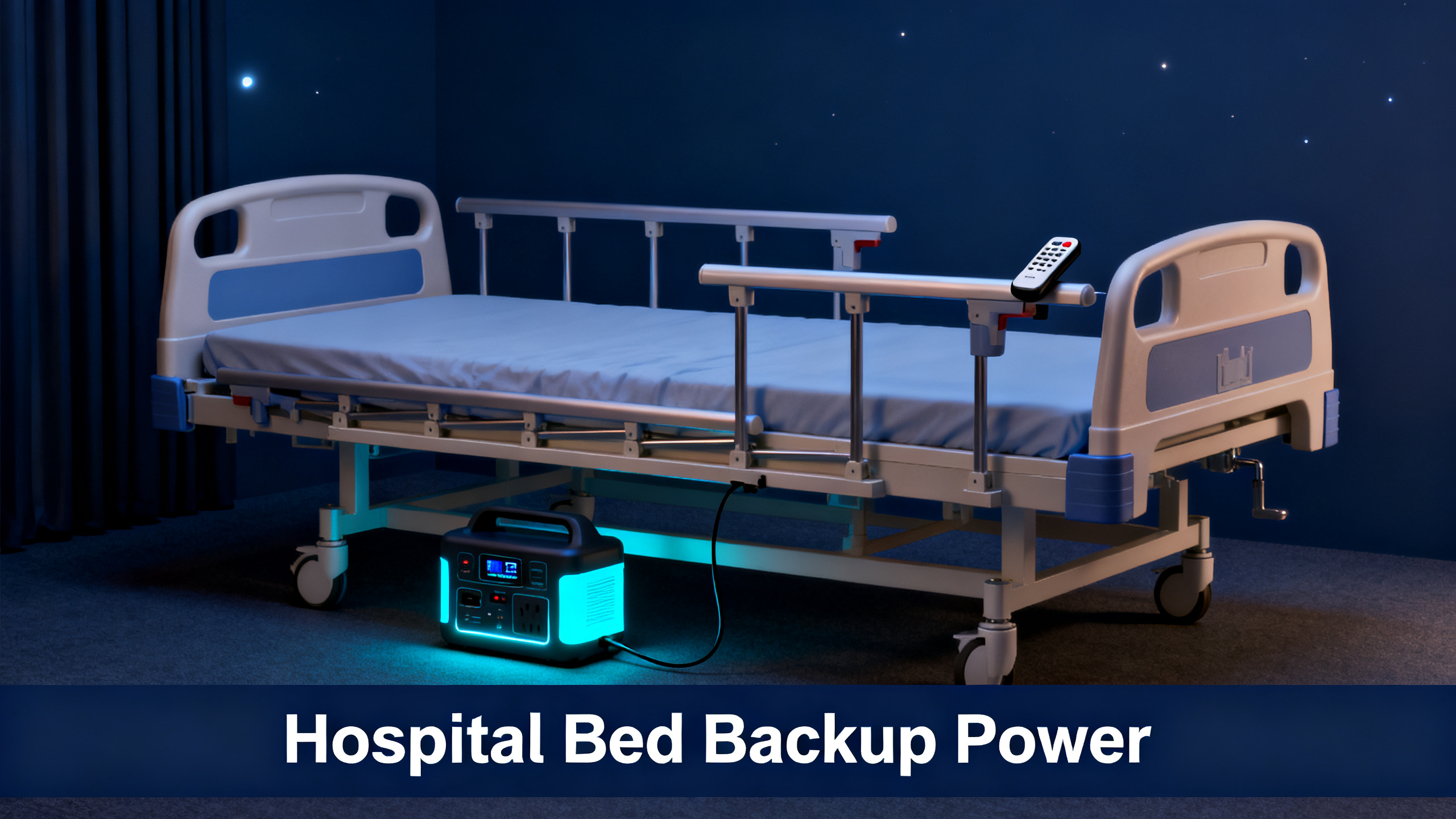
If you’re reading this, you’re already doing the right kind of planning. Managing a home hospital bed means power outages aren’t an inconvenience: they’re a medical event. This guide breaks down exactly what hospital bed backup power you need, how to size it for your specific setup, and which power stations hold up under real caregiver conditions.
Before zooming in on bed-specific needs, caregivers planning a full home setup should review our complete medical power guide covering CPAP, oxygen concentrators, dialysis, and refrigerated medications.

Best Overall: Hospital Bed Backup
Anker SOLIX F2600 (2,560Wh)
$1,999.99
- 2,560Wh LFP capacity (40+ hours bed runtime)
- 2400W continuous, 2800W surge (handles motor start)
- 10-year lifespan + 5-year warranty (InfiniPower™)
Get the 1-page outage plan
What to plug in first, how long a fridge really runs on a battery, and the 3 safety rules for connecting a power station to your home. Printable, sent by email.
About one email a week. Unsubscribe in one click. We may earn a commission when you buy through our links, at no extra cost to you. Privacy Policy
Why Hospital Bed Backup Power Is Non-Negotiable for Home Care
A hospital bed at home isn’t furniture. It’s active medical equipment with motors, control boards, and in many cases a pressure mattress running continuously. When grid power fails, that equipment stops, and the consequences compound quickly.
The Real Risks of an Unpowered Bed
When power cuts out, a motorized hospital bed freezes in its last position. For a patient with reflux, respiratory compromise, or active pressure injuries, that fixed position may not be safe for more than a few hours. Repositioning manually requires physical strength most solo caregivers don’t have on demand at 2 a.m.
Pressure injury risk escalates within 2 to 4 hours for high-risk patients. If the bed supports a low-air-loss or alternating-pressure mattress, that system shuts down too: the pump stops cycling, and the therapeutic surface becomes a static foam pad. That’s a meaningful clinical regression for any patient with compromised skin integrity.
⚠️ Important: Patients with respiratory conditions (sleep apnea, COPD, neuromuscular disease) who rely on head elevation are at acute risk when a bed freezes flat. Backup power should be treated as clinical continuity, not convenience.
Manual Crank Reality Check (Why It’s Not Enough)
Most home-care electric beds include a manual hand crank for emergencies. The reality: cranking head or foot sections typically requires 30 to 60 full rotations per position change. On bariatric beds, the mechanical load can exceed what a single caregiver can sustain safely. Height adjustment is usually not available manually at all.
The hand crank buys you minutes, not hours. For anything beyond a brief blip, a portable power station is the only reliable continuity solution short of a whole-home generator.
Understanding Hospital Bed Power Requirements
The first step in sizing backup power is knowing what you’re actually running. Hospital bed power draw varies significantly by bed type, and most caregivers underestimate the surge load on motor startup.
Wattage by Bed Type (Semi-Electric, Full Electric, Bariatric)
Semi-electric beds (head and foot adjustment only, manual height) draw 5 to 15W at idle and spike to 350 to 500W during motor actuation. Full electric beds, which add height adjustment, run 8 to 20W at idle with surge draws of 450 to 650W. Bariatric beds are the most demanding: 15 to 30W idle, 600 to 850W surge, and higher duty cycles overall.
For Drive Medical hospital bed specifications and other manufacturer data, check the spec sheet attached to your specific model. The wattage plate on the back of the control box is the most reliable source.
Pressure Mattress and Auxiliary Loads
If your bed includes a low-air-loss or alternating pressure mattress, the power profile changes substantially. The pump runs continuously at 25 to 60W, adding 0.6 to 1.4 kWh per day on top of the bed’s own draw. For wound-care patients or anyone with skin fragility, this load is non-negotiable: the pump cannot be cycled off to save power.
Factor in any auxiliary devices sharing the same circuit: a bedside CPAP or BiPAP, a suction machine, a feeding pump, or a patient lift charging station. Each adds to your baseline load calculation.
Surge vs Continuous: What Your Backup Must Handle
The surge requirement is where many caregivers get tripped up. A power station’s continuous output rating tells you how much load it can sustain indefinitely. The surge rating tells you how much it can handle for the brief spike when a motor starts. For hospital beds, that surge window is 0.5 to 2 seconds, but it reaches 2 to 4 times the idle draw.
Your backup must clear both numbers. A unit with 1,000W continuous but only 1,500W surge will not reliably start a bariatric bed motor without triggering overload protection. The Anker SOLIX F2600 (2400W continuous, 2800W surge) and EcoFlow DELTA Pro 3 (4000W continuous, up to 6000W with X-Boost) both clear every bed type in the table above.
Get the 1-page outage plan
What to plug in first, how long a fridge really runs on a battery, and the 3 safety rules for connecting a power station to your home. Printable, sent by email.
About one email a week. Unsubscribe in one click. We may earn a commission when you buy through our links, at no extra cost to you. Privacy Policy
Sizing Your Backup: How Many Hours Do You Need?
How long you need your backup to last depends on your outage risk and your patient’s clinical profile. There’s no universal answer, but there are useful planning tiers.
24-Hour Minimum (FDA-Recommended Baseline)
The FDA’s FDA home medical device guidance for home-use medical equipment recommends planning for at least 24-hour power continuity. For a full-electric bed running at 15 to 20W average draw, that’s 0.36 to 0.48 kWh consumed in 24 hours: well within a 2,560Wh unit’s capacity even with efficiency losses factored in.
A 24-hour target is appropriate for urban areas with reliable grid infrastructure and a history of brief outages only. If you’re in a region prone to multi-day weather events, 24 hours is a floor, not a plan.
72-Hour Storm-Zone Standard
For hurricane corridors, ice-storm zones, or any geography where 2 to 3 day outages are plausible, the 72-hour target is the practical standard. A full-electric bed at 15W average consumes roughly 1.08 kWh over 72 hours. Add a pressure mattress pump at 40W and the combined load reaches 4.0 kWh for the same window.
That pushes you firmly into 4,000Wh territory if you want full continuity through a 72-hour event with normal duty cycling. The EcoFlow DELTA Pro 3’s 4,048Wh base capacity covers that window before expansion batteries even enter the calculation.
Multi-Day Chronic-Care Planning (1 Week +)
For patients with long-term home-care needs in areas with uncertain grid reliability, the planning horizon extends to 7 days or more. At that scale, a single portable unit is rarely sufficient without solar recharging. The Anker F2600 supports up to 1,000W of solar input, which in adequate sun conditions can replace 80 to 100% of daily bed and mattress draw, effectively extending runtime indefinitely.
Expandable systems change the calculus further. The F2600 can be paired with an additional 760Wh expansion battery (up to 5,120Wh total). The DELTA Pro 3 expands from 4 kWh to 48 kWh with additional battery modules, which supports entire households for multiple days.
Anker F2600 Runtime: Hospital Bed Scenarios (2,560Wh)
🌕️
Semi-electric bed
10+ days
~10W average
🏥️
Full electric bed
5-7 days
~15W average
🌿
Bed + pressure mattress
36-48 hours
~50W combined
🫙
Bed + CPAP combo
48-60 hours
~40W combined
Estimates based on average 24-hour duty cycles. Actual runtime varies by usage pattern and ambient temperature.

Premium Pick: Multi-Day Backup
EcoFlow DELTA Pro 3 (4,048Wh)
$2,799 $3,699
UPS function with seamless switchover for life-critical equipment
Recommended Power Stations for Hospital Bed Backup
Two units stand out for home hospital bed backup: the Anker SOLIX F2600 for value-conscious long-term setups, and the EcoFlow DELTA Pro 3 for high-demand or multi-device configurations. Both use LiFePO4 (lithium iron phosphate) chemistry, which matters in a home-care context for its thermal stability and cycle longevity.
Anker SOLIX F2600: Best Overall Value
Spec analysis confirms the Anker SOLIX F2600 handles the 450 to 850W surge typical of full-electric and bariatric beds with significant headroom. At $1,999.99, it delivers 2,560Wh of LFP capacity, 2400W continuous output, and a 2800W surge rating. Runtime calculations based on that capacity and a typical 15W average draw suggest 5 to 7 days of continuous bed power, or 36 to 48 hours when combined with a pressure mattress pump at ~50W.
The InfiniPower™ technology backing the F2600 is the differentiating factor for long-term care scenarios. Anker’s published lifespan spec is 10 years with 3,000+ cycles before capacity degrades below 80%. For a caregiver planning a 5 to 10 year home-care situation, that lifespan data removes the “will this still work when we need it” question from the equation.
App control via Wi-Fi and Bluetooth lets caregivers monitor state of charge from another room, which is practical at night. HyperFlash AC input at 1440W means the unit recharges in under 2 hours from wall power, giving you a fast recovery window after a shorter outage. For full specs and performance data on this model, see our complete Anker SOLIX F2600 review covering 1,000+ cycle endurance and the InfiniPower™ technology.
✅ F2600 Strengths
- 10-year lifespan for long-term care planning
- App monitoring (state of charge, load)
- Fast recharge: 1440W AC input
- Expandable to 5,120Wh
- Strong surge headroom (2800W)
❌ F2600 Limitations
- No native UPS function (brief gap on switchover)
- Expansion battery sold separately
- No 240V output (single-voltage only)
EcoFlow DELTA Pro 3: Premium Multi-Day Pick
The EcoFlow DELTA Pro 3 enters the conversation when your needs exceed what a single-bed, single-device setup requires. At $2,799 (down from $3,699), it delivers 4,048Wh of LFP capacity, 4000W continuous output, and X-Boost surge handling up to 6000W. That headroom covers bariatric beds, pressure mattresses, and concurrent CPAP or oxygen concentrator loads without thermal throttling.
The defining feature for life-critical applications is the UPS function with less than 10ms switchover time. EcoFlow’s published specification sits well below the threshold most hospital bed control boards register as a power interruption. In practice, data from owner reports indicates the bed doesn’t flinch during a transfer: motors mid-cycle continue, control panels stay active, and pressure mattress pumps don’t lose their cycle position. For patients where even a brief power interruption would trigger a reset of a critical positioning or therapeutic device, the DELTA Pro 3’s UPS mode is the technical argument that justifies the price difference.
The DELTA Pro 3 is also UL9540 certified and supports 120V/240V dual voltage, making it compatible with whole-home transfer switch setups if you’re planning beyond the bedside.
Critical Care Equipment Needs (Multi-Device Setup)
Most home-care environments don’t run a single device in isolation. The hospital bed shares its backup budget with CPAPs, oxygen concentrators, refrigerated medications, and sometimes dialysis equipment. When multiple devices share one unit, load management becomes the determining factor in how long you can sustain continuity.
When a hospital bed shares a backup unit with a CPAP, an oxygen concentrator, or a refrigerator, home power load management becomes the difference between 8 hours and 30 hours of continuity.
Bed + CPAP/BiPAP Combo Sizing
A semi-electric bed at idle (~10W) plus a CPAP without heated humidifier (~30 to 40W) draws a combined 40 to 50W continuously. Runtime calculations for the Anker F2600 at that load: 2,560Wh divided by 45W = approximately 56 hours, with realistic efficiency losses putting the figure at 48 to 52 hours. For most outage scenarios short of a multi-day weather event, that’s comfortable coverage.
Add a heated humidifier (typically 100 to 120W additional) and the combined load jumps to 150 to 170W, reducing runtime to approximately 12 to 15 hours. In that configuration, a 4,000Wh unit becomes the more appropriate choice for 24+ hour coverage.

Bed + Oxygen Concentrator Stacking
Oxygen concentrators are among the most demanding devices in a home-care environment. A 5 LPM concentrator draws 150 to 350W continuously depending on flow rate and model. Stacked with a full-electric bed at 15 to 20W and a pressure mattress at 40W, the combined load reaches 200 to 410W. At 300W average, the Anker F2600 provides approximately 7 to 8 hours: enough for overnight coverage but not a 24-hour event.
In oxygen-concentrator households, the DELTA Pro 3’s 4,048Wh capacity is the practical floor for 24-hour continuity. Patients combining a hospital bed with home dialysis face especially high stakes: our home dialysis backup power breakdown shows why expandable units like the DELTA Pro 3 become non-negotiable.
Bed + Refrigerated Medications
Many home-care setups stack a hospital bed alongside a refrigerated medication unit, and our medication fridge backup sizing data shows the combined load typically falls within 1.5 kWh per 24-hour window. A compact medication refrigerator running at 50 to 80W average, combined with a hospital bed at 15W, totals 65 to 95W: a load the Anker F2600 sustains for 20 to 35 hours before recharging is needed.
Choose Your Backup Path
✅ Pick Anker SOLIX F2600 if…
- Single-bed setup (no dialysis or O2 concentrator)
- Smaller budget
- Long-term care planning (5-10 years)
- Caregiver wants app-based monitoring
- Backup target: 24-72 hour outages
⭐ Pick EcoFlow DELTA Pro 3 if…
- Bed + pressure mattress + CPAP combined
- Multi-day outages possible (storm zones)
- Need UPS function (under-10ms switchover)
- Budget allows expandable setup
- Bariatric bed or 240V appliance pairing
Connecting Your Hospital Bed: Step-by-Step
The connection process is more straightforward than most caregivers expect. Most home-care hospital beds use a standard NEMA 5-15 plug (the same three-prong plug as household appliances), which means no adapters or special wiring are required to connect to a portable power station.
Direct Plug-In (Single-Outlet Beds)
For semi-electric and most full-electric beds: plug the bed’s power cord directly into one of the power station’s AC outlets. Verify the bed’s surge draw falls below your unit’s surge rating before connecting. Turn on the power station first, then the bed. The bed should initialize normally.

💡 Pro Tip: Position the power station within cord reach of the bed’s wall outlet location. You’ll want to be able to swap back to grid power quickly when utility power restores, without moving equipment across the room.
UPS Pass-Through Setup (Recommended)
For units with UPS function (primarily the EcoFlow DELTA Pro 3), the recommended configuration is pass-through mode. The bed plugs into the power station, which remains connected to wall power. During normal grid operation, the unit passes power through and maintains its battery at full charge. On outage, the switchover to battery occurs in under 10ms, which is imperceptible to the bed’s control electronics.
This configuration eliminates the need to manually activate the power station during an outage and ensures the unit is always at full capacity when needed.
Transfer Switch Integration (Whole-Home Backup)
For caregivers planning a whole-home backup that includes the bedroom circuit alongside HVAC, kitchen, and other household loads, a transfer switch integration is the appropriate solution. The EcoFlow DELTA Pro 3 is compatible with the EcoFlow Smart Home Panel 2 for managed load distribution. This approach requires licensed electrical work and is beyond the scope of plug-in setup, but it’s the most resilient configuration for long-term chronic-care households.
Multi-Day Outage Scenarios
Your outage risk profile should drive your capacity decision. A caregiver in a dense urban grid with redundant infrastructure plans differently than one in a coastal storm zone or a wildfire region.
Hurricane and Tropical Storm Planning
Hurricane outages regularly extend 3 to 7 days in affected regions. For a hospital bed plus pressure mattress drawing ~50W combined, a 72-hour window requires approximately 3.6 kWh of usable capacity. The Anker F2600’s 2,560Wh covers roughly 48 hours at that load. The DELTA Pro 3’s 4,048Wh covers the full 72 hours with margin remaining for CPAP or lighting.

For week-long or longer storm recovery, solar input becomes critical. Both the F2600 (1,000W solar max) and the DELTA Pro 3 (1,600W+ solar input) can sustain full continuity through multi-week outages with adequate panel deployment.
Winter Storm and Ice Outages
Ice storm outages differ from hurricane scenarios in one important way: solar recharging is often limited. Cloud cover can reduce panel output to 15 to 25% of rated capacity for days at a time. For winter storm planning in northern climates, you need to size capacity for the full outage window without relying on solar recovery. The DELTA Pro 3’s expandable architecture (up to 48kWh with additional batteries) is the clearest answer for that planning constraint.
Cold temperatures also affect LFP battery performance: below 32°F, charging efficiency drops and discharge capacity can decrease by 20 to 30%. Both the F2600 and DELTA Pro 3 include battery thermal management systems, but indoor placement near the bed is preferable to garage or unheated-space storage in winter climates.
Wildfire Evacuation Considerations
Wildfire scenarios add a mobility dimension that fixed backup systems don’t address. The Anker F2600 weighs approximately 57 lbs, which is manageable for loading into a vehicle. The DELTA Pro 3 is heavier (approximately 98 lbs with wheels). For caregiver households in wildfire interface zones, a transport plan for the power station should be part of the evacuation checklist alongside medications, medical records, and wheelchair or mobility equipment.
Safety and Regulatory Considerations
Running powered medical equipment from a portable battery system raises legitimate questions about safety standards and regulatory compliance. Here’s what the data and current guidelines indicate.
FDA Home Medical Device Guidelines
The FDA’s oversight of home-use medical devices focuses on the devices themselves (hospital beds, CPAPs, concentrators) rather than the power sources. The FDA home medical device guidance recommends that caregivers maintain backup power plans for life-sustaining home-use devices. The FDA does not certify or endorse specific power stations, but its guidance aligns with the 24-hour minimum continuity standard used in this guide.
UL Certification: Why It Matters for Bedside Equipment
UL certification matters when placing high-capacity batteries in an occupied bedroom. The EcoFlow DELTA Pro 3 carries UL9540 certification, which is the standard for stationary energy storage systems. The Anker SOLIX F2600 carries UL certification appropriate for portable power stations. Both are appropriate for indoor, bedside use with adequate ventilation.
Avoid uncertified units from unknown brands for any life-critical application. Battery management system quality and cell-level protections are not visible in marketing specs but determine real-world safety under fault conditions.
Surge Protection and Battery Chemistry (LiFePO4 Advantage)
LiFePO4 (lithium iron phosphate), the chemistry in both recommended units, is the preferred choice for home medical applications for three reasons. First, it is thermally stable and does not enter thermal runaway under overcharge or puncture conditions, unlike NMC chemistry batteries. Second, it retains 80%+ capacity for 3,000 to 4,000 cycles, versus 500 to 1,000 cycles for older lithium-ion formulations. Third, its discharge curve is flat, meaning it maintains stable voltage output throughout the discharge cycle rather than sagging at low states of charge, which matters for sensitive motor control electronics.
FSA, HSA, and Insurance Considerations
Backup power for home medical equipment sits in a gray area for coverage purposes. Understanding the current rules helps you plan for reimbursement without relying on incorrect assumptions.
Medicare DME Coverage
Medicare’s Durable Medical Equipment (DME) benefit covers hospital beds when prescribed by a physician for a qualifying medical condition. However, the DME benefit does not extend to backup power sources for those beds. Portable power stations are not listed as covered DME items under current Medicare DME coverage guidelines.
Medicare Advantage plans may have different supplemental benefits: contact your specific plan to ask whether backup power for DME is covered under their supplemental home health benefit.
Documentation for FSA Reimbursement
Flexible Spending Accounts (FSA) and Health Savings Accounts (HSA) operate under IRS guidelines that allow reimbursement for medical expenses prescribed by a licensed healthcare provider. A portable power station used specifically and primarily to power prescribed medical equipment may qualify, but a Letter of Medical Necessity (LMN) from the prescribing physician is typically required.
Save the itemized receipt from your Anker or EcoFlow purchase. Request the LMN from the physician who prescribed the hospital bed or associated equipment. Submit with your FSA/HSA administrator’s required documentation form. Reimbursement is not guaranteed but is achievable with proper documentation for many caregiver households.
Building a Resilient Caregiver Setup
The power station is one component of a resilient home-care power plan. Backup-of-backup thinking, solar charging integration, and coordination with utility and healthcare providers round out a complete approach.
Solar Charging for Extended Outages
Solar input transforms a finite battery reserve into a continuously renewable resource. The Anker F2600 accepts up to 1,000W of solar input, and the EcoFlow DELTA Pro 3 supports up to 1,600W+ depending on configuration. A 400W rigid panel in good sun conditions generates approximately 1.6 to 2.0 kWh per day in summer, enough to cover a hospital bed plus CPAP combo (~1.0 kWh/day) with margin for battery replenishment.

For winter planning, size solar conservatively. Cloudy periods may reduce output to 10 to 20% of rated capacity. In those conditions, a 2-panel (800W rated) system may only deliver 80 to 160W per day, which extends but doesn’t fully replace the battery draw of a multi-device setup.
Backup-of-Backup (The Redundancy Principle)
For patients whose home-care situation is genuinely life-sustaining, a single backup unit is the minimum. The redundancy principle suggests a second, smaller unit for critical devices only (CPAP, suction, medication refrigerator) as a last-resort layer if the primary unit fails or runs out. A 1,000Wh unit priced at $500 to $700 serves as an inexpensive insurance layer that covers 12 to 20 hours of CPAP-only runtime if the primary unit needs service.
Emergency Medical Power Planning Framework
Covers evacuation, medication storage, and 72-hour readiness for chronic-care households.
Backup power is one piece of a broader caregiver plan: our emergency medical planning framework covers evacuation, medication storage, and 72-hour readiness for chronic-care households. Registering with your local utility as a medical baseline customer is another step worth taking: many utilities offer priority restoration for registered medical households, though guarantees vary by region.
Frequently Asked Questions
How long can a portable power station run a hospital bed?
Runtime depends on bed type and capacity. A 2,560Wh unit like the Anker F2600 typically powers a full-electric bed for 5 to 7 days at idle (approximately 15W average) and 36 to 48 hours when paired with a low-air-loss pressure mattress at a combined ~50W draw. A 4,048Wh unit like the EcoFlow DELTA Pro 3 nearly doubles those windows. Runtime calculations assume 85 to 90% inverter efficiency and typical duty cycling: actual results vary by usage pattern and ambient temperature.
Do I need a UPS function specifically for a hospital bed?
Yes, if the bed supports a patient who relies on continuous positioning (head elevation for reflux, pressure-relief cycling, continuous positioning for respiratory management). UPS function with sub-30ms switchover keeps motorized adjustments mid-cycle from resetting and protects against control-board glitches that can occur during raw power loss. For beds where a brief interruption causes no clinical consequence, standard switchover (typically under 200ms) is generally acceptable. When in doubt, UPS mode is the safer specification.
Can I plug a hospital bed directly into a power station?
Most semi-electric and full-electric home hospital beds use a standard NEMA 5-15 plug rated under 15A, so yes. Verify the bed’s surge requirement (typically 350 to 650W) sits below your power station’s surge rating. The Anker F2600 (2800W surge) and DELTA Pro 3 (6000W with X-Boost) both clear this bar comfortably across all common home-care bed types. Bariatric beds with 600 to 850W surge requirements should be verified against the specific unit’s surge spec before connection.
What happens to a hospital bed during a power outage without backup?
The bed freezes in its last position. Most home-care models include a manual hand crank for emergency repositioning, but cranks require physical effort (often 30 to 60 turns per position change) and fail outright on bariatric beds. Height adjustment is typically not available manually at all. Patients with respiratory issues, reflux risk, or active pressure injuries face meaningful clinical risk within hours of a fixed, unpowered position. Low-air-loss and alternating pressure mattresses also stop cycling immediately, removing therapeutic support for high-risk skin.
Is hospital bed backup power covered by Medicare or FSA?
Medicare generally does not directly cover portable power stations as DME. However, they may qualify for FSA or HSA reimbursement when used specifically to power prescribed medical equipment and accompanied by a Letter of Medical Necessity from the prescribing physician. Save your Anker or EcoFlow receipt and request the LMN documentation from the physician who prescribed the hospital bed or associated equipment. Medicare Advantage supplemental plans vary: contact your specific plan to ask about home health power backup benefits.
Can I run a hospital bed and a CPAP from the same backup?
Yes, with proper sizing. A semi-electric bed at idle plus a CPAP without humidifier at 30 to 40W draws roughly 40 to 55W continuous. A 2,560Wh unit handles this combo for approximately 40 to 50 hours. Add a heated humidifier (100 to 120W additional) and that window drops to 12 to 15 hours. Add an oxygen concentrator at 150 to 350W and capacity needs jump to 4,000Wh or more for 24-hour multi-device reliability.
What battery chemistry should I look for in a hospital bed backup?
LiFePO4 (lithium iron phosphate) is the appropriate choice for home medical applications. It offers 3,000 to 4,000 cycles before significant capacity degradation, maintains thermal stability under fault conditions (no thermal runaway risk), and delivers a flat discharge curve that sustains stable voltage output throughout the discharge window. That voltage stability matters for sensitive motor control electronics in electric beds. Both the Anker F2600 and EcoFlow DELTA Pro 3 use LiFePO4. Avoid NMC chemistry units for life-critical bedside applications.
How much should I budget for hospital bed backup power?
For a single-bed 24 to 72-hour solution, budget for a unit like the Anker F2600 ($1,999.99 currently). For multi-day or combined-device setups including pressure mattress and CPAP, budget for a unit like the EcoFlow DELTA Pro 3 ($2,799 currently). Whole-home solutions with transfer switch integration, expanded battery capacity, and solar input run $3,500 to $6,000 or more depending on total load and desired autonomy.
Conclusion
Hospital bed backup power isn’t optional for home caregivers managing patients with meaningful clinical risk from positioning loss, pressure mattress interruption, or multi-device dependency. The Anker SOLIX F2600 at $1,999.99 covers the majority of single-bed setups with 5 to 7 days of full-electric bed runtime, a 10-year lifespan backed by warranty, and app monitoring that fits naturally into a caregiver’s daily workflow.
For households running a pressure mattress, an oxygen concentrator, or planning for multi-day storm outages, the EcoFlow DELTA Pro 3’s UPS function and 4,048Wh capacity provide the headroom that prevents clinical gaps during extended events. The extra cost over the F2600 is justified when your load analysis shows that 2,560Wh isn’t enough to cover your specific device stack for your outage risk window.
Size for your actual load, plan for your actual outage risk, and document the purchase for potential FSA reimbursement. That’s the complete framework.
Anker SOLIX F2600
$1,999.99
Best long-term value for caregiver setups: 10-year lifespan, expandable, app-monitored.
Price checked automatically on Anker SOLIX’s US store. Free shipping available.
Originally published: April 30, 2026