
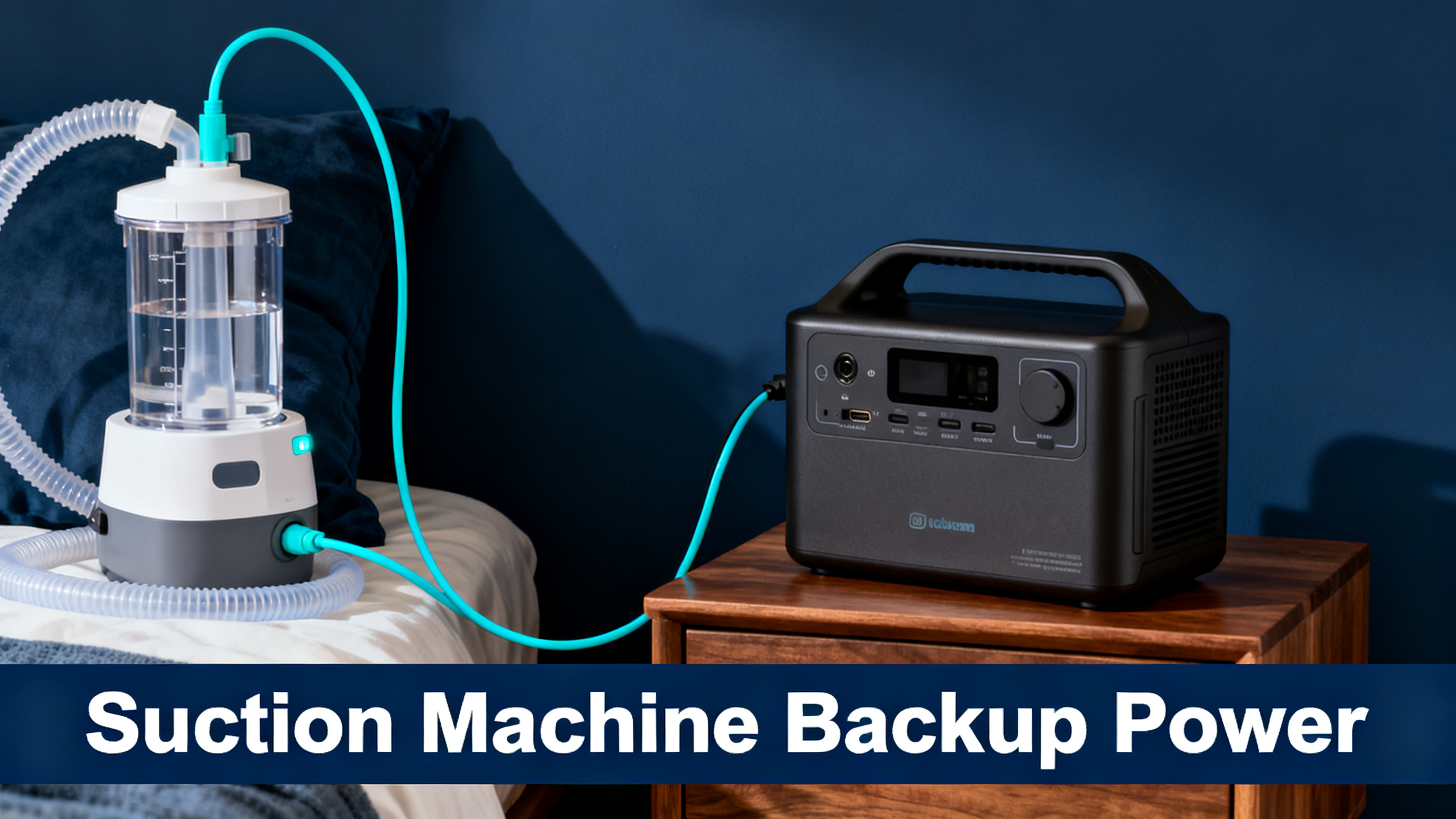
A power outage lasting more than an hour is an inconvenience for most households. For a caregiver managing a patient on a home suction machine, it’s a medical emergency in the making. Secretions that can’t be cleared become an airway obstruction risk within minutes, not hours. That’s a reality thousands of families navigate every day, and it’s why backup power for suction equipment isn’t optional.
This guide covers everything you need to know about suction machine backup power: how much capacity you actually need, which power stations handle the job reliably, why UPS switchover speed matters, and how to build a caregiver emergency plan that holds up under real outage conditions. Suction machines are part of a broader category of life-sustaining devices, and our complete medical equipment guide covers backup power for ventilators, oxygen concentrators, CPAPs, and home dialysis systems alongside aspirators.
The three power stations that consistently stand out for home suction use are the Anker SOLIX C1000, the Bluetti AC70, and the EcoFlow DELTA 2. Each fits a different caregiver profile. Here’s how to determine which one is right for your situation.

Editor’s Pick · Best Overall
Anker SOLIX C1000
$999.00
- 1,056Wh LFP, 1,800W output (2,400W peak)
- Recharges in under 60 minutes
- 11 ports, app monitoring, 5-year warranty
Get our Black Friday alerts for power stations
We track live prices on 40+ models from Jackery, EcoFlow, BLUETTI and Anker SOLIX. When a deal beats the lowest price we've recorded, you'll hear from us. During Black Friday week, one short recap a day at most.
Unsubscribe in one click. We may earn a commission when you buy through our links, at no extra cost to you. Privacy Policy
Why Suction Machines Need Reliable Backup Power
The Clinical Reality of Power Loss
Home suction equipment serves three main patient populations, and each faces serious risk during an unplanned outage. Tracheostomy patients depend on regular airway clearance to prevent mucus plugging, a condition that can compromise oxygenation rapidly. The American Lung Association tracheostomy resources describe how secretion management is foundational to airway safety for these patients.
Post-surgical recovery patients, particularly those coming home after thoracic or upper airway procedures, often require suction for the first days or weeks at home. Pediatric patients with neurological conditions or chronic respiratory issues make up the third group, and their smaller airways can be compromised even faster than adults. For any of these scenarios, a gap in suction capability isn’t a matter of discomfort. It’s a matter of safety.
The data on U.S. outage duration reinforces the urgency. Average residential outage durations exceeded five hours in 2024, with weather-related events often stretching into multi-day scenarios in vulnerable regions. That timeframe is far beyond what any built-in suction machine battery can handle independently.
Internal Battery Limits Aren’t Enough
Most corded home suction units, including popular models from Drive Medical, DeVilbiss, and Laerdal, include a small internal or clip-on battery rated for 30 to 60 minutes of operation. That’s designed for transport between rooms or a brief power interruption, not for a real outage scenario. Portable battery-powered aspirators (handheld Yankauer-style units) offer more freedom of movement but carry even smaller internal cells, typically supporting 20 to 40 minutes of intermittent use.
For any outage lasting longer than one hour, the internal battery in a corded suction machine provides essentially no meaningful protection. A dedicated power station bridges that gap entirely, transforming a single-use battery into hours or days of reliable capability.
Why Backup Power Is Non-Negotiable
⏱
Seconds-Critical Need
Tracheostomy patients can experience airway obstruction within minutes when secretions cannot be cleared.
🌺
Outage Frequency
U.S. households experienced average outages of over 5 hours in 2024, often during severe weather.
🏥
Home-Based Care Growth
More patients than ever rely on home suction equipment, including pediatric patients post-surgery.
🔋
Internal Battery Limits
Most home suction units have only 30 to 60 minutes of internal battery, insufficient for extended outages.
Power Requirements for Common Suction Equipment
Wattage Profiles by Device Type
Understanding how much power your suction machine draws is the starting point for sizing a backup correctly. Standard corded home suction units from brands like Drive Medical and DeVilbiss typically draw between 50 and 90 watts during active suctioning. Tracheostomy-specific units, which need to generate higher vacuum pressure consistently, often land in the 60 to 100W range during operation. Smaller pediatric or portable battery-assisted aspirators generally draw 30 to 60 watts.
The important distinction is that suction machines don’t run continuously. Most home protocols involve 10 to 20 minutes of active suctioning per hour, with the motor off or in standby between sessions. This intermittent pattern dramatically extends effective runtime from a power station compared to a device that draws power constantly.
Why Surge Capacity Matters
When a suction machine’s motor starts up, it briefly draws significantly more current than its rated wattage. This startup surge can spike to 1.5 to 2 times the nominal draw, typically lasting less than a second. A power station that can only handle its rated continuous wattage may trip a protection circuit on startup, cutting power to the device at exactly the wrong moment.
This is why features like the Bluetti AC70’s Power Lifting Mode (which extends output to 2,000W for resistive motor loads) and the EcoFlow DELTA 2’s X-Boost technology (rated to 2,200W) matter for medical equipment. The Anker SOLIX C1000’s 2,400W peak output provides the same protection. Any of the three recommended units here handles suction machine startup surges without issue.

Get our Black Friday alerts for power stations
We track live prices on 40+ models from Jackery, EcoFlow, BLUETTI and Anker SOLIX. When a deal beats the lowest price we've recorded, you'll hear from us. During Black Friday week, one short recap a day at most.
Unsubscribe in one click. We may earn a commission when you buy through our links, at no extra cost to you. Privacy Policy
UPS Function: Why It Matters for Suction Equipment
The Sub-30ms Switchover Standard
A UPS (uninterruptible power supply) function means the power station detects a grid outage and switches to battery power fast enough that connected devices never lose power. The standard for medical-grade UPS performance is a switchover time under 20 milliseconds. At that speed, even motorized medical equipment like suction machines, which are sensitive to brief power interruptions, continues operating without interruption.
The EcoFlow DELTA 2 specifies a switchover time of under 30 milliseconds, which is fast enough that most home suction equipment will not register the transition. The Bluetti AC70 and Anker SOLIX C1000 also operate in the 20ms range, placing all three in UPS-grade territory for home medical use. This matters most for tracheostomy patients, where even a momentary loss of suction at a critical moment is unacceptable.
Pass-Through Charging vs True UPS
Not all power stations marketed for backup use include genuine UPS-grade switchover. Some units operate in “pass-through” mode, where grid power flows through the unit to connected devices while the battery charges separately. This setup can introduce a brief gap when switching to battery during an outage, sometimes 50 to 200ms depending on the unit’s design.
For general home backup, that gap is imperceptible. For motor-driven medical equipment, it can cause a reset or protective shutdown. All three units recommended in this guide use true UPS-grade switchover rather than simple pass-through, which is why they’re suitable for suction machine backup where reliability is non-negotiable.


Top Power Stations for Suction Machine Backup
Best Overall: Anker SOLIX C1000
The Anker SOLIX C1000 earns its place as the top pick for most caregivers based on a combination of capacity, recharge speed, and long-term reliability. Its 1,056Wh LiFePO4 battery delivers approximately 13 hours of continuous suction machine runtime, and up to 40 hours under typical intermittent use patterns. The 5-year warranty on LFP chemistry rated for 3,000 cycles means years of reliable daily standby without battery degradation.
The standout specification for medical backup situations is charge speed. The C1000 reaches 80% capacity in just 43 minutes and completes a full charge in under an hour. That’s critical in multi-day outage scenarios where grid power may return for only a few hours. In those situations, the ability to recharge quickly from partial grid availability can mean the difference between staying at home and evacuating. Our detailed Anker SOLIX C1000 review covers charging speeds and ports in depth.
The C1000’s 11-port configuration also allows simultaneous backup of multiple devices, a genuine advantage in households where a suction machine isn’t the only critical equipment in use. App-based monitoring via Wi-Fi and Bluetooth gives caregivers visibility into remaining capacity without having to check the unit physically.
Most Portable: Bluetti AC70
At 22.5 pounds and currently priced at $329 (down from $599), the Bluetti AC70 is the most accessible entry point into reliable suction machine backup. Its 768Wh LiFePO4 capacity supports approximately 10 hours of continuous suction use, and around 30 hours under intermittent caregiver protocols. That’s more than enough coverage for the vast majority of outage scenarios. For caregivers prioritizing portability and budget, the AC70’s compact form earns it our portable pick (read the full Bluetti AC70 review for performance specs and runtime data).
The AC70’s expandability to 1,574Wh with a compatible expansion battery gives caregivers a clear upgrade path if needs change, without replacing the base unit. The Power Lifting Mode extends its effective output to 2,000W for motor startups, handling suction machine inrush current without any issue. Its slightly lower maximum solar input (200W vs 500-600W on the other two) is a consideration for multi-day solar recharging scenarios, but for most urban and suburban caregivers dealing with outages of 24 hours or less, it’s a non-issue.


Most Portable Option
Bluetti AC70
$329.00 $599.00
768Wh LFP, 1,000W output, expandable to 1,574Wh
Best UPS Function: EcoFlow DELTA 2
The EcoFlow DELTA 2 is the strongest choice when UPS-mode reliability is the top priority. Its sub-30ms switchover is the fastest of the three, and its X-Boost technology handles the startup surge of suction equipment cleanly. At $399 (currently discounted from $1,049), it offers 1,024Wh of LiFePO4 capacity at a price point between the AC70 and the C1000. For tracheostomy patients where every second matters during a power loss, the DELTA 2’s sub-30ms UPS function changes the game (full breakdown in our EcoFlow DELTA 2 review).
The DELTA 2’s expandability to 3kWh with an extra battery module is an advantage for households with multiple critical devices or extended outage scenarios. Its 500W solar input allows meaningful daytime recharging during multi-day outages, and the 5-year warranty on its 3,000-cycle LFP chemistry matches the Anker C1000’s longevity assurances.

| Specification | Bluetti AC70 | Anker SOLIX C1000 | EcoFlow DELTA 2 |
|---|---|---|---|
| Battery Capacity | 768Wh | 1,056Wh | 1,024Wh |
| AC Output (Continuous) | 1,000W (Power Lifting 2,000W) | 1,800W (Peak 2,400W) | 1,800W (X-Boost 2,200W) |
| Battery Chemistry | LiFePO4 | LiFePO4 (3,000 cycles) | LiFePO4 (3,000 cycles) |
| UPS Switchover | ~20ms (UPS-grade) | ~20ms (UPS-grade) | Under 30ms (UPS-grade) |
| Recharge Time (AC) | ~1.5 hrs (0-80%) | 43 min (0-80%) | ~50 min (0-80%) |
| Max Solar Input | 200W | 600W | 500W |
| Weight | 22.5 lbs | 28.4 lbs | 27 lbs |
| Warranty | 5 years | 5 years | 5 years |
| Current Price | $329 | $999 | $399 |
Choosing the Right Capacity for Your Suction Setup
Calculating Your Daily Watt-Hour Need
The formula for sizing backup power is straightforward: multiply your suction machine’s wattage by daily hours of operation, then add a 20% buffer for inverter efficiency losses. A unit drawing 75W for 4 hours per day needs approximately 360Wh per day (75W x 4h x 1.2 = 360Wh). A 768Wh power station like the Bluetti AC70 covers that load for just over two days before needing a recharge.
Three caregiver profiles illustrate how capacity requirements vary. A pediatric patient requiring brief suction sessions, perhaps 30 minutes of total daily use at 50W, needs only 30Wh per day. A tracheostomy patient with consistent hourly suctioning at 90W for 20 minutes per hour across 16 waking hours draws around 500Wh per day. A post-surgical patient in active recovery with near-continuous suction needs may require closer to 800Wh of daily capacity, pushing toward the Anker C1000 or DELTA 2 as the appropriate choice.
Multi-Day Outage Planning
For households planning against multi-day outage scenarios, the math shifts from daily capacity to total reserve. If your suction equipment draws 360Wh per day and you want 72 hours of reserve, you need at minimum 1,080Wh of usable capacity before efficiency losses. That points toward 1,000Wh-class units like the Anker C1000 or EcoFlow DELTA 2. Households running multiple critical devices simultaneously, a suction machine alongside a CPAP, medication fridge, or oxygen concentrator, should consider 1,500Wh or more as a starting point.
In those multi-device scenarios, pairing a 1,000Wh power station with a compatible expansion battery becomes a practical option. The EcoFlow DELTA 2 expands to 3kWh with the Smart Extra Battery, while the Bluetti AC70 can reach 1,574Wh with its paired expansion unit. Those configurations provide meaningful multi-day coverage even with significant concurrent loads.
Estimated Suction Machine Runtime by Power Station
Based on a typical home suction unit drawing ~75W during active use, with intermittent operation patterns (10-20 min/hour).
🔜
Bluetti AC70
~10 hrs
768Wh / continuous use
Up to 30 hrs intermittent
🟢
Anker SOLIX C1000
~13 hrs
1,056Wh / continuous use
Up to 40 hrs intermittent
🔲
EcoFlow DELTA 2
~12 hrs
1,024Wh / continuous use
Up to 38 hrs intermittent
⚠️
Internal Battery Only
30-60 min
Typical built-in unit
Insufficient for outages
Solar Recharging for Multi-Day Outages
Why Solar Compatibility Matters for Caregivers
Extended weather events, including hurricanes, ice storms, and major grid failures, regularly produce outages lasting 48 hours or more in vulnerable regions. In those scenarios, a fully charged 1,000Wh power station provides two to three days of suction machine coverage under typical intermittent use. But for outages beyond that window, the ability to recharge from solar panels becomes a practical necessity rather than a convenience.
All three recommended power stations accept solar input, and all include MPPT charge controllers that optimize panel output throughout the day. Solar compatibility turns a finite reserve into a renewable one, extending effective backup duration indefinitely as long as daytime sun is available. For caregivers in hurricane-prone coastal areas or rural regions with unreliable grid infrastructure, pairing a power station with even a single 200W solar panel meaningfully changes the risk calculus of a major outage.
Recommended Panel Sizing
The Bluetti AC70’s 200W maximum solar input means one mid-size panel can fully recharge it in favorable conditions in approximately 4 to 5 hours. That’s adequate for a daily recharge cycle in summer months across most of the U.S. The Anker SOLIX C1000 accepts up to 600W, allowing multiple panels in parallel and recharge times under 2 hours in good sun. The EcoFlow DELTA 2 supports up to 500W of solar input, achieving similar fast-recharge capability with two 200-250W panels.
For most caregiver households, a single 200W foldable panel paired with the AC70 provides a complete entry-level solar backup solution. For households using the C1000 or DELTA 2 as a primary backup, a 400W setup (two 200W panels) provides reliable full daily recharging even in partially overcast conditions.

Home Setup and Whole-House Considerations
Apartment vs Single-Family Homes
Caregivers in apartments or small homes typically need to power a suction machine in one primary location, with occasional portability between rooms. In those settings, a single 768Wh to 1,056Wh power station placed near the patient’s bed or primary care area covers nearly all outage scenarios. The Bluetti AC70’s 22.5-pound form factor makes it easy to move between rooms if needed, and its compact footprint fits on a bedside table or small cart. Caregivers in apartments or small homes can usually rely on a single 1,000Wh unit for suction needs, but if you’re powering additional essentials our small home backup power roundup explains how to size up.
Single-family homes may have more complex requirements, particularly if the patient spends time in multiple rooms or the household has additional critical loads. In those cases, a centrally located 1,000Wh-class unit with multiple outlet access points, or a second smaller unit for room-to-room use, often makes more sense than a single large unit that stays in one place.
Multi-Device Households
Many home health patients rely on more than one powered device. A tracheostomy patient who also uses a CPAP for sleep apnea presents a combined load of 75 to 200W depending on equipment. Adding a small medication refrigerator, a bedside lamp, or a phone charging load brings the daily energy requirement well above 500Wh. Households running multiple critical devices, such as a suction machine alongside a home dialysis system, need additional capacity planning. Our home dialysis backup guide details the runtime math for daily 4-hour treatments.
In multi-device situations, the Anker SOLIX C1000’s 11 ports and 1,056Wh capacity provide the most flexibility. Its app-based monitoring helps caregivers track remaining capacity across all connected loads in real time, which is a genuine operational advantage during an extended outage.
Is a Power Station Right for Your Setup?
✓ Buy a power station if…
- You care for someone with a tracheostomy or chronic respiratory condition
- Your area experiences regular outages of 4+ hours
- You want sub-30ms UPS protection during grid switches
- Your suction unit is corded with limited internal battery runtime
- You also need backup for a CPAP, oxygen concentrator, or hospital bed
✗ Skip and choose another solution if…
- You only need pocket-sized portability (look at battery-only suction units)
- Your home has a permanent standby generator already covering medical loads
- You require true medical-grade certification (consult your DME provider)
- Your suction needs are extremely brief and infrequent (under 10 min/day)
- You’re considering this for hospital or clinical, not home, use
Building a Caregiver Emergency Plan
Beyond the Power Station
A power station is the core of a home medical backup plan, but it works best as part of a broader preparedness framework. Caregivers should maintain a pre-positioned emergency bag with suction catheters, spare tubing, and a manual backup aspirator (bulb syringe or manual suction unit) for situations where even the power station fails. A clear communication plan, including contacts for the patient’s DME provider, home health agency, and local emergency services, should be documented and accessible to anyone who might assist during a crisis.
The Ready.gov medical needs preparedness checklist provides a comprehensive framework for households with medical equipment dependencies, covering everything from advance registration with local emergency management to evacuation planning with medical equipment in tow. Reviewing that resource alongside your equipment-specific backup plan is a practical starting point for any medical household.
Coordinate with Your DME Provider
Most U.S. utility companies maintain a Medical Baseline or Medical Priority program that gives households with life-sustaining equipment advance notice before planned outages and priority restoration during emergencies. Registering your household with your utility’s medical equipment program is a low-effort step with meaningful impact. Your durable medical equipment (DME) provider can assist with the documentation required for registration.
The CDC power outage health guidance also outlines specific steps for households with medical devices, including backup charging protocols and when to contact local emergency services if power cannot be restored within safe timeframes. Coordinating with your DME provider about minimum backup duration requirements for your specific suction equipment gives you the clearest baseline for sizing your power station investment correctly.
💡 Pro Tip: Contact your utility company’s customer service line and ask specifically about their Medical Baseline or Life Support Equipment program. Many utilities offer free registration and provide advance outage notifications by phone or text to registered medical households.
Best Power Stations for Medical Equipment at Home
Complete guide covering backup power for ventilators, CPAPs, oxygen concentrators, dialysis, and more.
Frequently Asked Questions
How long can a portable power station run a home suction machine?
A typical home suction unit draws 50 to 90W during active suctioning, and most home use is intermittent (10 to 20 minutes per hour). Runtime calculations based on the Anker SOLIX C1000’s 1,056Wh capacity show approximately 13 hours of continuous use, or up to 40 hours of typical intermittent caregiver use. The Bluetti AC70 (768Wh) supports about 10 hours continuous, and the EcoFlow DELTA 2 (1,024Wh) supports about 12 hours continuous.
Do power stations have UPS function for medical equipment?
Yes, all three power stations recommended in this guide include UPS-grade switchover. The EcoFlow DELTA 2 transitions in under 30 milliseconds, fast enough that most suction machines and similar medical equipment will not interrupt operation. The Bluetti AC70 and Anker SOLIX C1000 also offer UPS-class switchover, suitable for the vast majority of home suction units.
Can I plug a suction machine directly into a power station?
Yes. Standard home suction machines use a regular AC plug and can connect directly to any of the recommended power stations through their AC outlets. Always confirm the suction machine’s wattage rating (typically printed on the device label) is below the power station’s continuous output rating to ensure safe operation.
What capacity do I need for an overnight outage with a suction machine?
For a typical overnight outage of 8 to 12 hours, a 1,000Wh power station provides comfortable margin for intermittent suction needs while leaving capacity for charging phones, lighting, or a small medication fridge. The Anker SOLIX C1000 or EcoFlow DELTA 2 are well-sized for this scenario. For shorter outages or tighter budgets, the Bluetti AC70’s 768Wh capacity is sufficient.
Are these power stations safe to use indoors near a patient?
Yes. Unlike gas generators, lithium-iron-phosphate (LiFePO4) power stations produce no fumes or carbon monoxide, making them safe to operate in any room, including bedrooms, nurseries, and hospital-bed areas. All three recommended units use LiFePO4 chemistry, which is also the most thermally stable lithium battery type available.
Can I recharge the power station during an extended outage?
Yes. Both the Anker SOLIX C1000 and EcoFlow DELTA 2 accept up to 500 to 600W of solar input, allowing daytime recharging during multi-day outages. The Bluetti AC70 supports up to 200W of solar. Pairing any of these units with a foldable solar panel turns short-term backup into multi-day off-grid capability for medical households.
Final Recommendation: Which Power Station to Choose?
Most caregivers managing a home suction machine will find the Anker SOLIX C1000 covers the broadest range of scenarios well. Its 1,056Wh capacity, 43-minute rapid recharge, 5-year LFP warranty, and 11-port configuration address the core requirements of medical backup: sufficient runtime, fast recovery when grid power returns, and long-term reliability without battery degradation concerns. At $999, it’s the premium option, but the 5-year warranty and 3,000-cycle battery rating make the cost-per-year calculation favorable over time.
Caregivers with tighter budgets or smaller living spaces should look seriously at the Bluetti AC70 at $329. Its 768Wh LiFePO4 battery covers typical overnight and short-duration outages with capacity to spare, its 22.5-pound form makes it genuinely portable between rooms, and its expandability path means you’re not locked into a fixed capacity forever. For caregivers who primarily need coverage for outages under 24 hours and aren’t running concurrent high-draw devices, the AC70 delivers the core function at roughly a third of the C1000’s price.
The EcoFlow DELTA 2 at $399 is the pick for households where UPS switchover speed is the paramount concern. Its sub-30ms transition is the fastest of the three, and its X-Boost technology handles motor-startup surges cleanly. For tracheostomy patients where any interruption in suction capability is unacceptable, the DELTA 2’s UPS performance alongside its 1,024Wh capacity and current promotional pricing makes it a compelling choice.
Whatever you choose, having reliable backup power in place before you need it is what matters most. A power station on standby, kept at full charge, is a genuinely different kind of security for medical households than hoping an outage won’t happen.
Bluetti AC70 Review: Full Performance Analysis
Detailed specs, charge speed data, and runtime benchmarks for the AC70 across real-world use cases.
Anker SOLIX C1000
$999.00
Best all-around backup for home suction equipment
5-year warranty · Free shipping available · LFP battery
Originally published: April 30, 2026