
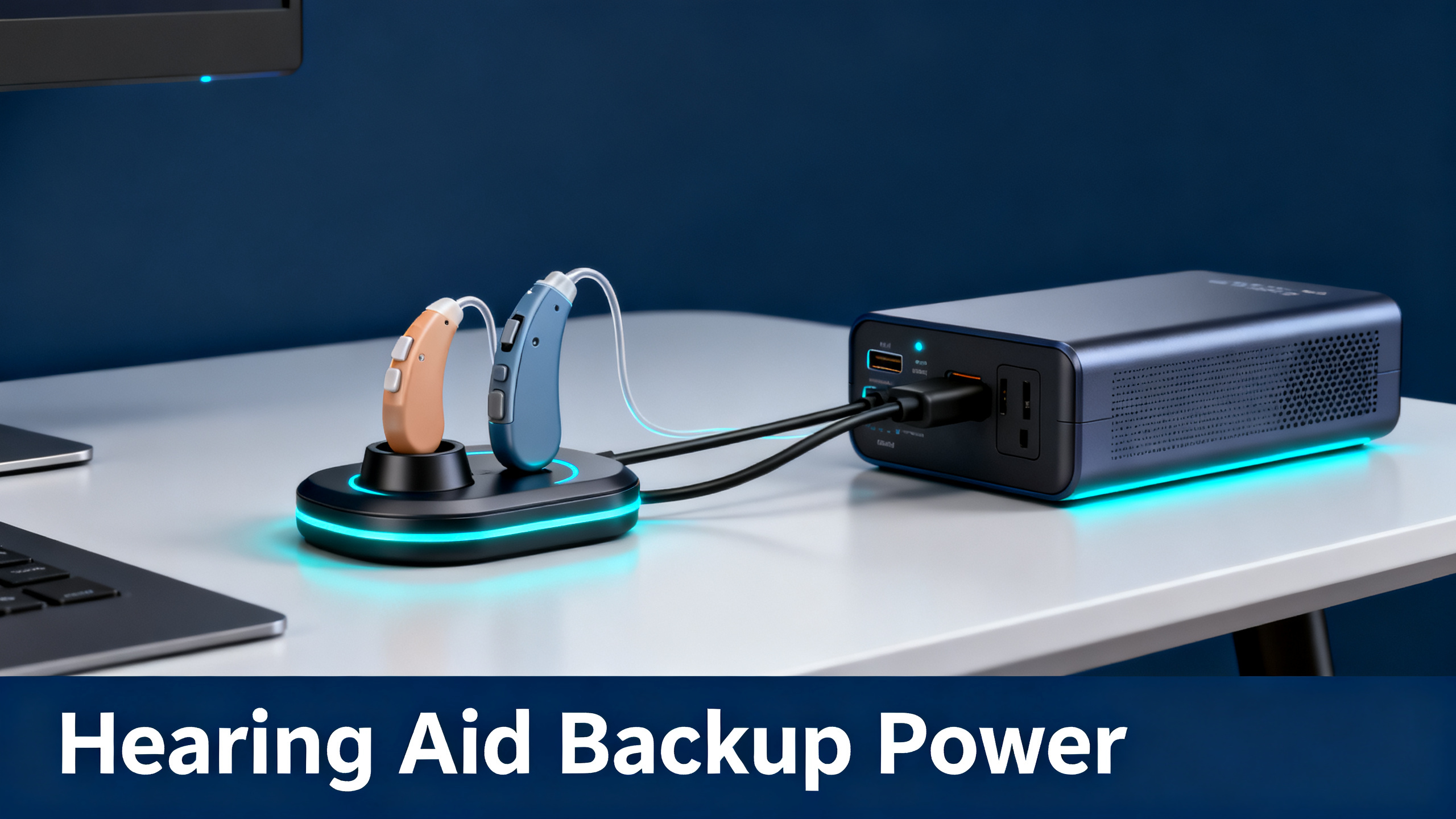
As a hearing aid or cochlear implant user, your devices aren’t optional accessories. They’re essential tools for communication, safety, and daily independence. So when the power goes out, the stakes are higher than a dark living room or a dead phone. Beyond hearing devices, our broader medical equipment power guide covers backup solutions for CPAP, oxygen, and other essential gear, but this article zeros in on the specific needs of hearing aid and cochlear implant users.
The good news: the power demands of hearing devices are surprisingly modest. A 240–300Wh portable power station handles days of charging, operates silently enough for bedside use, and fits in a carry-on bag. Here’s what you need to know to choose the right one, and stay connected through any outage.

Jackery Explorer 240D
$209
- LiFePO4, 10-year battery life
- Whisper-quiet (25dB-class)
- 1-hour fast charging via App
- 7.7 lbs, ultra-portable for travel
Get our Black Friday alerts for power stations
We track live prices on 40+ models from Jackery, EcoFlow, BLUETTI and Anker SOLIX. When a deal beats the lowest price we've recorded, you'll hear from us. During Black Friday week, one short recap a day at most.
Unsubscribe in one click. We may earn a commission when you buy through our links, at no extra cost to you. Privacy Policy
Why Power Backup Matters for Hearing Devices
Approximately 48 million Americans experience some degree of hearing loss. For the millions who rely on rechargeable hearing aids or cochlear implant processors, a power outage isn’t a minor inconvenience. It’s a communication barrier with real consequences: missed conversations, inability to hear alarms, and in some cases, genuine safety risks.
Modern rechargeable hearing aids typically need an overnight charge every 16–18 hours of use. Cochlear implant processors run on dedicated battery packs that require daily or every-other-day recharging, depending on the brand and usage profile. According to ASHA hearing aid maintenance guidelines, consistent charging and proper care are central to device reliability. An outage lasting more than a day creates a real gap in that routine.

It helps to understand the difference between the two device types. Hearing aids amplify sound through a tiny speaker. They’re self-contained, typically paired with a USB-C or proprietary charging dock. Cochlear implants involve an external processor worn behind the ear and a surgically implanted receiver. The processor needs daily charging, and many users also run a hearing aid dryer (dehumidifier) overnight to protect the electronics from moisture damage.
Hearing Device Power Demands
🦻
Hearing Aids (pair)
~5W charging
USB-C dock typical
🎧
Cochlear Processor
~8W charging
Proprietary chargers
💨
Hearing Aid Dryer
~15W
UV / heated dry box
📱
Streamer / Phone
~10W
Bluetooth accessory
Combined daily draw: 30-50Wh, easily covered by a 240Wh+ power station.
The key insight here: the combined daily draw of all your hearing-related devices rarely exceeds 30–50 watt-hours (Wh, the standard unit of battery capacity). A typical home refrigerator draws that much in about an hour. For hearing devices, a compact 240Wh power station provides days of coverage, not just hours.
What to Look For in a Power Station for Hearing Devices
Not all portable power stations are equal. For hearing aid and cochlear implant users, several specs matter more than raw capacity. Compact form factors matter when bedside placement or travel are priorities; our roundup of the best compact power stations highlights units under 10 lbs across all four major brands.
Capacity Sweet Spot (240-300Wh)
For hearing device charging alone, even a 100Wh unit would cover several days. But 240–300Wh gives you meaningful headroom to also charge your phone, a Bluetooth streamer, and a hearing aid dryer without any capacity anxiety. It also keeps the unit under the airline 300Wh carry-on threshold with airline approval. Units below 100Wh offer limited runtime flexibility; units above 500Wh are simply more than you need (and heavier).
Quiet Operation (Less Than 30dB Matters for Bedside)
Most portable power stations run a cooling fan under load. For medical device users who charge overnight at the bedside, fan noise is a real concern. The target is below 30dB at typical bed distances (3–6 feet). A quiet library registers around 40dB. The units in this guide all fall in the 25–30dB range, which is effectively inaudible during sleep.
Pure Sine Wave AC (Sensitive Electronics)
Some budget power stations output a modified sine wave, which can interfere with sensitive electronics or proprietary chargers. Cochlear implant processors in particular draw from dedicated chargers that assume clean AC power. All three picks in this guide deliver pure sine wave AC output, equivalent to your standard wall outlet.
USB-C PD Compatibility (Most Modern Chargers)
Many hearing aid brands have shifted to USB-C charging docks, particularly Phonak, Oticon, and Starkey. A USB-C Power Delivery (PD) port handles these natively. Even if your current charger uses AC, having a strong USB-C port future-proofs the setup and lets you charge a phone or streamer simultaneously.
Battery Chemistry (LiFePO4 Longevity)
LiFePO4 (lithium iron phosphate) batteries tolerate more charge cycles before degrading, typically 2,000–3,000 versus 500–800 for standard lithium-ion. For a power station used as a daily or weekly backup over many years, LiFePO4 is the practical choice. All three recommendations here use this chemistry.
UPS Function for Continuous Charging
A UPS (uninterruptible power supply) mode switches from grid power to battery power in milliseconds when an outage hits. For cochlear implant users running a continuous overnight charging routine, this means the charger never loses power mid-cycle. The Anker SOLIX C300X switches in 10ms; the EcoFlow RIVER 3 in under 20ms.

Get our Black Friday alerts for power stations
We track live prices on 40+ models from Jackery, EcoFlow, BLUETTI and Anker SOLIX. When a deal beats the lowest price we've recorded, you'll hear from us. During Black Friday week, one short recap a day at most.
Unsubscribe in one click. We may earn a commission when you buy through our links, at no extra cost to you. Privacy Policy
Cochlear Implant Charging Specifics
Cochlear implant systems from the three major manufacturers (Cochlear Limited, Advanced Bionics, and MED-EL) each use proprietary processor chargers. None of them are interchangeable. That means your power station needs to accommodate the original charger, plugged into an AC outlet, rather than relying on a generic USB-C cable.
Cochlear Limited’s Nucleus 8 and Kanso 2 processors, for example, use dedicated charging stations that draw approximately 8W and require standard AC power. Advanced Bionics processors typically charge via USB-C but at specific voltage profiles. For brand-specific connector requirements, always consult your audiologist or refer to Cochlear true wireless device charging info directly from the manufacturer.
⚠️ Important: Always consult your audiologist or device manufacturer for specific charging requirements before connecting your cochlear implant processor to any third-party power source.
Hearing aid dryers deserve a specific mention. UV dehumidifier boxes (brands like Dry-Brik, Zephyr, or Ear Technology) run 30–90 minute cycles at 15–25W. Running a nightly dry cycle adds roughly 20–35Wh to your daily draw, still well within what a 240Wh station handles comfortably. These units plug into a standard AC outlet, making the pure sine wave requirement particularly important.
Medical Device Power During Travel
Airline rules, TSA caps, and setup strategies for keeping devices charged on the road.
Top 3 Quiet, Compact Picks
The market has dozens of compact power stations, but most fall short on one or more of the criteria that matter for hearing device users: noise level, pure sine wave output, or LiFePO4 chemistry. Analysis of available units in the 240–300Wh range narrows the field to three standout options.
✅ Choose a 240-300Wh station if…
- You charge 1-2 hearing aid pairs daily
- You need bedside power that runs at <30dB
- You want a compact sub-300Wh unit for car trips (it still cannot fly: airlines cap batteries at 160Wh)
- Your priority is portability over runtime
❌ Look at higher capacity if…
- You also need to power a CPAP, oxygen, or fridge
- Outages in your area frequently exceed 5-7 days
- Multiple family members rely on medical devices
- You want whole-room coverage (lights, fan, charging)
What Can a 240Wh Power Station Run? (Hearing Aid Use Case)
🦻
Hearing Aid Charger
40+ cycles
5W full overnight
🎧
Cochlear Processor
25+ cycles
8W full charge
💨
Dry Box Cycle
12+ cycles
15W x 90 min
🛌
Multi-Day Outage
5-7 days
Mixed daily routine
Jackery Explorer 240D: Editor’s Pick
The Jackery Explorer 240D leads this lineup for hearing device users on two key metrics: noise floor and LiFePO4 longevity. At 25dB-class operation, it’s effectively silent at bedside distances. The LiFePO4 battery carries a 3,000-cycle rating, which translates to roughly a 10-year service life with daily charging. That’s a meaningful consideration for a device you plan to rely on for years.
Capacity sits at 256Wh, with 300W continuous AC output and 600W surge. Port variety covers AC, USB-C PD (100W), USB-A, and 12V DC. The 1-hour fast charge is activated via the Jackery app, which adds a minor wrinkle (requires a phone connection to trigger), but the result is a fully charged station in the time it takes to sleep in on a weekend morning. At 7.7 lbs, it moves easily between rooms or into a travel bag.
Note: the Explorer 240D is Jackery’s current 240-class model and the direct successor to the earlier 240 v2, keeping the same 256Wh capacity, LiFePO4 chemistry, and whisper-quiet operation. If you want a slightly larger package, the Explorer 300 Plus offers comparable silence and LiFePO4 chemistry. For a deeper look at build quality, port layout, and runtime specifics, the full Jackery Explorer 240 review covers the complete spec picture.
Anker SOLIX C300X: Best for USB-C Power Delivery
The Anker SOLIX C300X earns its spot through a combination of specs that matter specifically to medical device users. The 25dB noise rating at 3.3 feet is verified by Anker’s published specs, placing it among the quietest units in this capacity class. The 10ms UPS switchover is the fastest of the three picks, which matters if your cochlear processor charger is running an active charge cycle when an outage hits.
At 288Wh, it carries the largest capacity of the three. The dual 140W USB-C PD ports are a standout for households where both hearing aids and a smartphone need simultaneous charging. The 50-minute wall recharge to 80% (full charge faster than the competitor average) means a depleted unit is back in service quickly. The Anker SOLIX C300X review details exact charging curves and noise floor measurements across load levels.
Anker’s 5-year full warranty is worth noting for medical use cases, where device longevity matters more than it does for casual camping. The unit is 15% smaller than the category average and ships with a carry strap, which helps for travel or moving between rooms.
EcoFlow RIVER 3: Best Budget
At $199 (down from $239), the EcoFlow RIVER 3 makes the case that you don’t need to spend $300 to get reliable hearing device backup. The 245Wh LiFePO4 battery carries a 10-year design life and 3,000+ cycle rating. Noise level is rated under 30dB, which keeps it in the acceptable range for overnight bedside use.
The RIVER 3’s X-Boost technology is worth flagging for hearing aid dryer users. Standard 300W output combined with X-Boost can handle up to 600W loads, meaning UV dehumidifier boxes with higher wattage ratings run without issue. The under-20ms UPS switchover is fast enough to protect any mid-cycle charging routine. At 7.8 lbs and 30% smaller than the category average, it handles travel well. The Anker SOLIX C300X edges ahead if UPS speed and USB-C performance are priorities, but for straightforward home backup, the RIVER 3 delivers the core spec set at a meaningful price difference.


Power Solutions for Hearing Aid Users on the Go
Traveling with a portable power station for hearing aid or cochlear implant backup requires understanding a few key rules. TSA regulations and airline policies govern what you can bring onboard, and the rules differ depending on unit capacity. For the complete picture on TSA lithium battery rules for air travel, check the official guidelines before you fly, as requirements can change.
The practical summary: all three units in this guide (Jackery 240D at 256Wh, Anker C300X at 288Wh, EcoFlow RIVER 3 at 245Wh) fall under the 300Wh carry-on threshold. Units between 100Wh and 300Wh require prior airline approval for carry-on. Units under 100Wh are generally permitted without approval. Checked baggage is not an option for lithium batteries of any size. For a complete framework on managing travel power for hearing devices including airline rules and capacity caps, see the dedicated guide.
Hotel rooms present a simpler situation. All three units charge from a standard wall outlet and can run a nightly hearing device charging routine without drawing on room power at all, useful in older hotels with limited outlets or in countries where outlet standards differ. For cruise travel, ship electrical systems are generally stable, but the UPS function provides extra protection against momentary power fluctuations in port or during rough seas.
💡 Pro Tip: Contact your airline at least 48 hours before departure to request approval for your power station. Have the Wh rating written on the unit ready to confirm compliance at security.
Setting Up Your Charging Station at Home
The most effective setup for hearing device users is a dedicated overnight charging station at the bedside. Position the power station on a nightstand or small shelf within reach, with your hearing aid dock and cochlear charger plugged into the AC ports. Run the power station in pass-through mode during normal grid operation: it stays charged from the wall while powering your devices. When the grid fails, it transitions to battery without any action required.
Keep the dry box on the same power strip or directly plugged into the station’s second AC port. A 90-minute UV cycle starting as you go to bed finishes well before the hearing aid charging dock needs to run, so timing conflicts are minimal. Leave at least 6 inches of clearance around the unit for ventilation, even though fan operation is minimal at the low loads these devices draw.
💡 Pro Tip: Recharge your power station every 2-3 months even during extended non-use. LiFePO4 batteries hold charge well, but a storage charge of around 50% extends long-term cell health.
A typical overnight schedule for a hearing aid user with a cochlear processor: dry box runs 8–10 PM (35Wh), hearing aid dock charges 10 PM to 6 AM (5Wh overnight), cochlear processor charges 10 PM to midnight (8Wh). Total draw: roughly 48Wh. A 256Wh station covers this for approximately 5 days without a recharge, and the 10-year LiFePO4 cycle life means the routine can continue reliably for years.
Emergency Planning and Multi-Device Households
A 72-hour emergency kit should include your power station as a priority item, alongside the original chargers for every hearing device in the household. Proprietary chargers are not interchangeable: if a Cochlear Nucleus charger is lost or forgotten, a USB-C cable is not a substitute. Keep a checklist with the kit that lists every charger required.
When multiple family members use hearing devices, the math remains manageable. Two hearing aid pairs and one cochlear processor together draw approximately 18Wh per overnight charge cycle. A 256Wh station covers this load for 5–7 days without supplemental charging. Add a dry box and a phone, and you’re looking at 60–70Wh per day, still well within 3–4 days of coverage from a single charge.
For households that combine hearing aids with other medical devices (CPAP, home oxygen, powered wheelchairs), the 240Wh capacity class becomes limiting. Our wheelchair charging guide covers the math for shared power stations across multiple devices and explores the capacity thresholds where 1,000Wh+ units become necessary.
Solar recharging extends your options significantly during extended outages. All three picks accept solar panel input: the Jackery 240D accepts up to 100W solar input, as does the Anker C300X (via USB-C PD 3.1). On a clear day with a 100W panel, a depleted unit can be fully recharged in 3–4 hours. This makes even a multi-week outage manageable for hearing device needs specifically.
Best Power Stations for Medical Equipment at Home
CPAP, oxygen concentrators, and multi-device household backup solutions compared.
Frequently Asked Questions
Can I really power my hearing aid charger from a portable power station all night?
Yes. A 240Wh-class power station can run a hearing aid charging dock (typically 5W) for the entire night and still have over 95% capacity remaining the next morning. The combined daily draw of a hearing aid pair, a streamer, and a phone charger rarely exceeds 50Wh, well under the capacity of any of the three picks in this guide.
Is a power station safe for charging cochlear implant processors?
When using a pure sine wave AC outlet, yes. All three units recommended in this article (Jackery Explorer 240D, Anker SOLIX C300X, EcoFlow RIVER 3) deliver pure sine wave output, which is the same waveform as your wall outlet. Always use the manufacturer’s original charger plugged into the AC port for medical-grade safety. Consult your audiologist for any device-specific concerns.
How loud is a power station overnight on a bedside table?
The three picks here operate at 25–30dB, quieter than a whisper (30dB) or a library (40dB). Spec analysis confirms that the Anker C300X is rated at 25dB at 3.3 feet, which is essentially inaudible at typical bed distances. Hearing aid users sensitive to ambient noise will not detect the unit during sleep.
Can I take a 240Wh power station on a plane?
Yes, all three units in this guide fall under the 300Wh airline threshold for carry-on with prior airline approval. Always check your specific airline’s lithium battery policy and the latest TSA guidelines before flying. Never place lithium battery power stations in checked baggage, as this is prohibited regardless of capacity.
What capacity do I need if my whole family uses hearing devices?
For 2–3 device users charging hearing aids and a single processor each, a 240Wh station handles 3–5 days of routine use during an outage. Households combining hearing aids with CPAP, oxygen, or other medical equipment should size up to 1,000Wh-class units. Our broader guide on multi-device home backup setups walks through the math for higher-demand households.
The Bottom Line: Stay Connected Through Any Outage
Hearing aid and cochlear implant users have specific needs that general-purpose power station reviews rarely address: near-silent operation, pure sine wave AC, compact form factor, and LiFePO4 longevity. The good news is that these requirements align well with the 240–300Wh class, which happens to be the most portable and TSA-compatible segment of the market.
For most hearing device users, the Jackery Explorer 240D at $209 is the strongest overall package: whisper-quiet, LiFePO4, 256Wh, and genuinely portable at 7.7 lbs. The Anker SOLIX C300X at $299.99 earns the top spot if you prioritize fast UPS switchover and dual 140W USB-C output. The EcoFlow RIVER 3 at $199 is the practical choice when budget is the primary constraint and core reliability is non-negotiable.
Whichever unit you choose, verify specific charging requirements with your audiologist or device manufacturer before setting up your routine. These stations provide the power infrastructure; your care team provides the device-specific guidance.
EcoFlow RIVER 3
$199 $239
Best budget pick: silent, fast, portable
Price verified April 2026, free shipping available
Originally published: April 30, 2026