
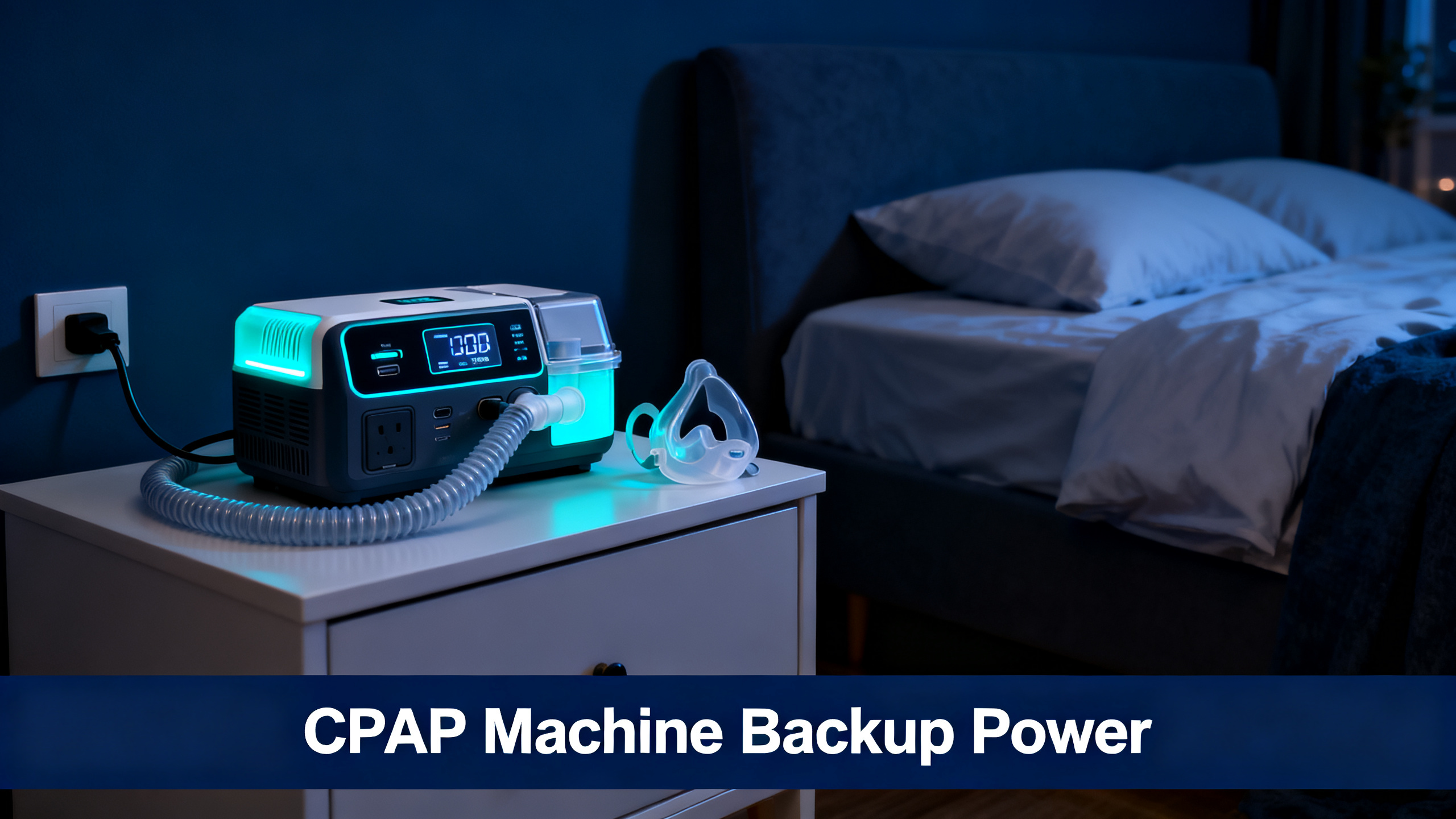
Sleep apnea therapy does not pause when the grid does. If you rely on a CPAP machine every night, a power outage is not an inconvenience: it is a missed therapy session, fragmented sleep, and the return of every symptom you bought the machine to control. A reliable backup power solution turns that risk into a non-issue.
This guide covers everything you need to choose the right backup power station for your CPAP machine, whether you are planning for home outages, RV travel, or off-grid camping. Before diving into CPAP-specific setups, our complete medical devices guide covers all home healthcare scenarios in one place. Continuity matters because sleep apnea treatment continuity directly affects daytime alertness, cardiovascular health, and quality of life.

Anker SOLIX C1000 Gen 2
$499.99
- 1,024Wh LFP, 10-year InfiniPower guarantee
- 2,000W AC output across 10 ports
- Fully recharged in 49 minutes via HyperFlash
Get the 1-page outage plan
What to plug in first, how long a fridge really runs on a battery, and the 3 safety rules for connecting a power station to your home. Printable, sent by email.
About one email a week. Unsubscribe in one click. We may earn a commission when you buy through our links, at no extra cost to you. Privacy Policy
Why CPAP Users Need Dedicated Backup Power
A CPAP machine is not a luxury electronic device. It is a prescribed medical therapy that maintains your airway through positive air pressure delivered every minute you are asleep. When the power cuts, the airway support stops. Within seconds, breathing patterns return to the apneic episodes the therapy was designed to eliminate.
For someone with moderate to severe obstructive sleep apnea, missing a single night of CPAP therapy can result in dozens of breathing pauses per hour, oxygen desaturation, elevated blood pressure overnight, and significant daytime impairment the next morning. Multiply that across a multi-day grid outage and the health impact compounds quickly.
What Happens When Power Cuts Out During CPAP Therapy
Most CPAP machines do not include an internal battery. When AC power disappears, the unit shuts off completely. The pressurized air feeding your mask stops, and most users wake up within seconds because of the sudden change in breathing resistance and the silence of the motor.
The next problem is restart. Without alternative power, the therapy session simply ends. If you live in an area prone to extended outages from storms, ice events, or grid instability, this becomes a recurring sleep disruption that defeats the purpose of CPAP treatment.
Why Generators Are Not Ideal for CPAP Machines
Conventional gas generators have three problems for CPAP use: noise, fuel logistics, and power quality. A generator running outside your bedroom window is loud enough to disturb sleep on its own, and most CPAP users do not want to manage fuel storage just to maintain therapy through a 12-hour outage.
The deeper issue is power quality. Many inexpensive generators output a modified or rough sine wave that can damage sensitive CPAP electronics over time. Pure sine wave inverter generators exist, but at that point a battery-based portable power station offers cleaner output, silent operation, and instant readiness, which is exactly why CPAP machine power requirements increasingly point patients toward LFP power stations rather than fuel-based generators.
How Much Power Does a CPAP Machine Actually Use?
This is the question that determines everything else: capacity, runtime, and budget. Most CPAP users assume their machines draw far more power than they actually do. Real consumption depends almost entirely on whether you use a heated humidifier and heated tubing, not on the pressure setting itself.
CPAP Wattage: Baseline, Humidifier, and Heated Tube
A typical modern CPAP machine without humidification draws between 30 and 50 watts during normal operation. That includes the blower motor running at therapeutic pressures of 4 to 20 cm H2O, plus the small electronics and display. This is roughly the same continuous draw as a small LED desk lamp.
Add a heated humidifier and the picture changes significantly. Heated humidifiers are resistive heating elements that consume 30 to 60 watts on their own depending on temperature setting. Heated tubing adds another 5 to 15 watts. Combined, a CPAP with humidifier and heated tube on a moderate setting typically draws 60 to 100 watts continuously.
Travel CPAP machines like the ResMed AirMini consume even less, especially in DC mode. Powered directly from a 12V output, these units can run on 20 to 40 watts, which dramatically extends backup runtime.
Calculating How Many Nights of Backup You Need
The math is simpler than it looks. Multiply your CPAP’s wattage by 8 hours of sleep, then by the number of backup nights you want, then add a 20% buffer for inverter inefficiency. A 50W CPAP across 8 hours equals 400Wh per night. For three nights of backup, you need 400 x 3 x 1.2, which equals 1,440Wh of usable capacity.
This is why 1,024Wh has emerged as the practical sweet spot for CPAP backup. It covers two solid nights of CPAP plus humidifier use, or four to seven nights without humidifier, while staying portable enough to carry between rooms or to a vehicle. Both products covered below sit at this 1,024Wh capacity for that exact reason.
How Many Nights Can It Power Your CPAP? (1,024Wh)
😴
CPAP (no humidifier)
4 to 7 nights
30 to 50W
💧
CPAP + Heated Humidifier
2 to 4 nights
60 to 100W
🌬️
BiPAP (dual pressure)
3 to 5 nights
50 to 80W
🏕️
Travel CPAP (camping)
6 to 10 nights
20 to 40W DC mode
Runtime estimates based on 8-hour sleep sessions. Actual results vary by CPAP model, pressure setting, and humidifier usage. Using DC mode on travel machines significantly extends runtime.
Anker SOLIX C1000 Gen 2
Best overall CPAP backup, 4 to 7 nights of runtime
$499.99
Get the 1-page outage plan
What to plug in first, how long a fridge really runs on a battery, and the 3 safety rules for connecting a power station to your home. Printable, sent by email.
About one email a week. Unsubscribe in one click. We may earn a commission when you buy through our links, at no extra cost to you. Privacy Policy
The Two Features That Matter Most for CPAP Backup
Battery capacity gets all the marketing attention, but two technical features determine whether a power station will actually keep your CPAP running safely: pure sine wave AC output and UPS switchover. Get either one wrong, and you risk damaging the machine or interrupting therapy during the moment power transfers from the grid to battery.
Pure Sine Wave Output: Why It Protects Your Machine
CPAP electronics are designed to run on the smooth, clean alternating current that flows from a wall outlet. This waveform is called a pure sine wave. Cheaper inverters and many basic generators produce a modified sine wave: a stepped, blocky approximation of clean AC that works fine for resistive loads like incandescent lights but stresses sensitive electronics over time.
Running a CPAP on modified sine wave power can cause buzzing in the motor, premature electronic component failure, and in some cases voids the manufacturer warranty. Both the Anker SOLIX C1000 Gen 2 and EcoFlow DELTA 2 produce pure sine wave output, which is the minimum requirement for any CPAP backup setup.
UPS Function: Seamless Switchover Under 30ms
A UPS function (Uninterruptible Power Supply) lets the power station sit between your wall outlet and your CPAP. Grid power flows through the station while it stays fully charged. When the grid drops, the station switches to battery power so quickly that the CPAP never registers an interruption.
The switchover speed matters because most CPAP machines reset if power is lost for more than about 30 milliseconds. A reset means the machine reboots, the therapy session ends, and you wake up. The EcoFlow DELTA 2 with UPS for CPAP is the only station in this price range that switches to battery in under 30 milliseconds, which is fast enough that the CPAP simply keeps running. The Anker SOLIX C1000 Gen 2 also includes UPS functionality, though manufacturer documentation does not specify exact switchover time.


Best Power Stations for CPAP Machines (2026)
Two products stand out for the 1,024Wh capacity tier where CPAP backup makes the most sense. Both produce pure sine wave AC, both include UPS functionality, and both fit the mid-range price bracket where reliability does not require a $1,500 investment. The differences come down to warranty depth, recharge speed, and how fast the UPS hands off to battery.
Anker SOLIX C1000 Gen 2: Best for Home Backup
The Anker SOLIX C1000 Gen 2 is built around long-term reliability. Spec analysis shows the unit pairs a 1,024Wh LiFePO4 battery with a 10-year InfiniPower guarantee, meaning the battery retains at least 80% capacity after 4,000 charge cycles. For a device you want to trust every night for the next decade, that warranty depth matters more than any short-term performance advantage.
Performance data confirms the C1000 Gen 2 delivers 2,000W of continuous AC output across 10 ports, with 3,000W peak surge capability. That is far more than any CPAP setup needs, but it means you can simultaneously run a CPAP, a small fridge, lighting, and charge phones during an extended outage without exceeding the inverter’s limits.
The standout feature is recharge speed. With Anker’s HyperFlash technology, the unit accepts 1,600W of AC input and reaches a full charge from empty in 49 minutes. During a planned outage warning or between rolling blackouts, that means you can top up the battery in less than an hour rather than waiting through a half-day charge cycle. For a detailed breakdown of all specs and real-world runtime data, read our full Anker SOLIX C1000 review.
Editor’s Pick, Home Backup
Anker SOLIX C1000 Gen 2
1,024Wh | 2,000W | 10-Year Warranty
$499.99
EcoFlow DELTA 2: Best UPS Switchover
The EcoFlow DELTA 2 matches the C1000 Gen 2 on capacity (1,024Wh) but takes a different approach to charging speed and UPS performance. Where the Anker prioritizes the fastest possible recharge time, the DELTA 2 prioritizes the fastest possible switchover from grid to battery: under 30 milliseconds, fast enough that the CPAP never sees the gap.
AC output is 1,800W continuous with 2,200W via X-Boost technology, which is enough headroom for any CPAP plus other small loads. The LFP battery is rated for 3,000+ cycles before reaching 80% capacity, with a 5-year warranty covering the battery. That is shorter than Anker’s 10-year guarantee but still well beyond what most users need from a backup unit.
The DELTA 2 also expands. With the optional Smart Extra Battery, capacity scales from 1,024Wh up to 3,072Wh, which is enough for a week of CPAP plus humidifier therapy through a major outage. For users who anticipate longer-duration emergencies, that expandability path is genuinely useful.

Which Is Right for You?
The two options solve slightly different problems. The Anker C1000 Gen 2 wins on long-term reliability and recharge speed. The EcoFlow DELTA 2 wins on UPS switchover speed and price. Both will run your CPAP safely for multiple nights. The right pick depends on which scenario describes your situation best.
For Home Outage Backup (Reliability Priority)
If your primary concern is multi-night home outages from storms or grid instability, the Anker C1000 Gen 2 is the stronger choice. The 10-year battery guarantee aligns with the long ownership horizon of medical backup equipment, and the 49-minute full recharge means you can quickly top up the unit when grid power returns intermittently during a multi-day outage.
For Camping and Off-Grid CPAP Use
For RV travel, car camping, and extended off-grid use, both units perform well, but the EcoFlow DELTA 2’s slightly lower price makes it the better value if reliability is not your sole concern. The expandable battery system on the DELTA 2 also helps for longer trips. For airline travel and ultralight applications, neither unit is ideal: smaller stations or the DC mode of travel CPAPs are more practical.
For Budget-Conscious Buyers
At $399, the EcoFlow DELTA 2 is $100 cheaper than the C1000 Gen 2 while offering the same 1,024Wh capacity and faster UPS switchover. The trade-offs are a shorter battery warranty (5 years vs 10) and slower full recharge time. If budget is the deciding factor, the DELTA 2 delivers genuinely competitive specs at a lower price point.
Anker C1000 Gen 2 is right if…
- You need 3+ nights of home backup during outages
- Long-term reliability matters (10-year InfiniPower)
- You want to recharge fast between outages (49 min)
- You also need to power other home devices
EcoFlow DELTA 2 is right if…
- Zero-interruption during power flickers is critical
- UPS switchover under 30ms protects CPAP memory
- Budget is a priority ($399 vs $499)
- You also use it for camping or travel
Powering Your CPAP While Camping
Camping with sleep apnea used to mean either skipping therapy or hauling a generator. Modern portable power stations make multi-night CPAP use practical for tent camping, RV travel, and off-grid stays. The key is matching capacity to your machine’s actual draw and using DC mode whenever possible to stretch runtime.

Medical Device Power During Travel
For camping and travel scenarios, see our dedicated guide to CPAP travel power options, including airline carry-on rules.
Travel CPAP vs Standard CPAP: Runtime Differences
Travel CPAP machines like the ResMed AirMini and Transcend Micro are engineered for portability, which also means they consume far less power than full-size home units. Average draw for a travel CPAP without humidification is 20 to 35 watts, compared to 40 to 60 watts for standard machines.
That difference compounds dramatically over multiple nights. A standard CPAP at 50W will pull about 400Wh per night across an 8-hour session. A travel CPAP at 25W pulls only 200Wh per night. On a 1,024Wh power station, that means roughly 2 to 3 nights for a standard machine versus 5 to 6 nights for a travel unit, before accounting for inverter inefficiency.
Using DC Mode to Extend Battery Life
Most travel CPAPs and many standard machines support direct 12V or 24V DC input through an optional cable. Powered via DC, the machine bypasses the inverter entirely, which eliminates the 10 to 15% efficiency loss associated with converting battery DC to AC and back to DC inside the machine.
💡 Pro Tip: If your CPAP supports 12V DC input, always use the DC cable when running off a power station. You will gain 15 to 25% more runtime per charge, which often means an extra night of therapy on the same battery capacity.
Other Respiratory Devices to Consider
CPAP is the most common nightly therapy, but it is not the only respiratory device that needs reliable backup power. If you or a household member uses a BiPAP, oxygen concentrator, or both alongside a CPAP, the sizing math changes and the priority features may shift toward higher capacity or longer continuous runtime.
BiPAP Machine Power Needs
BiPAP machines deliver two different pressure levels (one for inhalation, one for exhalation) and typically draw slightly more power than standard CPAP units, in the range of 50 to 80 watts. Runtime calculations on a 1,024Wh station indicate 3 to 5 nights of BiPAP backup without humidification, which is comparable to CPAP plus humidifier scenarios.
BiPAP Machine Power Solutions
If you use a BiPAP instead of a CPAP, the requirements differ slightly. Our BiPAP power solutions guide covers the specifics.
CPAP + Oxygen Concentrator Combined Setup
Patients prescribed both CPAP therapy and supplemental oxygen face a more complex backup challenge. Portable oxygen concentrators typically draw 100 to 250 watts continuously, far more than the CPAP itself. Combined runtime on a 1,024Wh station drops to roughly 6 to 10 hours of paired operation, which means a single night of backup at most.
For dual-therapy users, expandable systems or a higher-capacity station in the 2,000Wh+ range becomes necessary. Patients using supplemental oxygen alongside CPAP therapy should read our guide to oxygen concentrator backup power for combined load calculations and recommended capacity tiers.
⚠️ Important: If you use any prescribed respiratory device, discuss your backup power plan with your physician or DME provider. They can confirm specific power requirements for your model and advise on whether your prescribed therapy can safely tolerate brief interruptions during a UPS switchover.
Frequently Asked Questions
Can a portable power station safely run a CPAP machine?
Yes, provided it produces a pure sine wave AC output, the same clean power as the grid. Modified sine wave units can damage CPAP electronics and void warranties. Both the Anker SOLIX C1000 Gen 2 and EcoFlow DELTA 2 produce pure sine wave output, making them fully compatible with all major CPAP brands including ResMed, Philips Respironics, and Fisher & Paykel.
How many nights can a 1,024Wh power station run a CPAP?
Runtime calculations based on standard CPAP draw indicate 4 to 7 nights without a humidifier (30 to 50W typical draw), or 2 to 4 nights with a heated humidifier active (60 to 100W). Using DC mode on travel CPAP machines like the ResMed AirMini can extend this to 6 to 10 nights per charge.
Does my CPAP need a UPS function in the backup power station?
A UPS (Uninterruptible Power Supply) function allows the station to switch from grid power to battery power in under 30 milliseconds, which is fast enough that most CPAP machines never detect the interruption. Without UPS, the CPAP may reset mid-session and lose therapy settings. The EcoFlow DELTA 2 switches in under 30ms. The Anker SOLIX C1000 Gen 2 also includes UPS functionality but manufacturer data does not specify exact switchover time.
Can I use my CPAP power station for camping?
Yes. Both units reviewed here are portable enough for car camping and RV use. For backpacking, smaller options like the Jackery Explorer 300 or EcoFlow RIVER 3 may be more practical. When using a travel CPAP with a 12V DC cable connected directly to the station, runtime increases significantly compared to using the AC outlet.
Will using a power station for CPAP void my warranty?
Using any power source outside the manufacturer’s certified power supply may affect warranty coverage. Data from major CPAP brands indicates that pure sine wave AC power at the correct voltage (110V/60Hz in the US) is safe. Consulting your CPAP manufacturer’s documentation before relying on an alternative power source for ongoing therapy is advisable.
How do I size a backup power station for my CPAP?
Identify your CPAP’s wattage (listed on the device label or manual). Multiply by 8 hours (average sleep) to get nightly Wh consumption. Multiply by the number of backup nights desired, then add 20% buffer for efficiency losses. Example: 50W CPAP x 8 hrs = 400Wh per night. For 3 nights: 400 x 3 x 1.2 = 1,440Wh minimum. A 1,024Wh station covers approximately 2 nights at this draw.
Final Recommendation
For most CPAP users planning serious home backup, the Anker SOLIX C1000 Gen 2 is the better long-term investment. The 10-year InfiniPower guarantee, 49-minute full recharge, and 2,000W output give you reliability across the kind of multi-day outage scenarios where backup actually matters. Spending an extra $100 over the DELTA 2 buys five additional years of warranty protection on the most expensive component, the battery.
Choose the EcoFlow DELTA 2 if budget is your deciding factor or if you specifically need the fastest possible UPS switchover. Both products will safely power your CPAP through nights of grid loss. The Anker simply offers a longer ownership horizon and faster recovery between outages.
Anker SOLIX C1000 Gen 2
$499.99
Best CPAP backup power station, 10-year InfiniPower
Price verified April 2026, free shipping available
Originally published: April 30, 2026