
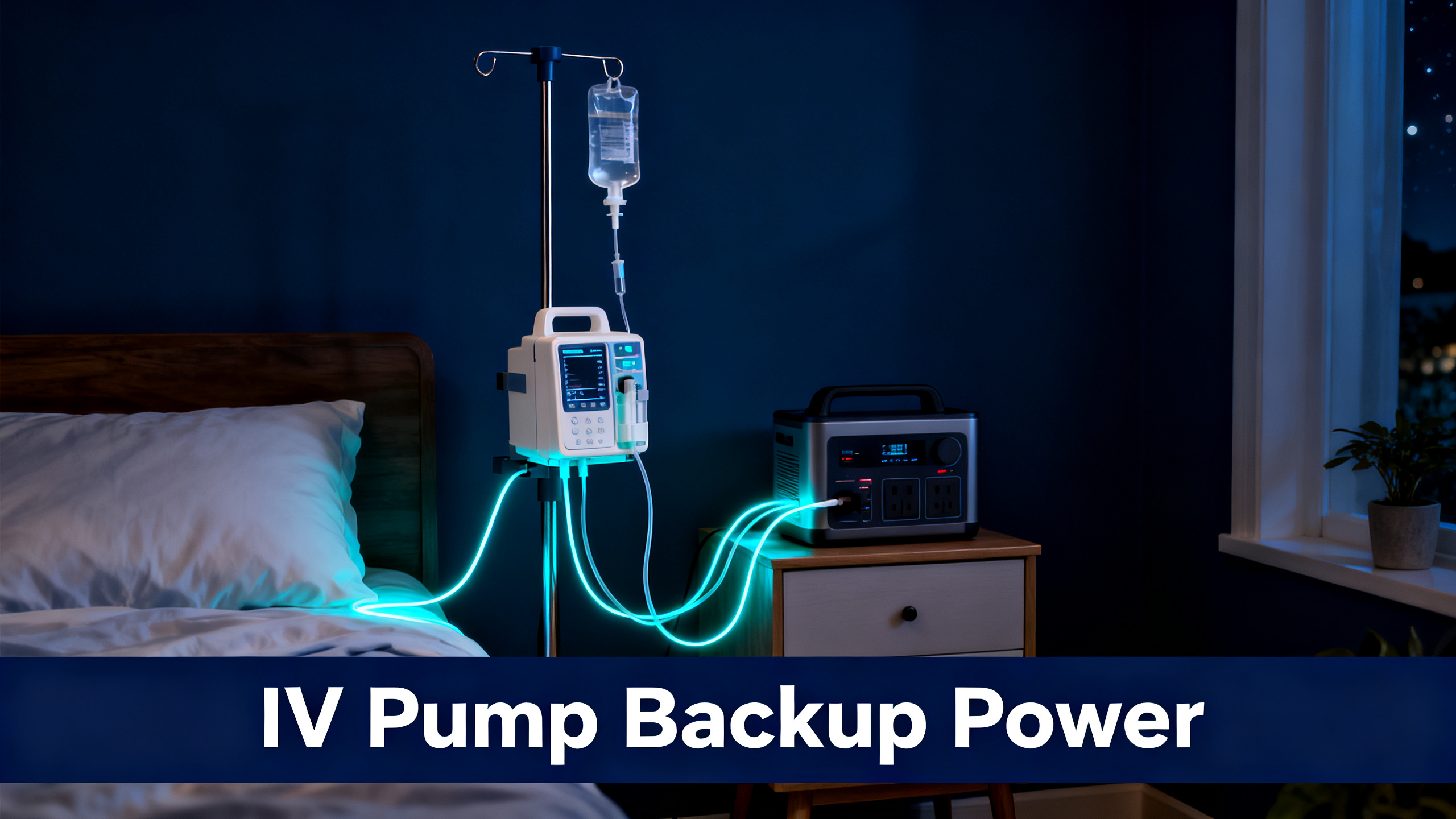
If you or someone in your care depends on home IV infusion therapy, a power outage isn’t an inconvenience. It’s a medical event. The pump pauses, the alarm sounds, and if no one is prepared, therapy is interrupted at the worst possible time.
Before diving into IV-pump-specific solutions, our complete medical equipment guide covers the broader framework for choosing backup power for any home health setup. This article focuses specifically on the three power stations that specification analysis, capacity data, and home infusion community feedback consistently identify as the most appropriate options for IV pump backup power in 2026.

Editor’s Pick: Best Overall
Anker SOLIX C1000 Portable Power Station
$449 $799
- 1,056Wh capacity, 1,800W output (SurgePad to 2,400W)
- LFP chemistry: 3,000 cycles, 10-year battery life, 5-year warranty
- Recharges 0-100% in under an hour
Get our Black Friday alerts for power stations
We track live prices on 40+ models from Jackery, EcoFlow, BLUETTI and Anker SOLIX. When a deal beats the lowest price we've recorded, you'll hear from us. During Black Friday week, one short recap a day at most.
Unsubscribe in one click. We may earn a commission when you buy through our links, at no extra cost to you. Privacy Policy
Why IV Pump Power Backup Is Non-Negotiable
Home infusion therapy gives you clinical-grade treatment in the comfort of your own space. But that independence comes with a critical vulnerability: your IV pump runs on wall power. When the grid goes down, the clock starts immediately.
IV pumps are FDA-classified Class II medical devices designed to deliver fluids at precise, controlled rates. A power interruption doesn’t just pause therapy. It triggers alarms, disrupts infusion schedules, and in some cases can compromise treatment efficacy. Before diving into IV-pump-specific solutions, our complete medical equipment guide covers the broader framework for choosing backup power for any home health setup.
What Happens When an IV Pump Loses Power
Modern IV pumps respond to power loss in seconds. Most emit audible alarms within 10-30 seconds of detecting an interruption. The pump may pause delivery, display fault codes, or enter a safe-hold state that requires manual intervention to resume. For nighttime infusions, this means waking a patient or caregiver at 2 a.m. to restart therapy.
The downstream effects compound quickly. Interrupted antibiotic infusions can reduce serum drug levels below therapeutic thresholds. TPN (total parenteral nutrition) interruptions affect caloric delivery for patients who depend on infusion as their primary nutrition source. The stakes are high enough that backup power isn’t optional for most home infusion patients.
Internal Pump Batteries: Why They’re Not Enough
Most volumetric IV pumps ship with an internal battery providing 2-8 hours of runtime. That’s adequate for a brief outage. It’s not adequate for a storm that takes the grid down for 12, 24, or 48 hours.
Internal batteries also degrade over time. A pump that originally offered 6 hours of backup may deliver 3-4 hours after two years of daily charging cycles. Relying on an aging internal battery as your sole backup is a documented risk pattern in home infusion communities.
Typical IV Pump Power Requirements
💧
Volumetric IV Pump
10-30W
Steady draw
🍽️
Enteral Feeding Pump
5-15W
Low draw
💉
Syringe Pump
5-20W
Variable draw
🚿
PCA/Multi-Channel
30-50W
Highest draw
What to Look for in an IV Pump Backup Power Station
Not every portable power station is suitable for medical backup. Consumer camping units often have compromises that matter little outdoors but become critical in a home health context. Here’s the analytical framework for evaluating your options.
Capacity (Wh): Sizing for Overnight Coverage
Watt-hours (Wh) measure how much energy a station can store, similar to the size of a fuel tank. To calculate your runtime: divide the station’s capacity by your pump’s wattage, then multiply by 0.9 (inverter efficiency factor). A 30W pump on a 512Wh station delivers approximately 15 hours of runtime. For multi-day coverage, 768Wh+ is the practical minimum.
UPS Switchover Time: Critical for Modern Pumps
UPS (uninterruptible power supply) function means the station detects a grid failure and switches to battery before your pump notices. Sub-30ms switchover is the standard that prevents alarm triggering on most modern infusion pumps. Without UPS function, even a 200ms gap can cause the pump to alarm and pause delivery.
Pure Sine Wave Output: Required for Sensitive Electronics
IV pumps contain sensitive microprocessors and motor-driven delivery mechanisms. They require pure sine wave AC power, identical to what comes from your wall outlet. Modified sine wave stations can cause motor humming, erratic display behavior, and premature component wear. All three recommended units here output pure sine wave.
Battery Chemistry: Why LFP Wins for Daily Medical Use
LiFePO4 (LFP) chemistry offers 3,000+ charge cycles versus 500 cycles for older NMC lithium-ion. For a patient who keeps a power station plugged in and charges it daily, LFP translates to 8-10 years of service life versus 18 months for NMC. The long-term math strongly favors LFP for any daily medical application.
Noise Level: Mandatory Consideration for Bedside Use
Power stations with active cooling fans can reach 45-55 dB under load. For bedside use, that’s the equivalent of a quiet conversation running all night. Look for units rated under 40 dB, or those with fanless operation at low loads. This spec is often buried in manufacturer documentation but matters significantly for nighttime infusion patients.
Get our Black Friday alerts for power stations
We track live prices on 40+ models from Jackery, EcoFlow, BLUETTI and Anker SOLIX. When a deal beats the lowest price we've recorded, you'll hear from us. During Black Friday week, one short recap a day at most.
Unsubscribe in one click. We may earn a commission when you buy through our links, at no extra cost to you. Privacy Policy
Top 3 IV Pump Backup Power Stations (2026 Picks)
Specification analysis across the current market identified three units that meet the medical-use criteria above. Here’s how they compare at a glance, followed by detailed coverage of each.
#1 Editor’s Pick: Anker SOLIX C1000, Best Overall
For home IV therapy patients, the Anker SOLIX C1000 addresses the three most critical criteria simultaneously: LFP chemistry for daily-use longevity, a 5-year warranty that covers the expected life of most home infusion programs, and a 1,056Wh capacity that provides genuine multi-day runtime on typical infusion pumps.
The C1000 is priced at $449 (down from $799), which positions it as a serious medical backup investment rather than a casual camping purchase. Runtime calculations using the 1,056Wh capacity and a 90% inverter efficiency factor show 30-95 hours on a standard volumetric pump drawing 10-30W. For a patient receiving 8-hour overnight infusions, that’s 4-11 nights of uninterrupted therapy on a single charge.
| Specification | Anker SOLIX C1000 |
|---|---|
| Battery Capacity | 1,056 Wh (expandable to 2,000 Wh) |
| AC Output (Continuous) | 1,800W (2,400W SurgePad) |
| Battery Type | LiFePO4 (LFP) |
| Cycle Life | 3,000 cycles to 80% |
| UPS Switchover | Approx. 20ms (pass-through) |
| Output Type | Pure Sine Wave |
| Recharge Time (AC) | Under 1 hr (0-100%) |
| Max Solar Input | 600W |
| Warranty | 5 years |
Anker SOLIX C1000: IV Pump Runtime (1,056Wh)
💧
Volumetric Pump
30-95 hrs
10-30W draw
🍽️
Feeding Pump
60-190 hrs
5-15W draw
💉
Syringe Pump
45-190 hrs
5-20W draw
🚿
PCA/Multi-Ch.
19-31 hrs
30-50W draw
Runtime calculations assume 90% inverter efficiency. Real-world results vary by pump model and infusion rate.
Why the C1000 Stands Out for Medical Use
The sub-60-minute full recharge is a standout spec for medical users specifically. If a caregiver needs to recharge between infusion sessions, a sub-60-minute turnaround means the unit is ready again before the next therapy cycle begins. The SurgePad feature, which extends output to 2,400W for high-demand devices, also means the C1000 can handle concurrent device loads without tripping the inverter.
The 5-year warranty is the other differentiator. For patients on multi-year home infusion programs, a warranty that covers the expected treatment duration provides meaningful peace of mind. Anker’s hassle-free replacement policy means a defective unit gets replaced without lengthy RMA processes.
Calculate Your Exact Runtime
Input your pump’s wattage for precise hour estimates based on your specific model.
Anker C1000 Strengths and Limitations
Strengths: LFP chemistry with 3,000 cycles, 5-year warranty, sub-60-minute recharge, app monitoring for remote status checks. The ability to power multiple simultaneous devices makes it viable for patients running several pieces of equipment.
Limitations: At 1,056Wh, the C1000 still isn’t designed for sustained high-draw concurrent loads like an oxygen concentrator plus IV pump running continuously for days. Patients with complex multi-device needs should evaluate the runtime implications carefully using the calculator above. The unit also weighs more than the EcoFlow RIVER 2 Max, which matters for patients who need to move it room to room.
#2 UPS Pick: EcoFlow RIVER 2 Max, Sub-30ms Switchover
The EcoFlow RIVER 2 Max makes a compelling case for patients where UPS continuity is the primary concern. At $249 (down from $469), it’s the most accessible option in the lineup, and the sub-30ms switchover mode is the feature that directly addresses IV pump alarm behavior during outages.

| Specification | EcoFlow RIVER 2 Max |
|---|---|
| Battery Capacity | 512 Wh |
| AC Output (Continuous) | 500W (1,000W X-Boost) |
| Battery Type | LiFePO4 (LFP) |
| Cycle Life | 3,000 cycles to 80% |
| UPS Switchover | Sub-30ms (key feature) |
| Output Type | Pure Sine Wave |
| Recharge Time (AC) | 60 min (0-100%) |
| Max Solar Input | 220W |
| Warranty | 5 years |
The 30ms UPS Function Explained
When wall power fails, the RIVER 2 Max detects the interruption and completes the switch to battery in under 30 milliseconds. For context, the human eye takes approximately 150ms to process a blink. The switch happens faster than your pump’s power-loss detection circuit can register a fault.
This matters because most modern IV pumps are programmed to alarm when they detect a power discontinuity lasting more than 50-100ms. A standard power station without UPS mode introduces a 200-500ms gap during the switch, which is long enough to trigger alarm sequences. The RIVER 2 Max eliminates that gap entirely.


Where the RIVER 2 Max Fits Best
The RIVER 2 Max is the right choice for patients whose primary concern is seamless therapy continuity during brief-to-medium outages. The 512Wh capacity covers 15+ hours on a standard 30W pump, and the compact form factor sits comfortably beside an IV pole or hospital-style bed.
Where it’s not the optimal choice: multi-day outages where the C1000’s additional 544Wh capacity becomes meaningful, or for patients running concurrent high-draw devices. The RIVER 2 Max also lacks the higher output ceiling of the C1000, though EcoFlow’s 5-year coverage is still competitive with the wider market.
#3 Jackery Pick: Jackery Explorer 1000 v2, 4,000-Cycle LFP Battery
The Jackery Explorer 1000 v2 is the pick for patients who prefer Jackery. It stores 1,070Wh on LiFePO4 cells rated for 4,000 cycles to 70% capacity and delivers 1,500W of AC output. It carries a 5-year warranty (3 + 2 years on jackery.com) and weighs about 23.8 lb. In Emergency Super Charge mode, set in the Jackery app, it recharges from 0 to 100% in about an hour.

| Specification | Jackery Explorer 1000 v2 |
|---|---|
| Battery Capacity | 1,070 Wh |
| AC Output (Continuous) | 1,500W |
| Battery Type | LiFePO4 (LFP) |
| Cycle Life | 4,000 cycles to 70% |
| UPS Switchover | Not verified (test with your pump) |
| Output Type | Pure Sine Wave |
| Weight | About 23.8 lb |
| Warranty | 5 years (3 + 2 on jackery.com) |
Why Acoustic Performance Matters at Night
Home infusion patients frequently receive therapy during sleep, particularly for antibiotic protocols and TPN. A power station sitting beside the bed at 45-55 dB produces background noise comparable to a quiet office or moderate rainfall. For light sleepers or patients with sleep disorders, that level of ambient noise measurably affects sleep quality.
Whichever unit you choose, run it beside the bed at your pump’s actual load before you rely on it overnight. Caregiver feedback from home infusion communities consistently highlights acoustic comfort as an underrated factor in long-term backup power satisfaction.
Update: Why This Pick Changed
Earlier versions of this guide listed the Jackery Explorer 500 v2 here. Jackery no longer lists it in its US catalog, so this pick now goes to the Explorer 1000 v2 at $559. With 1,070Wh instead of 512Wh, it stores about twice the energy for overnight infusions.
How Long Will My Power Station Run an IV Pump?
Runtime calculations for IV pumps follow a straightforward formula: (Station Wh x 0.9) / Pump Wattage = Hours. The 0.9 factor accounts for inverter efficiency losses, which typically run 8-12% for quality units like those reviewed here.
Calculation Method (Capacity / Wattage x Efficiency)
To apply this to your specific pump: locate the wattage on the pump’s label or user manual (listed as “power consumption” or “rated power”). A volumetric pump drawing 20W on the Anker C1000 (1,056Wh): 1,056 x 0.9 / 20 = 47.5 hours. The same pump on the RIVER 2 Max (512Wh): 512 x 0.9 / 20 = 23 hours. For exact runtime estimates based on your specific pump’s wattage, our portable power station runtime calculator returns precise hours per device.
Real-World Examples for Each Recommended Unit
A patient on 8-hour overnight antibiotic infusions at 15W average draw: the RIVER 2 Max provides approximately 30 hours, covering nearly 4 nights. The C1000 extends that to 63 hours, close to 8 nights between charges, and the Explorer 1000 v2 reaches about 64 hours (8 nights). A TPN patient at 50W continuous: the C1000 and the Explorer 1000 v2 each deliver roughly 19 hours per charge, comfortably over the typical 12-hour infusion window with buffer.
UPS Function: Why It Matters for IV Pumps
Most discussions of UPS function focus on computers and servers. For IV pumps, the context is different but the principle is identical: you need continuous power delivery with zero detectable interruption. The question is whether your pump’s internal threshold matches the switchover speed of your backup unit.
Sub-30ms vs Sub-20ms Switchover
Sub-30ms (EcoFlow RIVER 2 Max) and sub-20ms (Anker C1000 pass-through mode) both fall well within the tolerance window of virtually all modern IV pumps. Published fault detection thresholds for major infusion pump platforms typically sit at 50-100ms. Either unit comfortably clears that threshold.
Why a Brief Interruption Triggers Pump Alarms
Infusion pumps are designed for clinical environments where undetected power loss could go unnoticed. The alarm system is a patient safety feature: if power drops even briefly, the pump notifies a caregiver. In a hospital, that’s appropriate. At home at 3 a.m., it’s disruptive and often causes patients to unnecessarily interrupt therapy. UPS function makes the outage invisible to the pump’s detection circuit entirely.
⚠️ Important: Keep your IV pump plugged into the power station continuously, with the station itself plugged into the wall. This pass-through configuration is what enables seamless UPS switchover. Plugging in only during an outage introduces a manual delay and requires you to be present when the grid fails.
Multi-Device Setups: IV Pump Plus Other Equipment
Home infusion patients rarely rely on a single device. A typical bedside setup might include an IV pump, a pulse oximeter, a laptop or tablet for caregivers, and a cell phone charger. Calculating the combined load is essential before selecting a unit.
Most home infusion patients also rely on a medical alert system backup, which shares charging priorities with IV pumps during outages. For respiratory care patients, the same power station can also drive suction machine power options without compromising IV runtime. Coordinating multiple medical devices on a single power station requires basic home power load management, which determines what to power simultaneously without overloading the inverter.
Common Pairings (Pump + Pulse Ox, Pump + Concentrator)
IV pump (20W) + pulse oximeter (5W) + phone charging (10W): total 35W. On the RIVER 2 Max, that’s roughly 13 hours. On the C1000, approximately 27 hours. That combined load is well within the output capacity of all three recommended units.
IV pump (20W) + portable oxygen concentrator (150W): total 170W. The C1000 handles this for approximately 5.6 hours. The RIVER 2 Max manages roughly 2.7 hours. For patients requiring both modalities, the C1000 is the minimum practical choice, with a preference for even higher-capacity units if concurrent runtime needs to exceed 5-6 hours.
Load Management Priorities
If your station is running low during an outage, prioritize the IV pump above all other devices. Disconnect non-critical loads (laptop, tablet, secondary USB devices) to extend therapy runtime. A phone charger drawing 10W adds meaningfully to total consumption when every hour matters.
Emergency Action Plan for IV Pump Patients
A power station provides the hardware. An emergency plan provides the protocol. Following official power outage preparedness guidance, patients dependent on electrically powered medical equipment should have a documented response plan that doesn’t require real-time decision-making when an outage occurs.
Before an Outage: Pre-Charge Routine
Keep your power station plugged into the wall at all times, with the IV pump plugged into the power station. This configuration means the station is always at full charge and operating in pass-through mode. No action is required when the grid fails. Verify the station’s charge level weekly via its display or app.
During an Outage: 4-Step Protocol
Step 1: Confirm the power station has switched to battery mode (the display will indicate “discharging” or show a battery icon). Step 2: Note the estimated runtime displayed on the station. Step 3: Disconnect non-essential devices to extend IV pump runtime. Step 4: Contact your infusion pharmacy if the estimated runtime is shorter than your current therapy window.
When to Call 911 or Your Home Health Provider
Call your home health provider immediately if: the power station fails to switch to battery mode, the pump alarms and cannot be reset, or the estimated runtime is insufficient for the current infusion. Call 911 if therapy interruption poses an immediate health risk, your provider cannot be reached, or if you believe the patient requires emergency medical attention due to a missed infusion.

Working With Your Home Health Provider
Backup power selection for home infusion therapy isn’t solely a consumer decision. Your infusion pharmacy and prescriber have clinical and contractual stakes in how you manage power continuity. The National Home Infusion Association resources include guidance on backup power planning that your provider may reference during care coordination.
Notify Your Infusion Pharmacy of Your Backup Plan
Inform your infusion pharmacy that you’ve implemented a backup power station. Some pharmacies maintain lists of patients without backup power and prioritize emergency medication delivery for those patients during extended outages. Having a power station documented in your care plan may affect how your pharmacy triages outage support calls.
Insurance and Medical Necessity Documentation
Consumer power stations are not currently covered as durable medical equipment under standard Medicare or Medicaid guidelines. However, some supplemental insurance plans and state Medicaid waivers cover backup power for ventilator-dependent patients and may extend to IV pump patients in specific clinical circumstances. Your prescriber or case manager can advise on documentation requirements for a medical necessity claim.
Related Critical Care Equipment
Patients managing both home infusion and renal therapy should review our dedicated dialysis backup power planning, which requires significantly higher capacity. Dialysis machines typically draw 500-1,200W continuously, placing them in a different capacity category than IV pumps. The two backup systems generally cannot share a single consumer-grade power station without careful load calculation.
Home Medical Equipment Backup: Full Guide
Compare power requirements across all home health devices: pumps, concentrators, CPAP, dialysis, and more.
Final Verdict: Which IV Pump Backup Should You Choose?
The right choice depends on your specific therapy profile and outage risk. For most home infusion patients, the Anker SOLIX C1000 represents the strongest combination of capacity, longevity, and warranty coverage. The EcoFlow RIVER 2 Max is the right call when budget is a constraint or when sub-30ms UPS switchover is the primary requirement. The Jackery Explorer 1000 v2 suits patients who prefer Jackery: it offers C1000-class capacity (1,070Wh) on LFP cells rated for 4,000 cycles to 70%, with a 5-year warranty. Test its switchover with your pump before relying on it overnight.
✅ A power station is the right solution if…
- You or a family member relies on home IV therapy daily or nightly
- Your area experiences power outages more than twice a year
- Your IV pump’s internal battery lasts under 4 hours
- You need silent, indoor-safe backup (no fuel generators)
- You want a single unit covering pump, monitor, and phone charging
❌ A power station may not be enough if…
- You depend on multiple high-draw devices (oxygen concentrator + IV pump + dialysis)
- Your local outages routinely exceed 72 hours (consider a whole-home system)
- Your home health team mandates a UL-listed medical UPS specifically
- You need 240V output for clinical-grade equipment
- Your medical insurance requires a regulated medical-device backup
Medical Disclaimer: This article provides general guidance on backup power for home medical equipment and does not constitute medical advice. Always consult your home health provider, infusion pharmacy, or physician before making changes to your power backup setup. IV pump backup arrangements should be coordinated with your prescriber and may require specific UL-listed equipment depending on your therapy and insurance. The portable power stations reviewed here are consumer-grade products, not FDA-cleared medical UPS devices.
Anker SOLIX C1000
$449
Best overall pick: 5-year warranty, LFP chemistry, 19+ hours runtime on standard IV pumps
Price verified April 2026. Free shipping on orders over $200
Frequently Asked Questions
Can a portable power station safely power an IV pump?
Specification analysis confirms that pure sine wave power stations like the three reviewed here meet the electrical purity requirements of consumer IV pumps. However, your infusion pharmacy and prescriber should verify compatibility with your specific pump model. Always test the setup during normal hours before relying on it during an outage.
How long can a power station run an IV pump?
Runtime depends on pump wattage and station capacity. A typical volumetric IV pump drawing 10-30W can run 30-95 hours on a 1,056Wh Anker SOLIX C1000. A feeding pump at 5-15W can run 60-190 hours on the same unit. Use our portable power station runtime calculator for exact figures based on your specific pump’s wattage.
Do I need UPS function for an IV pump backup?
Modern IV pumps tolerate brief interruptions under 50ms without alarming, but sub-30ms UPS switchover (like the EcoFlow RIVER 2 Max) provides seamless transitions and avoids interruption alerts. UPS function is strongly recommended for nighttime infusions where alarms can disturb sleep and require caregiver intervention.
What size power station do I need for overnight IV therapy?
For an 8-hour overnight infusion, calculate: pump wattage x 8 hours x 1.2 (efficiency buffer). A 30W pump needs roughly 290Wh, well within a 512Wh RIVER 2 Max. For longer therapies or multiple concurrent devices, target 1,000Wh or more (Anker C1000).
Is a portable power station FDA-approved for medical use?
Consumer power stations are not FDA-cleared as medical devices. They are general-purpose UPS systems suitable for backing up consumer electronics including IV pumps with internal batteries. Patients requiring strictly medical-grade UPS should consult their home health agency for regulated alternatives.
Can I run my IV pump and oxygen concentrator on the same power station?
Yes, if the combined wattage stays under the inverter limit. An IV pump (30W) plus a portable concentrator (100-300W) totals 130-330W, within the 500-1,200W output range of the recommended units. Continuous oxygen concentrators drawing 500-600W require larger capacity stations and careful runtime planning.
Should I unplug my IV pump from the wall and plug into the power station?
No. Keep your IV pump plugged into the power station continuously, with the power station plugged into the wall. The station charges normally and switches to battery instantly when wall power fails. This approach avoids any manual intervention during an outage and enables the UPS function to work as designed.
How often should I test my IV pump backup setup?
A monthly test is recommended. Disconnect the power station from the wall during a non-critical infusion period to verify automatic switchover, alarm response, and runtime expectations. Document the test in your home health logbook and report any anomalies to your infusion pharmacy immediately.
Originally published: April 30, 2026