
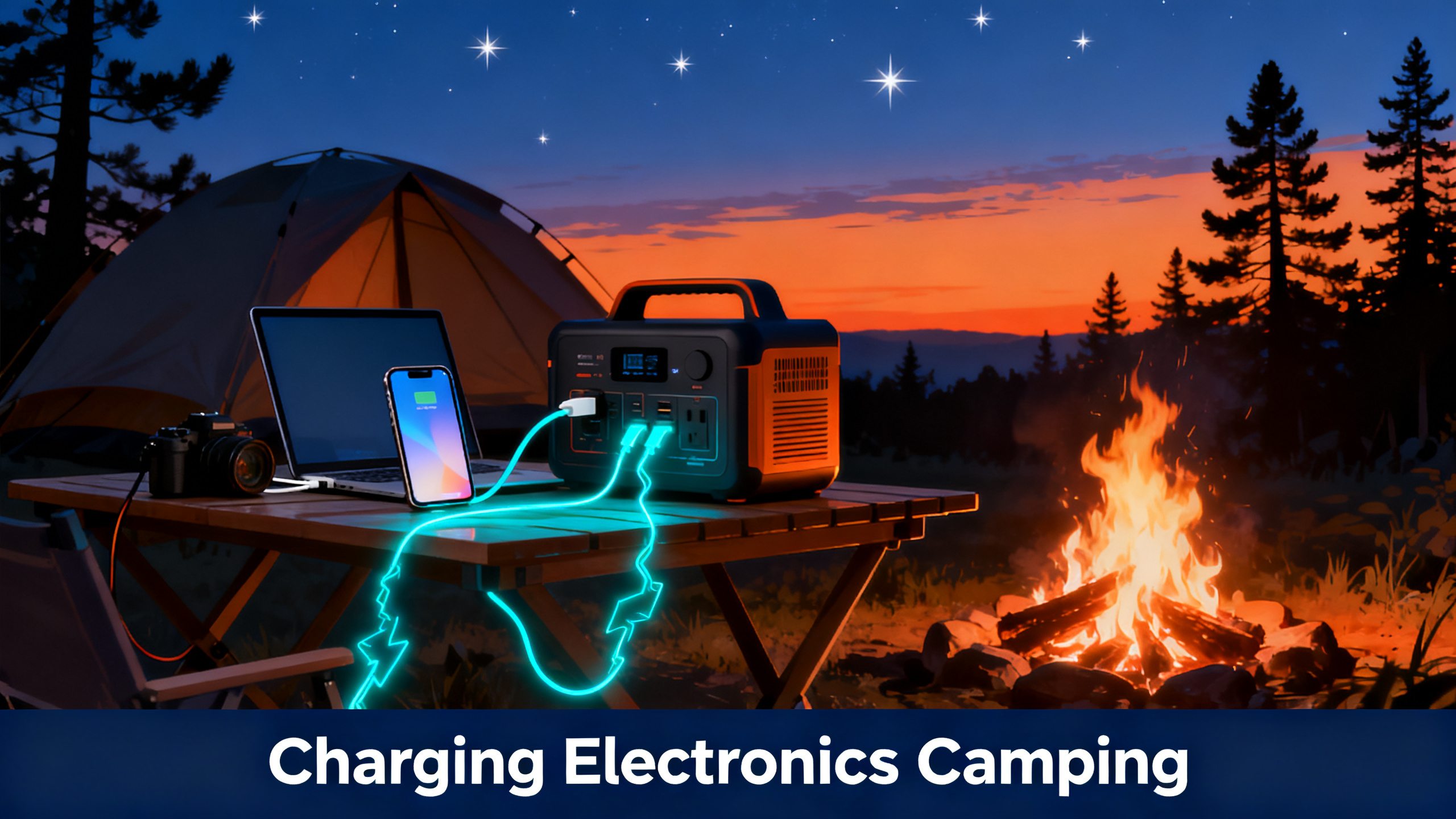
You packed your phone, your camera, your laptop, and your earbuds. The campsite is perfect. By night two, everything is dead. If you’ve hit this wall before, you already understand why charging electronics while camping needs a real strategy, not just a portable power bank.
The device load at a modern campsite looks nothing like it did a decade ago. A single camping trip now involves smartphones, mirrorless cameras, laptops for remote workers, action cameras, GPS devices, and wireless earbuds, all drawing from the same reserve. Standard 20,000mAh power banks cover maybe 4-5 phone charges and not much else. A 240-288Wh portable power station changes the equation: enough capacity for two to three nights of multi-device charging, with ports that actually match what your devices need.
This guide focuses on three stations in the entry-level capacity tier (240-288Wh), selected for camping electronics specifically: the Anker SOLIX C300X DC at $279.98, the EcoFlow RIVER 3 at $199.00, and the Jackery Explorer 240 at $219.00. Here’s how to size your choice to your device load and trip length.

Why Standard Power Banks Fall Short for Multi-Day Trips
Your phone is dead on day two of a four-day camping trip. You pull out the 20,000mAh power bank you packed, charge the phone overnight, and wake up on day three with a full phone and an empty power bank. That’s the wall most campers hit when they rely on a traditional power bank for charging electronics while camping.
Power banks solve the single-device problem. They don’t solve the multi-day, multi-device problem. A typical 20,000mAh (72Wh) bank covers roughly 4-5 smartphone charges. Add a mirrorless camera, a pair of earbuds, and a laptop, and you’ve exhausted your supply before dinner on day two.
The Device Load Problem: It’s Not Just Phones Anymore
The average camper now carries far more electronics than a decade ago. Smartphones, action cameras, mirrorless cameras, wireless earbuds, GPS devices, e-readers, tablets, and in many cases a laptop for remote workers who camp. Each device draws from the same limited reserve. Portable power stations address this directly: they offer 240-288Wh of usable capacity (roughly 3-4x a large power bank) with multiple simultaneous output ports.
The difference isn’t just capacity. It’s the ability to charge a laptop via USB-C at 100W while simultaneously topping up a camera battery and a phone. A power bank physically can’t do that. The output wattage caps are too low for laptops, and most have just one or two ports.
Why USB-C Wattage Matters More Than Capacity
Here’s a spec that most campers overlook: USB-C wattage on a portable power station varies dramatically between models. A station might advertise USB-C outputs but only deliver 18W per port. That’s enough for a phone. It’s not enough for a laptop, which typically requires 45-100W to charge at full speed.
For charging electronics while camping, the practical rule is this: if you carry a laptop, you need a station with at least one USB-C port rated at 60W or higher. The Anker SOLIX C300X DC addresses this with dual 140W USB-C ports, which covers even power-hungry 16″ MacBook Pros and Windows gaming laptops. That’s meaningfully different from a station offering 18W USB-C.
Anker SOLIX C300X DC
$279.98
- 288Wh capacity, 300W output
- 7 ports including dual 140W USB-C
- 0-80% in 2.5 hours with 100W charger included
How Much Power Do You Actually Need?
The answer depends on three variables: how many devices you carry, how many nights you’ll be away from a power source, and whether you plan to recharge the station via solar. Getting this right upfront prevents both under-buying (dead station on day three) and over-buying (carrying 10 extra pounds you didn’t need).
Calculating Your Wh Requirements Per Trip
Start with your device list and typical daily consumption. A smartphone with a 15Wh battery, charged once per day, uses 15Wh. A mirrorless camera with a 12Wh battery, charged once every two days, adds 6Wh per day. A 13″ laptop with a 50Wh battery, topped up once daily, contributes 50Wh. Add 20% for system inefficiency (all batteries lose some energy in conversion), and a typical three-device camper needs roughly 85-90Wh per day.
For a three-night trip, that’s 255-270Wh of total demand. A 256-288Wh station covers this exactly, with little margin to spare. Campers who also carry drones, tablets, or wireless speakers should add those draws before sizing their station.
The Trip Length Multiplier
One night out: a quality power bank is genuinely sufficient. Two to three nights with multiple devices: a 240-288Wh portable power station is the practical sweet spot. Four or more nights: either size up to a larger station (500Wh+) or pair a 256-288Wh station with a compatible solar panel for daily recharge. The three options in this guide all sit in the 240-288Wh range, targeting the two-to-three night use case that covers most weekend campers.
How Many Charges Per Device? (256Wh Station)
📱
Smartphone
~16x
15Wh avg battery
💻
Laptop (13″)
~4x
50-60Wh battery
📷
Camera (DSLR)
~20x
12-15Wh battery
🎮
Nintendo Switch
~15x
16Wh battery
🎧
Earbuds (case)
~50x
5Wh case
Estimates based on 256Wh usable capacity at 85% efficiency. Actual results vary by device model and charge level.
Output Types Explained: AC vs USB-C vs USB-A
Not all ports are created equal, and the mix of outputs on your station determines which devices you can actually charge. Understanding the difference takes about two minutes and saves a lot of frustration at the campsite.
For a full breakdown of port standards and what each can power, the USB-C, USB-A, AC outputs guide is the reference. Here’s the short version for camping electronics specifically.
When You Need an AC Port
AC outlets (the standard wall plug format) matter when a device requires a proprietary charger that doesn’t have a USB alternative. Older laptops with barrel-plug chargers, some camera chargers, CPAP machines, and certain drone rapid chargers all fall into this category. The Jackery Explorer 240 includes a pure sine wave AC outlet, which handles sensitive electronics without the risk of interference from modified sine wave inverters.
Keep in mind that AC conversion introduces efficiency losses of roughly 10-15%. Charging via USB-C direct, when your device supports it, is always more efficient than routing through an AC outlet with an adapter.
USB-C PD: The Laptop Charger Replacement
USB-C Power Delivery (PD) is the reason modern laptops can charge from a portable power station without a bulky proprietary adapter. The protocol negotiates wattage between the station and the device, delivering only what’s needed. A MacBook Air charges at 30-67W. A 16″ MacBook Pro pulls up to 96W. A Windows ultrabook typically needs 45-65W.
The wattage ceiling on the station’s USB-C port sets the practical limit. The Anker SOLIX C300X DC offers dual 140W USB-C ports, covering every consumer laptop currently on the market. The EcoFlow RIVER 3 tops out at 100W USB-C, which covers most ultrabooks and even many larger laptops at full speed. The Jackery Explorer 240 offers 18W USB-C, limiting it to phones and tablets via that port.


Top Picks for Charging Electronics While Camping
The three stations below cover distinct price points and use cases in the 240-288Wh range. None of them is the universal right answer. The right pick depends on your specific device mix, budget, and recharge priorities.
Best Overall: Anker SOLIX C300X DC : 288Wh, 7 Ports, 140W USB-C
The Anker SOLIX C300X review breaks down its seven-port layout in detail, but the headline figure for electronics charging is 300W total output with dual 140W USB-C. At 288Wh capacity, it sits at the top of this capacity tier. The included 100W wall charger brings it from empty to 80% in 2.5 hours, which matters if you’re staging at a campground with power before heading into a backcountry site.
The port selection is notably comprehensive for a compact station: two 140W USB-C (bidirectional, usable for both input and output), one 100W USB-C output, one 15W USB-C, two 12W USB-A, and a 120W car socket. That’s simultaneous charging for a laptop, camera, two phones, earbuds, and a GPS device without any port conflicts. At $279.98, it carries a modest premium over the EcoFlow RIVER 3, justified by the higher USB-C wattage ceiling and the seventh port.
Best for Fast Recharge: EcoFlow RIVER 3 : 245Wh, 60-Minute Charge
The EcoFlow RIVER 3 entry-level review confirms roughly 60-minute full charge from 0-100%, which is a key advantage for weekend campers who have access to a wall outlet for a limited window before heading out. No other station in this price range matches that recharge speed. At $199.00, it’s also the most affordable option here.
The RIVER 3 handles 245Wh with six output ports: one 100W USB-C, two USB-A, two AC outlets (rated at 300W total), and a car outlet. The sub-20ms switch-over mode also makes it capable for light home backup applications if you want dual use. Its 100W USB-C cap now covers most ultrabooks and many larger laptops at full speed. For a device mix of phones, cameras, earbuds, and a laptop, the RIVER 3 covers the full list at a competitive price.
EcoFlow RIVER 3 Review: Full Analysis
Runtime tests, port performance, and who should buy it
Best Budget AC Option: Jackery Explorer 240 : 240Wh, Pure Sine Wave
At $219.00, the Jackery Explorer 240 is the lightest option in this group at under 7 lbs, and its pure sine wave AC outlet handles sensitive electronics without issue. Read the full Jackery Explorer 240 review for runtime estimates across phones, laptops, and cameras. The relevant summary for campers: 240Wh capacity with 200W continuous output (400W surge), quick AC charging in 5.5 hours, and a 2-year warranty with a 1-year extension available.
The Explorer 240’s weak point is its USB-C output at 18W, which is only suitable for phones and small accessories. Laptop users need to route through the AC outlet using their original charger, which works but adds efficiency losses. For campers who primarily use smartphones, cameras, and other USB-A devices, the Explorer 240 covers the basics at a price point that makes the purchase easy to justify.
LFP Upgrade Pick: Jackery Explorer 300 Plus : 288Wh, 3,000+ Cycles
For the LFP upgrade to the 240, the Jackery 300 v2 ultra-light review explains the battery longevity advantage in detail. The Explorer 300 Plus uses LiFePO4 (LFP) chemistry instead of standard lithium-ion, which delivers 3,000+ charge cycles versus roughly 500 for conventional cells. That’s a six-fold longevity advantage: a station you use 50 times per year lasts 60+ years in theory, versus under a decade with standard chemistry.
At $299.99, the 300 Plus costs $80 more than the Explorer 240 and $20 more than the Anker SOLIX C300X. The trade-off is straightforward: pay more now, replace less frequently. For frequent campers and outdoor enthusiasts who’ll put real cycles on the station, the LFP chemistry justifies the premium. For occasional campers doing 5-10 trips per year, the standard lithium-ion options offer better value per dollar spent.

See the Anker SOLIX C300X full specifications and EcoFlow RIVER 3 official specifications for complete port and input/output ratings.
Charging Strategies to Maximize Every Wh
Even a perfectly sized station loses usable capacity if you charge inefficiently. A few practical habits extend what you get out of your 256-288Wh reserve, especially on longer trips where the margin between enough and not enough is tight.
Charge Devices at Different Times, Not All at Once
Running four devices simultaneously splits the available output across all ports and increases heat generation in the battery. Data on multi-port simultaneous charging shows that total system efficiency drops by 5-10% compared to sequential charging. The practical approach: charge high-priority devices first (laptop, camera), then cycle to secondary devices (earbuds, phone). This also lets you monitor what’s actually drawing power at each stage.
⚠️ Common mistake: Charging everything overnight on a cold night. Battery efficiency drops 10-20% in sub-40°F temperatures. Keep the station inside your tent or sleeping area where temperatures stay warmer, and you’ll recover meaningful capacity.
Solar Recharge: When It Makes Sense
Solar input is worth considering for trips of three nights or more. The EcoFlow RIVER 3 accepts up to 110W solar input; the Anker SOLIX C300X accepts up to 65W via its bidirectional 140W USB-C port. A single 100W panel in direct sun for 4-5 hours can add 80-100Wh of usable capacity, covering roughly one full day’s device charging load for most campers. That effectively extends a 256-288Wh station to run indefinitely in good weather.
The limitation is panel weight and packability. A rigid 100W panel weighs 15-20 lbs. Flexible or foldable panels in the same range weigh 4-8 lbs but cost more. For car camping where weight doesn’t matter, a 100W rigid panel paired with either the Anker or EcoFlow station makes sense. For backpacking, the calculus tilts toward carrying extra capacity in the station itself rather than the panel.
Power Management by Priority
Not all devices are created equal in an emergency. A GPS device or emergency communicator is more important than a Nintendo Switch. Assign priority tiers before you leave: critical devices that must stay charged (navigation, communication, medical), useful devices (camera, laptop), and discretionary devices (gaming, secondary speakers). When capacity gets tight, you’ll know exactly what to protect and what to let drain.
Backpacking Power: Ultralight Options
Sub-5 lb picks for hikers where every ounce counts
Device-Specific Charging Tips
Different devices have different requirements at the campsite. Here’s what the data shows for the categories most campers carry.
Laptops: Match the Wattage
Laptop charging speed is constrained by whichever is lower: the port’s output rating or the laptop’s input rating. A MacBook Pro that accepts 96W connected to a 60W USB-C port charges at 60W. That’s fine for overnight charging; it’s slow for mid-day top-ups where you need it charged quickly before an afternoon without power. For work-from-camp users who need reliable fast charging, the Anker SOLIX C300X’s 140W USB-C ports are the practical choice. The Anker SOLIX C300X review confirms the full 140W output is sustained, not just advertised.
One practical note: if your laptop uses a proprietary charger (older Dell, HP, or Lenovo models with barrel plugs), route through the AC outlet. The efficiency loss is acceptable given the alternative is not charging at all.
Cameras and Drones: Plan for Cold Temperatures
Camera batteries lose 10-30% of rated capacity in temperatures below 40°F. Mirrorless cameras in cold conditions drain faster and recover more slowly. The practical fix: store spare batteries in an inner jacket pocket between shots to keep them warm, and plan your charging windows during the warmer parts of the day. Drone batteries are especially sensitive, with DJI recommending not charging or flying in sub-32°F conditions at all.
For drone users, confirm your charger’s wattage requirement before the trip. DJI Mavic and Mini series chargers typically draw 30-90W and can route through either USB-C or AC depending on the model. The Anker SOLIX C300X’s car socket (120W) handles most rapid drone chargers as an alternative to USB-C.
Phones and Tablets: The Easy Part
Phones and tablets are the lowest-complexity devices to charge camping. Any USB-A or USB-C port handles them. The data point worth knowing: two phones charged simultaneously draw roughly 30-40W total, which is a small fraction of what any station in this guide can deliver. You’ll never run into port-priority issues with phones. The only consideration is leaving enough capacity for higher-priority devices after the phones are full.
Use a power station if…
- You carry 3+ devices (phone, laptop, camera)
- You camp 2+ nights without access to a plug
- You need to charge at specific times (golden hour for photos)
- You camp with others who also need power
Skip a station if…
- You only carry a single smartphone for one night
- Your campsite has power hookups
- Weight is critical (backpacking solo)
- Budget is under $80 (a power bank covers your needs)
Hikers travelling light have a separate set of constraints: see ultralight backpacking power options for sub-5 lb picks. Campers prioritizing portability above all else will also find value in the best compact portable power stations roundup.
Frequently Asked Questions
Can a power station charge a laptop while camping?
Yes. Any station with a USB-C PD port rated at 45W or higher handles most 13-15″ laptops. The Anker SOLIX C300X DC delivers 140W on two USB-C ports, covering even power-hungry 16″ MacBook Pro and gaming laptops. A 240-288Wh station provides 4-5 full charges on a typical 50-60Wh laptop battery. The Jackery Explorer 240 includes an AC outlet for laptops that require a proprietary charger.
How many times can a 256Wh station charge a phone?
A 245Wh capacity (like the EcoFlow RIVER 3) delivers approximately 13-15 full charges for a modern smartphone with a 15Wh battery, accounting for 85% system efficiency. This covers a 7-day camping trip at roughly 2 charges per day with capacity to spare.
Do I need solar panels to charge electronics camping?
Not for short trips. A 256-300Wh station covers 2-3 nights of multi-device charging without any solar input. For trips beyond 3-4 days, a compatible solar panel extends the usable capacity indefinitely in good sun conditions. The EcoFlow RIVER 3 accepts up to 110W solar input; the Anker SOLIX C300X accepts up to 65W via its 140W two-way USB-C port.
What is the lightest option for charging electronics camping?
The EcoFlow RIVER 3 weighs approximately 7.8 lbs for 245Wh, making it one of the lightest stations in this capacity range. For ultralight camping, the Anker SOLIX C200X DC at 192Wh weighs around 4.4 lbs with competitive port density. Backpackers with a single phone and camera may prefer a 100Wh-class power bank instead.
Can I charge a drone battery from a camping power station?
Yes, with caveats. Consumer drones (DJI Mini 3, Air 3) use 43-77Wh batteries requiring DC charging at 30-90W. A station with a USB-C PD port at 65W or higher or a car outlet handles most drone chargers. Cold temperatures reduce battery performance on both the station and the drone, so plan for longer charge times in sub-50°F conditions.
Conclusion: Match Station to Your Device Load
Charging electronics while camping comes down to one practical question: how many devices do you carry, and for how many nights? A 240-288Wh portable power station handles the two-to-three night multi-device scenario reliably. Beyond that, add solar.
The Anker SOLIX C300X DC is the strongest all-around choice at $279.98 for campers who carry a laptop: dual 140W USB-C ports cover every current laptop without compromise, and seven total ports handle a full group’s device load simultaneously. The EcoFlow RIVER 3 at $199.00 is the value pick for phone-and-camera users who prioritize the 60-minute recharge window. The Jackery Explorer 240 at $219.00 serves campers who need AC for proprietary chargers at a competitive weight of under 7 lbs.
If cooking gear is part of your setup, the camp kitchen power guide covers wattage requirements for induction burners, coffee makers, and electric griddles. For a complete overview of every option available for every camping style, the guide to best solar generators for camping covers the full field.
Anker SOLIX C300X DC
$279.98
Best compact station for multi-device camping
Price verified April 2026 : Free shipping available
Originally published: April 28, 2026