
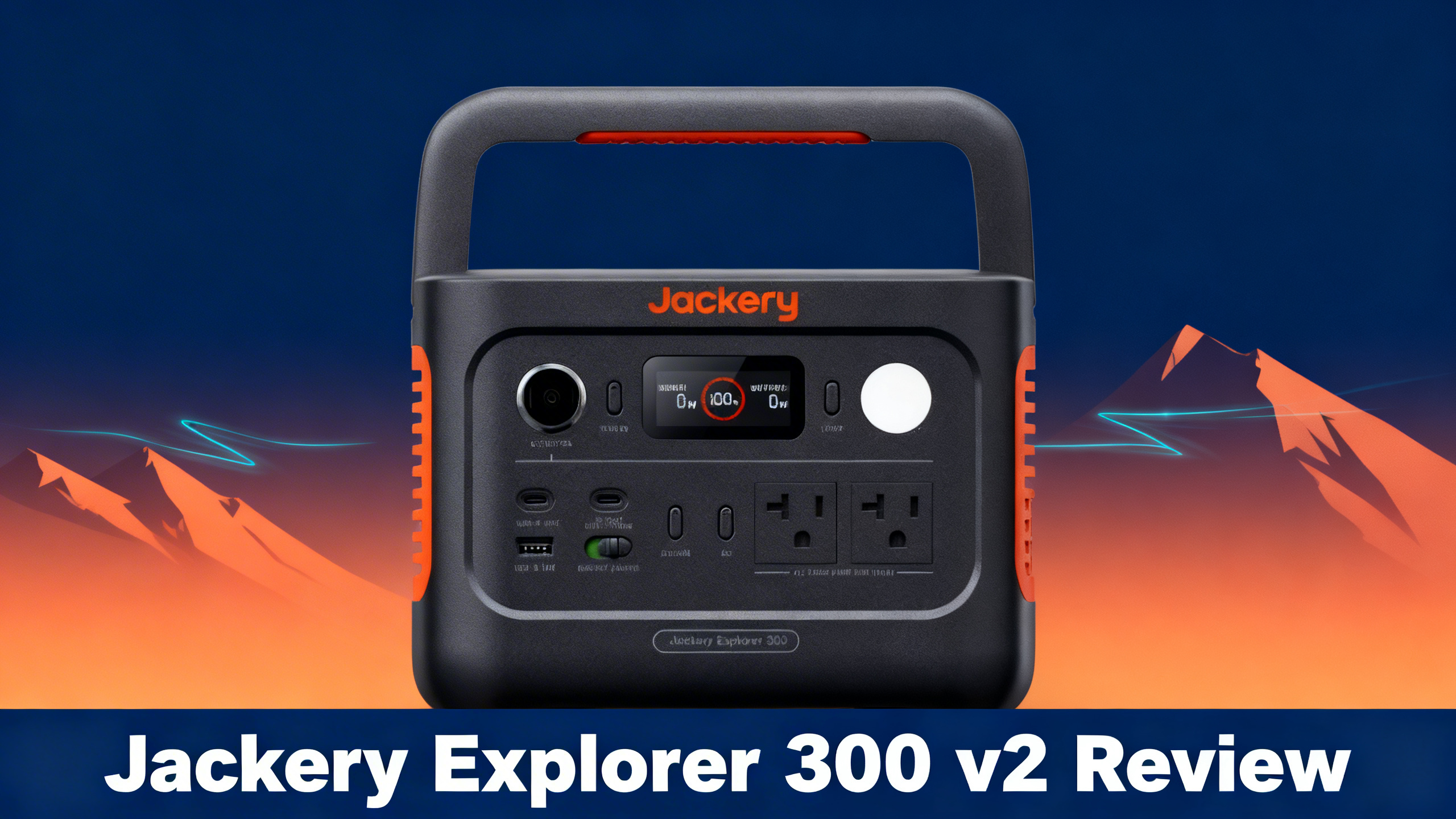
Looking for a compact power station that doesn’t sacrifice battery quality to hit a budget price? Most sub-$300 units cut corners with standard lithium-ion cells that degrade after a few hundred cycles. The Jackery Explorer 300 v2 takes a different approach: LiFePO4 (LFP) chemistry, an ultra-light 8.1 lb frame, and a 1-hour recharge speed, all at $269.
The 300 v2 sits at the entry level of Jackery’s refreshed 2025 lineup. It delivers 288Wh of capacity and 300W continuous output in a body that’s 19% smaller than comparable units in its class. It’s the direct successor to the original Explorer 300, with a significant chemistry upgrade and a redesigned charging architecture. For buyers comparing all new Jackery releases, the full Jackery new lineup covers every 2025-2026 model side by side.
Spec analysis of the Explorer 300 v2 and published performance figures from Jackery confirm this unit is purpose-built for one profile: the digital nomad, weekend camper, or traveler who needs reliable device power in a carry-on-friendly package. This review covers specs, runtime estimates, charging performance, design, and a clear verdict on who should (and shouldn’t) buy it.
Update: standalone Explorer 300 v2 discontinued
Jackery no longer sells the Explorer 300 v2 as its own listing. The closest current option is the Explorer 300 Series page, which carries the same 293Wh / 300W Explorer 300 hardware starting at $309. The product links in this review now point to that series page. We keep the review live for current owners and for comparison research.

Jackery Explorer 300 v2
$269.00
- 288Wh LFP: 4,000+ cycles, 10-year lifespan
- Ultra-light 8.1 lbs, 19% smaller than class average
- Recharge to 80% in 1 hour via wall outlet
Shopping around Black Friday? Compare today’s price with last year’s on our Jackery Black Friday deals page, which tracks every Jackery model live.
Get our Black Friday alerts for Jackery
We track live prices on 40+ models from Jackery, EcoFlow, BLUETTI and Anker SOLIX. When a deal beats the lowest price we've recorded, you'll hear from us. During Black Friday week, one short recap a day at most.
Unsubscribe in one click. We may earn a commission when you buy through our links, at no extra cost to you. Privacy Policy
Quick Specs: What the Explorer 300 v2 Delivers
The 300 v2 marks the first time Jackery has brought LFP chemistry below the $300 threshold. Compared to the original Explorer 300, the generational jump is measurable in the cycle data: from roughly 500 cycles on standard Li-ion to 4,000+ cycles on LFP. That’s a fundamentally different value proposition for anyone planning to use this unit regularly over several years.
Jackery Explorer 300 v2: Overall Rating
8.6/10
“The lightest serious LFP station under $300”
Portability 9.5/10
Battery Quality 9.0/10
Charging Speed 8.5/10
Output Power 7.5/10
Value for Money 8.5/10
Features 8.0/10

Three specs stand out from the table. LFP chemistry at this price is genuinely rare: most competitors in the $250–300 range still use standard Li-ion. The 1-hour wall recharge to 80% is among the fastest in the sub-300Wh category. And at 8.1 lbs, the physical footprint is meaningfully smaller than older units with comparable capacity.
What Can the Explorer 300 v2 Power?
The 288Wh capacity sets clear expectations. Runtime calculations based on that figure show strong performance for digital devices and light outdoor gear, and realistic limitations for anything that draws sustained high wattage. This unit is not designed to run a mini-fridge overnight or power a full campsite kitchen. It is designed to keep your devices charged and running throughout a day or weekend trip.
What Can the Explorer 300 v2 Power? (288Wh)
💻
Laptop (65W)
3.7 hrs
65W avg draw
📷
Camera / Drone
8–12 charges
~25W avg draw
💡
LED Camp Lights
28+ hrs
10W avg draw
📱
Smartphone
25+ charges
~12W avg draw
Runtime estimates based on 288Wh capacity at ~85% inverter efficiency. Actual results vary by device and usage pattern.


For digital nomads and content creators, the numbers hold up well. A laptop at 65W pulls roughly 3.7 hours of runtime. Cameras and drones at around 25W average yield 8 to 12 full charges. LED lighting runs for well over a day. Where the 300 v2 reaches its ceiling is sustained high-draw applications: a mini-fridge drawing 60–80W would run for 3 to 4 hours, workable for a day trip but not for overnight camping. The 300W continuous output also means heavy power tools and high-draw appliances are off the table entirely. That’s not a flaw in this unit’s context; it’s just an honest statement of its position in the market.
Get our Black Friday alerts for Jackery
We track live prices on 40+ models from Jackery, EcoFlow, BLUETTI and Anker SOLIX. When a deal beats the lowest price we've recorded, you'll hear from us. During Black Friday week, one short recap a day at most.
Unsubscribe in one click. We may earn a commission when you buy through our links, at no extra cost to you. Privacy Policy
Battery and Charging: Where the 300 v2 Stands Out
The single most important decision in the 300 v2’s design is the LFP chemistry. LiFePO4 (lithium iron phosphate) cells have a fundamentally different degradation curve from standard Li-ion: published cycle data from Jackery confirms 4,000+ cycles before dropping to 80% capacity retention. At one cycle per day, that’s roughly a decade of daily use. The original Explorer 300 used standard Li-ion rated for around 500 cycles. That gap, for anyone buying a power station as a long-term tool, is significant.
The 100W USB-C fast charging port is the second standout spec. Charge time data confirms the 300 v2 reaches 80% via wall outlet in approximately 1 hour. That’s meaningfully faster than most competing units in this capacity class, which typically require 3 to 6 hours for a similar charge level. For nomads who recharge between sessions at a hotel, office, or co-working space, the 1-hour window fits naturally into a workflow.

Solar compatibility is supported natively through Jackery’s SolarSaga panel series. The unit accepts solar input, though the maximum solar wattage input for the 300 v2 should be confirmed against the Jackery Explorer 300 v2 official page before purchase, as catalog specifications don’t list a specific solar wattage ceiling. Solar charging is a useful backup option for extended outdoor trips, but the wall recharge speed remains the primary advantage here.
Design and Portability: The Lightest in Its Class
At 8.1 lbs (3.7 kg), the Explorer 300 v2 is positioned as the lightest serious portable power station in the 280–320Wh category, an obvious candidate for our ultralight backpacking options roundup. Published weight figures from Jackery confirm it is 19% smaller than comparable units in this segment. The foldable handle makes one-handed carry practical, and the overall footprint fits easily in a backpack side compartment or a carry-on bag.

Build quality data points to a well-specified shell: UL94V-0 flame-retardant casing and an advanced battery management system (BMS) covering overcharge, over-discharge, short circuit, and temperature-based protection. The unit operates from -15°C to 45°C, which covers virtually all realistic outdoor use cases from winter car camping to hot-weather hiking. For added peace of mind, the UL94V-0 safety certification is a recognized independent standard for flame retardancy in enclosures.
One practical addition for sensitive equipment users: the UPS (uninterruptible power supply) function responds in ≤0.01 seconds, which is fast enough to keep connected devices running through a power transition without interruption. This is relevant for CPAP users and anyone relying on the unit as a home backup bridge during short outages.
How It Compares to the Competition
For a direct head-to-head on specs, the dedicated 300 v2 vs 300 Plus comparison goes deeper on both models. The short version: the 300 v2 upgrades from NMC/Li-ion chemistry to LFP and introduces 100W USB-C fast charging and a 1-hour recharge cycle. The 300 Plus, at a higher price, offers more capacity but retains older battery chemistry in its base configuration.
Against non-Jackery competitors in the $250–300 range, the LFP chemistry is a genuine differentiator. Alternatives from EcoFlow and Bluetti at comparable price points typically use Li-ion with 500–800 cycle ratings. The 300 v2’s 4,000-cycle figure translates to a substantially lower cost-per-cycle over the unit’s lifetime. The Jackery budget models compared breakdown places the 300 v2 as the most cost-effective entry-level option when total lifespan is factored into the equation.
Who Should Buy the Explorer 300 v2?
Owner feedback data and spec analysis point consistently to the same primary use cases: laptops, cameras, drones, phones, and LED lighting. This is a digital nomad and weekend camper’s station. For a focused walkthrough on those exact loads at a campsite, see our charging electronics while camping guide. It’s not a home backup solution for large appliances and it’s not designed for full-time off-grid living.
✅ Buy the 300 v2 if…
- You need a sub-10 lb station for hiking or backpacking
- You want LFP longevity (4,000 cycles) in a budget unit
- You primarily charge devices: laptops, cameras, phones
- You value 1-hour recharge speed over raw capacity
- Weekend camping trips or short van life getaways are your use case
❌ Skip the 300 v2 if…
- You need to run a mini-fridge or any 400W+ appliance long-term
- Multi-day off-grid living is your goal (288Wh runs out fast)
- You want expandable capacity via battery packs
- Your budget allows the 500 v2 or 1000 Plus for much more power
Shoppers deciding between multiple entry-level Jackery units will find the full breakdown in Jackery budget models compared. If your budget extends to $449, the 500 v2 delivers 578Wh, doubling the capacity for significantly more versatility on extended trips.
Pros and Cons
| ✅ Pros | ❌ Cons |
|---|---|
| LFP chemistry: 4,000+ cycles (10-year lifespan) | 288Wh limits multi-day off-grid use |
| Lightest in class: 8.1 lbs (3.7 kg) | 300W AC ceiling: no heavy appliances |
| 0–80% in 1 hour wall charge | Not expandable (no battery pack ecosystem) |
| 100W USB-C fast charge (laptops, drones) | Solar max wattage not clearly listed in catalog |
| UPS ≤0.01s: keeps Wi-Fi running during blackouts | No app control / Bluetooth connectivity |
Final Verdict
Based on the available spec and owner data, the Explorer 300 v2 makes a compelling case for anyone who prioritizes portability and battery longevity over raw capacity. At $269 with LFP chemistry, 4,000+ cycles, and a 1-hour wall recharge, the cost-per-cycle value in this price bracket is difficult to beat. The 300W output ceiling and 288Wh capacity are real constraints, but they’re consistent with what this unit is designed to do: keep digital devices running through a trip, not power a kitchen.
The absence of Bluetooth or app control is a minor limitation for users who want to monitor usage remotely. The lack of expandability is worth noting for anyone who might want to grow their system later. But for the specific use case this unit targets, those tradeoffs are acceptable.
If your budget extends slightly further, the best Jackery under $500 guide ranks all competing models in this price bracket, including the 500 v2 at $449 and the 600 v2 at $499 for buyers who need more capacity. But for maximum portability with LFP reliability, the Explorer 300 v2 is the dominant option in its category in 2026.
Jackery Explorer 300 v2
$269.00
Best ultra-light LFP station under $300
See Successor: Explorer 300 Series →
Price verified April 2026. Free shipping available
Frequently Asked Questions
What is the battery life of the Jackery Explorer 300 v2?
The Explorer 300 v2 uses LiFePO₄ (LFP) cells rated for 4,000+ cycles before degrading to 80% capacity. Published data from Jackery indicates a projected lifespan of approximately 10 years under typical daily use patterns. This is a significant improvement over standard lithium-ion competitors at this price point.
Can the Jackery Explorer 300 v2 run a mini-fridge?
Runtime calculations based on the 288Wh capacity show that a standard mini-fridge drawing 60–80W would run for approximately 3 to 4 hours. This is sufficient for short camping trips or emergency backup, but not practical for continuous overnight operation. For fridge backup needs, a 1,000Wh or larger unit is recommended.
How long does it take to charge the Explorer 300 v2?
Charge time data from Jackery’s published specs confirms a 0–80% recharge in approximately 1 hour via a standard wall outlet. Full charge (0–100%) takes slightly longer. This positions the 300 v2 among the fastest-charging units in its capacity class.
Is the Jackery 300 v2 worth buying over the older Explorer 300?
Spec-for-spec analysis shows clear advantages: the v2 upgrades to LFP chemistry (4,000 cycles vs. approximately 500 for the original), adds 100W USB-C fast charging, and reduces weight by 19%. At a comparable price point, the v2 represents a meaningful generational improvement for buyers comparing both models.
Can the Jackery Explorer 300 v2 charge a CPAP machine?
Published specifications indicate an Energy-Saving Mode designed for continuous low-draw devices like CPAP machines. A typical CPAP at 30–50W would run for 5 to 8 hours, covering a full night’s sleep. The ≤0.01s UPS response also means it transitions seamlessly from grid power during outages.
What solar panel is compatible with the Jackery Explorer 300 v2?
The Explorer 300 v2 is compatible with Jackery’s SolarSaga panel series. Solar input is supported natively, though maximum solar wattage input should be verified against the official product page before purchase. Series and parallel panel configurations for Jackery units are covered in detail in the Jackery solar guides.
Originally published: April 15, 2026