
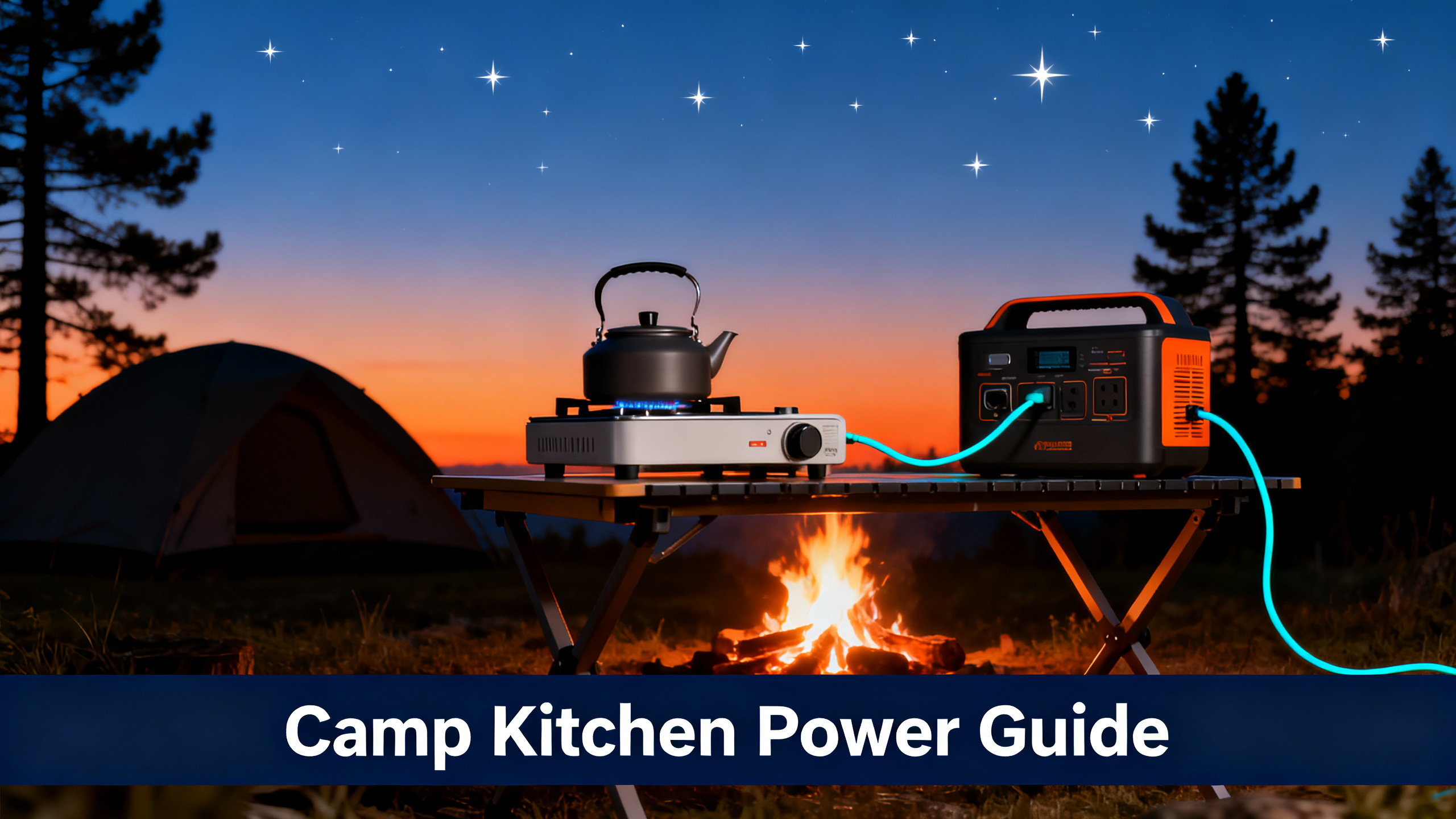
Planning a camp kitchen that goes beyond trail mix and granola bars? Whether you’re brewing espresso at sunrise, running a 12V fridge through a hot weekend, or cooking a full griddle breakfast for the crew, your power needs are more demanding than most campers realize.
This guide is built for outdoor cooks: people who treat campsite cooking as part of the experience, not an afterthought. Here’s how to size your camping power station correctly, which appliances you can realistically run, and which three stations deliver the best performance for cooking loads in 2026.

✅ This guide is for you if…
- You cook hot meals at the campsite (not just snacks)
- You rely on a camp fridge for a weekend or longer
- You want coffee maker or electric kettle capability
- You’re comparing 700–1,500Wh stations for cooking loads
❌ You may need a different guide if…
- You’re backpacking (ultralight is the priority)
- You need induction cooktop or full oven capability
- You’re outfitting an RV with shore power needs
- Budget is under $300 (different tier of options)
Anker SOLIX C1000: Top Camp Kitchen Pick
$449.00
- 1,056Wh capacity, 1,800W output (2,400W SurgePad)
- Charges 0–80% in just 43 minutes via AC
- 11 ports for simultaneous kitchen appliances
Why Your Camp Kitchen Needs a Dedicated Power Station
Common Power Challenges at the Campsite Kitchen
Most campers underestimate their kitchen’s power demand until something doesn’t work. A portable bluetooth speaker runs for days on a small battery bank. A coffee maker draws 800W for 10 minutes and drains a modest station significantly. The challenge isn’t just capacity: it’s understanding surge loads, simultaneous draws, and how LFP (lithium ferro-phosphate) batteries hold up across a full weekend of cooking.
Running a 12V camp fridge alongside a coffee maker in the morning, then powering a slow cooker through the afternoon, is a realistic scenario for the outdoor cook. Published load analysis shows that scenario comfortably fits within a 768–1,024Wh station, provided you’re not running everything at peak simultaneously.
What a Power Station Can and Cannot Run
A camping power station in the 700–1,500Wh range handles most camp kitchen appliances with reliable results. Coffee makers, electric kettles, 12V fridges, slow cookers, and blenders all fall within the output range of current mid-tier stations. High-resistance appliances are a different matter.
Standard induction cooktops typically demand 1,800–2,200W continuous. That’s at or above the rated output ceiling for most portable stations in this category. The Bluetti AC180P and EcoFlow DELTA 2 hit 1,800W rated output, but sustained induction cooking will stress them. For induction capability, you’d be looking at a different class of equipment entirely. For glamping power setups for full kitchens, the calculus changes.
⚠️ Important: Surge watts vs. running watts is the most misunderstood distinction in camp kitchen planning. An electric kettle rated at 1,200W needs that full wattage for the 4-minute boil. Your station’s surge capacity (not just rated output) must cover that peak draw.
Understanding Your Camp Kitchen Power Requirements
Typical Daily Power Consumption by Cook Type
As a camp cook, your daily power profile depends heavily on what you’re actually preparing. A coffee-and-cold-breakfast morning might pull only 150–200Wh for the brew cycle. A full hot breakfast with griddle, coffee maker, and fridge running continuously could draw 600–800Wh across 90 minutes of cooking. Data from appliance wattage specifications, confirmed by U.S. Department of Energy appliance wattage data, forms the basis for the calculations below.
Here’s how to think about a full day’s consumption. Morning cooking (breakfast): 300–600Wh. Fridge running through the day at 45W average over 12 hours: 540Wh. Evening meal (slow cooker, 6 hours at 200W): 1,200Wh. Total: roughly 2,000–2,400Wh for a full day of active cooking with constant fridge operation. That’s why solar recharging matters on trips longer than two nights.
Camp Kitchen Power Requirements
☕
Coffee Maker
600–900W
~15 min brew
🥛
Electric Griddle
1,200–1,500W
running watts
🭇
Electric Kettle
1,000–1,500W
~4 min boil
❄
12V Camp Fridge
35–60W
avg continuous
🍲
Slow Cooker
150–300W
6–8 hr cook
🌀
Blender
300–600W
per cycle
Surge Watts vs. Running Watts for Kitchen Appliances
Every appliance has two wattage figures: the surge (startup) draw and the sustained running draw. For camp kitchen use, this distinction is critical. An electric kettle hits its full 1,000–1,500W immediately and holds it for the entire boil. A compressor-driven 12V fridge spikes at startup (up to 3x running watts for a fraction of a second) then settles to 35–60W. Your station’s surge capacity needs to cover those spikes.
The Anker SOLIX C1000’s SurgePad technology handles loads up to 2,400W, making it compatible with griddles and all kettles in standard camp use. The EcoFlow DELTA 2’s X-Boost pushes the effective ceiling to 2,200W surge, a comparable appliance compatibility window. Keep in mind that surge tolerance is spec-dependent: always verify the continuous output rating, not just the peak figure, before committing to a station for a specific appliance.
Sizing Your Station for a 2-Night or Week-Long Trip
For a two-night weekend with moderate cooking (coffee, fridge, one hot meal per day), a 768–1,024Wh station typically covers the load without solar recharging. Add a 200W solar panel and that range extends comfortably through a full week in decent sunlight conditions.
Week-long trips with active cooking change the math significantly. Runtime calculations based on a continuous 45W fridge draw plus 600Wh of daily cooking show a 768Wh station hitting 50% daily capacity without solar input. For extended trips, a station with 400–500W solar input (like the DELTA 2 or AC180P) and a paired 200W panel becomes the practical minimum for self-sufficiency. That’s why solar compatibility is listed as an essential feature in every camp kitchen power selection guide.
Best Power Stations for Camp Kitchens in 2026
Spec analysis across the current portable power station market points to three models that consistently match camp kitchen demands: a fast-charging compact, a high-value mid-range, and a premium extended-range option. Here’s what the data shows for each.
Anker SOLIX C1000: Best for Fast Recharging Cooks
The Anker SOLIX C1000 brings 1,056Wh capacity and 1,800W continuous output in a form factor designed for frequent recharging scenarios. Its defining feature for camp kitchen use is the HyperFast charging system: 0–80% in 43 minutes via AC wall outlet, with a full charge in under an hour. For weekend campers who recharge at a trailhead before heading out, or at a campground with hookups, that turnaround time changes the calculus.
Published performance data confirms the C1000 handles coffee makers (600–900W), electric kettles, 12V fridges, and slow cookers without issue. The 2,400W SurgePad expands appliance compatibility for higher-draw kitchen gear. With 11 output ports and LFP battery chemistry rated for 3,000 cycles (approximately a 10-year useful life), it’s a station built for repeated camp use rather than occasional deployment.
Anker SOLIX C800: Full Spec Analysis
Runtime data across 12 appliance categories, solar pairing results, and long-term durability analysis.
The earlier C800 line added a compact camping-lights variant at a smaller capacity tier. See the complete Anker SOLIX C800 Plus review for that side-by-side comparison. For this guide, the C1000 at $449 represents the primary recommendation for camp kitchen use at this capacity tier.
Where the C1000 stands out: the 600W max solar input is the highest of the three featured stations. For trips where grid access isn’t available and solar is the primary recharge method, that ceiling helps. A 200W panel in good sunlight recovers roughly 600–800Wh daily through the C1000’s MPPT controller, and the station can accept far more panel wattage than the alternatives when you scale up your solar setup.
EcoFlow DELTA 2: Best Value for Weekend Camp Chefs
At $399 (currently marked down from $1,049), the EcoFlow DELTA 2 delivers a 1,024Wh capacity and 1,800W AC output with X-Boost technology pushing the effective surge ceiling to 2,200W. That output profile opens the door to electric griddle use, which both the C1000 and the DELTA 2 handle with comparable headroom at 1,800W.

Published specs confirm the DELTA 2 can sustain a 1,400W electric griddle for approximately 44 minutes per full charge (at 85% conversion efficiency). Runtime calculations based on the 1,024Wh capacity show roughly 22 hours of continuous 12V fridge operation at 45W average draw. The 15-port output array gives a camp kitchen setup room to run fridge, coffee maker, and device charging simultaneously without port conflicts.
Full specs and performance analysis in the EcoFlow DELTA 2 1024Wh review. One practical note: stock availability has fluctuated for this model (check current availability before purchasing). The current pricing represents a significant discount from list, making it the most compelling value in the camp kitchen category at this spec level.


Bluetti AC180P: Best for Extended Multi-Day Cooking
The Bluetti AC180P positions itself as the premium pick with 1,440Wh capacity, 1,800W AC output, and the widest solar input ceiling of the three: 500W max through its MPPT controller. At $649 (down from $999), it targets camp cooks planning multi-day or week-long trips where capacity and solar self-sufficiency matter more than compact form factor.

Performance data indicates the AC180P handles sustained simultaneous loads with more margin than the C1000 thanks to its larger capacity buffer, though both share the same 1,800W output ceiling. Runtime calculations show approximately 26–32 hours of 12V fridge operation per charge (at 45W average draw and 85% efficiency). The 2,500-cycle LFP rating translates to a similar 10-year lifespan, and the 16-port output includes a 30A RV plug for campers who transition between campsite and vehicle power.
Detailed output analysis and solar pairing data in the Bluetti AC180P review. The AC180P is available through Bluetti’s affiliate program. Check current price: Bluetti AC180P at $649.
Which One Should You Choose?
The right station depends on your trip length and cooking profile. For weekend cooks who want maximum recharge speed and plan to grid-charge between trips, the C1000 at $449 is the practical pick. For weekend cooks who want maximum appliance flexibility (griddle capability, comparable capacity) at the lowest price, the DELTA 2 at $399 wins on value. For multi-day or week-long trips with solar as the primary recharge, the AC180P’s 1,440Wh capacity and 500W solar input make it the right call despite the higher price.
Essential Features to Look For in a Camp Kitchen Power Station
Output Wattage and Surge Capacity
For camp kitchen use specifically, the minimum viable continuous output is 1,000W. That covers most coffee makers and electric kettles with comfortable headroom. If you want electric griddle capability, you need 1,200W minimum continuous and a surge rating above 1,500W. The three stations reviewed here all meet or exceed that threshold.
Don’t confuse peak (surge) watts with continuous output. A station rated at 2,000W peak but 800W continuous will shut down within seconds when you push a 1,200W griddle. Always verify the continuous output specification on the product page, and cross-reference with the specific appliance you plan to run. The official Anker SOLIX C1000 product page details the SurgePad specification clearly as an example of accurate spec disclosure.

Battery Chemistry and Long-Term Durability
All three stations reviewed here use LFP (lithium ferro-phosphate) chemistry. For camp kitchen use, that matters more than for casual device charging. LFP handles deeper discharge cycles and higher sustained loads better than standard NMC lithium cells, and the cycle ratings (2,500–3,000 cycles) translate to 10 years of realistic camp use for a weekly camper.
A recurring strength noted across owner feedback for all three models is thermal stability under sustained cooking loads. LFP chemistry runs cooler under extended output than NMC alternatives. That’s relevant when your station is sitting in a camp kitchen setup in summer heat while simultaneously running a fridge and charging devices.
Solar Charging Compatibility for Campsite Recharging
For trips longer than a weekend, solar recharging is the variable that separates a sufficient station from the right one. The C1000’s 600W max solar input can recover 1,400–1,800Wh in optimal conditions, the highest of the three. The DELTA 2 and AC180P’s 500W max solar input can recover 1,200–1,500Wh. Paired with a 200W portable panel, any of these stations can realistically maintain a camp kitchen through a week-long trip with moderate daily consumption.
Port Variety for Simultaneous Kitchen Loads
A camp kitchen typically runs multiple devices simultaneously: a fridge through a DC port, a coffee maker through AC, device charging through USB-C. All three stations handle that combination. The AC180P’s 16 output ports (including a 30A RV plug) give the most flexibility for complex setups. The C1000’s 11-port layout covers every standard camp kitchen need without excess.
Solar Charging for Camp Kitchens: What to Expect
Solar recharging at camp is less predictable than AC wall charging, and camp kitchen loads accelerate the math considerably. A useful rule: plan for 4–5 peak sun hours per day in most North American camping regions (less in coastal or forested sites, more in the Southwest). With a 200W panel paired to the C1000, that yields roughly 800–1,000Wh recovered daily under good conditions. A 200W panel paired to the DELTA 2 or AC180P yields the same, since all three MPPT controllers manage 200W input efficiently.


The practical limit for camp kitchen solar sufficiency is roughly 400Wh of net daily cooking consumption (fridge plus two hot meals). Below that threshold, a 200W panel plus any of the three featured stations maintains capacity across a week-long trip in decent sunlight. Above 400Wh daily consumption (full cooking loads, continuous fridge, device charging), you’re either accepting gradual capacity reduction or stepping up to a 400W panel setup.
Pass-through charging is supported by all three stations: you can cook with the station while solar panels are connected and recharging simultaneously. That’s particularly useful for slow-cooker meals that run for hours. The station draws from the battery for cooking load while solar input reduces the net depletion rate.
💡 Pro Tip: Position your solar panels before starting your morning cook. The peak sun window (10am–2pm) should overlap with your highest-draw appliance use if possible. Capturing 200–300W during breakfast prep meaningfully offsets the coffee maker and fridge load.
Cooling + Cooking Combo: Powering a Camp Fridge Alongside Cooking Gear
Running a 12V compressor fridge alongside active cooking appliances is the most common camp kitchen power scenario, and the one most likely to catch campers off-guard on capacity. A 45W average fridge draw seems modest until you add 8 hours of continuous operation: that’s 360Wh gone before you’ve cooked a single meal.
Runtime calculations for the three featured stations show the following for a day with fridge running 12 hours plus one hot breakfast (400Wh cooking load):
- Anker SOLIX C1000 (1,056Wh): 1,056Wh minus 540Wh (fridge) minus 400Wh (cooking) = 116Wh remaining without solar recharging. With a 200W panel on a good sun day, that margin widens comfortably by early afternoon.
- EcoFlow DELTA 2 (1,024Wh): 1,024Wh minus 540Wh minus 400Wh = 84Wh remaining. Solar recharging covers the margin comfortably.
- Bluetti AC180P (1,440Wh): 1,440Wh minus 540Wh minus 400Wh = 500Wh remaining. Two full days of moderate cooking before needing meaningful recharging.
Cooling + Cooking Combo
If a powered cooler or fan is part of the plan, the power math changes again. Powered coolers draw 40–80W continuous. Combined with a compressor fridge, that’s potentially 100–140W of continuous DC load running alongside your AC cooking draws. If camping cooling for fridges and coolers details the power math in full, sizing up from a 768Wh to a 1,024Wh station becomes the practical recommendation for any setup with both active refrigeration and cooling.
Solar Pairing for Camp Kitchen Setups
Panel wattage recommendations, MPPT efficiency data, and daily recovery calculations for active camp kitchens.
Related Power Needs at the Campsite
A camp kitchen is rarely the only power draw at your site. Beyond cooking appliances and the fridge, a complete campsite power budget includes lighting, device charging, and sometimes heating or cooling equipment. Understanding the full load picture helps you size correctly the first time rather than running short on day two.
Beyond cooking, camping lighting solutions are the next biggest power draw in any camp setup. LED camp lights are efficient (5–15W each) but add up when running through the evening. A full lighting setup for a group camp might pull 30–60W for 6 hours: 180–360Wh that needs to be accounted for alongside kitchen loads.
A complete camp power plan also accounts for charging electronics while camping, from phones to laptops. A laptop charges at 45–65W and cycles through 2–3 charges over a weekend. A group of four smartphones adds another 60–80Wh of charging load daily. These draws are modest individually but compound into meaningful capacity requirements over a multi-day trip.
Frequently Asked Questions
Can a portable power station run an electric griddle while camping?
Yes, with a station providing at least 1,200W continuous output. The Anker SOLIX C1000 (1,800W continuous, 2,400W SurgePad) and the EcoFlow DELTA 2 (1,800W continuous, 2,200W X-Boost) both handle standard electric griddles. A 1,400W griddle will consume capacity quickly: roughly 30 minutes of active cooking per 700Wh of usable capacity. Plan your cooking sessions accordingly, and consider solar recharging between meals on longer trips.
How long will a 1,000Wh power station run a camp fridge?
A 12V camp fridge draws 35 to 60W continuously on average. A 1,000Wh station provides 16 to 28 hours of theoretical runtime at 85% conversion efficiency. In real-world conditions with door openings and compressor cycling, expect 18 to 22 hours. The EcoFlow DELTA 2 at 1,024Wh and the Bluetti AC180P at 1,440Wh both fit this profile, with the AC180P extending that estimate considerably at its larger capacity.
What size power station do I need for a coffee maker while camping?
A standard camp coffee maker draws 600 to 900W at peak. A 500Wh station supports 5 to 6 brew cycles per charge at that draw rate. To combine a coffee maker with a camp fridge running continuously, a minimum of 768Wh is recommended. The Anker SOLIX C1000 at 1,056Wh comfortably clears that threshold and covers a full weekend of coffee-plus-fridge use without solar input.
Can I charge a power station with solar while cooking at camp?
Yes. All three stations reviewed here support pass-through charging: solar panels can recharge the station while appliances are drawing power simultaneously. Models with 500 to 600W solar input capacity (the C1000, DELTA 2, and AC180P) can recharge meaningfully while in use. In optimal sunlight, 300W of panels recover approximately 1,500Wh per day, which offsets the consumption of an active camp kitchen running moderate cooking loads.
Is the Anker SOLIX C1000 or EcoFlow DELTA 2 better for camp cooking?
Spec analysis shows the two are closely matched: both deliver 1,800W output, and the C1000 edges ahead on capacity at 1,056Wh versus the DELTA 2’s 1,024Wh. The C1000 adds faster recharging (0–80% in 43 minutes, full in under an hour) and a higher 600W solar input ceiling, making it the stronger pick for cooks who grid-charge between trips or lean on solar. For budget-conscious buyers, the DELTA 2’s current pricing at $399 (versus $449 for the C1000) makes it the marginally cheaper option.
Final Recommendation: Our Top Camp Kitchen Power Station
For most weekend camp cooks, the Anker SOLIX C1000 at $449 represents the clearest match between camping power station specs and actual camp kitchen demands. Its 1,056Wh capacity covers coffee, fridge, and one or two hot meals per day across a standard weekend trip with room to spare. The sub-hour recharge speed (0–80% in 43 minutes) removes the anxiety of arriving at camp with a depleted station. And the SurgePad 2,400W ceiling handles the appliances most camp cooks actually use.
If your cooking load includes an electric griddle or your trips extend beyond two nights without reliable grid access, the EcoFlow DELTA 2 at $399 delivers more capacity and higher output at a lower price point, making it the practical value choice. The Bluetti AC180P at $649 is the right call for multi-day expeditions where 1,440Wh capacity and 500W solar input make the station genuinely self-sufficient with a proper panel setup.

All three stations use LFP battery chemistry with 2,500–3,000-cycle ratings, meaning the station you buy this season should still be running strong through your camping trips a decade from now. That long-term durability matters for equipment that travels, gets loaded and unloaded from trucks, and operates in temperature extremes across seasons of use.
For a full overview of options by camping style and budget, the best solar generators for camping guide covers every use case.
Best Solar Generators for Camping 2026
Full comparison by camping style, budget, and use case: from weekend backpackers to full-time van lifers.
Anker SOLIX C1000
$449.00
Top-rated camp kitchen power station 2026
Price verified April 2026: Free shipping available
Originally published: April 28, 2026