
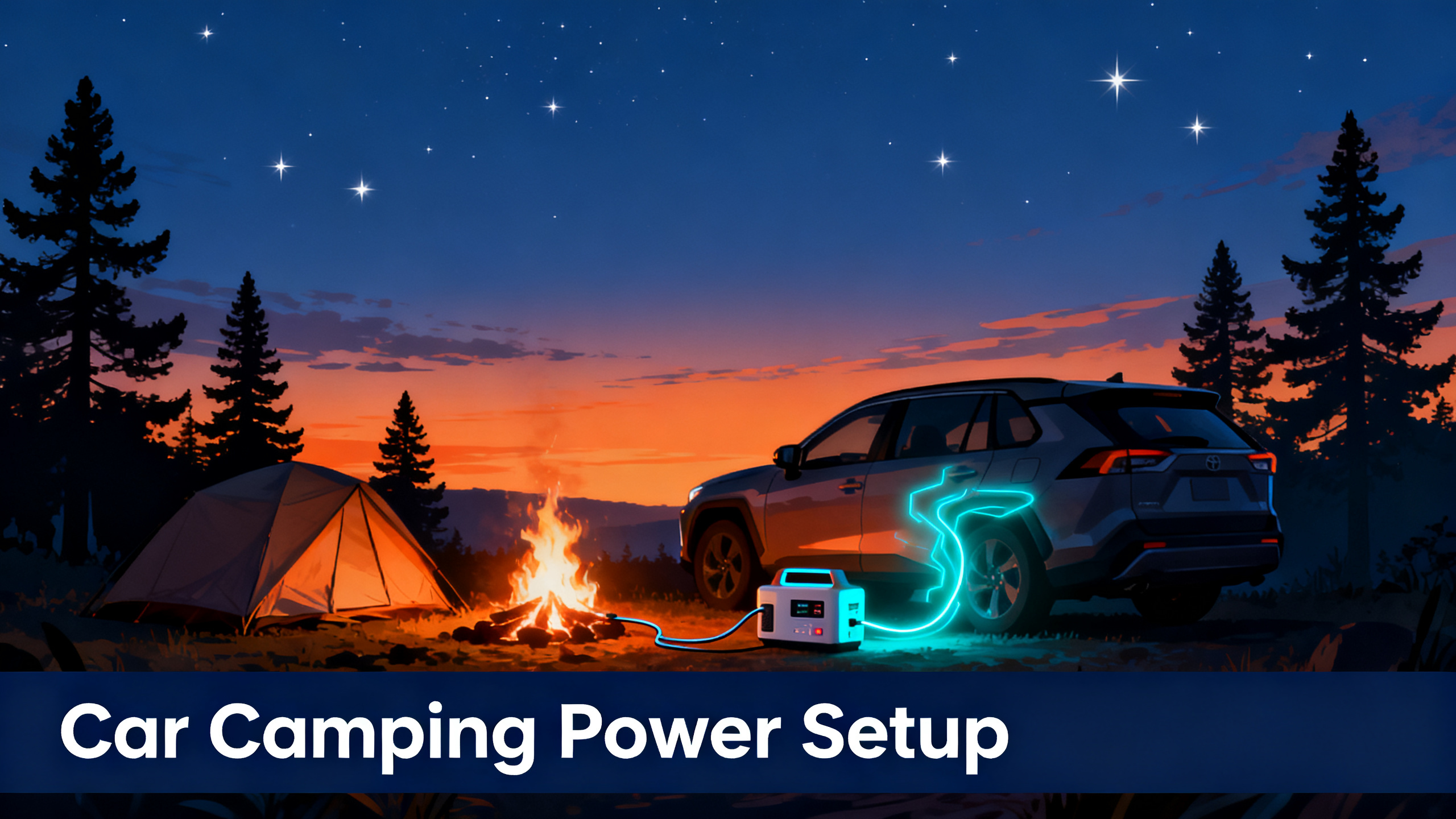
The difference between a comfortable car camping trip and a frustrating one often comes down to one thing: reliable power. Dead phones, warm food, a CPAP that quits at midnight, a lamp that flickers out at 9 PM. Most campers solve this with a gas generator, but noise restrictions, fuel logistics, and fumes inside an enclosed campsite make that a poor fit for most car camping scenarios.
Portable power stations have become the practical alternative. Quiet, fume-free, and increasingly affordable, they’ve matured into capable systems that handle everything from USB charging to full camp kitchens. But picking the right unit and setting it up correctly requires knowing a few things upfront. Check out REI’s car camping essentials guide for baseline gear context before focusing on your power setup.
This guide walks through the exact process of sizing, selecting, and setting up a portable power station for car camping, with specific model recommendations across three budget tiers. If you’re new to portable power stations, the process is more straightforward than it looks.

Jackery Explorer 1000 v2
$499.00
- 1070Wh LiFePO₂, 1500W AC output
- 0 to 100% in 1 hour (Emergency Super Charge)
- 4,000 cycles, 5-year warranty
Step 1: Sizing Your Power Needs
Before you look at a single product page, you need a number: your total daily watt-hour (Wh) requirement. Think of watt-hours as your fuel tank. A bigger tank lets you run more devices for longer, but it also costs more and weighs more. The goal is matching the tank to your actual trip, not buying the biggest one available.
The calculation is straightforward. For each device you plan to use, multiply its wattage by the number of hours you’ll run it per day. Add those figures together, then apply a 20% buffer to account for efficiency losses. That final number is your minimum daily capacity target. For a precise calculation tailored to your specific devices, use the power station capacity calculator to avoid under- or over-sizing.
Appliance Wattage Reference
A few key appliance draws to anchor your estimate: LED camp lights run at 10 to 20W, a standard laptop charges at 45 to 90W, a 12V cooler averages 40 to 60W continuous, a smartphone draws 10 to 18W per charge, a drip coffee maker pulls 700 to 1,000W, and a portable fan uses 20 to 50W. High-draw appliances like coffee makers and electric grills run for short bursts, so they affect your capacity target less than continuous-draw devices like coolers.
How Many Days Are You Camping?
Single-day campers can get away with a unit sized for one daily cycle. For two to four day trips, you have two options: bring enough capacity to cover the full trip without recharging, or plan to recharge via solar during the stay. Solar recharging changes the math significantly. A 200W solar panel in full sun replenishes roughly 160 to 180Wh per hour, which means a 1,000Wh station can recover most of its charge over five to seven hours of good sun exposure.
How Much Power Do You Need? (Car Camping Sizing Guide)
🧑
Solo Camper
300–600Wh
Lights, phone, small fan
👫
Couple / Weekend
700–1,200Wh
Lights, laptops, cooler
👨👩👧
Family / Multi-Day
1,200–2,000Wh
Appliances, electric grill
⛺
Extended Stay / Group
2,000Wh+
Full kitchen, CPAP, AC
Portable Power Station Capacity Calculator
Enter your devices and get an exact Wh recommendation for your camping setup.

Step 2: Choosing the Right Power Station
With your capacity target in hand, narrowing down models becomes mechanical. Four specs matter most: capacity (Wh), AC continuous output (W), charge speed (how long to refill), and weight. A unit with 1,000Wh and a 1,500W output handles nearly all standard camping appliances. Units below 500W output will struggle with coffee makers, electric skillets, and some air pumps.
Key Specs to Compare
Capacity tells you how long the unit runs. Output tells you what it can run simultaneously. Charge speed determines how practical solar or car top-up becomes during the trip. Weight matters for car camping less than backpacking, but units above 30 lbs can be awkward for a single person to maneuver from trunk to campsite. LiFePO4 (lithium iron phosphate) chemistry, now standard on most newer units, adds meaningful longevity: 3,000 to 4,000 cycles versus 500 to 800 cycles on older lithium-ion designs.
★ Top pick. Prices verified April 2026. Check current pricing via affiliate links above.
Recommended Power Stations for Car Camping
The four models below represent the clearest options across the main car camping use cases. Each covers a distinct segment: compact solo travel, mid-range couple use, rugged outdoor conditions, and a cross-brand budget option. All four use LiFePO4 chemistry, which matters for multi-season longevity.
Solo Trips and Weekend Getaways: Jackery Explorer 500 v2
The Explorer 500 v2 holds 512Wh of capacity and delivers 500W continuous AC output (1,000W surge). It’s a compact, lightweight LiFePO4 unit that’s easy to move from trunk to campsite. Fast AC charging makes morning top-ups via a campsite outlet practical. The port layout covers USB-C, USB-A, and AC. Check availability before purchasing. For a closely related unit, see the Jackery Explorer 600 v2 review.
Where the 500 v2 falls short: the 500W output rules out standard drip coffee makers and most electric skillets. If kitchen appliances are a priority for your trip, size up to the 1000 v2. The 500 v2 suits a solo camper keeping electronics charged, running LED camp lights, and maybe a 12V cooler on low mode.


Couples and Multi-Day Trips: Jackery Explorer 1000 v2
The Explorer 1000 v2 is the practical pick for most car camping scenarios. It holds 1,070Wh, delivers 1,500W continuous AC output with a 3,000W surge, and charges from 0 to 100% in one hour via AC. The Emergency Super Charge feature and ChargeShield 2.0 (62-layer protection system) make it durable for frequent charge cycles. LiFePO4 cells are rated at 4,000+ cycles with a 5-year warranty.
The Jackery Explorer 1000 v2 ($499.00) costs only $50 more than the 500 v2 but adds more than 550Wh of capacity and triple the AC output. For two people running a cooler, laptops, camp lighting, and a coffee maker, the 1000 v2 handles it. The Explorer 1000 v2 builds directly on the proven Explorer 1000 platform. See the Jackery Explorer 1000 review for baseline spec context before reading the v2 improvements.

Rugged Conditions and Extended Stays: Jackery Explorer 1500 Ultra
The Explorer 1500 Ultra is the pick for campers who prioritize durability over price. It’s IP65-rated (fully dustproof, water-resistant to direct spray), shockproof to level 9 seismic standards, and drop-resistant from 1 meter. It holds 1,536Wh and delivers 1,800W continuous AC output with a 3,600W 5-second peak. AC charge time is 1.5 hours. Solar input maxes at 800W, making it the fastest solar-charged option in this lineup.
At $999.00, the 1500 Ultra costs exactly twice the 1000 v2. That premium buys 466Wh more capacity, 300W more output, IP65 protection, and significantly faster solar charging. For campers who regularly camp in wet or dusty environments, or who need a unit that can handle rough handling across seasons, the data supports the price. Technical specs, drop-test data, and charging performance are documented in the Jackery Explorer 1500 Ultra IP65 rugged review.

Alternative: EcoFlow DELTA 2
For campers not committed to the Jackery ecosystem, the EcoFlow DELTA 2 at $399.00 delivers competitive specs: 1,024Wh capacity, 1,800W AC output (2,200W with X-Boost technology), and an 80-minute AC charge time. The 3,000-cycle LiFePO4 battery comes with a 5-year warranty. Capacity is expandable to 3kWh via add-on battery modules, which no Jackery model in this range currently matches.
Check availability before purchasing, as stock varies. Campers who want expandable capacity without a Jackery ecosystem should read the EcoFlow DELTA 2 review for a direct comparison.

Alternative: Bluetti AC180P
The Bluetti AC180P at $649 offers 1,440Wh with a 1,800W output and strong solar charging performance. It positions between the 1000 v2 and 1500 Ultra in both price and capacity. The Bluetti AC180P review covers its solar charging performance in detail. Worth considering for campers who want more capacity than the 1000 v2 but don’t need the 1500 Ultra’s IP65 rugged certification.
Step 3: Charging and Runtime Planning
Knowing your unit’s capacity is one thing. Knowing how to keep it charged across a multi-day trip is where most campers underplan. There are three charging methods available, and the right strategy depends on your trip length and campsite type.
AC Wall Charging Before the Trip
Always start a trip with a full charge. AC wall charging is the fastest and most reliable method. The Explorer 1000 v2 goes from 0 to 100% in one hour via AC, which means you can top it up the morning of departure without disrupting your schedule. Don’t rely on charging it “the night before” if you’re leaving before dawn. A unit stored partially charged loses a small amount to self-discharge over days to weeks.
💡 Pro Tip: If your power station supports pass-through charging (running devices while charging), you can connect it to an outlet at a rest stop or a campsite electrical hookup and power your devices simultaneously. Check your model’s documentation, as some units throttle output during charging to protect the battery.
Solar Charging at the Campsite
Solar is the method that extends a finite battery into an indefinite one, provided your campsite gets adequate sun. A 200W panel paired with the Explorer 1000 v2 delivers roughly 160 to 170Wh per peak sun hour. In most North American camping locations from May through September, expect four to six peak sun hours per day, which translates to 640 to 1,020Wh of recovery. That’s enough to fully recharge the 1000 v2 in five to seven hours.
Panel angle matters more than most campers expect. Perpendicular to the sun at solar noon generates maximum output. Tilting the panel by 30 to 45 degrees (versus laying flat) can add 15 to 25% efficiency over a full day. Partial shade from trees or a vehicle can cut output by 50% or more, since most panels experience significant efficiency drops across the whole string when even one cell is shaded.
What Can the Explorer 1000 v2 Power? (1070Wh)
💡
LED Camp Lights
~53 hrs
20W
💻
Laptop
~15 charges
65W avg
❄️
12V Cooler
~17 hrs
60W avg
📱
Smartphone
~100 charges
10Wh avg
☕
Coffee Maker
~14 brews
700W avg
Estimates based on published capacity (1070Wh) at ~85% efficiency. Actual runtime varies by load and temperature.
Car Charging While Driving
Every power station in this guide accepts 12V car charging input via the standard cigarette lighter port or an included DC cable. Car charging is slow: the Explorer 1000 v2 takes approximately 12 hours to fully charge via 12V/10A car output. That translates to roughly 120Wh per hour of driving. A two-hour highway drive recovers about 240Wh, which partially offsets a night of light use but won’t sustain heavy loads. Use car charging as a supplement, not a primary strategy.
Step 4: Setting Up Your Camp Power System
Physical setup is quick once you’ve picked your unit and planned your charging strategy. A few decisions upfront make the system more efficient and extend your battery’s lifespan across multiple trips.
Where to Place the Power Station
Keep the unit in a shaded, ventilated spot. Direct sun exposure raises internal temperature and reduces both output efficiency and long-term battery health. Most units have integrated temperature management that throttles charging or output at high temperatures, so keeping the unit cool is a performance issue, not just a comfort one. Keep it off the ground in damp conditions and away from direct rain (unless your unit is IP65-rated, like the 1500 Ultra). A picnic table in the shade of a canopy is the standard setup.
⚠️ Common Mistake: Running the power station inside a car or enclosed tent for heat. Even though these units produce no fumes, the enclosed heat environment stresses the battery management system and can trigger thermal protection shutoffs. Keep ventilation clear.
Powering Your Camp Kitchen
Kitchen appliances are the highest-draw items in a car camping setup. A drip coffee maker pulls 700 to 1,000W. An electric griddle runs at 1,200 to 1,500W. A portable induction cooktop draws 1,000 to 1,800W. The key rule: verify that your power station’s continuous output rating exceeds the appliance’s draw. The Explorer 1000 v2 at 1,500W handles a coffee maker. The Explorer 1500 Ultra at 1,800W handles an induction cooktop. The Explorer 500 v2 at 500W does not handle either.
Camp Kitchen Power Guide
Appliance wattage tables, runtime planning, and the best power stations for cooking duty.
For a dedicated breakdown of appliance wattage, runtime planning, and the best units for cooking duty, consult the complete camp kitchen power guide.


Managing Multiple Devices Simultaneously
Power stations don’t sum device draws perfectly. Running a cooler (60W), two laptops (130W combined), and camp lighting (20W) simultaneously pulls 210W continuous. On a 1,000Wh station at 85% efficiency, that’s roughly four hours of continuous runtime. Staggering high-draw activities reduces the simultaneous load: brew coffee first, then charge laptops while the cooler cycles on and off through the day. This approach extends effective runtime without any additional hardware.
Step 5: Variations, Adapting This Setup to Other Camping Styles
Car camping provides the most flexibility of any outdoor power scenario. You’re not carrying the unit on your back, and you have a vehicle nearby for charging support. But the same core setup scales in both directions depending on your trip type.
If you’re scaling down to tent camping power, the priority shifts toward weight and compact form factor. A 300 to 400Wh unit under 10 lbs becomes more valuable than a 1,000Wh station you have to carry between parking and campsite. The tradeoff: less capacity for the same per-hour cost.
✓ This setup is ideal if…
- You drive to the campsite (no weight limit)
- You camp 2 to 7 nights and want real comfort
- You need to charge laptops or run a cooler
- You want solar recharging on location
- You dislike generator noise and fuel logistics
✗ Consider alternatives if…
- You need to run a full HVAC system
- You’re backpacking (weight matters)
- You stay at RV parks with shore power hookup
- Your trip is longer than 5 days with zero solar
RV campers at sites with electrical hookups don’t need a standalone station at all. Boondockers and dispersed campers, on the other hand, benefit from larger capacity combined with maximum solar input. The 1500 Ultra’s 800W solar max is the most relevant spec for that use case in this lineup.
Common Mistakes to Avoid
Undersizing Your Capacity
The most frequent mistake is buying a 300 to 400Wh unit for a scenario that actually needs 700 to 800Wh. This happens when campers calculate only their phone and laptop charging needs but forget the cooler. A 12V cooler running continuously for eight hours at 60W consumes 480Wh on its own. Add laptop charging, lights, and a morning coffee maker cycle, and a 300Wh unit is depleted before noon on day one.
⚠️ Common Mistake: Forgetting to account for efficiency losses. Published capacity (e.g., 1,070Wh on the Explorer 1000 v2) reflects stored energy, not usable output. Expect approximately 85% of rated capacity as actual usable watt-hours due to inverter conversion losses. Build that buffer into your sizing calculation.
Forgetting to Pre-Charge Before Leaving
Portable power stations can sit in a garage for months between trips. Self-discharge is slow on LiFePO4 units (roughly 1 to 3% per month), but a unit that was 70% charged at the end of last season might be sitting at 60% when you load it into the car. Always do a full AC charge the day before departure. Verify the charge level via the display, not by memory.
Ignoring Temperature Limits
All lithium batteries have operating temperature ranges. The Explorer 1000 v2 operates from 14°F to 104°F for discharge and 32°F to 104°F for charging. Below freezing, charging is disabled or severely throttled on most units to protect the cells. In practical terms: if you’re camping in winter conditions, a power station that won’t accept a solar charge below 32°F is a meaningful limitation. The Explorer 1500 Ultra’s operational range extends down to 5°F for discharge, which covers most below-freezing camping scenarios outside of extreme alpine conditions.
Is Car Camping Power Right for You?
For most car campers, a portable power station solves the power problem cleanly. No fuel, no fumes, no noise restrictions, no generator maintenance. The operational trade-off is finite capacity: you’re working with a tank that needs refilling either via solar or a wall outlet.
Capacity analysis for the Explorer 1000 v2 (1,070Wh at 85% efficiency) shows approximately 910Wh of usable capacity per charge. For a couple running moderate loads over three days, that’s sufficient without solar. Add a 200W panel, and the same unit becomes functionally unlimited in good sun conditions. The math generally works in the user’s favor for car camping trips of one to five days in typical weather.
Conclusion
Setting up reliable power for a car camping trip breaks down into a straightforward sequence: calculate your daily watt-hour needs, match a unit’s capacity and output to that calculation, plan your charging method, and set up the physical system with ventilation and device prioritization in mind.
For most two-person car camping trips, the Jackery Explorer 1000 v2 at $499.00 covers the range. It delivers 1,070Wh, 1,500W output, and a one-hour AC charge time. Solo campers with light loads can step down to the Explorer 500 v2. Campers who regularly deal with wet or dusty conditions, or who need the highest solar input rate, have a clear case for the Explorer 1500 Ultra at $999.00. Budget-conscious campers should verify the EcoFlow DELTA 2’s current availability at $399.00 for a capable cross-brand option.
For full technical documentation, visit Jackery’s official Explorer 1000 v2 page. For a full comparison of the top models across all camping styles, the guide to the best solar generators for camping covers every category in detail.
Jackery Explorer 1000 v2
$499.00
Best all-around car camping power station 2026
Price verified April 2026 , Free shipping available
Frequently Asked Questions
What size power station do I need for car camping?
For solo weekenders, 300 to 600Wh covers lights, phone charging, and a small fan. Couples running a cooler and laptops need 700 to 1,200Wh. Families or multi-day trips with cooking appliances should target 1,200Wh or more. The Jackery Explorer 1000 v2 at 1,070Wh covers the majority of car camping use cases. Use the power station capacity calculator to refine your estimate based on your specific device list.
Can I charge a power station from my car while driving?
Yes. Most power stations include a 12V car charging input. The Jackery Explorer 1000 v2 charges via car DC in approximately 12 hours at standard 12V/10A rates. This translates to roughly 120Wh of recovery per hour of driving. Car charging works well as a supplement during transit but is too slow to serve as a primary recharging strategy. Hybrid charging, which combines AC and solar simultaneously, is available on compatible models like the Explorer 500 v2 for fast top-ups.
Is a 1000Wh power station enough for a 3-day camping trip?
For two people with moderate use (LED lights, two laptops, a 12V cooler, and smartphone charging), a 1,000Wh station typically covers 2 to 3 days without recharging. Capacity calculations at 85% efficiency on the Explorer 1000 v2 (1,070Wh) show approximately 910Wh usable. Adding a 200W solar panel extends this indefinitely in good sunlight conditions, with 5 to 7 hours of direct sun sufficient to fully recharge the unit.
Can I run a camp coffee maker with a portable power station?
A standard drip coffee maker draws 700 to 1,000W. The Jackery Explorer 1000 v2 (1,500W output) and the EcoFlow DELTA 2 (1,800W output) both handle this comfortably. The Explorer 500 v2 (500W continuous output) cannot run most conventional drip machines but can power a 300W travel kettle or a small single-serve machine. Always confirm the appliance’s wattage on the label before connecting it to a unit that is near its output limit.
What is the best way to recharge a power station at a campsite?
Solar panels are the most practical option at car camping sites without electrical hookups. A 200W panel paired with the Explorer 1000 v2 recharges it in 5 to 7 hours in direct sunlight. Panel angle and shade exposure significantly affect actual output. Wind and overcast conditions can reduce recovery by 30 to 60%. For shaded sites or multi-day trips without sun reliability, a full AC charge before departure remains the most dependable approach.
Originally published: April 28, 2026