
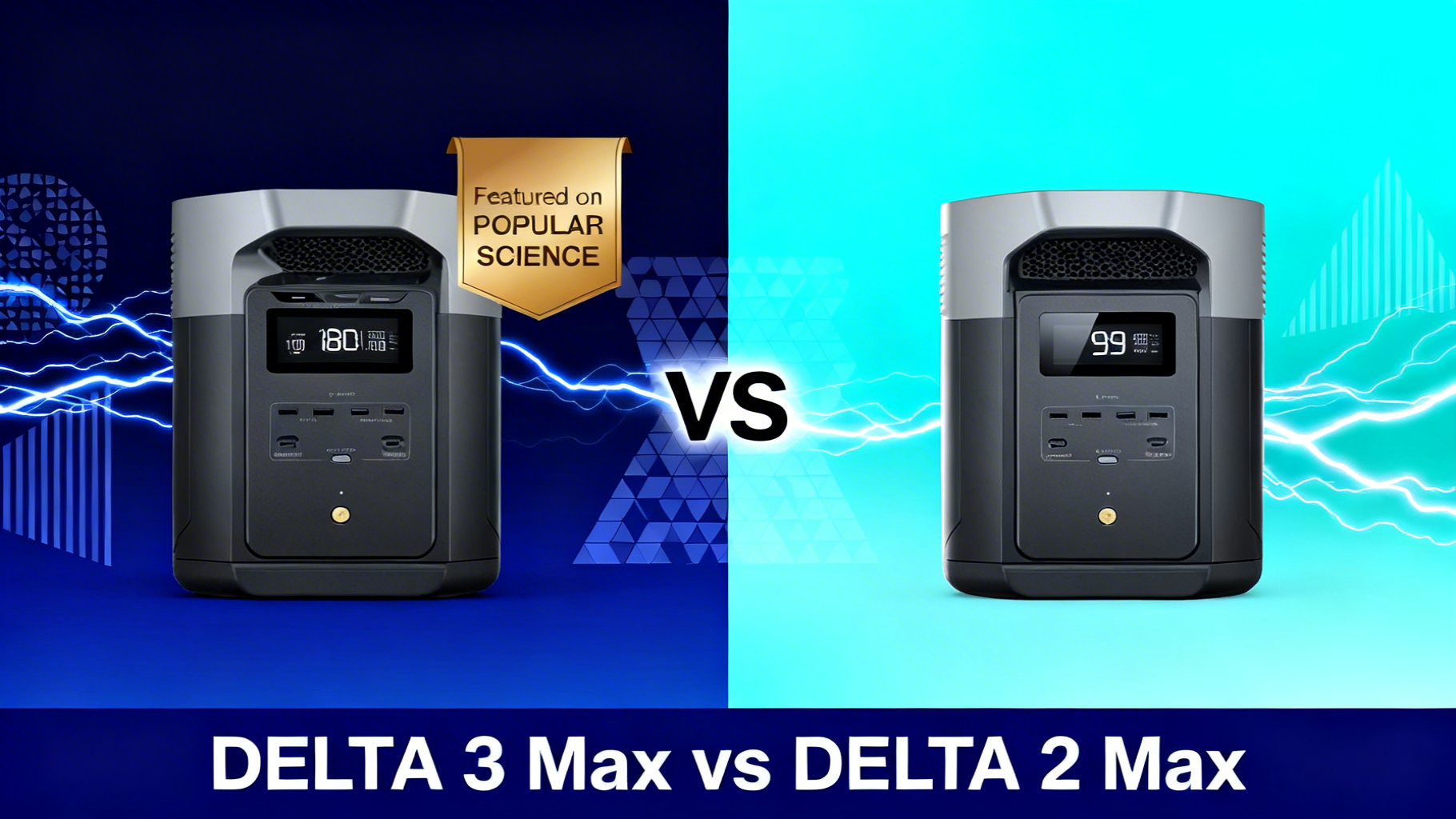
Two EcoFlow power stations. Same 1800W output. Same LFP chemistry. A $150 price gap. If you’re trying to decide between the DELTA 3 Classic and the DELTA 3 1500 (Air), the specs on paper look close enough to make the choice genuinely confusing.
Spec-for-spec analysis reveals that the gap isn’t about power delivery: both units push 1800W continuous with a 3600W surge. The real difference is about priorities: the Classic trades 48% less capacity and no expandability for a faster charge time, a lower price, and a quicker auto-switch. The 1500 (Air) trades a $150 premium for significantly more usable energy, a path to 5.5kWh, and IP54 weather protection on the battery pack.
This comparison covers every meaningful dimension: capacity and runtime, charging speed, expandability, solar input, UPS performance, and use-case fit. The goal is a clear answer based on your actual needs, not a promotional summary. For a full overview of every model in the DELTA lineup, our EcoFlow DELTA series buyer’s guide walks through every tier from the Classic to the Pro Ultra.


More Capacity
DELTA 3 1500 (Air)
1,512Wh | Expandable to 5.5kWh
$599 $1,099
Update (July 2026): The EcoFlow DELTA 3 1500 (Air) has been discontinued and is no longer sold new by EcoFlow. Links for it here now lead to its successor, the EcoFlow DELTA 3 Plus (1,024Wh, 1800W AC output, expandable to 5kWh, from $569). This comparison stays live to help existing DELTA 3 1500 (Air) owners and buyers weighing any remaining or secondhand stock.
Get our Black Friday alerts for EcoFlow
We track live prices on 40+ models from Jackery, EcoFlow, BLUETTI and Anker SOLIX. When a deal beats the lowest price we've recorded, you'll hear from us. During Black Friday week, one short recap a day at most.
Unsubscribe in one click. We may earn a commission when you buy through our links, at no extra cost to you. Privacy Policy
At a Glance: Key Differences
The table tells the story concisely. Both units deliver identical power output and share the same LFP chemistry with its 3,000-plus cycle lifespan. Where they diverge: the Classic charges faster and switches to battery power more precisely, while the 1500 (Air) packs 50% more energy and adds the ability to grow with additional battery packs.
Neither spec list is universally better. The right choice depends on your primary use case, budget flexibility, and whether you anticipate needing more capacity in the future. The sections below break down each dimension in detail.
DELTA 3 Classic Overview ($449 | 1,024Wh)
The EcoFlow DELTA 3 Classic is the entry point to EcoFlow’s third-generation DELTA platform. At $449, it sits at a discount from its original $599 MSRP and targets campers, weekend van lifers, and users who need reliable backup power without locking into a premium ecosystem. According to the official DELTA 3 Classic specifications, the unit’s standout technical features are its 45-minute charge time to 80% and its 10ms auto-switch, which is the fastest in this price bracket.
The 1,024Wh LFP battery is rated for 3,000-plus cycles to 80% capacity, translating to a claimed 10-year lifespan. X-Boost technology extends usable compatibility to appliances drawing up to 2,600W, even though the continuous AC output caps at 1,800W. This means devices like microwaves, refrigerators, and heated blankets that nominally exceed the unit’s watt rating can still run. The 30dB noise floor at 600W output is notably quiet for the category.

Key specs at a glance: 1,024Wh capacity, 1,800W continuous output (3,600W surge), LFP battery chemistry, up to 500W solar input, OASIS 3.0 app control for real-time monitoring, and an estimated weight of around 28 lbs (12.7 kg). The 3-year standard warranty extends to 5 years with EcoFlow App registration. For casual users who want solid specs at a lower price and don’t anticipate capacity expansion, the Classic remains a compelling buy in 2026.
Get our Black Friday alerts for EcoFlow
We track live prices on 40+ models from Jackery, EcoFlow, BLUETTI and Anker SOLIX. When a deal beats the lowest price we've recorded, you'll hear from us. During Black Friday week, one short recap a day at most.
Unsubscribe in one click. We may earn a commission when you buy through our links, at no extra cost to you. Privacy Policy
DELTA 3 1500 (Air) Overview ($599 | 1,512Wh)
The EcoFlow DELTA 3 1500, marketed in some channels as the DELTA 3 Air, is the mid-tier offering in the third-generation DELTA lineup. At $599 (reduced from its original $1,099 price), it positions as the capacity-focused choice for users with longer outage scenarios, RV and van life applications, or anyone building toward a more robust off-grid system. The official DELTA 3 1500 product page highlights expandability to 5.5kWh as its primary selling point.
With 1,512Wh on board, the 1500 holds 48% more usable energy than the Classic. The battery pack carries an IP54 rating for dust and splash resistance, a meaningful advantage for outdoor or truck bed storage. The 5-year warranty is included without requiring app registration, which simplifies ownership. Charging to 80% via AC takes 60 minutes: 15 minutes longer than the Classic, though still comfortably in the fast-charging bracket.
Key specs: 1,512Wh capacity, 1,800W AC output, LFP chemistry, expandable to 5.5kWh with compatible add-on batteries, IP54-rated battery pack, smart app control, and an estimated weight around 33 lbs (15 kg). The auto-switch time clocks in at 15ms, adequate for most home backup needs but marginally slower than the Classic’s 10ms for precision UPS applications. For users who need room to grow, the 1500 (Air) offers a future-proof foundation the Classic simply cannot match.
EcoFlow DELTA 3 1500 (Air)
1,512Wh | Expandable to 5.5kWh | IP54 | 5-yr warranty
$599
Capacity and What They Power
The 488Wh gap between these two units is the single most consequential spec difference. Runtime calculations based on the respective capacities show concrete outcomes by appliance. To estimate runtimes for your specific devices, our runtime calculator handles the math in seconds.
DELTA 3 Classic: What Can It Power? (1,024Wh)
❄️
Mini Fridge
~17 hrs
60W avg
💻
Laptop
~17 charges
60Wh battery
📺
TV (65in)
~14 hrs
75W avg
🌡️
CPAP
~17 nights
30-60W
DELTA 3 1500 (Air): What Can It Power? (1,512Wh)
❄️
Mini Fridge
~25 hrs
60W avg
💻
Laptop
~25 charges
60Wh battery
📺
TV (65in)
~20 hrs
75W avg
🏠
Full Fridge
~10 hrs
150W avg
The 488Wh difference translates to roughly 8 additional hours of mini-fridge runtime, 8 extra laptop charges, or 8 more nights of CPAP use. For a weekend camping trip, the Classic’s 1,024Wh is generally sufficient. For a two-to-three-day power outage covering a fridge, lights, and device charging simultaneously, the 1500’s larger reservoir provides meaningful headroom.
One important nuance: real-world efficiency typically runs 85-90% of rated capacity due to inverter conversion losses. Runtime calculations built on capacity data should factor in this efficiency buffer for accurate planning.
Charging Speed Head-to-Head

Charge time data confirms a meaningful advantage for the Classic: 45 minutes to 80% versus 60 minutes for the 1500. Both are fast by portable power station standards, but the Classic’s 15-minute lead matters in scenarios where a quick charge before departure is critical. The Classic supports four charging methods: AC wall outlet, car 12V, solar, and simultaneous combination charging.
The DELTA 3 1500 (Air) matches these charging modes and adds IP54 protection on the battery pack, which means the battery module can be charged or stored in conditions where the Classic’s housing might be a concern. For garage storage or sheltered outdoor setups, this distinction is minor. For truck-bed or exposed campsite use, the IP54 rating adds a real margin of safety.
Solar input data from EcoFlow’s published specifications shows the Classic accepts up to 500W of solar input. Solar compatibility across both models supports the same panel ecosystem, though confirmed solar input figures for the 1500 should be verified against EcoFlow’s current specification sheet for the most up-to-date limits. In peak sun conditions, the Classic’s 500W solar ceiling covers a meaningful portion of daily recharge needs without grid dependency.
💡 Pro Tip: When combining AC and solar input on either unit, the total charge rate can exceed the AC-only speed. If you’re in a rush before a trip, pairing a wall outlet with even a small solar panel shortens recharge time further.
Expandability and Long-Term Value
Expandability is where the two units diverge most fundamentally. The DELTA 3 Classic is a closed system: its 1,024Wh capacity is fixed. There’s no official upgrade path to add battery modules. If your power needs grow, the Classic’s ceiling remains constant, meaning an upgrade requires buying a new unit entirely.
The DELTA 3 1500 (Air), by contrast, supports expansion to 5.5kWh through compatible EcoFlow add-on batteries. For users who start with a home backup or van life setup and anticipate scaling, this is a fundamentally different value proposition. The $599 entry point isn’t just buying a larger battery today; it’s buying into a platform with headroom.
The long-term value calculation favors the 1500 for anyone who anticipates needing more than 1,024Wh within two to three years. Rather than replacing the unit, adding a battery module brings capacity up incrementally. For users who are certain their needs won’t grow beyond weekend trips and short outages, the Classic’s fixed capacity is a perfectly rational choice that keeps $150 in your pocket today.
EcoFlow DELTA 3 1500 (Air)
1,512Wh | Expandable to 5.5kWh | IP54 | 5-yr warranty
$599
Solar Input and Off-Grid Performance
The DELTA 3 Classic accepts up to 500W of solar input according to EcoFlow’s published specifications, making it compatible with larger panel arrays without throttling input. At 500W of solar input under ideal conditions (full sun, correct panel orientation, optimal temperature), a full recharge from empty would take approximately 2.5 to 3 hours. Realistic field conditions with partial clouds or suboptimal panel angle push that estimate to 4 to 6 hours.
Both units support the OASIS 3.0 smart app, which provides real-time visibility into solar input rates, battery state, and load consumption. For extended off-grid use, this kind of monitoring makes energy budgeting practical rather than guesswork. EcoFlow’s panel lineup, including the 160W and 220W portable options, pairs naturally with both units.
For serious off-grid scenarios spanning multiple days without grid access, the 1500’s larger 1,512Wh baseline means the same solar input refills a proportionally larger buffer. On equivalent solar days, the 1500 ends up with more stored energy than the Classic would have at the same point in the day. This compounding effect matters for van life builds and remote cabin setups where every watt-hour counts.
UPS and Auto-Switch Performance
Auto-switch time measures how quickly a power station transitions from grid power to battery power during an outage. Analysis of the specification data reveals a meaningful gap: the Classic switches in 10ms, the 1500 switches in 15ms. Both values are fast enough for most consumer electronics. The distinction becomes relevant for specific sensitive equipment.
NAS drives, home servers, and networking equipment with strict uptime requirements often specify UPS switch times under 10ms to avoid data corruption or connection drops during transitions. The Classic’s 10ms rating, combined with EcoFlow’s explicit UPS claims in the product spec sheet, positions it as the better choice for users running network infrastructure at home. The 1500’s 15ms response is adequate for virtually all other home appliances, including computers, medical equipment, and entertainment systems.
For most buyers, the 5ms difference won’t register in daily use. The Classic’s advantage here is specific and real, but it only matters if you’re protecting equipment that explicitly requires sub-10ms UPS response. If your priority is home network uptime and data protection, the Classic earns that scenario decisively.
⚠️ Important: Neither unit is a substitute for a dedicated rack-mount UPS for enterprise-grade server protection. For home NAS and workstation backup, both the Classic and the 1500 provide meaningful uptime support: the Classic with greater precision.
Winner by Use Case
✅ Choose DELTA 3 Classic if…
- Budget is your primary constraint ($449 vs $599)
- You need faster charging: 45 min vs 60 min to 80%
- UPS precision matters: 10ms auto-switch vs 15ms
- Camping, tailgating, or day-trip portability is the main use
- You never plan to expand capacity
✅ Choose DELTA 3 1500 (Air) if…
- You want 48% more capacity for multi-day outages
- Future expandability to 5.5kWh is on the roadmap
- IP54 weather-sealing matters for your environment
- 5-year warranty included (no app registration required)
- RV, van life, or home backup is the primary scenario

Best for Camping and Day Trips
Winner: DELTA 3 Classic. At 28 lbs versus 33 lbs for the 1500, the Classic is more manageable for car camping and day trips. The 1,024Wh capacity covers a weekend of lighting, device charging, and a mini-fridge without issue. Campers prioritizing weight will also want to check our roundup of best power stations for camping for full context.
Best for Home Backup (Short Outages)
Winner: DELTA 3 1500 (Air). A one-to-two-day outage covering a refrigerator, lighting, and phone charging runs the Classic to near-empty fast. The 1500’s 1,512Wh provides meaningful additional buffer, and the expandability to 5.5kWh covers longer scenarios. Buyers focused on home resilience should also read our home backup power station guide before committing.
Best for RV and Van Life
Winner: DELTA 3 1500 (Air). For extended travel where grid access is irregular, more capacity is almost always better. The 1500’s IP54 battery rating adds protection against dusty and damp environments typical of truck beds and cargo areas. The expansion path to 5.5kWh accommodates growing power demands as the rig evolves.
Best for CPAP and Medical Equipment
Winner: DELTA 3 Classic. The 10ms auto-switch is the relevant spec for medical equipment requiring uninterrupted power. Runtime calculations confirm the 1,024Wh capacity supports a CPAP drawing 30-60W for approximately 17 nights, which is more than adequate for home outage protection. The lower price and faster recharge also simplify the overnight routine.
Best for Future-Proofing Your Setup
Winner: DELTA 3 1500 (Air). If your power needs are likely to grow, the 1500’s expansion capability is the only path that doesn’t require buying a completely new unit. The included 5-year warranty also reduces long-term maintenance risk. Both models appear in our list of best portable power stations of 2026, each earning a spot for different buyer profiles.
Final Recommendation
Spec-for-spec analysis does not produce a universal winner here. Both units are well-built, both share the same LFP chemistry and identical power output, and both are priced competitively relative to their original MSRPs.
Choose the DELTA 3 Classic at $449 if: you camp or tailgate on weekends, you protect a home NAS or server and the 10ms auto-switch precision matters, or budget is the deciding factor and you don’t foresee needing more than 1,024Wh. The faster 45-minute charge time is a genuine quality-of-life advantage for time-sensitive use.
Choose the DELTA 3 1500 (Air) at $599 if: you run an RV or van, your home backup scenario covers multi-day outages, you want IP54 protection on the battery, or you’re building a system you’ll scale over time. The included 5-year warranty and expansion path to 5.5kWh make the $150 premium straightforward to justify for users whose needs match those parameters. Note that the DELTA 3 1500 (Air) has been discontinued as of July 2026, so buying one now means finding remaining or secondhand stock; its links here point to the EcoFlow DELTA 3 Plus successor.
DELTA 3 1500 (Air)
$599
Best for: Home backup, RV, expandability needed
FAQ
Is the EcoFlow DELTA 3 Air the same as the DELTA 3 1500?
Yes. EcoFlow markets the DELTA 3 1500 under the “DELTA 3 Air” designation in some regions and promotional materials, emphasizing its portable-first positioning. The specs are identical: 1,512Wh capacity, 1800W AC output, and expandability to 5.5kWh. If you’re seeing both names while shopping, they refer to the same unit.
Is the DELTA 3 Classic worth $150 less than the DELTA 3 1500?
For buyers who don’t need expansion capability and prioritize faster charging (45 min vs 60 min to 80%), the DELTA 3 Classic offers strong value at $449. The 1500 justifies its premium for users who want a path to 5.5kWh and the included IP54 battery protection. If your use is strictly camping or light home backup with no scaling plans, the Classic’s lower price is a rational choice.
Can the EcoFlow DELTA 3 Classic power a refrigerator?
With X-Boost technology, the DELTA 3 Classic supports appliances drawing up to 2,600W, including most full-size refrigerators. Runtime data based on the 1,024Wh capacity indicates approximately 8-10 hours for a standard refrigerator drawing 100-120W average. Running additional loads concurrently will reduce that estimate proportionally.
Which model has a better warranty?
The DELTA 3 1500 (Air) includes a 5-year warranty automatically. The DELTA 3 Classic provides a 3-year standard warranty, extendable to 5 years via EcoFlow App registration. For buyers who want full 5-year coverage without an extra step, the 1500 has the edge. Both warranties cover manufacturing defects under normal use conditions.
Can either model power a whole house?
Neither model is designed for whole-home backup on its own. The DELTA 3 Classic delivers 1,024Wh and the 1500 provides 1,512Wh: both suit targeted backup for essential devices. The DELTA 3 1500 can expand to 5.5kWh for extended coverage of high-priority circuits, while whole-home scenarios typically require the EcoFlow DELTA Pro Ultra ecosystem with transfer switch integration.
Related Reads
Originally published: March 31, 2026