
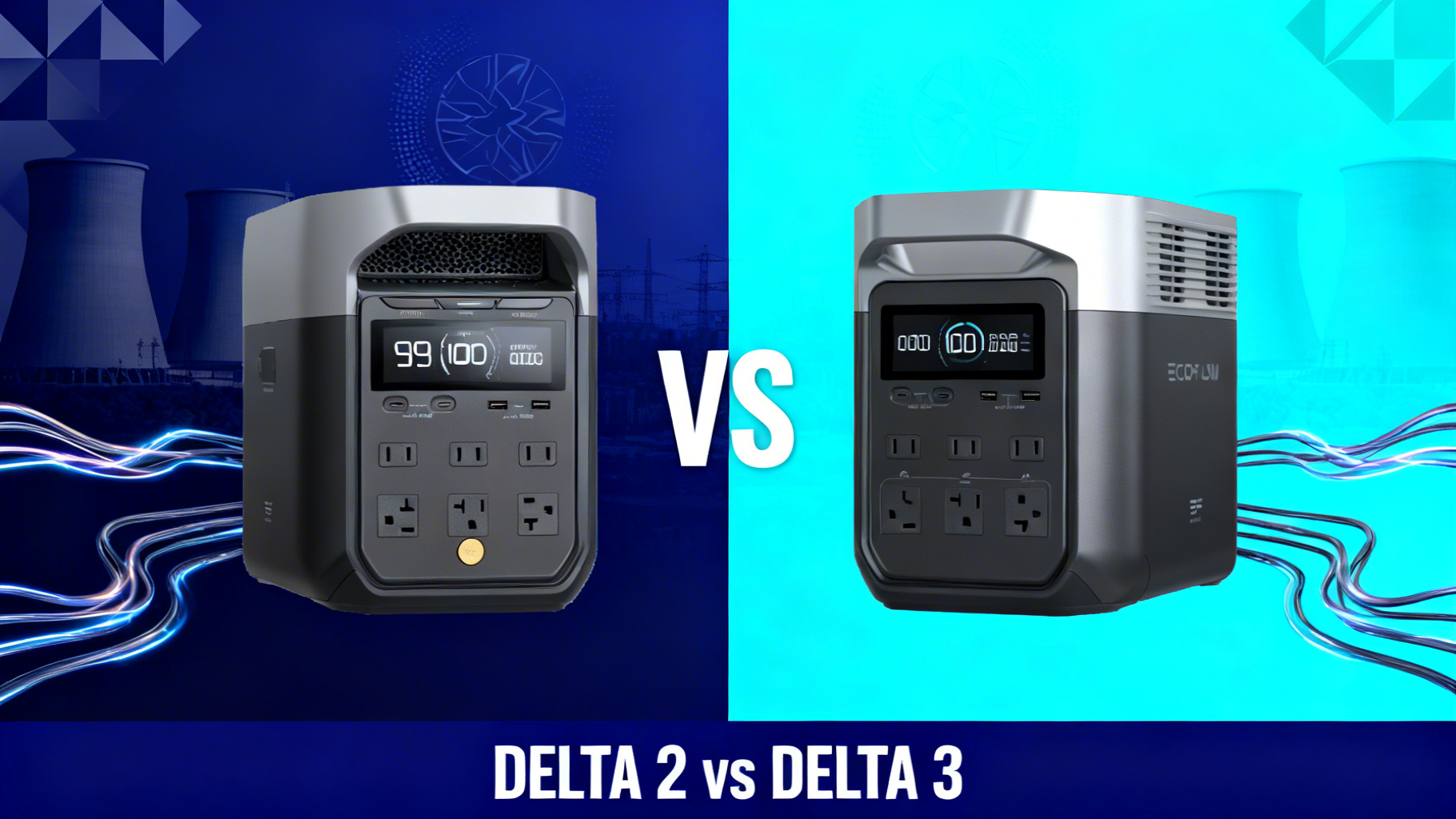
Choosing between the EcoFlow DELTA 2 and DELTA 3 feels straightforward on paper: same 1,024Wh capacity, same 1,800W AC output, same five-year warranty. Yet a $100 price gap separates them, and that gap reflects a meaningful generational leap in expandability and charging flexibility. So which one actually belongs in your setup?
Both stations target the same audience: campers, van lifers, and homeowners who want reliable backup power without stepping up to a whole-home system. The DELTA 2 has been a proven mid-range workhorse since its release. The DELTA 3 is the newer architecture, built around a broader ecosystem and more recharge options. If you’re still exploring your options beyond the DELTA line, our roundup of the best portable power stations of 2026 covers every budget and use case.
This comparison breaks down five key dimensions: expandability, charging methods, surge output, real-world use cases, and long-term value. The DELTA 2 wins on price and proven reliability. The DELTA 3 wins on flexibility and future-proofing. Here’s how to decide which one is right for you.

EcoFlow DELTA 2
$399 $1,049
- 1,024Wh capacity, expandable to 3kWh
- 1800W AC output (2200W with X-Boost)
- 7x faster AC charging vs previous gen
Get our Black Friday alerts for EcoFlow
We track live prices on 40+ models from Jackery, EcoFlow, BLUETTI and Anker SOLIX. When a deal beats the lowest price we've recorded, you'll hear from us. During Black Friday week, one short recap a day at most.
Unsubscribe in one click. We may earn a commission when you buy through our links, at no extra cost to you. Privacy Policy
At a Glance: Key Differences Between DELTA 2 and DELTA 3
Before diving into the detail, here’s the fast overview. Both stations share the same base capacity and AC output. The real differences emerge at the edges: surge wattage, expandability ceiling, and the number of ways you can recharge the unit.
Three takeaways stand out. First, capacity is identical: this comparison is not about how long each unit runs, but about how each unit charges and expands. Second, the DELTA 3’s surge capability (3,600W) meaningfully exceeds the DELTA 2’s (2,200W), which matters for high-draw appliances. Third, the DELTA 3 supports five distinct input methods versus the DELTA 2’s four, with the 800W Alternator Charger being the most significant addition for mobile users.


EcoFlow DELTA 2 Overview: The Proven Mid-Range Standard
The DELTA 2 is EcoFlow’s established mid-range option, built around a 1,024Wh capacity and designed for users who need reliable backup power without overcomplicating the setup. Spec data for the official EcoFlow DELTA 2 specifications confirms: 1,800W continuous AC output with X-Boost pushing that to 2,200W, enough to handle most household appliances and power tools.
Where the DELTA 2 earns its place is value. At $399 (down from $1,049 MSRP), it delivers a well-rounded spec sheet for the price. Expandability reaches 3kWh with a single DELTA 2 Smart Extra Battery, which covers the majority of home backup scenarios. Charging options include AC, solar, car, and EV adapter. The seven-times-faster AC charging over the original DELTA is a genuine upgrade, and the five-year warranty reflects EcoFlow’s confidence in the platform’s longevity.
The limitation is the expansion ceiling. Users who anticipate needing more than 3kWh, or who plan to charge primarily from a vehicle alternator, will hit the DELTA 2’s constraints quickly. For a deeper look at the DELTA 2 on its own terms, our EcoFlow DELTA 2 review covers performance data and use case analysis in full detail.
Get our Black Friday alerts for EcoFlow
We track live prices on 40+ models from Jackery, EcoFlow, BLUETTI and Anker SOLIX. When a deal beats the lowest price we've recorded, you'll hear from us. During Black Friday week, one short recap a day at most.
Unsubscribe in one click. We may earn a commission when you buy through our links, at no extra cost to you. Privacy Policy
EcoFlow DELTA 3 Overview: The Next-Generation Upgrade
The DELTA 3 keeps the same 1,024Wh base capacity as the DELTA 2 but introduces a substantially larger ecosystem. Published specifications for the official EcoFlow DELTA 3 specifications show: 1,800W AC output, 2,200W with X-Boost, and a surge ceiling of 3,600W. That surge spec is the most immediate hardware upgrade over the DELTA 2, relevant for appliances with heavy startup draws.
The bigger story is recharge versatility. The DELTA 3 supports five input methods: standard AC, solar, 800W Alternator Charger, Smart Generator 3000 (Dual Fuel), and simultaneous Multicharging. For van lifers and RV users, the 800W Alternator Charger is the standout addition, allowing the unit to recharge while the vehicle is in motion without straining the alternator. Expandability reaches 5kWh through compatibility with multiple extra battery types, including the DELTA 3 Extra Battery, DELTA Pro 3 Extra Battery, DELTA 2 Extra Battery, and DELTA 2 Max Extra Battery.
The trade-offs are straightforward. The DELTA 3 costs $100 more, and cross-compatibility with some older DELTA 2 accessories is not fully confirmed for all configurations. Users invested in the DELTA 2 ecosystem should verify compatibility before purchasing expansion batteries. For a complete breakdown of the DELTA 3 as a standalone unit, see our EcoFlow DELTA 3 review.

Head-to-Head: Battery Capacity and Expandability
At the base level, both stations are identical: 1,024Wh each. Runtime calculations produce the same results for standard loads on either unit. The divergence appears as soon as you look at the expansion ceiling.
The DELTA 2 supports one extra battery, bringing total capacity to 3kWh. That level covers a full day of typical home essentials during a power outage: refrigerator, lighting, phone and laptop charging, and a CPAP machine. For most weekend campers and homeowners who experience short outages, 3kWh is genuinely sufficient.
The DELTA 3’s expansion path reaches 5kWh and accommodates multiple battery types. For users who anticipate multi-day outages or who run higher-draw appliances for extended periods, the DELTA 3’s ceiling provides meaningful headroom. The ability to stack compatible batteries from different DELTA product lines also gives the DELTA 3 a more flexible upgrade path over time.
Charging Speed and Recharge Methods Compared
Both the DELTA 2 and DELTA 3 support fast AC charging from a standard wall outlet. Published charge time data for both units confirms competitive 0-100% times in the same general range for AC input. Solar input specs are also comparable at the base level, with each unit accepting similar maximum wattage from compatible panels. Our DELTA 3 solar setup guide covers optimal panel pairings for the newer model.
The DELTA 3’s real advantage here is diversity of input, not raw AC charging speed. Three input methods exclusive to the DELTA 3 define the gap: the 800W Alternator Charger, Smart Generator 3000 (Dual Fuel) compatibility, and simultaneous Multicharging. For anyone operating in a vehicle-dependent context, the 800W alternator option enables recharging during long drives at a rate that meaningfully closes the energy gap by arrival at camp. That is a capability the DELTA 2 simply does not offer.

⚠️ Important: The DELTA 3’s Multicharging feature allows simultaneous use of multiple input sources. Combining AC with solar, for example, can reduce total charge time significantly. Consult EcoFlow’s official documentation for specific wattage limits when stacking inputs.
X-Boost and Output Power: Where DELTA 3 Pulls Ahead
X-Boost is EcoFlow’s technology for powering appliances whose rated wattage exceeds the unit’s continuous AC output. Both stations use X-Boost, but the performance ceiling is different. The DELTA 2 manages X-Boost up to 2,200W. The DELTA 3 extends that to 2,200W standard plus a 3,600W surge output.
In practical terms, the surge difference matters for a specific category of appliances: those with high startup draws that briefly spike above rated wattage. Well pumps, portable air conditioners, refrigerator compressors starting cold, and heavy power tools all fall into this category. Spec analysis confirms the DELTA 3 handles these scenarios more reliably than the DELTA 2 under peak demand conditions.
For standard home and camping loads, the surge difference is academic. Refrigerators, laptops, TVs, and lighting all fall well within the DELTA 2’s range. The gap becomes relevant specifically for users who intend to run high-startup appliances from their station.
What Can Each Station Power?
Since both stations share identical 1,024Wh capacity, runtime calculations produce the same results for standard loads. The data below applies equally to both units under normal operating conditions.
What Can Either Station Power? (1,024Wh)
❄️
Mini Fridge
~17 hrs
60W avg
💡
LED Lights
~34 hrs
30W avg
💻
Laptop
~10 hrs
65W avg
📱
Smartphone
~85 charges
12W avg
Runtime calculations based on 1,024Wh capacity at ~85% efficiency. Actual results vary by load.
The divergence appears when running appliances that approach or exceed the DELTA 2’s surge limit. A portable air conditioner on the DELTA 3 runs reliably; on the DELTA 2, it’s situational depending on the unit’s startup draw. For precise estimates tailored to your specific appliances, use our portable power station runtime calculator.

Winner by Use Case
Home Backup (Power Outages)
For home backup, the DELTA 2 wins on price if your outage profile is typical: a few hours to a day, running essentials like a refrigerator, lighting, and device charging. The 3kWh expansion ceiling covers the majority of residential outage scenarios in North America, where most outages resolve within 24 hours.
The DELTA 3 earns its premium for users who experience multi-day outages or want to power a well pump or sump pump during a storm. The 5kWh ceiling and higher surge tolerance make it the safer choice for those edge cases. Our dedicated DELTA 2 home backup guide maps out exact circuits and load calculations if you want to model your specific setup before committing.
Camping and Outdoor Adventures
For weekend camping, runtime analysis shows both stations perform identically. Running a camp fridge, lights, a phone, and a laptop over a two-day trip sits comfortably within the 1,024Wh base capacity of either unit. The DELTA 2 at $399 is the straightforward choice here.
The DELTA 3 gains an edge for van or vehicle-based camping where the 800W Alternator Charger comes into play. Driving three to four hours between sites can restore a substantial portion of the battery, effectively extending the trip without needing a shore power connection. For tent camping or stationary setups, the DELTA 2 wins on value.

RV and Van Life
The DELTA 3 wins this category clearly. The 800W Alternator Charger is specifically designed for the driving-and-charging workflow that defines van life and extended RV trips. Combined with 5kWh expansion and Smart Generator 3000 compatibility for backup charging, the DELTA 3 offers a more complete off-grid energy architecture than the DELTA 2 can provide. For full-time mobile living, the $100 premium is well justified.
Emergency Preparedness
Resilience in an emergency comes from having multiple ways to restore power. The DELTA 3’s five input methods give it a clear advantage here. When grid power is unavailable, being able to recharge from a vehicle alternator, a generator, or stacked solar sources means the unit stays useful longer. The DELTA 2’s four input methods are solid, but the DELTA 3’s redundancy is worth the additional investment for preparedness-focused buyers.
Budget-Conscious Buyers
The DELTA 2 wins without discussion. At $399 versus $499, it delivers the same base performance for standard use cases at a lower entry price. If 3kWh expansion is sufficient and alternator charging is not a priority, the DELTA 2 provides everything most users need at a meaningful savings. The $100 difference is only worth paying if at least one of the DELTA 3’s exclusive features maps directly to your use case.
✅ Choose DELTA 2 if…
- Budget is a primary constraint
- You need home backup or casual camping
- You already own a DELTA 2 Extra Battery
- 3kWh expansion is enough for your use case
✅ Choose DELTA 3 if…
- You want 5kWh expandability for longer outages
- 800W Alternator Charger for RV or van builds matters
- Smart Generator 3000 compatibility is a priority
- You’re future-proofing for heavier loads
Price and Long-Term Value Analysis
At $399 for the DELTA 2 and $499 for the DELTA 3, the cost-per-Wh is identical at the base level: both units store 1,024Wh. The $100 gap buys you a specific set of upgrades, not additional capacity. Whether those upgrades represent value depends entirely on whether you’ll use them.
Long-term value shifts toward the DELTA 3 for users who will actively leverage the alternator charger or the expanded battery ecosystem. The broader compatibility with DELTA Pro 3 and DELTA 2 Max Extra Batteries means future upgrades are more flexible. For users who are simply looking for home backup and occasional camping, the DELTA 2’s established ecosystem and lower price represent better value for the same core performance.

Final Recommendation
There is no universal winner between the DELTA 2 and DELTA 3. The right choice depends on one question: do the DELTA 3’s exclusive features match a real need in your situation?
If the answer is yes, namely you need 5kWh expansion, alternator charging, or Smart Generator compatibility, then the $100 premium is a straightforward justification. If the answer is no, the DELTA 2 delivers identical base performance at a lower cost and draws on a proven, widely available ecosystem.
For budget-constrained buyers and users with standard home backup or camping needs, the EcoFlow DELTA 2 is the stronger value pick. For mobile users, future-focused buyers, and anyone who expects to push beyond 3kWh, the EcoFlow DELTA 3 offers a more capable long-term platform. If neither model seems right for your scale of needs, our full EcoFlow DELTA series buyer’s guide covers every generation from entry-level to whole-home. Alternatively, our roundup of the best portable power stations of 2026 includes options at every capacity and price point.
EcoFlow DELTA 3
$499
Best upgrade for expandability and future-proofing
Price verified March 2026. Free shipping available.
Related Reads
Frequently Asked Questions
Is the EcoFlow DELTA 3 worth the extra $100 over the DELTA 2?
Analysis of the spec differences shows the DELTA 3 justifies its $100 premium for users who need 5kWh expandability, 800W alternator charging, or Smart Generator 3000 compatibility. For standard home backup or casual camping where 3kWh is sufficient, the DELTA 2 delivers the same core performance at a better price. The $100 question comes down to whether you’ll actively use any of the DELTA 3’s exclusive features. If at least one of those features maps to your real use case, the upgrade is worth it.
Can the EcoFlow DELTA 2 use the DELTA 3 Extra Battery?
Cross-compatibility data from EcoFlow indicates the DELTA 3 supports multiple extra battery types, including the DELTA 2 Extra Battery and DELTA 2 Max Extra Battery. The reverse direction, using the DELTA 3 Extra Battery with the DELTA 2, is not confirmed for all configurations. Before purchasing expansion batteries for either system, checking EcoFlow’s official compatibility chart is strongly recommended to avoid pairing incompatible hardware.
What is the surge wattage difference between DELTA 2 and DELTA 3?
Published specifications show the DELTA 3 reaches a surge output of 3,600W with X-Boost, compared to the DELTA 2’s 2,200W X-Boost ceiling. That 1,400W difference matters specifically for appliances with high startup draws: well pumps, portable air conditioners, and heavy power tools. For most standard home and camping appliances, refrigerators, laptops, TVs, and lights, both units operate comfortably within their respective limits and the difference is not relevant in day-to-day use.
Does the DELTA 3 charge faster than the DELTA 2?
Both models support fast AC charging from a wall outlet, with comparable charge times for 0-100% via AC input. The meaningful difference is flexibility, not raw speed. The DELTA 3 adds three input methods not available on the DELTA 2: 800W Alternator Charger, Smart Generator 3000 (Dual Fuel), and simultaneous Multicharging. For users with access to a vehicle alternator or dual-fuel generator, total recharge options are significantly broader on the DELTA 3, even if the AC-to-full time is similar between the two.
Which is better for camping, DELTA 2 or DELTA 3?
Runtime calculations show identical performance for standard camping loads since both units share 1,024Wh capacity. For tent or stationary camping, the DELTA 2 offers the same capability at $100 less, making it the better value. The DELTA 3 gains a clear advantage for van or vehicle-based camping, where the 800W Alternator Charger enables recharging while driving between sites. If your camping setup involves a vehicle and long drives, the DELTA 3’s alternator charging capability justifies the premium.
Originally published: March 31, 2026