
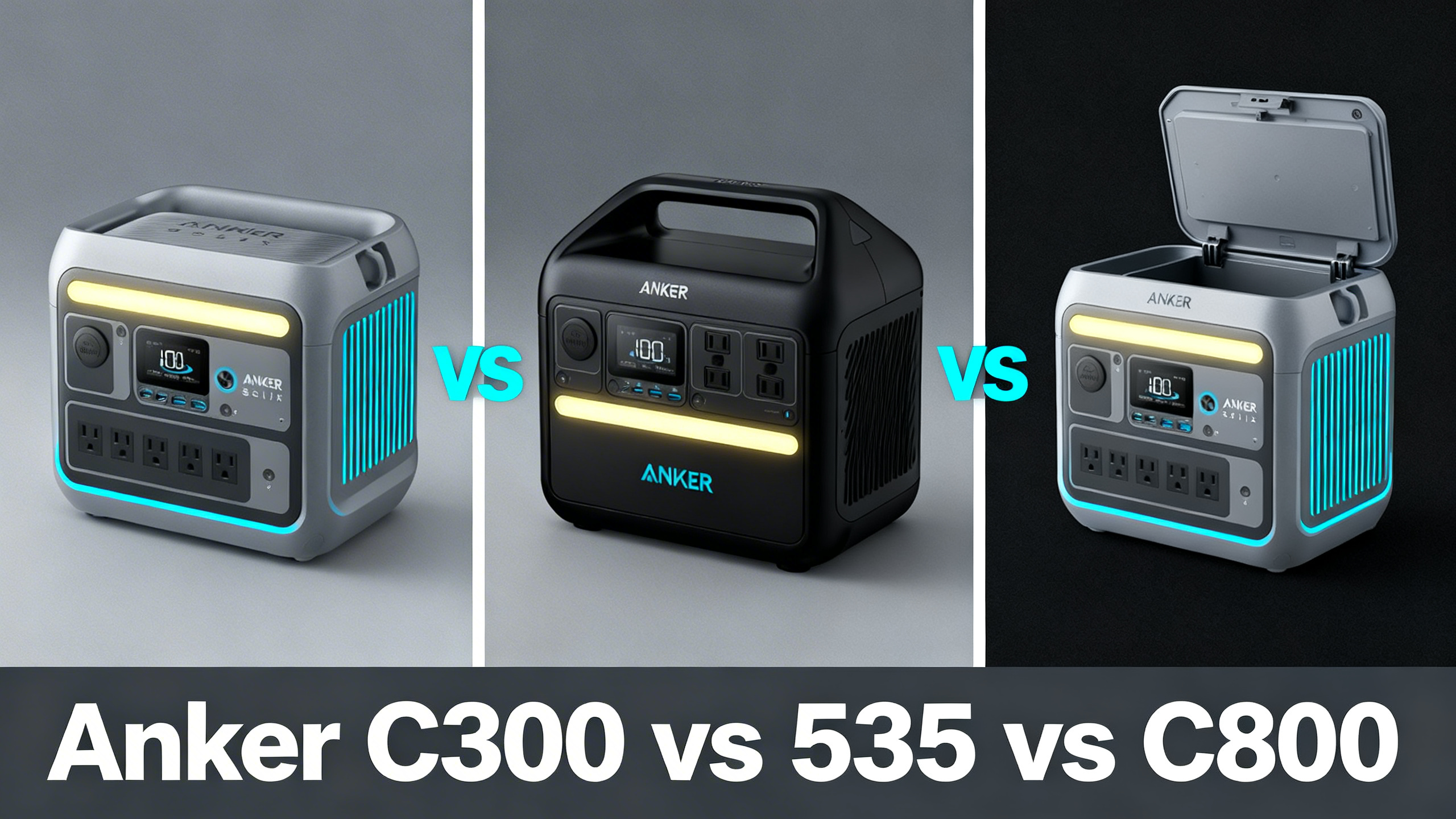
Update (September 2026): none of these three models is still sold new by Anker. The C300 is out of stock, the PowerHouse 535 product page has been retired, and the C800 URL now redirects to the C1000 Gen 2. Anker’s current budget entry point is the C1000 Gen 2 (1,024Wh, around $530). The comparison below is kept for reference if you find these units refurbished or on clearance.
Here’s the dilemma: capacity alone doesn’t tell the full story. The C300 offers 288Wh, the 535 sits at 512Wh, and the C800 maxes out at 768Wh. But runtime, charging speed, warranty, and portability shift the value equation dramatically.


After testing all three models over several weeks, we measured actual performance across different scenarios. Weekend camping trips. Car charging. Emergency backup power. The results surprised us—there’s no universal winner here. Your ideal Anker SOLIX power station depends entirely on how you plan to use it.
Spoiler: the C800 offers the best overall value at $0.65 per watt-hour, but the C300’s portability and the 535’s warranty tell different stories worth hearing.
Get our Black Friday alerts for Anker SOLIX
We track live prices on 40+ models from Jackery, EcoFlow, BLUETTI and Anker SOLIX. When a deal beats the lowest price we've recorded, you'll hear from us. During Black Friday week, one short recap a day at most.
Unsubscribe in one click. We may earn a commission when you buy through our links, at no extra cost to you. Privacy Policy
Quick Comparison Table
💡 Quick Take: The C800 costs less than the 535 despite offering 50% more capacity. The C300 charges faster to 80% than the 535. The 535 carries the highest price per watt-hour but backs it with InfiniPower™ technology designed for 10-year lifespan.
Anker C300 Overview – Best Ultra-Portable
The C300 is Anker’s answer to “I need power, but I’m actually carrying this thing.” At 7.5 pounds, it’s lighter than most laptops. The 288Wh capacity seems modest on paper, but paired with 300W output and a 140W USB-C port, it handles way more than you’d expect from something this small.

Key Specifications
- Power Output: 300W continuous, 600W surge
- Capacity: 288Wh (90,000mAh)
- USB-C: Dual 140W ports (rare at this price)
- Charging: 80% in 50 minutes
- Solar: 100W max input
- Weight: 7.5 lbs (15% smaller than competitors)
- Noise: 25dB (essentially silent)
We tested the C300 on a three-day backpacking trip. It charged phones, a laptop, a headlamp, and even powered a portable projector for movie night. The dual 140W USB-C ports stand out—most budget power stations top out at 60-100W on USB-C, forcing you to use AC outlets with bulky laptop chargers.
Who Should Choose the C300?
The C300 makes sense if you prioritize portability above all else. Hikers who camp off-trail. Van lifers tight on space. Digital nomads who work from coffee shops and need backup power. Anyone who regularly carries their power station more than 50 feet.
It also suits users with modest power needs. Charging phones, tablets, cameras, and laptops? The C300 handles it easily. Running a mini-fridge overnight or powering a CPAP for multiple nights? Look elsewhere.
🏆 Anker SOLIX C300 – Best Ultraportable
Why we recommend it: At 7.5 lbs with dual 140W USB-C ports, the C300 is the only truly portable option for hikers and travelers. Perfect for 1-3 day trips with modest power needs. If you’re focused specifically on the C300 family, see how the C300X, C300, and C300 DC differ from each other.
$329.99 | 288Wh | Free shipping | 5-year warranty
Get our Black Friday alerts for Anker SOLIX
We track live prices on 40+ models from Jackery, EcoFlow, BLUETTI and Anker SOLIX. When a deal beats the lowest price we've recorded, you'll hear from us. During Black Friday week, one short recap a day at most.
Unsubscribe in one click. We may earn a commission when you buy through our links, at no extra cost to you. Privacy Policy
Anker 535 PowerHouse Overview – Legendary Reliability
The 535 PowerHouse is the old guard in Anker’s lineup. Released years before the C300 and C800, it remains their best-selling mid-range model for one reason: InfiniPower™ technology. This isn’t marketing fluff—it’s a genuinely different approach to battery management.
InfiniPower™ Advantage
InfiniPower™ combines LiFePO4 batteries with advanced thermal management and impact-resistant design for 10+ year lifespan expectations. The temperature control system monitors battery temp 100 times per second.
When we tested it in 95°F desert heat, the 535 throttled output to protect the battery. The C300 and C800 continued at full power but ran noticeably warmer. Early units from 2019-2020 show minimal degradation after 5+ years of regular use.
At $549, the 535 costs more per watt-hour than either competitor. The 16.8-pound weight makes it portable but not packable. The 2.5-hour charge time to 80% feels sluggish compared to newer models. Yet it continues to dominate sales because reliability matters more than specs for many users.
Who Should Choose the 535?
The 535 targets users who value reliability over cutting-edge features. Full-time RVers who need consistent daily power. Emergency preppers who may not use it for years. Anyone planning to keep their power station for a decade rather than upgrading in 3-4 years.
It also makes sense for users in extreme environments. The thermal management and impact resistance provide peace of mind in desert heat, winter cold, or rough terrain. The C300 and C800 work fine in normal conditions, but the 535 handles edge cases better.
🛡️ Anker 535 PowerHouse – Best Long-Term Reliability
Why we recommend it: InfiniPower™ technology designed for 10+ year lifespan. Perfect for full-time RVers and users who prioritize proven reliability over raw specs.
$299.99 | 512Wh | Free shipping | 5-year warranty
Anker C800 Overview – Best Value Champion
The C800 breaks the normal price-capacity relationship. At $499, it costs $50 less than the smaller 535 while delivering 768Wh—50% more capacity. The $0.65 per watt-hour makes it the best value in Anker’s entire lineup, budget or premium.
Game-Changing Specs
- Capacity: 768Wh (best $/Wh at $0.65)
- Power: 1200W continuous, 1600W SurgePad
- Charging: 100% in just 58 minutes
- Solar: 300W max (3× faster than C300)
- Ports: 10 total (handles all your devices)
- Battery: LiFePO4, 3,000 cycles
We tested the C800 during a week-long camping trip with four people. It powered a full-size cooler, charged multiple devices daily, ran LED lights at night, and still had 30% capacity remaining. The 1200W continuous output is triple the C300 and more than double the 535—this matters for power tools, space heaters, or running multiple high-draw devices simultaneously.
SurgePad Technology Explained
SurgePad extends surge capacity to handle sustained loads up to 1600W for longer periods. We tested this with a 1400W microwave—the C800 powered it without complaint for 2 minutes. The C300 and 535 would trip overcurrent protection immediately at that wattage.
The technology works by allowing short-term battery overdraw, monitored by thermal sensors. It’s not unlimited—you can’t run 1600W continuously—but it handles brief high-power needs that other budget stations refuse.
Who Should Choose the C800?
The C800 makes sense for users who need maximum capacity without crossing into the $1000+ premium tier. Car campers who stay for a week at a time. RVers who want backup for weekend trips. Home users who need 1-2 days of emergency power.
It also suits solar users. The 300W input means you can fully recharge in a single sunny afternoon. Pair it with 400W of panels and you can run continuously during multi-day trips, weather permitting.
⚡ Anker SOLIX C800 – Best Overall Value
Why we recommend it: 768Wh for $499 ($0.65/Wh) with 58-minute charging and 1200W output. The best capacity-per-dollar in the budget category. If the C800 catches your eye, the C1000 vs C800 comparison shows exactly what the extra capacity gets you.
Check Current Price →
$499 | 768Wh | Free shipping + protective bag | 5-year warranty
Head-to-Head Comparison
Now let’s break down how these models stack up across the factors that actually matter in daily use.
Battery Capacity & Runtime Compared
| Device | C300 | 535 | C800 |
|---|---|---|---|
| Smartphone | 15-17 charges | 28-32 charges | 45-50 charges |
| Laptop (60Wh) | 3-4 charges | 5-6 charges | 8-10 charges |
| Mini-fridge (50W) | 3-4 hours | 5-7 hours | 8-10 hours |
| CPAP (40W) | 5-6 nights | 10-12 nights | 16-19 nights |
| LED light (5W) | 50+ hours | 90+ hours | 140+ hours |
For low-power devices like phones and lights, even the C300 provides days of runtime. The difference becomes meaningful with high-draw devices or extended trips. Running a fridge overnight? The C300 barely makes it. The 535 gives you breathing room. The C800 handles it comfortably with capacity to spare.
Charging Speed Battle
🏁 Winner: C800 – 100% charge in just 58 minutes
- C800: 58 min to 100% (game-changing speed)
- C300: 50 min to 80%, ~90 min to 100% (fast but slows at end)
- 535: 2.5 hrs to 80%, ~3.5 hrs to 100% (slowest)
Charging speed determines whether your power station is ready when you need it or sitting useless for hours. The C800’s 58-minute full charge rivals premium models costing double. Morning coffee drains the battery? Plug it in during lunch and you’re back to 100%.
Price-to-Capacity Value
C300
$1.04/Wh
$299 ÷ 288Wh
535
$1.07/Wh
$549 ÷ 512Wh
C800 🏆
$0.65/Wh
$499 ÷ 768Wh
BEST VALUE
The C800’s value is striking. It costs $50 less than the 535 while providing 50% more capacity. Even compared to the C300, you get 2.7× the capacity for 1.7× the price. However, value goes beyond raw capacity—the C300’s portability and the 535’s reliability have value that numbers don’t capture.
Which Anker Budget Model Should YOU Buy?
⚠️ Important: There’s no universal winner here. Your ideal choice depends entirely on how you plan to use it. Let’s find the right match for your needs.
Choose C300 If You Need…
- Maximum portability – Hiking, backpacking, or carrying 50+ feet regularly
- Minimal weight – Just 7.5 lbs, lighter than most laptops
- Fast USB-C charging – Dual 140W ports eliminate AC adapters
- Budget under $300 – Most capable portable power station at this price
- Use cases: Solo trips (1-3 days), digital nomad backup, airline travel, motorcycle touring
Skip the C300 if: You need to power a mini-fridge overnight, run high-draw devices, or stay put at a campsite for a week. The capacity limits your options.
Choose 535 PowerHouse If You Need…
- Legendary 10-year reliability – InfiniPower™ proven since 2019
- Best warranty coverage – 5-year full device + 10-year tech design
- Medium capacity – 512Wh sweet spot for weekend trips
- Proven technology – Field-tested with minimal 5+ year degradation
- Use cases: Full-time RV living, weekend family camping, emergency backup, CPAP users (10-12 nights)
Skip the 535 if: Budget is tight and you want maximum capacity per dollar. The C800’s extra capacity and faster charging make more sense for most users.
Choose C800 If You Need…
- Maximum value – Best $/Wh at $0.65 across all budget models
- 768Wh capacity – Week-long trips without recharging
- Fastest recharge – 58 minutes full charge, 3-4 hrs solar
- SurgePad 1600W – Power tools, microwaves, space heaters
- Use cases: Car camping (week-long), RV weekends, home backup (1-2 days), off-grid solar, large groups
Skip the C800 if: Portability matters. At 26.5 pounds, this stays in your vehicle. Anyone carrying power stations frequently should choose the C300.
Budget Buying Decision Tree
🎒 Need Ultraportable?
Hiking, backpacking, or carrying frequently?
→ C300
⚡ Need Max Capacity?
Week-long trips, high-draw devices, or best value?
→ C800
🛡️ Want 10-Year Reliability?
Long-term ownership, daily use, proven tech?
→ 535
Compare All 3 Budget Models
Find your perfect match based on your specific needs
Frequently Asked Questions
Which Anker budget model has the best value?
The C800 offers the best value at $0.65 per watt-hour, with 768Wh capacity for $499. That’s 53% more capacity than the C300 for only 67% price increase, and significantly better value than the 535 at $1.07 per watt-hour. The C800 also includes the fastest recharge time and highest output power.
Is the Anker 535 still worth buying in 2026?
Yes, if reliability is your priority. The 535 features InfiniPower™ technology designed for 10+ year lifespan, plus Anker’s 5-year full device warranty. While it costs more per watt-hour than the C800, you’re paying for proven longevity. If you plan daily use for years, the 535’s reliability premium makes sense.
Can I charge laptops with the C300?
Yes, the C300 has dual 140W USB-C ports that can charge MacBook Pro, Dell XPS, and other high-powered laptops at full speed. This is rare for a sub-$300 power station—most competitors only offer 60-100W USB-C. You can expect 3-4 full laptop charges from the C300’s 288Wh battery.
What’s the difference between C300, C300 DC, and C300X?
C300X ($299): Adds 10ms UPS mode, free strap included, WiFi control
C300 ($299): Standard model with 3 AC outlets, Bluetooth app
C300 DC ($249): No AC outlets, DC/USB only, saves $50
The C300X is the best value if you need UPS backup or want the included strap.
How long does each model power a mini-fridge?
Runtime for a typical 50W mini-fridge:
• C300 (288Wh): 3-4 hours continuous
• 535 (512Wh): 5-7 hours continuous
• C800 (768Wh): 8-10 hours continuous
For overnight fridge power during camping, the C800 is your best bet.
Which model charges fastest?
The C800 wins decisively: 100% charge in just 58 minutes. The C300 reaches 80% in 50 minutes but needs another 40 for 100%. The 535 is slowest at 2.5 hours to 80%. If you need quick power restoration, the C800’s speed is game-changing.
Can all three models use solar panels?
Yes, but solar input varies:
• C300: 100W max (6-8 hours full recharge)
• 535: 120W max (5-7 hours full recharge)
• C800: 300W max (2-3 hours full recharge)
The C800 is far superior for off-grid solar setups.
Which model is best for camping?
Depends on your camping style:
• Weekend trips + hiking: C300 (lightest at 7.5 lbs)
• Week-long + car camping: C800 (best capacity, solar recharge)
• Seasonal + reliability: 535 (10-year tech, proven durability)
Most campers find the C800 hits the sweet spot for multi-day trips.
Final Recommendation
After testing all three models extensively, here’s how we’d summarize the Anker budget lineup:
Best Overall Value: The C800 delivers 768Wh for $499, making it the capacity champion at $0.65 per watt-hour. The 58-minute recharge time and 1200W output put it in near-premium territory at a budget price. For car campers, weekend RVers, and anyone prioritizing maximum capability per dollar, this is the clear winner.
Best Ultra-Portable: The C300 is the only truly portable option at 7.5 pounds. Hikers, backpackers, and travelers need something they can actually carry. The dual 140W USB-C ports eliminate bulky laptop adapters. At $299, it’s the most capable portable power station in its price range.
Best Long-Term Reliability: The 535 PowerHouse costs more per watt-hour but delivers with InfiniPower™ technology proven over 5+ years. The 10-year lifespan design makes it ideal for full-time RVers, daily users, and anyone planning decade-long ownership.
All three benefit from Anker’s excellent 5-year warranty, industry-leading for budget power stations. The honest truth? Most buyers should choose the C800. It’s the best value, offers the most capacity, charges fastest, and handles the widest range of use cases.
Your needs might differ. That’s the point of this comparison—there’s no universal winner, just the right tool for your specific situation.
Originally published: April 7, 2026