
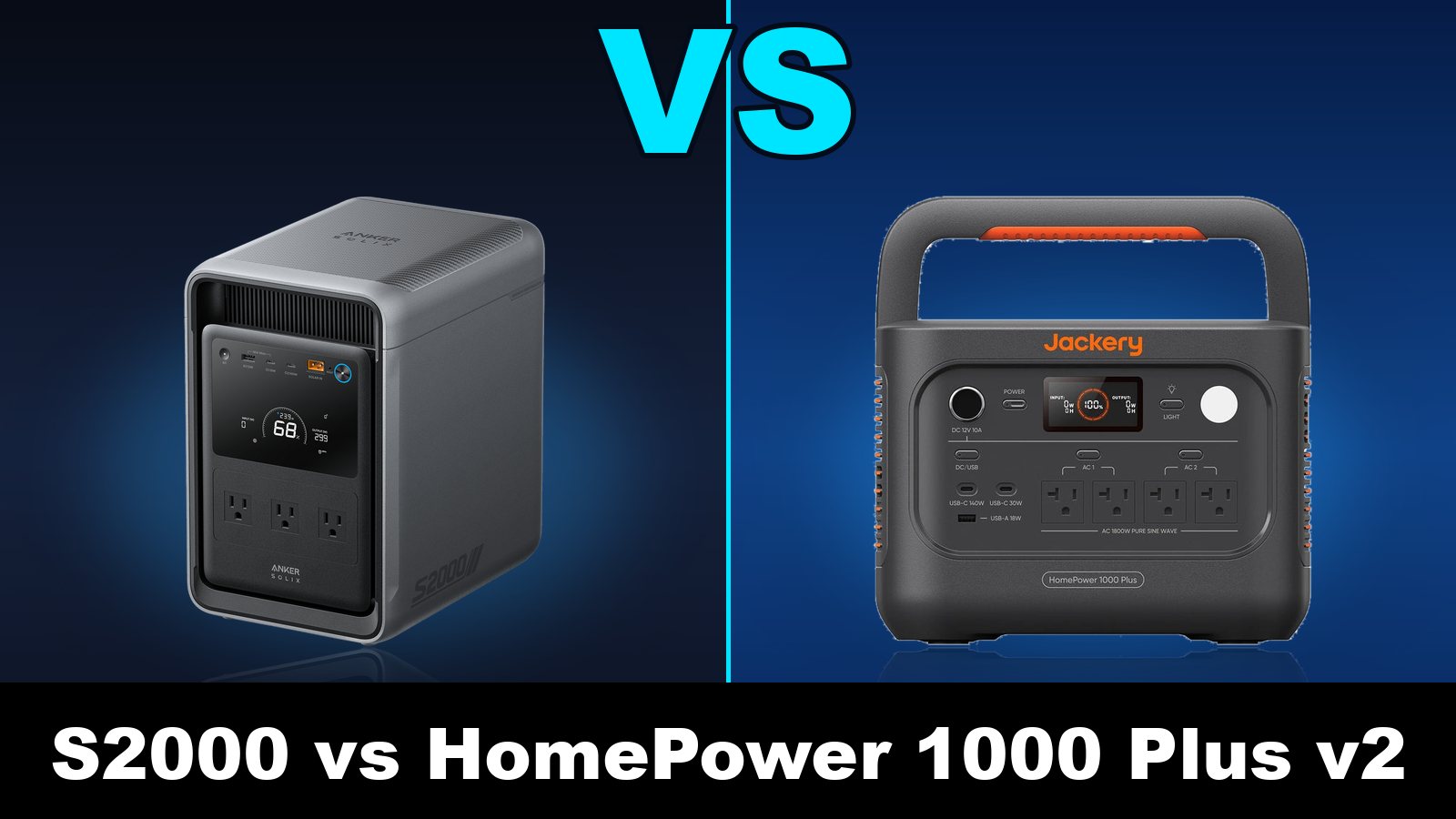

S2000
- you want 2,010Wh in one box
- your loads stay under 1,500W
- you want the lowest idle draw: 6W

HomePower 1000 Plus v2
- you’ll carry it: 23.8 lb
- you’ll grow it to 11kWh later
- you need 1,800W or a 12V port
Prices and stock checked by our price engine on November 5, 2026 at 9:30 AM EST. Each product is rechecked several times a day; the time refreshes when you load the page.
Twice the runtime today, or a smaller box that grows into a home battery.
The Anker SOLIX S2000 stores 2,010Wh and delivers 1,500W from five outlets, is rated for 6,000 cycles to 80% and quoted at 6W idle, but takes no extra battery, 400W of solar and has no 12V socket, at 35.7 lb. The Jackery HomePower 1000 Plus v2 stores 1,024Wh and delivers 1,800W from four outlets, has a 12V port, takes 400W of solar and up to five Battery Pack 2000 Plus v2 for about 11kWh, weighs 23.8 lb and is rated to charge from 14°F. Both switch to battery in 10ms. For the longest runtime from one box, the S2000; for a lighter unit with more power per outlet and a path to a bigger system, the HomePower.
Below: every difference with numbers, a 20-second calculator for your own gear, eight modeled situations, a 2kWh option with more power, and what published tests found on each.
Both switch to battery in 10ms, take 400W of solar and run from an app over Wi-Fi and Bluetooth; prices sit $19.01 apart today. The S2000 has nearly twice the battery and the lower idle draw. The HomePower 1000 Plus v2 has 300W more output, a 12V port, room for five extra packs, 11.9 lb less weight and charging from 14°F.
- you want 2kWh without extra packs
- a fridge must run a day and more
- you want 6,000 cycles to 80%
- you’ll add packs up to 11kWh
- you run 1,800W appliances
- it charges in the cold, from 14°F
The six differences that decide it
Both use LFP cells, switch to battery in 10ms, take 400W of solar between 11 or 16V and 60V, and connect to their brand’s app over Wi-Fi and Bluetooth. These six gaps decide it.
Will it run your setup? Check in 20 seconds
Estimates use 85% usable capacity and 70% of rated solar output. Real results vary with temperature, inverter load, shade and appliance cycling. Fridge and freezer watts are daily averages and do not include compressor startup surges.
Runtime by appliance, one at a time
Simple energy estimates, not measured runtimes: about 1,708Wh usable on the S2000 and 870Wh on the HomePower 1000 Plus v2, without extra batteries. Gizmodo ran a fridge 42 hours on an S2000 and about 22.5 hours on the HomePower.
Appliance for appliance, the S2000 lasts twice as long as the HomePower 1000 Plus v2.
Same appliance, same watts: the gap is always the size of the battery.Get our Black Friday alerts for power stations
We track live prices on 40+ models from Jackery, EcoFlow, BLUETTI and Anker SOLIX. When a deal beats the lowest price we've recorded, you'll hear from us. During Black Friday week, one short recap a day at most.
Unsubscribe in one click. We may earn a commission when you buy through our links, at no extra cost to you. Privacy Policy
The price gap, in numbers
The Anker SOLIX S2000 costs $19.01 less than the Jackery HomePower 1000 Plus v2 and still holds 986Wh more.
Prices refresh daily from Anker US and Jackery US.Per Wh, read the first card: one unit has nearly twice the battery of the other. Both are rated for 6,000 cycles, but Anker counts them to 80% of capacity and Jackery to 70%, so the S2000’s rating is the stricter one. The third card prices the HomePower once it matches and passes the S2000’s capacity with one extra pack.
The third option: the Anker SOLIX C2000 Gen 2 at $999.99

Anker SOLIX C2000 Gen 2: $999.99 today
If you want the S2000’s 2kWh class with more power than either: 2,048Wh and 2,400W from five 20A outlets plus a TT-30 for an RV, 800W of solar, a 12V socket, a 10ms switchover and one BP2000 Gen 2 for 4,096Wh, at 41.7 lb. It charges from 32°F, like the S2000. Pick it if your loads go past 1,800W. Our C2000 Gen 2 review goes deeper. See the C2000 Gen 2 at Anker.
Eight modeled situations, worked out
Same formula as the calculator above: 85% of the rated capacity, no extra battery unless stated.
24-hour outage, essentials only
The S2000 runs close to a full day; the HomePower 1000 Plus v2 an evening and a night. With one Battery Pack 2000 Plus v2 the HomePower passes a full day.
A full-size fridge, alone
About 28 hours on the S2000 and 14 on the HomePower by the formula. Gizmodo measured 42 hours on an S2000 and about 22.5 hours on the HomePower 1000 Plus v2, with different fridges.
A 1,700W space heater or kettle
The HomePower runs it within its 1,800W rating. Anker rates the S2000’s SurgePad mode at 2,600W for heating loads, not while it charges from the wall, but CleanTechnica found the S2000 can’t run electric heaters or cooktops; plan on the HomePower for this one.
A 12V fridge or car accessory
The HomePower 1000 Plus v2 has a 12V, 10A port. The S2000 has no 12V socket, so a car cooler runs from its AC adapter, with conversion losses.
Charging in a cold garage
Jackery rates the HomePower 1000 Plus v2 to charge and run from 14°F to 113°F. Anker rates the S2000 to charge from 32°F; it runs down to −4°F.
Refill from solar, each at its maximum
Same 400W ceiling, so the bigger battery takes twice the sun: more than a full day on the S2000, about half a day on the HomePower. Android Authority saw the S2000 reach 80% in 4.5 hours on solar.
Refill from the wall before a storm
Same 1,600W fastest input on both, so the smaller battery fills sooner. Both need a fast mode: UltraFast on the S2000, Emergency Charging in the Jackery app; Gizmodo saw about 1,060W until he switched it on.
Carrying it
The HomePower 1000 Plus v2 is a one-hand carry; CleanTechnica found its handle sturdy and fairly comfortable. The S2000 is a compact tower at 35.7 lb with a single handle.
Ten more differences, the spec sheet and the box
Smaller gaps that rarely decide the purchase, then the full specifications and what ships in the box.
S2000 and HomePower 1000 Plus v2 weight, dimensions and full specifications
Weight: 35.7 lb for the S2000 and 23.8 lb for the HomePower 1000 Plus v2. Dimensions: 8.2 × 11.1 × 12.7 in and 12.4 × 7.9 × 9.2 in. Everything else is in the sheet below.
Anker SOLIX S2000 and Jackery HomePower 1000 Plus v2 full specifications
Every published figure for both units, grouped. Green marks the better value.
What’s in the box
S2000
- S2000 power station2,010Wh, 35.7 lb
- AC charging cable
- User guide
- Solar cable sold separatelyPV to XT60i, per the manual
HomePower 1000 Plus v2
- HomePower 1000 Plus v21,024Wh, 23.8 lb
- AC charging cable
- Documents
- Car charging cable sold separatelyper the manual
From the Anker and Jackery US pages and manuals; neither brand includes a solar cable, and Jackery sells the car charging cable separately.
07 · ChargingHow fast each one refills
Shorter bar, faster refill. Each row is scaled to its slower unit.
S2000: ESS News measured about 1.2 hours to 80% and 1.7 hours to full from a 20A household circuitHomePower 1000 Plus v2: Gizmodo measured about 1,060W from the wall until Emergency Charging raised it to 1,600W
Our solar times assume panels deliver 70% of their rating; the brands’ figures assume ideal sun.
Every port, side by side
S2000
HomePower 1000 Plus v2
Practical consequence: the S2000 has five household outlets, three on the front and two on the back, two USB-C, one USB-A and no 12V socket. The HomePower 1000 Plus v2 has four household outlets on two buttons, so one pair can shut off at a battery level you choose, two USB-C, one USB-A and a 12V port.
09 · NoiseNoise: S2000 vs HomePower 1000 Plus v2
Both are rated near 30dB. Reviewers found the Anker SOLIX S2000 loud only under load or fast charging, and the Jackery HomePower 1000 Plus v2‘s fan loud while it charged and powered a load at once.
Brand figures give no distance; no reviewer published a dB reading for either.Every figure we found, with its source
What reviewers heard: Fans run only under load or fast charging (ESS News); UltraFast charging uncomfortably loud (Android Authority).
What reviewers heard: The fan spun up loudly when it charged and powered a load at once in UPS use, and stayed quiet otherwise (Gizmodo).
Measured by a tester Brand figure
- Overnight, skip the fast modes: Quiet Charging on the Jackery, standard charging on the Anker.
Cold and heat: S2000 vs HomePower 1000 Plus v2
The Jackery HomePower 1000 Plus v2 charges and runs from 14°F to 113°F. The Anker SOLIX S2000 charges from 32°F to 104°F and runs from −4°F to 104°F.
Figures from Anker US and Jackery US, with their US manuals.- Charge the S2000 indoors in winter: it doesn’t charge below 32°F.
- Jackery’s manual asks you to store the HomePower between 32°F and 77°F beyond three months.
App, UPS and smart features
Both switch in 10ms. The Anker SOLIX S2000 adds Storm Guard; the Jackery HomePower 1000 Plus v2 adds Smart Load Prioritization and room for five extra packs.
Both apps work over Wi-Fi and Bluetooth.Green zone: a switch under about 16ms, which most desktop PCs ride through without restarting.
Can you add a battery later? The Anker SOLIX S2000 takes no extra battery. The Jackery HomePower 1000 Plus v2 takes up to five Battery Pack 2000 Plus v2, and not the older Jackery packs.
Does it top up before a storm? Anker lists Storm Guard on the Anker SOLIX S2000, available over Wi-Fi. Jackery lists no storm mode for the HomePower 1000 Plus v2, and Gizmodo found no equivalent.
Can it shed outlets automatically? On the Jackery HomePower 1000 Plus v2, two buttons each control a pair of outlets, and the app can shut the non-essential pair off at a battery level you set.
Does it work as a UPS? Both switch to battery in 10ms per their brands. Gizmodo saw no interruption on a TV when he unplugged the Jackery HomePower 1000 Plus v2 from the wall.
Can it charge off-peak? Both have a time-of-use mode. Jackery keeps 60% of the HomePower 1000 Plus v2 in reserve by default, per its manual; the S2000’s needs Wi-Fi, per Anker’s FAQ.
Warranty and support
The Anker SOLIX S2000 gets 5 years from Anker. The Jackery HomePower 1000 Plus v2 gets 3 years plus 2: automatic for Jackery.com purchases per its page, after registration per its manual.
Same 6,000 cycles, counted to 80% on the S2000 and to 70% on the HomePower.Subject to each brand’s warranty terms and eligibility.
Anker rates the S2000 at 6,000 cycles to 80% capacity, and 10,000 to 60%; Jackery rates the HomePower 1000 Plus v2 at 6,000 cycles to 70%. Calendar aging and heat also reduce capacity, so read both as ceilings.
- On the HomePower, register it with Jackery if you didn’t buy it on Jackery.com, and charge it fully within 7 days of purchase and at least every 6 months to keep the cell coverage.
- Keep proof of purchase for the S2000’s 5-year coverage.
What reviewers report
We have not lab-tested these two units. Here is what 6 published reviews found, with the source, author and date for each point. Reviews of UK and EU units are flagged: those models charge from 230V outlets and have different sockets, so their charge times and outlet findings don’t carry over to US units.
S2000: ESS News (May 2026), Android Authority (June 2026), CleanTechnica (June 2026), Gizmodo (July 2026), all US unitsHomePower 1000 Plus v2: Gizmodo (October 2026), CleanTechnica (August 2026)
Usable capacity
- S2000Reviewer Kept a refrigerator going for 42 hours before the battery reached 5%. Gizmodo, Wes Davis, July 2026
- S2000Reviewer Just over 60 hours on a fridge, with a kettle used three times and a microwave once. Android Authority, Edgar Cervantes, June 2026
- HomePower 1000 Plus v2Reviewer With only the inverter on and no load, it lost 14% of its charge in 24 hours, about 10W of idle draw. Gizmodo, Wes Davis, October 2026
Charging
- S2000Reviewer About 1.2 hours to 80% and 1.7 hours to full from a 20A household circuit. ESS News, Andrew Riha, May 2026
- S2000Reviewer About 1.7 hours from 10% to full in UltraFast mode; 80% in 4.5 hours from a 400W panel in ideal sun. Android Authority, June 2026
- HomePower 1000 Plus v2Reviewer Wall charging held at about 1,060W until Emergency Charging was turned on in the app, which raised it to 1,600W. Gizmodo, Wes Davis, October 2026
Noise and heat
- HomePower 1000 Plus v2Reviewer The fan spun up loudly when charging and discharging at once in UPS use; it stayed quiet otherwise. Gizmodo, Wes Davis, October 2026
UPS and output
- S2000Reviewer Dropped only to 99% after 10 hours on standby with AC on, about 2W. ESS News, May 2026
- S2000Reviewer A 600 to 700W window air conditioner most likely never started its compressor. Gizmodo, July 2026
- S2000Reviewer Can’t run electric heaters, cooktops or double induction burners; ran a fridge, lights, internet and a phone charger at once. CleanTechnica, Kyle Field, June 2026
- HomePower 1000 Plus v2Reviewer His household fridge ran about 22.5 hours before the battery reached 3%. Gizmodo, Wes Davis, October 2026
- HomePower 1000 Plus v2Reviewer A hair dryer plus a space heater at 2,070W ran about a minute before the AC output shut off. Gizmodo, Wes Davis, October 2026
- HomePower 1000 Plus v2Reviewer Unplugging it from the wall while gaming on a TV caused no visible interruption. Gizmodo, Wes Davis, October 2026
- HomePower 1000 Plus v2Reviewer Notes that 1,800W lets it handle about any load a 120V 15A breaker can carry, not a whole home. CleanTechnica, Larry Evans, August 2026
Daily use and issues
- S2000Reviewer Cons: only three USB ports and no handle that makes it truly portable. Android Authority, June 2026
- S2000Reviewer Cons: 400W solar input is modest, no TT-30 RV plug, and a second handle would help. ESS News, May 2026
- HomePower 1000 Plus v2Reviewer Found the handle sturdy and fairly comfortable, and suggested a shoulder strap or backpack for carrying it further. CleanTechnica, Larry Evans, August 2026
Practical limits before you buy
- The S2000 stops at 1,500W. A microwave and a coffee maker together overload it, and Gizmodo’s window AC most likely never started its compressor.
- The S2000 can’t be expanded and has no 12V socket.
- The HomePower 1000 Plus v2 stops at 1,800W; Gizmodo saw its AC output shut off after about a minute at 2,070W.
- Both need a fast mode for the quickest wall refill: UltraFast on the S2000, Emergency Charging in the Jackery app.
- The S2000 doesn’t charge below 32°F or above 104°F. Keep it out of a freezing or very hot garage while it charges.
- Neither ships with a solar cable, and Jackery sells the HomePower’s car charging cable separately.
- HomePower 1000 Plus v2, per its US documentation: Expands only with the Battery Pack 2000 Plus v2 (up to five, 11kWh); not compatible with the Battery Pack 2000 Plus or 1000 Plus.
- HomePower 1000 Plus v2, per its US documentation: Solar input 400W max over two DC8020 ports, 16-60V; same panels on both ports; do not charge from car and solar at once.
- HomePower 1000 Plus v2, per its US documentation: Charging and discharging temperature 14°F to 113°F; storage beyond 3 months at 32°F to 77°F.
- HomePower 1000 Plus v2, per its US documentation: Car charging cable not included; 12V vehicles only. DC 12V output port 10A (car battery charging cable sold separately).
Frequently asked questions
What is the difference between the Anker S2000 and the Jackery HomePower 1000 Plus v2?
The S2000 stores 2,010Wh and delivers 1,500W from five outlets, rated for 6,000 cycles to 80%, with no battery port or 12V socket, at 35.7 lb. The HomePower 1000 Plus v2 stores 1,024Wh and delivers 1,800W from four outlets, has a 12V port and takes up to five 2kWh packs, at 23.8 lb. Both switch in 10ms and take 400W of solar.
Which is cheaper?
The Anker SOLIX S2000 costs $19.01 less today: $729.99, against $749 for the Jackery HomePower 1000 Plus v2. Prices refresh daily; the price section above has the full breakdown.
Which lasts longer in an outage?
Out of the box, the S2000: nearly twice the battery and a 6W idle draw. With one Battery Pack 2000 Plus v2 the HomePower reaches 3,072Wh, and up to about 11kWh with five.
Can either run a microwave?
Yes, a typical 1,100W microwave runs on both. A microwave and a coffee maker together overload both.
Which charges in the cold?
The HomePower 1000 Plus v2, from 14°F per Jackery. The S2000 charges from 32°F, though it runs down to −4°F.
Do they work as a UPS?
Both switch to battery in 10ms per their brands, fast enough for most desktop PCs and routers. Gizmodo saw no interruption on a TV when he pulled the HomePower’s wall plug.
Can I add a battery to the S2000?
No, it has no battery port. The HomePower 1000 Plus v2 takes up to five Battery Pack 2000 Plus v2.
How much do they weigh?
35.7 lb for the S2000 and 23.8 lb for the HomePower 1000 Plus v2.
Related comparisons and reviews
How we compared and sources
Research-based comparison. We have not lab-tested these units. Specs come from Anker’s US page and user guide for the S2000 and Jackery’s US page, tech specs and user manual for the HomePower 1000 Plus v2; usage observations are attributed to named reviewers. Prices and availability were checked on October 31, 2026.
- Specs: Anker US, S2000 and its US user guide (AS220); Jackery US, HomePower 1000 Plus v2, its tech specs and its US user manual (JHP-1000B), read on October 31, 2026.
- Jackery’s US manual for this model is titled HomePower 1000 Plus; the model number JHP-1000B and every figure match the v2 product page. The HomePower price is the black unit alone; the white unit and the bundle with an AC extension cable are listed at other prices. Our own S2000 review is offline, so we link the C2000 Gen 2 review instead.
- Reviewer reports on the HomePower 1000 Plus v2: Gizmodo, Wes Davis, October 2026, CleanTechnica, Larry Evans, August 2026.
- Reviewer reports on the S2000 (US units): ESS News (Andrew Riha, May 2026), Android Authority (Edgar Cervantes, June 2026), CleanTechnica (Kyle Field, June 2026) and Gizmodo (Wes Davis, July 2026).
- Runtime = capacity × 0.85 ÷ watts. Solar harvest = min(panel watts, max input) × sun hours × 0.70. Cost per lifetime kWh = price ÷ (cycles × capacity in kWh).
2,010Wh and 6W idle in one fixed box, or 1,024Wh, 1,800W and a 12V port at 23.8 lb that grows to 11kWh. Both switch in 10ms.
Prices checked November 5, 2026 at 9:30 AM EST
Looking at other models? Browse all power station comparisons, or pick any two models on the hub and we point you to the right duel.
Originally published: November 3, 2026