
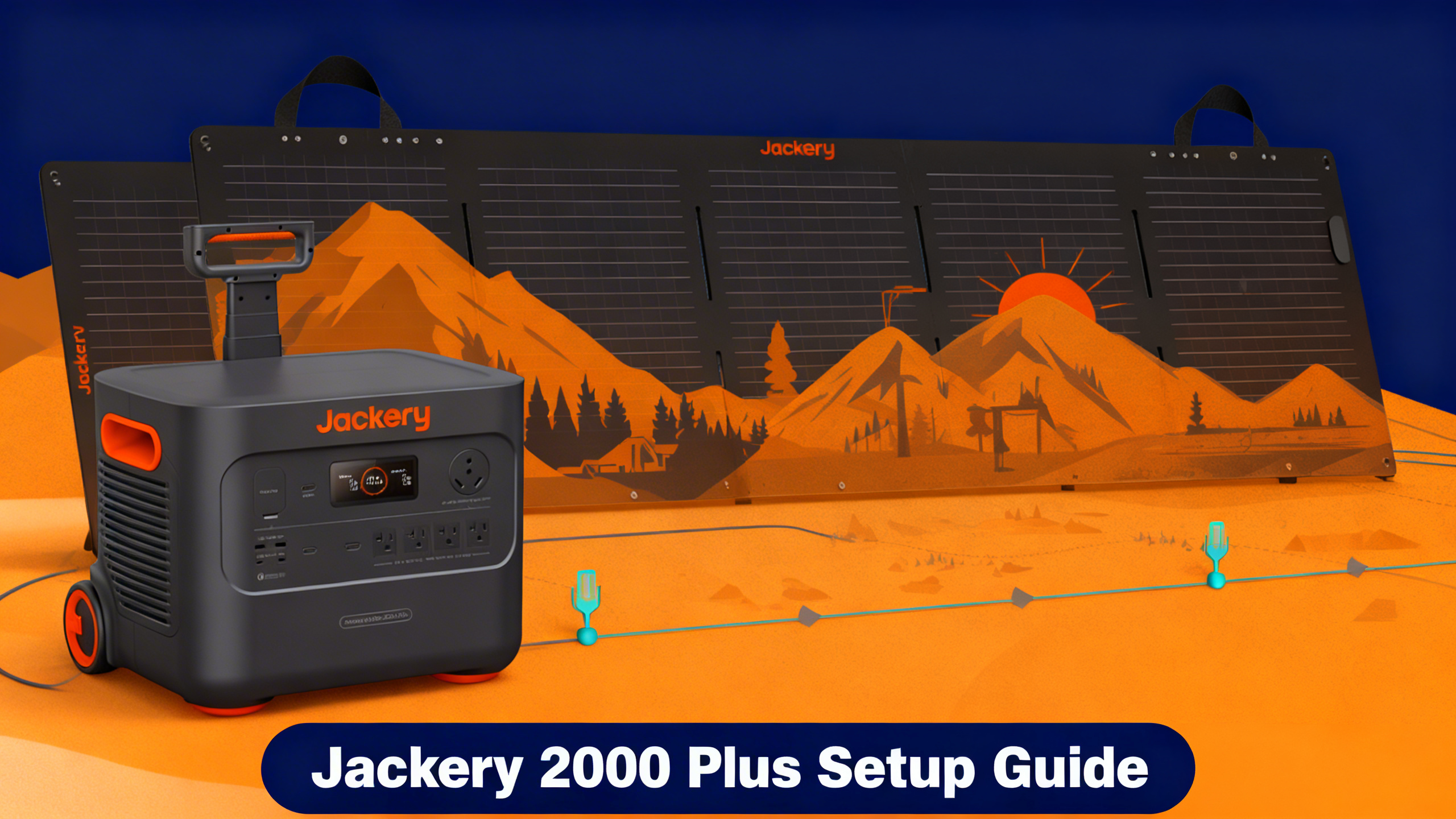
The Jackery Explorer 2000 Plus doesn’t fit the standard portable power station mold. Most units ship with a fixed capacity and that’s what you get forever. The 2000 Plus is built differently: it starts at 2,042.8Wh and scales all the way to 24kWh by stacking Battery Pack modules. Understanding how that expansion actually works, physically and electrically, is the key to getting the most out of this system.
This guide breaks down the architecture of the expandable system, walks through the connection process step by step, explains what the BMS is actually doing, and helps you decide which capacity tier makes sense for your situation.

Jackery Explorer 2000 Plus
$899 $1,399 -36% OFF
- 2,042.8Wh LFP base capacity
- Expandable 2kWh to 24kWh with battery packs
- 6,000W max output in parallel
- IBC solar charge: full in 2 hrs (6x 200W panels)
Get our Black Friday alerts for Jackery
We track live prices on 40+ models from Jackery, EcoFlow, BLUETTI and Anker SOLIX. When a deal beats the lowest price we've recorded, you'll hear from us. During Black Friday week, one short recap a day at most.
Unsubscribe in one click. We may earn a commission when you buy through our links, at no extra cost to you. Privacy Policy
What Is the Jackery 2000 Plus Expandable System?
At its core, the system pairs the Explorer 2000 Plus base unit with one or more Battery Pack 2000 Plus modules. The Explorer 2000 Plus base station is a 2,042.8Wh LFP unit that ships ready to expand. It houses the inverter, the primary BMS, the MPPT solar controller, and all output ports. Think of it as the control center.
The Battery Packs are pure energy storage. Each one adds 2,042.8Wh to the system with its own integrated BMS, and they connect via a dedicated expansion port, not a standard cable. The base unit recognizes the packs automatically and recalculates total capacity on its display.
The analogy that makes this click: picture building a power wall block by block, each block pre-wired and plug-and-play. You don’t need to configure anything. You connect, power on, and the system handles the rest. The practical implication is that you don’t need to buy 12kWh on day one. You buy what you need now and expand when your needs or budget change.
This guide covers the expansion mechanics, solar integration, capacity tiers, and real-world use cases. By the end, you’ll have a clear picture of how the system works and which configuration fits your situation.
Why Expandable Capacity Matters for Portable Power Users
The Cost of Buying More Capacity Than You Need
A fixed 5kWh system costs roughly $3,000 to $5,000 depending on the brand. If your actual usage is 2kWh per day, you’ve locked up capital in capacity that sits idle. The expandable model flips this: the 2000 Plus base unit at $899 gives you 2kWh and a clear upgrade path. You scale when the need is real, not speculative.
Real-World Impact: Scaling From Weekend Trips to Whole-Home Backup
Consider a van build. At the start, 2kWh covers a mini-fridge (28 hrs), a laptop (34 hrs), and phone charging with room to spare. A year later, you add a rooftop air conditioner and a second refrigerator. Instead of replacing the unit, you add a Battery Pack 2000 Plus ($899) and double your capacity to 4kWh. Two years later, you’re full-timing and need 8kWh: two more packs, same base unit, no rewiring.
The same logic applies to home backup. A 2kWh base covers refrigerator, lights, and device charging through a 24-hour outage. Add one pack and you’re at 4kWh, covering two nights without solar. The system grows with your risk tolerance and budget, not the reverse.
The Problem With Fixed-Capacity Systems
Fixed systems leave two bad options when your needs change: buy a second unit (expensive, redundant) or sell the old one at a loss and upgrade. The 2000 Plus ecosystem avoids this entirely. The base unit never becomes obsolete because the battery packs are modular. That’s a meaningful long-term cost advantage for anyone whose power requirements are likely to evolve.
What Can the 2000 Plus System Power? (Base 2kWh)
❄️
Mini Fridge
~28 hrs
60W avg draw
💻
Laptop
~34 hrs
45W draw
📺
55″ Smart TV
~17 hrs
100W draw
🌀
CPAP Machine
~50 hrs
30W w/o heat
🏠
Full Fridge
~14 hrs
120W avg draw
Runtime estimates based on 2,042.8Wh capacity at 85% inverter efficiency. Actual results vary with load and temperature.
Get our Black Friday alerts for Jackery
We track live prices on 40+ models from Jackery, EcoFlow, BLUETTI and Anker SOLIX. When a deal beats the lowest price we've recorded, you'll hear from us. During Black Friday week, one short recap a day at most.
Unsubscribe in one click. We may earn a commission when you buy through our links, at no extra cost to you. Privacy Policy
The Battery Pack 2000 Plus: Your Expansion Module
Each Battery Pack 2000 Plus adds exactly 2,042.8Wh to the system, and up to five packs can connect simultaneously to a single base unit. The pack runs LiFePO4 (LFP) chemistry, the same as the base unit, which matters for long-term cycle life and temperature stability.

Core Specifications
How Many Packs Can You Connect?
The capacity math is straightforward: each pack adds 2,042.8Wh to the base unit’s 2,042.8Wh. One pack brings you to approximately 4kWh. Two packs: 6kWh. Three: 8kWh. Four: 10kWh. Five: 12kWh, which is the single-base maximum.
For the 24kWh ceiling, the system requires two Explorer 2000 Plus base units connected in parallel, each loaded with five battery packs. That’s a configuration suited to off-grid cabins or whole-home backup scenarios where you need multi-day autonomy. For most van builds and home backup use cases, the 4kWh to 8kWh range covers realistic needs without the cost of a dual-base setup.
Required Expansion Module
Jackery Battery Pack 2000 Plus
2,042.8Wh per pack, up to 5 packs for 24kWh total
$899 $1,399
The Science Behind the System: How Expansion Actually Works
The Core Components
Let’s break down how the expansion architecture actually works. The Explorer 2000 Plus base unit contains three critical systems: a 6,000W inverter (in parallel configuration), a primary BMS that serves as the system controller, and an IBC MPPT solar charge controller. These components manage all energy flow in and out of the system.
The Battery Pack 2000 Plus contains LFP cells, its own 12-layer BMS, and a bidirectional communication port. That communication link is what separates this from a simple parallel battery connection. The packs and the base unit actively exchange data: state of charge, temperature, voltage balance, and charge/discharge rates. The base unit’s BMS uses this data to manage the entire system as a unified array rather than independent units.
The expansion cable carries both power and communication signals. It’s not a dumb power cable, it’s a data link that lets the base unit see and control every connected pack.
Step-by-Step: Connecting a Battery Pack
The connection process is designed to be straightforward. No tools, no configuration, no firmware updates required.
- Power down the base unit completely before making any expansion connections. This is the one step people skip. The BMS initialization sequence happens at power-on, and it needs to detect all connected modules at startup.
- Connect the expansion cable to the dedicated expansion port on the Explorer 2000 Plus. The port is labeled and located on the side panel, distinct from all output ports.
- Connect the other end to the Battery Pack 2000 Plus expansion port. The connectors are keyed, so incorrect insertion isn’t possible.
- Power on the base unit. The display updates automatically to show the combined capacity. You’ll know it’s working when the Wh reading reflects the sum of all connected modules.
- Begin charging normally. AC wall charging or solar charging now distributes across all connected modules simultaneously. You don’t need to charge packs separately.
⚠️ Common Mistake: Connecting or disconnecting battery packs while the base unit is powered on. Always power down first. Hot-swapping is not supported and can trigger BMS protection faults that require a full restart to clear.
Jackery 2000 Plus: Capacity Expansion Tiers
2kWh
Base Unit Only
1x Explorer 2000 Plus
$899
4kWh
+1 Battery Pack
Base + 1x Pack 2000 Plus
$1,798
6kWh
+2 Battery Packs
Base + 2x Pack 2000 Plus
$2,697
12kWh
+5 Battery Packs
Base + 5x Pack 2000 Plus
$5,394
*Max configuration: 2 base units in parallel + 5 packs each = 24kWh total
The 12-Layer BMS: What It Protects Against
The Battery Pack’s BMS monitors and protects against 12 distinct failure conditions: over-voltage, under-voltage, over-current, short circuit, over-temperature, under-temperature, cell imbalance, state-of-charge deviation, communication protocol errors, reverse polarity, humidity ingress, and mechanical shock. This isn’t just a safety feature; it’s what enables the system to balance charge and discharge evenly across multiple modules of potentially different ages and states of charge.
In practical terms: if you add a new battery pack to a system that already has one partially depleted pack, the BMS manages the charge redistribution automatically. You don’t need to manually equalize anything. For more technical background on how battery storage technology works at a system level, the U.S. Department of Energy provides a solid primer.
Solar Charging the Expandable System
The IBC technology at the heart of Jackery solar charging lets this system reach full charge in approximately 2 hours under optimal conditions, which is exceptional for a 2kWh unit. IBC panels (Interdigitated Back Contact) achieve approximately 25% efficiency, compared to 20% for standard polycrystalline panels. That efficiency gap translates directly into faster charging with fewer panels.
IBC Technology: What Makes It Fast
Six SolarSaga 200W panels connected to the 2000 Plus deliver 1,200W of solar input. At that input rate and the 2,042.8Wh base capacity, a full charge in 2 hours is realistic in direct sunlight. Add one Battery Pack (4kWh total) and the same panel array takes approximately 4 hours. Scale to 6kWh with two packs and you’re looking at roughly 6 hours, assuming consistent full sun.
The key spec to understand here is solar input voltage. The 2000 Plus accepts a specific voltage range via its MPPT controller, and panel wiring configuration (series vs. parallel) affects whether you stay within that range. For panel angle optimization, cloudy-day performance, and SolarSaga wiring configurations, the dedicated solar charging guide covers those specifics in full detail.


Wiring Configuration for Maximum Solar Input
For the SolarSaga 200W panels, series wiring increases voltage while parallel wiring increases current. The MPPT controller on the 2000 Plus operates within specific voltage bounds, so the correct configuration depends on how many panels you’re connecting. The official product specifications confirm the solar input parameters, and it’s worth checking those before wiring more than 3 panels together.
💡 Pro Tip: When charging a multi-pack system with solar, the BMS distributes incoming solar current across all connected modules simultaneously. You don’t need to charge packs individually or sequence the charging. One solar input connection to the base unit handles the entire array.
Capacity Tiers: Choosing Your System Size
The right configuration depends on your daily energy draw, how long you need to run without recharging, and your budget. Here’s a practical breakdown:

For a deeper look at appliance loads and runtime needs, the home backup power planning guide walks through wattage calculations for every room.
Jackery Explorer 2000 Plus Review
Full analysis of the base station: specs, performance data, and who it’s for.
Real-World Use Cases: Who Needs This System?
The expandable architecture fits a specific profile: someone whose power needs are either uncertain or likely to grow. If you know you’ll always need exactly 2kWh and nothing more, a fixed-capacity unit at the same price point is a cleaner choice. But if your needs are evolving, the 2000 Plus system makes more financial sense over time.
For van life and RV builds, the phased approach is particularly practical. Start with 2kWh at $899, which handles a mini-fridge, lighting, device charging, and a laptop for multi-day trips. When you install a roof-mounted air conditioner or add a second occupant, you add one pack and double your reserves without touching the wiring or inverter setup.

For home backup, the 2kWh base unit covers refrigerator, lights, phone charging, and a router continuously for about 14 to 28 hours depending on the specific loads. That handles most short outages. Add one pack to reach 4kWh and you’re covered for a 24 to 48-hour outage with the same loads. With daily solar replenishment via 6 SolarSaga 200W panels, a 4kWh to 6kWh configuration can sustain essential circuits indefinitely through most weather patterns.
For off-grid cabins, the maximum 12kWh to 24kWh configurations become relevant. A well-insulated cabin with efficient appliances typically draws 3 to 5kWh per day. A 12kWh system paired with 1,200W of solar input covers 2 to 3 cloudy days without recharging, which handles most weather events in most climates.
Invest in this system if…
- You need more than 2kWh today but want room to grow
- Your power needs will increase (family, new appliances, EV)
- You’re building a van or RV off-grid setup incrementally
- You want whole-home backup eventually at a lower upfront cost
- Solar is part of your setup (IBC tech charges both base + packs)
Skip if…
- You only need occasional camping power under 500Wh
- Budget is under $500 (look at the 300v2 or 500v2 instead)
- You need a ruggedized outdoor unit (look at the 1500 Ultra)
- Your use case is purely stationary home backup at maximum scale
Frequently Asked Questions
How many Battery Pack 2000 Plus units can I connect to one Explorer 2000 Plus?
Spec analysis confirms the Explorer 2000 Plus supports up to 5 Battery Pack 2000 Plus modules per base unit. That brings the total capacity of one base unit configuration to approximately 12kWh (2,042.8Wh base + 5 x 2,042.8Wh). For the maximum 24kWh configuration, two base units are connected in parallel, each with 5 battery packs.
Can I charge the Battery Pack 2000 Plus separately, without the base unit?
Performance data indicates the Battery Pack 2000 Plus supports direct solar charging. Published specifications confirm it can be charged via 6 SolarSaga 200W panels in approximately 2 hours independently. This means the battery pack itself has an integrated MPPT controller, allowing it to charge while the base unit is in use or disconnected.
Is the Battery Pack 2000 Plus compatible with the Explorer 1000 Plus or other Jackery models?
Published compatibility data confirms the Battery Pack 2000 Plus is exclusively compatible with the Jackery Explorer 2000 Plus. The expansion port and BMS communication protocol are specific to the 2000 Plus ecosystem. The Explorer 1000 Plus uses a different expansion module (Battery Pack 1000 Plus), which is not cross-compatible.
Does expanding the system affect the output wattage?
Capacity data confirms that adding battery packs increases available energy storage (kWh) without changing the inverter output rating of the base unit. The Explorer 2000 Plus outputs a maximum of 6,000W in parallel configuration regardless of how many battery packs are connected. Battery packs add runtime, not wattage.
How long does it take to charge the full system (base + 1 pack) from AC wall power?
Published data indicates the system manages AC charging across connected modules simultaneously via the BMS. Charge time is not simply additive across modules. For precise total system charge times at varying configurations, the Jackery product page and manual provide tier-specific data.
Can the Jackery 2000 Plus expandable system power a whole home?
Analysis of published capacity tiers shows the maximum 24kWh configuration (two base units + 10 battery packs) can support a typical American home for 1 to 2 days depending on load. A standard home consumes 30 to 50 kWh per day on average. For continuous whole-home coverage, pairing the system with 6 to 12 SolarSaga 200W panels enables daily solar replenishment. The system is best characterized as extended-duration home backup rather than permanent whole-home replacement.
Final Verdict: Is the 2000 Plus Expandable System Worth It?
The data points to a clear conclusion: the Jackery 2000 Plus expandable system offers the best progression-per-dollar ratio in the LFP portable power market under $1,000 for the base unit. The LFP chemistry delivers a 10-year lifespan, the IBC solar charging cuts recharge time to 2 hours at base capacity, and the modular architecture means your initial investment scales with your needs rather than becoming obsolete.
This system is for users who are building toward a larger capacity goal incrementally, whether that’s a van build, a home backup setup, or an off-grid cabin. It’s not the right fit if your needs are fixed and modest. For anyone planning to grow their off-grid or backup capacity over time, the 2000 Plus system is the most cost-efficient path to get there. For a broader look at planning multi-stage off-grid builds, our guide on expansion strategies for off-grid systems covers cross-brand options and long-term planning.
For a complete look at the base unit on its own merits, the Explorer 2000 Plus review covers specs, performance data, and head-to-head comparisons in full.
Jackery Explorer 2000 Plus
$899
Best expandable power system under $1,000
Price verified April 2026. Free shipping on orders $100+
Originally published: April 15, 2026