
You’ve built your off-grid solar system, sized the panels, picked your battery bank. Then comes a five-day stretch of dense overcast in February, and your battery monitor reads 12%. This is the moment every off-grid owner faces eventually, and it is the reason a single-source system, no matter how well sized, is never enough.
For a complete overview of system sizing and solar components, start with our off-grid solar power systems guide before layering in the backup strategies below. This article focuses on what happens when solar alone falls short, and how to build a redundant power architecture that keeps your home running through any weather pattern, season, or unexpected demand spike.
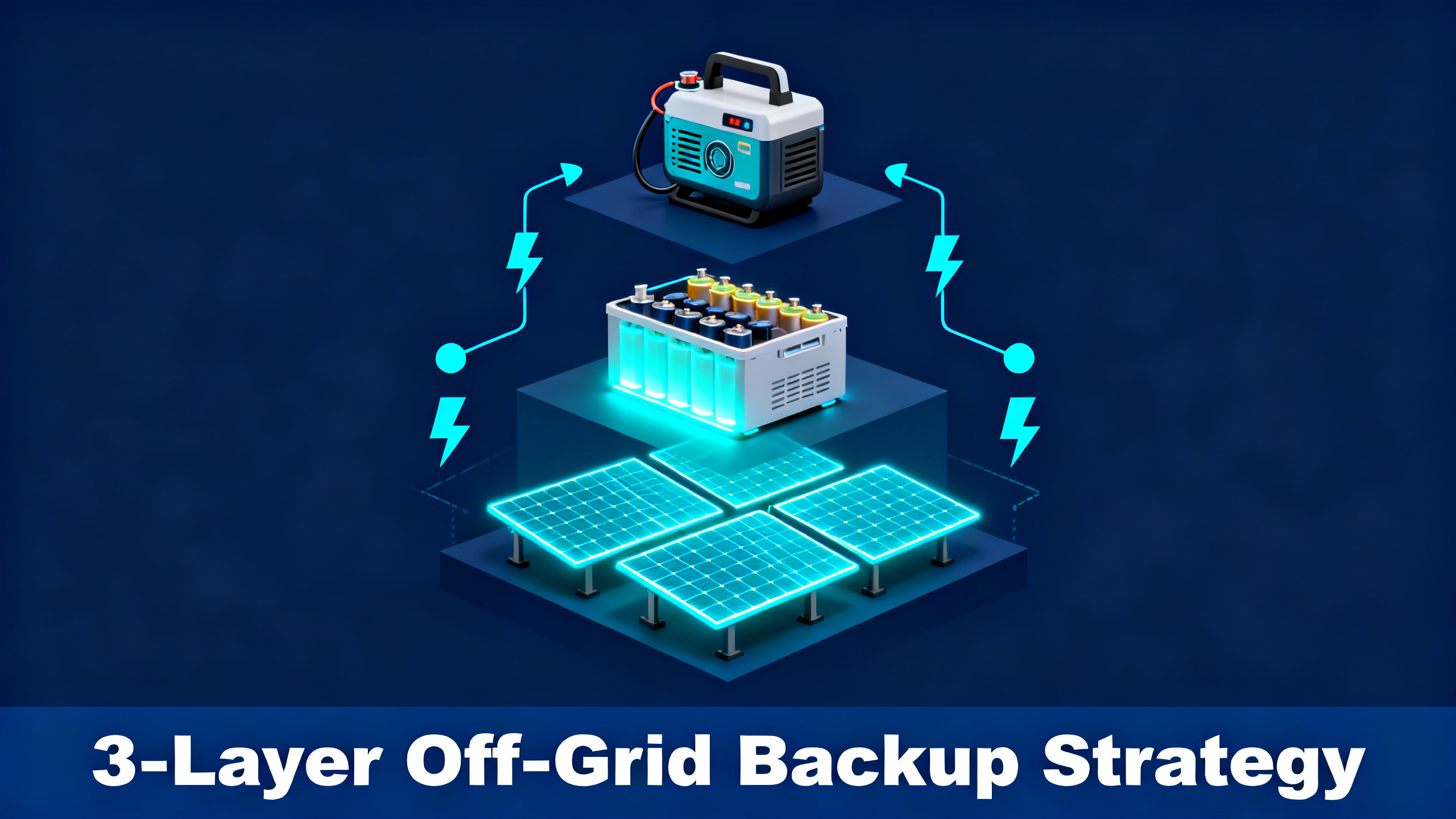
The framework that defines reliable off-grid living comes down to three layers: solar as the foundation, a generator as the bridge, and either vehicle alternator charging or shore power as the safety net. Each layer activates under different conditions, and a properly designed system uses all three.
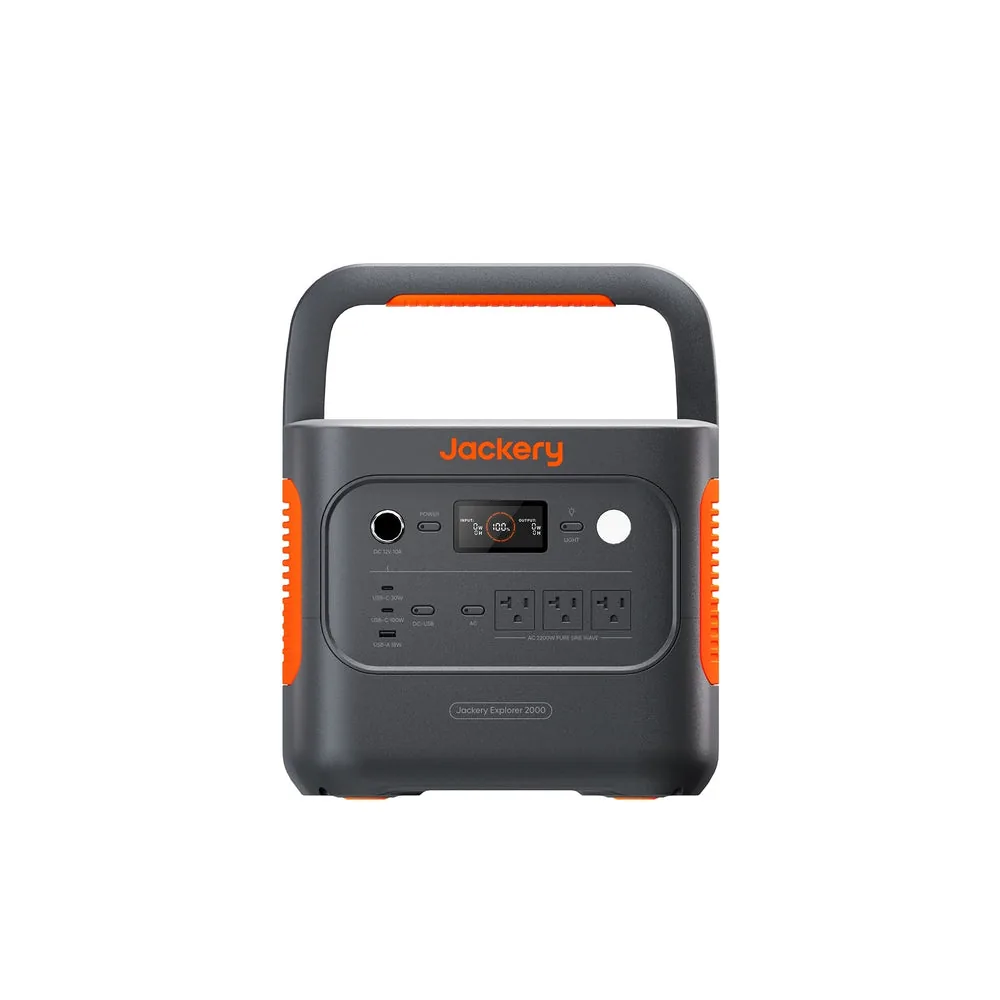
Jackery Explorer 2000 v2
$799 $1,499
- 2042Wh LiFePO4, charges in 1.7 hours via AC
- 2200W output, 20ms switchover, generator-compatible
- ~95% charge retention after 12 months storage
THE 3-LAYER BACKUP STRATEGY FOR OFF-GRID SOLAR
☀️
Layer 1, Primary
Solar
Main power source. Generates daily and charges battery bank. Zero fuel cost.
⛽
Layer 2, Secondary
Generator
Activates when solar falls short: cloudy stretches, winter, high-demand days.
🚗
Layer 3, Emergency
Vehicle / Shore
Last resort: alternator charging during travel, or shore power on visits to town.
A properly designed off-grid system never relies on a single source.
Get our Black Friday alerts for power stations
We track live prices on 40+ models from Jackery, EcoFlow, BLUETTI and Anker SOLIX. When a deal beats the lowest price we've recorded, you'll hear from us. During Black Friday week, one short recap a day at most.
Unsubscribe in one click. We may earn a commission when you buy through our links, at no extra cost to you. Privacy Policy
Why Off-Grid Systems Need a Backup Plan
The Problem: Solar Has a Predictable Weakness
Solar production is seasonal, weather-dependent, and finite. A 4kW array that produces 25kWh on a clear July day will deliver 8kWh or less on an overcast December day at the same latitude. Real-world data from owner-installed systems consistently shows winter production drops of 60% to 75% compared to summer peaks, even before factoring in snow cover or atmospheric haze.
Understanding solar production in winter months is essential before sizing your generator backup, because the gap between production and consumption widens dramatically in December and January. Battery storage masks the daily variation, but it cannot overcome a multi-day deficit. Once your bank cycles below 30% state of charge for several days, lithium iron phosphate cells begin operating outside their optimal range, reducing both runtime and long-term cycle life.
What Happens When Your Battery Bank Hits Zero
When an off-grid battery bank fully depletes, three cascading consequences follow. First, the inverter shuts down, taking all AC loads offline (lights, refrigeration, well pumps, internet). Second, the BMS locks the battery into protection mode, often requiring a manual reset before recharging can begin. Third, even after recharging starts, deep discharge events accumulate damage that shortens overall battery lifespan, particularly on older lithium-ion chemistries.
Per the U.S. Department of Energy backup power guidelines, redundancy is the foundation of reliable off-grid operation. A backup generator paired with an emergency tertiary source (vehicle or shore) ensures that no single failure mode brings the entire system down.
Generator Integration: Choosing and Sizing the Right Generator
Key Specs to Match Your Power Station
The generator’s job is straightforward: refill your battery bank as fast as possible during low-solar periods, while running essential loads in pass-through. Two specs determine compatibility. First, the generator’s continuous AC output must equal or exceed your power station’s maximum AC input rating. Second, total harmonic distortion (THD) should stay below 5% for use with sensitive electronics, which means an inverter-class generator rather than a conventional brushed unit.
For step-by-step wiring and configuration, our dedicated guide on how to pair a generator with your power station covers every connection method in detail.

Gas vs. Propane vs. Tri-Fuel: Which Fuel Type Makes Sense Off-Grid
Fuel choice matters more off-grid than in any other use case, because resupply is hard. Gasoline offers the highest energy density (about 33.7 kWh per gallon) but degrades within 3 to 6 months without stabilizer, making large stockpiles impractical. Propane delivers slightly less energy per pound (around 26 kWh per gallon equivalent), but it stores indefinitely in sealed tanks, runs cleaner, and produces less engine wear over the long haul.
Tri-fuel generators (gasoline, propane, natural gas) have become the off-grid default for properties that prioritize fuel flexibility. Owner feedback patterns consistently report propane as the preferred primary fuel for storage longevity, with gasoline reserved as a high-density emergency reserve. Mobile off-grid users in RVs and vans can apply the same generator pairing techniques, with additional considerations for space constraints and fuel storage.
Inverter Generators vs. Conventional: The Off-Grid Trade-Off
Conventional generators run their engine at constant 3,600 RPM regardless of load, which wastes fuel at low draws and creates higher noise (typically 70 to 80 dB at 23 feet). Inverter generators throttle engine speed to match load, cutting fuel consumption by 30% to 40% during partial-load operation and reducing noise to the 50 to 60 dB range. For off-grid use where fuel resupply is costly and quiet operation matters, the inverter premium pays for itself within the first season.
HOW MUCH GENERATOR DO YOU NEED? Off-Grid Sizing Reference
Recharge times assume 80% AC input efficiency. Match generator output to your power station’s maximum AC input rating. Jackery Explorer 2000 v2 official specs.
Get our Black Friday alerts for power stations
We track live prices on 40+ models from Jackery, EcoFlow, BLUETTI and Anker SOLIX. When a deal beats the lowest price we've recorded, you'll hear from us. During Black Friday week, one short recap a day at most.
Unsubscribe in one click. We may earn a commission when you buy through our links, at no extra cost to you. Privacy Policy
How to Pair a Generator with Your Power Station
Direct AC Input: The Standard Method
The simplest and most universal pairing method connects the generator’s AC outlet directly to the power station’s AC charging port. The power station’s BMS handles voltage regulation and charge control, accepting whatever clean AC power the generator delivers. Performance data confirms that a 2,000W generator can fully recharge a 2042Wh power station like the Jackery Explorer 2000 v2 in approximately 1.7 hours, accounting for typical 85% to 90% conversion efficiency.
DC Coupling: Smart Generator Ecosystems (Anker SOLIX)
Smart generators bypass the AC-DC-AC inefficiency loop by feeding direct current straight into the battery bank. The Anker SOLIX Smart Generator 5500 connects to the SOLIX E10 home backup system via a high-voltage DC cable, eliminating one full conversion stage and improving end-to-end efficiency by an estimated 8% to 12%. The trade-off is ecosystem lock-in: DC coupling only works between paired devices from the same manufacturer.
Auto-Start vs. Manual Start: Operational Considerations
Auto-start generators monitor battery state of charge and fire up when the bank hits a configurable threshold (commonly 30% to 40%). This automation eliminates the 3 AM scramble during winter storms but adds a layer of mechanical complexity (battery starter, fuel solenoid, control board) that requires periodic maintenance. Manual-start units are cheaper, simpler, and more reliable in cold weather, but they require the owner to be present and aware.
Vehicle Charging as Emergency Backup
Alternator Charging: What to Expect
Vehicle alternators are designed to maintain a starter battery and run accessories, not to function as primary chargers for off-grid energy storage. A standard 12V cigarette-lighter port delivers about 10 amps continuous (120W), which adds roughly 100 to 120Wh per hour of drive time after losses. For a 2042Wh power station, that translates to nearly 17 hours of driving to fully recharge from empty. The math makes vehicle charging a top-up tool, not a primary backup.
12V vs. 24V vs. High-Voltage DC Input
Modern power stations increasingly support high-voltage DC input (typically 11V to 60V) through dedicated alternator charging cables. These accept output from a DC-to-DC charger wired directly to the vehicle’s alternator output, bypassing the cigarette lighter circuit entirely. Output rises to 400W to 600W, cutting recharge time by a factor of 4 to 6 compared to standard 12V charging.

How Much Charge Does a Drive Actually Add?
Runtime calculations based on 2042Wh capacity and typical alternator output suggest that a 30-minute drive to town adds 50 to 75Wh on a standard 12V port, or 200 to 300Wh through a high-voltage DC charger. That is enough to power a fridge for 3 to 5 hours or a CPAP machine for one full night. As a tertiary backup, vehicle charging shines when you need 10% to 20% of capacity to bridge a multi-day gap, not when you need a full reset.
Shore Power Integration When Available
Identifying Shore Power Opportunities
Off-grid properties with occasional grid access can adapt solar backup charging strategies designed for home systems to top up batteries during infrequent town visits. Common shore power touchpoints for off-grid users include marina pedestals (30A or 50A), RV park hookups (20A, 30A, or 50A), public EV charging stations (Level 2 AC), and friendly neighbors with grid power. Each delivers full AC charging speed equivalent to home wall power.
Optimizing AC Input Speed for Fast Top-Ups
A modern power station with 1,800W AC input can refill a 2042Wh battery in approximately 1.7 hours from a standard 15A outlet. Larger units with 3,000W or higher AC input rates need a 20A or 30A circuit to hit advertised charge speeds. When planning a shore power top-up, verify the outlet’s amperage rating and bring an appropriate adapter (NEMA 14-30, NEMA 14-50, TT-30) so you do not bottleneck on the cable.

The 3-Layer Backup Strategy (Complete Framework)
Layer 1: Solar as the Foundation
Solar should cover 100% of average daily consumption during the worst expected solar month. If your December production runs at 4kWh per day and your average winter consumption is 6kWh per day, you have a 2kWh daily deficit that the next two layers must cover. Sizing solar for the worst month is more cost-effective than oversizing batteries to bridge a deficit, since panel costs continue to fall while battery prices remain stable.
Layer 2: Generator as the Bridge
The generator handles the predictable shortfall: cloudy weeks, winter months, high-demand events (holidays, guests, power tools). Spec-for-spec analysis shows that a properly sized generator running 2 to 4 hours every other day during winter consumes 5 to 10 gallons of fuel per week, a cost-predictable expense that fits within most off-grid operating budgets.

For a technical breakdown of smart generator capabilities, see our analysis of the smart generator for off-grid backup from Anker SOLIX.
Layer 3: Vehicle or Shore Power as the Safety Net
Layer 3 covers the catastrophic scenario: generator failure, fuel shortage, or extended weather event beyond planned reserves. Vehicle alternator charging provides 100W to 600W of supplementary input that can extend critical-load runtime by days. Shore power, when geographically accessible, delivers full AC speed for emergency top-ups during planned town visits.
Sizing Each Layer for Your Actual Consumption

The sizing rule for layered backup is simple: solar handles 80% of yearly demand, the generator covers another 15%, and emergency sources fill the remaining 5%. A homestead consuming 2,500kWh per year should plan on solar producing 2,000kWh, the generator covering 375kWh (roughly 100 hours of runtime annually), and emergency sources delivering 125kWh. This proportion holds across most temperate latitudes between 30° and 50° North.

WHICH BACKUP LAYER IS RIGHT FOR YOUR SITUATION?
⛽ You Need a Generator If…
- You experience 3+ consecutive cloudy days in winter
- Your system powers a full kitchen, HVAC, or power tools
- You live more than 30 minutes from any grid connection
- You cannot reduce load during low-solar periods
🚗 Vehicle Charging Works If…
- You regularly drive to town (weekly or more)
- Your battery bank is under 5 kWh total
- Your vehicle has a DC alternator output port
- You use your vehicle for work or regular errands
🔌 Shore Power Fits If…
- Your property has occasional grid access (seasonal cabin)
- You visit a marina, RV park, or neighbor with grid power
- Your power station accepts standard AC input (most do)
- You can plan supply trips around low-sun forecasts
Frequently Asked Questions
What size generator do I need for an off-grid solar system?
Generator sizing depends on two factors: your power station’s maximum AC input rating, and your daily consumption gap during low-solar periods. A 2,042Wh battery with an 1,800W AC input needs roughly 1.5 to 2 hours of generator run time to fully recharge from 20%. Most mid-range off-grid setups pair well with a 2,000W to 4,000W inverter generator. Large homestead systems with 10+ kWh banks benefit from 5,000W to 6,000W units.
Can I run my off-grid power station directly from a generator?
Yes. Most portable power stations accept standard AC input from a generator. Connect the generator’s AC output to the power station’s AC charging port using a standard extension cord rated for the generator’s amperage. The power station’s BMS manages the charging process. Verify that the generator’s output wattage does not exceed the power station’s maximum AC input rating.
How long can I run a generator to charge a 2,000Wh power station?
A 2,000W generator charging a 2,042Wh power station takes approximately 1.3 to 1.7 hours, accounting for 85% to 90% conversion efficiency. A smaller 1,000W generator would take 2.5 to 3 hours. Runtime calculations based on published specs confirm that matching generator output to the power station’s AC input rating maximizes efficiency and minimizes fuel cost.
Is vehicle charging a reliable backup for an off-grid system?
Vehicle charging via 12V DC output delivers 100W to 200W in most passenger vehicles, adding roughly 50 to 100Wh per hour of drive time. This is adequate as a top-up source for small systems (under 3 kWh) but insufficient as a primary backup for larger installations. Dedicated DC alternator chargers can boost output to 400W to 600W, making vehicle charging a practical layer-3 backup for medium systems.
What fuel type is best for an off-grid backup generator?
Propane is widely preferred for off-grid use because it stores indefinitely without degradation, is easier to stockpile than gasoline, and produces cleaner combustion. Gasoline offers higher energy density but degrades within 3 to 6 months without stabilizer. Tri-fuel generators (gasoline, propane, natural gas) provide maximum flexibility and are the top choice when fuel availability is unpredictable.
Can I automate the switch between solar and generator in an off-grid system?
Automation depends on the power station and generator models. Some ecosystems, including the Anker SOLIX E10 with Smart Generator 5500, include automatic backup activation when battery levels drop below a configurable threshold. Standalone power stations paired with conventional generators require manual intervention. Smart transfer switches and auto-start generators can add automation to most existing setups.
Conclusion: Build Redundancy Before You Need It
The single biggest mistake off-grid owners make is treating backup power as an afterthought. By the time you realize the battery bank is empty during a January storm, the moment to plan is long gone. A three-layer approach (solar, generator, vehicle or shore) covers every realistic failure scenario, from a week of overcast skies to a multi-day fuel resupply delay.
For most mid-range off-grid systems, the foundation pairs a high-quality LFP power station with a properly sized inverter generator and a vehicle alternator cable for emergencies. The Jackery Explorer 2000 v2 hits the sweet spot of capacity, charge speed, and price for this role, and pairs cleanly with any 2,000W to 3,000W inverter generator on the market.
Jackery Explorer 2000 v2
$799
Best mid-range backup for off-grid solar systems
Price verified May 2026, free shipping available
Originally published: May 7, 2026