
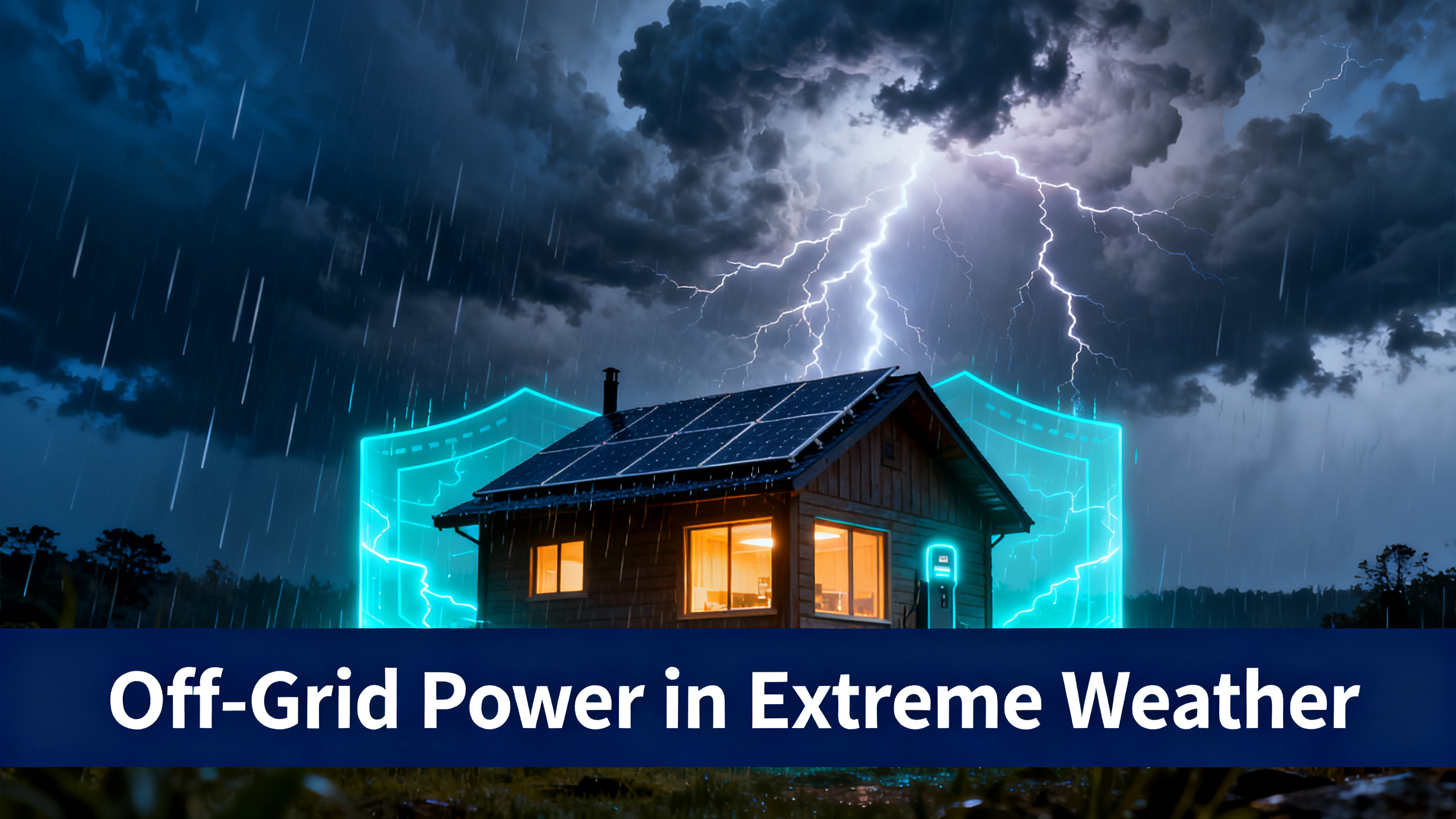
Cold environments turn published battery capacity into a moving target. A 3,000Wh power station rated for sea-level summer use can deliver close to 50% less energy at -20°C, leaving off-grid systems short of expected runtime when reliability matters most. Understanding how extreme weather interacts with lithium chemistry, panel output, and charging windows is what separates a system that works through January from one that fails on the first cold snap.
The variables are quantifiable. Battery chemistry (LFP versus NMC), operating temperature floors, charging thresholds, and solar yield reductions all follow published data patterns engineers have documented for years. What changes is how that data translates into your specific off-grid application: a remote cabin in Vermont needs different planning than a desert van conversion in Arizona.
If you’re still sizing your system from scratch, start with our off-grid solar power systems guide before diving into the weather variables below. This article focuses on the temperature, weather, and storm protection layer that sits on top of basic system design.

Editor’s quick pick: Jackery HomePower 3000
A 3,072Wh LFP unit built for multi-day off-grid autonomy. Skip ahead to the comparison or jump straight to specs.
Get our Black Friday alerts for power stations
We track live prices on 40+ models from Jackery, EcoFlow, BLUETTI and Anker SOLIX. When a deal beats the lowest price we've recorded, you'll hear from us. During Black Friday week, one short recap a day at most.
Unsubscribe in one click. We may earn a commission when you buy through our links, at no extra cost to you. Privacy Policy
How Cold Affects Battery Capacity: The Data
Lithium battery cells produce electricity through ion movement between electrodes. Cold temperatures slow that ion movement, increasing internal resistance and reducing the energy your battery can actually deliver. The effect is non-linear: capacity drops gently between 25°C and 0°C, then accelerates sharply below freezing.
Two chemistries dominate the portable power station market: lithium iron phosphate (LFP) and nickel manganese cobalt (NMC). Their cold-weather behavior differs significantly. LFP cells maintain functionality down to -20°C in discharge mode and recover full performance once warmed. NMC cells often hit a hard discharge floor at 0°C and risk permanent capacity loss when charged in cold conditions.
LFP vs NMC: Capacity Retention in Cold (% of Rated Wh)
25°C / 77°F
100%
LFP & NMC
10°C / 50°F
~90%
LFP (NMC: ~85%)
0°C / 32°F
~80%
LFP (NMC: ~70%)
-10°C / 14°F
~65%
LFP (NMC: may fail)
-20°C / -4°F
~50%
LFP only
Figures based on published electrochemical data and manufacturer discharge specifications. Actual performance varies by state of charge, discharge rate, and battery age.
The figures above represent published electrochemical performance data, not extrapolations. According to EcoFlow’s official cold weather guidance, capacity losses begin at moderate cold (10°C) and compound rapidly as temperatures drop further. For off-grid systems planned around precise daily energy budgets, ignoring these reductions leads to undersized capacity and mid-winter shortfalls.
LFP vs NMC: Which Chemistry Handles Cold Better?
The chemistry difference comes down to bond stability. LFP uses an iron-phosphate cathode structure that maintains electrochemical activity at low temperatures. NMC cells rely on a more energy-dense but cold-sensitive nickel-cobalt structure. For off-grid applications in any climate that sees sub-zero temperatures, LFP is the correct specification.
This matters beyond cold-weather performance. LFP also offers 3,000+ cycle life versus 500-1,000 for NMC, better thermal runaway safety, and more stable voltage curves under load. The trade-off is energy density: LFP units are physically larger and heavier per Wh than NMC equivalents.

Spec analysis confirms that all three brands featured in this guide (Jackery, EcoFlow, Anker SOLIX) have shifted their flagship off-grid models to LFP chemistry. The Jackery HomePower 3000, EcoFlow DELTA Pro, and Anker SOLIX F3800 all use LFP cells, which is why they discharge below freezing while older NMC units stop at 0°C. If a current off-grid build still uses NMC, it should be considered a transitional system, not a long-term solution.
The Charging Temperature Floor: Why It Matters More Than Discharge
Most users focus on whether their power station can run appliances in cold weather. The more dangerous question is whether it can charge safely. Charging an LFP cell below 0°C causes lithium plating, a process where metallic lithium deposits on the anode instead of intercalating properly. This damage is permanent and reduces capacity for the life of the battery.
Verified specs across LFP models indicate a minimum charging temperature of 0°C (32°F) for most units without active battery heating. EcoFlow integrates a heating system on premium models like the DELTA Pro Ultra and DELTA 2 Max, which automatically warms the cells before accepting charge below freezing. Standard models including the DELTA Pro require user intervention: bring the unit indoors or warm it before plugging in.
The practical rule for cold-weather off-grid systems: discharge in the cold if needed, but always warm the battery to at least 5°C before initiating charge. A frozen battery accepting a 1,000W solar input will degrade faster than the same battery discharging at -15°C.
Model by model: we read the current Jackery, EcoFlow, BLUETTI and Anker SOLIX manuals for their charge, use and storage limits in never charge a power station below 32°F.
Operating Temperature Ranges by Brand and Model
Manufacturer specs publish two temperature ranges for every power station: one for discharge (using stored energy) and one for charging (refilling the battery). The discharge range is almost always wider than the charging range, which catches many off-grid users off guard. A unit rated to “operate at -10°C” usually means discharge only, with charging permitted only at higher temperatures.
Comparing the major LFP units side by side reveals significant differences in cold tolerance. The Jackery HomePower 3000 pairs a large 3,072Wh LFP battery with LFP’s inherent sub-freezing discharge tolerance, while EcoFlow and Anker SOLIX publish a -10°C floor. Older NMC-based stations from any brand typically cap at 0°C.
Operating Temperature Ranges: Key Models Compared
Note: Min temps are discharge ratings. Charging in cold requires higher temps, always verify charging specs separately.
The temperature ranges in the table reflect manufacturer-published discharge specs. Charging tolerance is typically narrower: most LFP models in this category accept charge between 0°C and 40°C unless equipped with active battery heating. For off-grid installations exposed to outdoor temperatures, this gap is the critical planning variable.
Get our Black Friday alerts for power stations
We track live prices on 40+ models from Jackery, EcoFlow, BLUETTI and Anker SOLIX. When a deal beats the lowest price we've recorded, you'll hear from us. During Black Friday week, one short recap a day at most.
Unsubscribe in one click. We may earn a commission when you buy through our links, at no extra cost to you. Privacy Policy
Solar Production in Winter: What the Numbers Show
Two factors drive winter solar yield, and they pull in opposite directions. Lower temperatures actually improve photovoltaic cell efficiency, with most panels gaining 0.3-0.5% output per degree below 25°C standard test conditions. The catch: that efficiency boost is dwarfed by the reduction in available solar energy, which depends on sun angle and daylight hours.
At 45° latitude (roughly Maine, Oregon, or southern France), winter daily solar yield typically drops to 30-50% of summer peak. Higher latitudes see steeper losses. Snow cover compounds the problem when panels are buried, but cleared snow on adjacent ground actually increases yield through albedo (reflected light reaches panels at a useful angle).
Panel output losses are only part of the equation. Our dedicated guide to solar charging in winter and cold weather covers optimal tilt angles, snow clearing strategies, and realistic daily yield estimates for different latitudes.
Storms compound the winter shortfall further: for a data-driven breakdown of overcast performance, see our analysis of solar performance on cloudy days. Multi-day storm fronts can reduce yield to 10-20% of clear-sky output, which is why winter system sizing must factor in worst-case sequences, not just average production.
Sizing for Winter: How Much Extra Panel Capacity You Need
The practical rule for cold-climate off-grid systems: oversize your solar array by 30-50% beyond summer-rated needs. If your daily energy budget is 3,000Wh, plan for 4,500-5,000W of generation potential to maintain that yield through deep winter conditions.
Runtime calculations based on capacity show what this means in practice. A Jackery HomePower 3000 (3,072Wh) loaded for daily depletion needs roughly 4,700Wh of generation potential to fully recharge during a winter day with 65% efficiency loss factored in. That translates to a 1,500-2,000W panel array under typical winter conditions in temperate zones.
Pairing the Jackery HomePower 3000 with two compatible SolarSaga 200W panels (400W total) covers baseline three-season recharging. Winter applications demand adding panels or sourcing higher-wattage rigid panels to bridge the seasonal yield gap.
An early-season example: wet October snow is the classic line-breaker, as Montana’s first winter storm shows. The NWS warnings and the prep list are in our Montana storm update.
Storm Protection for Your Off-Grid System
Wind, driving rain, and heavy snow loads create physical risks that purely electrical specs do not address. Most portable power stations carry no IP rating or sit at IP54 (dust-protected, splash-resistant only). Direct exposure to a coastal storm or sustained winter precipitation will compromise the unit unless additional protection is in place.
If your off-grid property also serves as a primary residence, pair these outdoor-system strategies with a complete winter storm power backup planning framework. A storm-ready system addresses both the off-grid hardware and the household load priorities that determine which circuits stay live.
Solar panels themselves are more weather-resistant than the power stations they feed. Most quality rigid panels rate IP67 or IP68 for full waterproofing. The vulnerable points are connection junctions, MC4 connectors, and any inverter or charge controller mounted outdoors. Sealing these with weatherproof boxes and using cable glands at all entry points significantly extends storm survivability.
For the power station itself, three options exist: bring it indoors before storms, install it in a ventilated weatherproof enclosure, or use a manufacturer-designed protective cover. Anker offers a dedicated cover for the SOLIX F3800 (SKU A17X9011) at $129, which extends outdoor tolerance without voiding warranty terms. Custom enclosures must preserve airflow, since LFP units generate heat under load and require ventilation to operate within thermal specs.
Best Power Stations for Extreme Cold (3 Picks with Cold Specs)
Three units stand out for off-grid use in extreme weather, each addressing a different priority. The selection criteria below focus on documented cold ratings, LFP chemistry, and capacity sufficient for multi-day autonomy. These are not promotional picks, they reflect what the published specs and operational profiles support.


Jackery HomePower 3000: Large LFP Capacity for Off-Grid
The HomePower 3000 packs 3,072Wh of LFP capacity with 3,600W output (7,200W surge), enough to run refrigeration, lighting, and electronics for multi-day off-grid autonomy. LFP chemistry lets it discharge below freezing, and Jackery’s ZeroDrain design retains around 95% of stored charge after a full year of standby. It fully recharges in as fast as 1.7 hours via wall power, minimizing the recharge window during short winter days.
Best application: permanent off-grid living, four-season van life, and remote cabins where multi-day capacity and fast recharge matter. At $1,299 with a 5-year warranty, it is competitively priced for a 3kWh-class LFP unit and pairs with Jackery’s SolarSaga panels for solar recharging.
EcoFlow DELTA Pro: Expandable Capacity for Multi-Day Outages
The DELTA Pro extends to 25kWh of total capacity through stackable expansion batteries, making it the most scalable option for off-grid residential use. The base 3,600Wh unit operates down to -10°C, which covers most U.S. off-grid scenarios outside extreme northern latitudes. EcoFlow’s premium lineup (DELTA Pro Ultra, DELTA 2 Max) integrates active battery heating; the standard DELTA Pro does not, meaning user-managed pre-warming is required for cold charging.
Best application: off-grid homes anticipating capacity expansion over time, multi-day blackout backup, and properties with substantial daily energy budgets. The $1,599 entry price (compared to its $3,699 historical reference) makes it the value leader among 3,600Wh+ LFP units.
Anker SOLIX F3800: High-Output System for Extreme Demand
The F3800 targets the highest power demands in the portable category: 6,000W AC output with native 120V/240V handles heat pumps, well pumps, and EV charging that other units cannot. Smart temperature control monitors cell conditions 100 times per second according to manufacturer specs, providing tighter thermal management than passive systems. Capacity expands to 53.8kWh through the SOLIX ecosystem, exceeding most off-grid residential needs.
Best application: large off-grid properties, properties with 240V loads, and operations where peak power matters more than absolute portability. At $1,799 for the base unit, the cost per watt of output is lower than competing options in the LFP category.
Operational Strategies for Year-Round Off-Grid Reliability
Winter readiness is not just about hardware specifications. Operational habits determine whether your system survives multiple cold seasons or degrades prematurely. The patterns below come from documented manufacturer guidance and consistent owner feedback across LFP power station communities.
✅ Proven Strategies
- Store batteries indoors above 0°C during non-use
- Pre-warm units to room temp before charging in cold
- Oversize solar by 30-50% for winter yield losses
- Use an insulated enclosure for outdoor installs
- Maintain 20-80% SoC during prolonged cold storage
- Increase panel tilt angle 15-20° for low winter sun
❌ Common Mistakes
- Charging a frozen or near-frozen LFP battery
- Storing at full charge in sub-zero temperatures
- Using rated capacity figures without cold derating
- Leaving panels flat under snow (blocks and scratches)
- Running NMC batteries below 0°C discharge floor
- Ignoring manufacturer min charging temp specs
The “store at 20-80% state of charge” guideline matters most for prolonged cold storage. A fully charged LFP cell sitting at -10°C for weeks experiences accelerated calendar aging, while the same cell at 50% SoC degrades far slower. For seasonal off-grid setups (summer cabins, occasional-use systems), storing the unit indoors at half charge through winter preserves long-term capacity.
Pre-warming before charging is non-negotiable for any unit without active battery heating. The simplest method: bring the power station indoors several hours before solar production begins, or use a small electric blanket on a thermostat-controlled outlet to maintain 5-15°C battery temperature overnight. Jackery’s winter usage recommendations document specific protocols for their LFP lineup that translate well to other manufacturers’ equipment.
For a full seasonal protocol, our guide to maintaining your power station in harsh conditions provides a step-by-step checklist adapted to extreme environments. The combination of correct storage SoC, pre-warming protocols, and seasonal inspection routines extends usable lifespan by years for any LFP unit operating in cold climates.
Frequently Asked Questions
Can I use a power station in freezing temperatures?
LFP-based power stations, including large units like the Jackery HomePower 3000, can discharge in sub-zero conditions thanks to their iron-phosphate chemistry. However, charging should not occur below 0°C (32°F) without an active battery heating system, as it risks permanent cell damage through lithium plating. Always check both discharge and charging temperature specs before deploying a unit outdoors in winter.
How much capacity do I lose in cold weather?
Published electrochemical data indicates LFP batteries retain approximately 80% of rated capacity at 0°C, dropping to around 65% at -10°C and 50% at -20°C. NMC batteries degrade faster, often losing 30-40% at 0°C and risking complete failure below that threshold. For accurate winter system sizing, derate stated Wh by these factors based on your coldest expected operating temperature.
Does cold weather affect solar panel output?
Cold temperatures actually improve panel efficiency by 0.3-0.5% per degree below 25°C standard test conditions. The real winter challenge is reduced sun hours and lower irradiance angle, which can cut daily yield by 30-70% depending on latitude, independent of panel efficiency. Snow cover, cloud cover, and shorter days are the dominant variables for winter solar production.
Which is better in cold weather: LFP or NMC batteries?
LFP chemistry performs significantly better in cold environments. The iron-phosphate bond structure maintains electrochemical activity at lower temperatures compared to nickel-manganese-cobalt chemistry. For any off-grid system in a cold climate, LFP is the correct specification. The trade-off is lower energy density per kg, meaning LFP units are physically larger than NMC equivalents at the same capacity.
How do I protect my power station from extreme heat?
Operating above 40-45°C accelerates cell degradation. Store units in shaded, ventilated locations and avoid charging in direct sunlight during peak summer hours. Most current LFP units have built-in thermal management that throttles charge rate in high heat, published thermal specs confirm automatic protection kicks in above rated operating temperatures. Forced ventilation around the unit can extend safe operating windows during heat waves.
Can I leave my power station outside during a storm?
Only units with IP65 or higher ratings should remain outdoors in rain and dust. Most power stations are IP54 or unrated, meaning they tolerate light splashes but not driving rain or sustained moisture. Using a manufacturer-designed protective cover (available for models like the Anker SOLIX F3800) extends outdoor tolerance without voiding warranty. For severe storms, indoor storage is the safer protocol.
Bottom Line: Engineering for the Worst Day
Off-grid systems live or die by their performance during the toughest week of the year, not the average. Cold-weather capacity loss, winter solar shortfalls, and storm exposure all compound in the same months, which is why planning around peak summer figures sets you up for January disappointment. LFP chemistry, oversized solar arrays, proper SoC management, and weatherproofing are not optional refinements, they are the baseline for any system meant to run year-round.
Among current units, the Jackery HomePower 3000 pairs a large 3,072Wh LFP battery with 3,600W output and a fast 1.7-hour recharge. That combination of capacity, LFP cold tolerance, and quick top-ups makes it one of the closest things to a “set and forget” off-grid unit for demanding climates.
Jackery HomePower 3000
$1,299
Large 3,072Wh LFP off-grid power station, 3600W output, 5-year warranty
Price verified May 2026, free shipping available
Originally published: May 7, 2026