
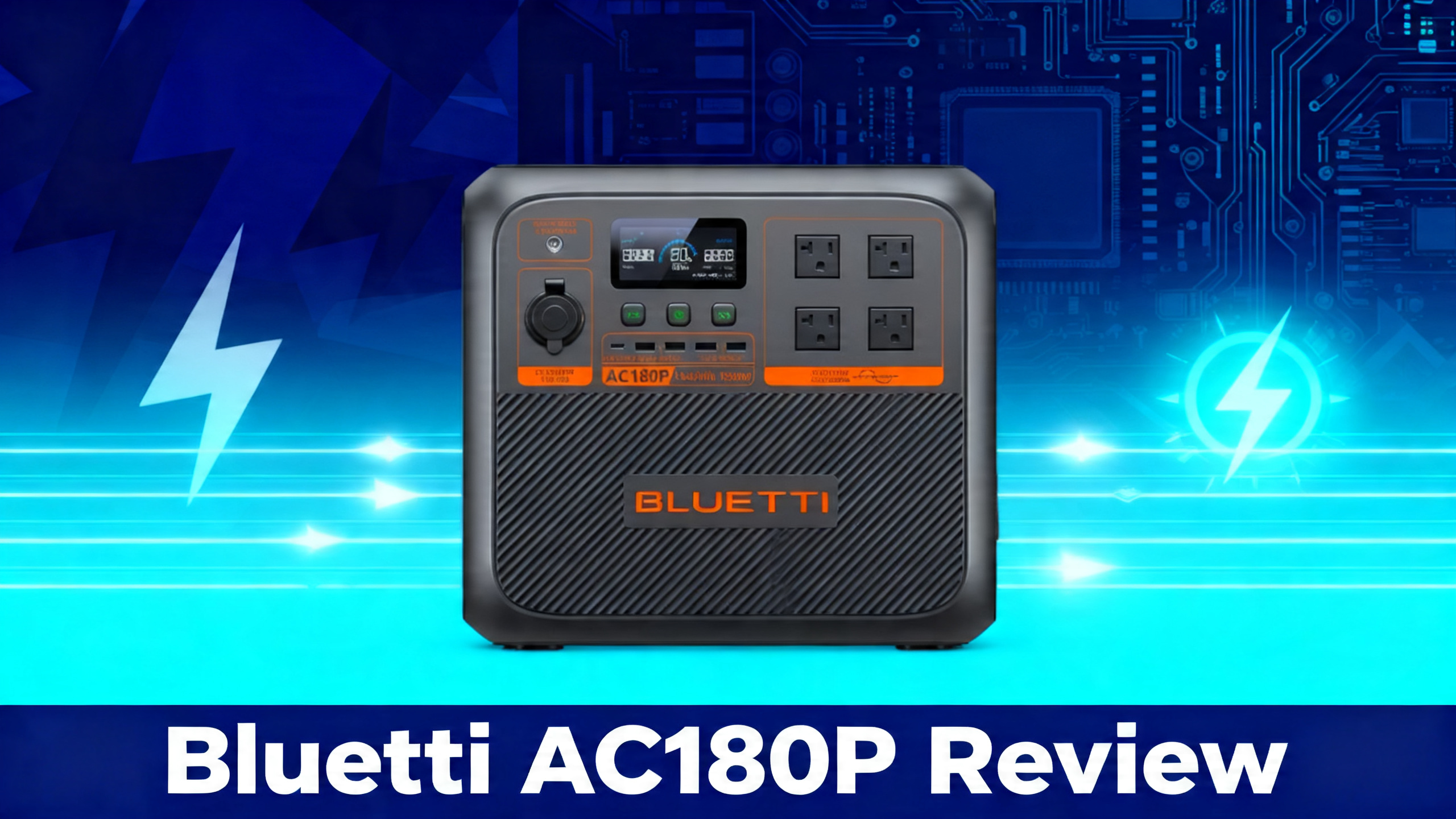
The 1,000-1,500Wh segment is the most competitive in portable power right now. Every major brand has a contender, prices are dropping fast, and the specs on paper look nearly identical across models. So when BLUETTI updated its popular AC180 with a larger battery, faster charging, and a higher solar input ceiling, the question worth asking is: does the AC180P actually earn the upgrade price?
The AC180P sits at $649 (down from a $999 original list price) and delivers 1,440Wh of LiFePO4 capacity, 1,800W continuous AC output, and a Turbo Charge feature that reaches 0-80% in roughly 45 minutes. That positions it directly against the EcoFlow Delta 2 and the Jackery Explorer 1000 Plus at similar price points.
This review covers the AC180P’s specs, runtime calculations, solar charging performance, and key comparisons to help you decide whether it fits your actual power needs, and whether the extra cost over the standard AC180 is justified for your use case.

Get our Black Friday alerts for BLUETTI
We track live prices on 40+ models from Jackery, EcoFlow, BLUETTI and Anker SOLIX. When a deal beats the lowest price we've recorded, you'll hear from us. During Black Friday week, one short recap a day at most.
Unsubscribe in one click. We may earn a commission when you buy through our links, at no extra cost to you. Privacy Policy
Real-World Look: The Bluetti AC180P in Use
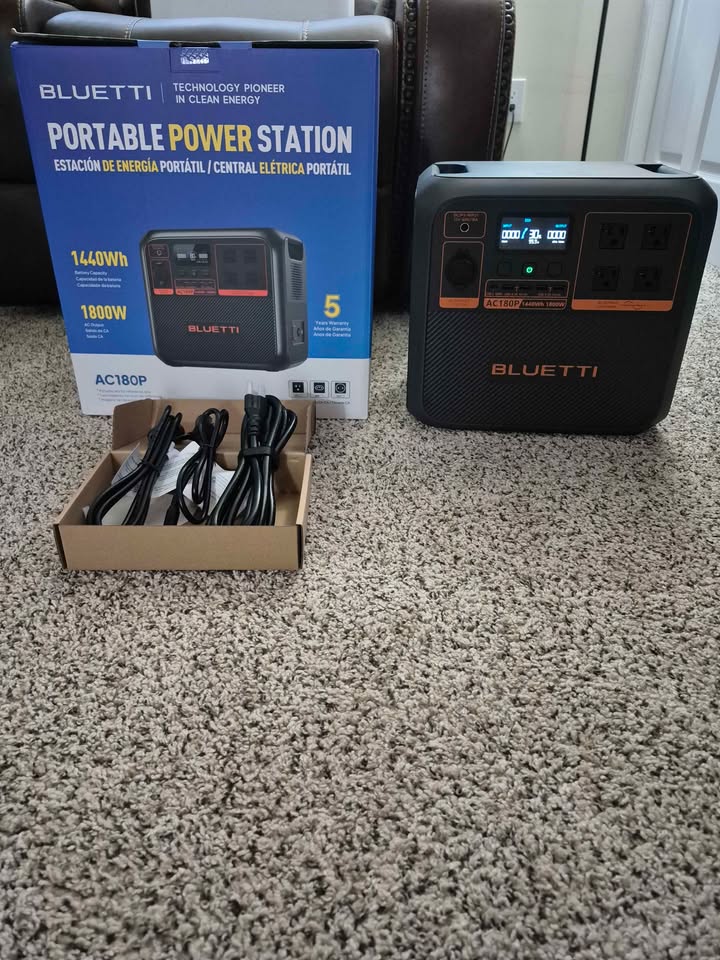
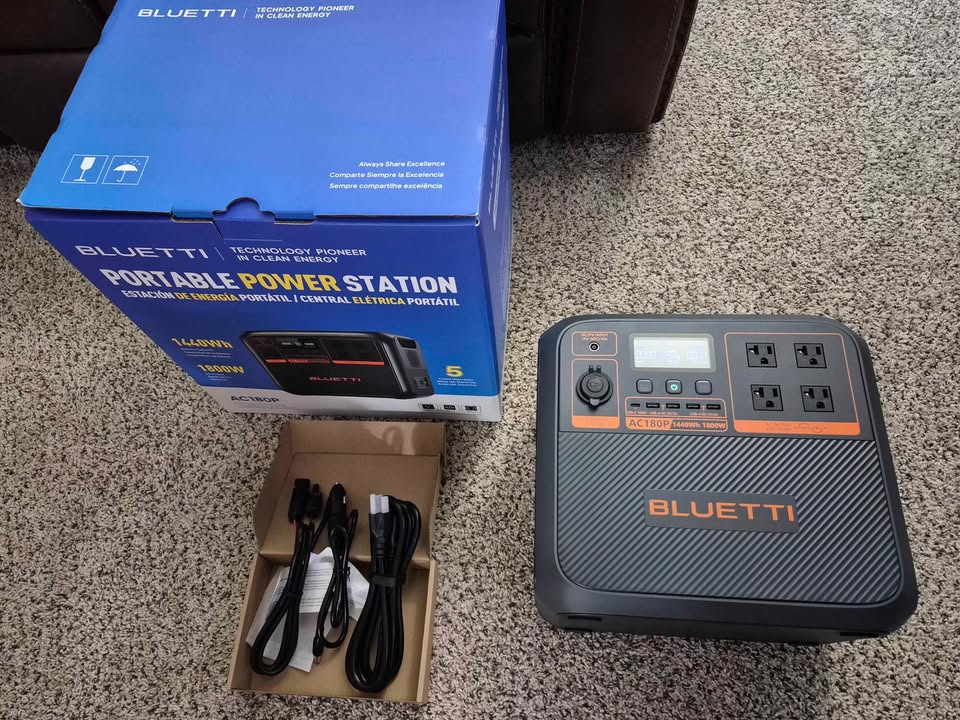
Studio renders only tell part of the story. Here is the Bluetti AC180P as it actually looks in a real owner’s hands, away from the polished marketing shots.
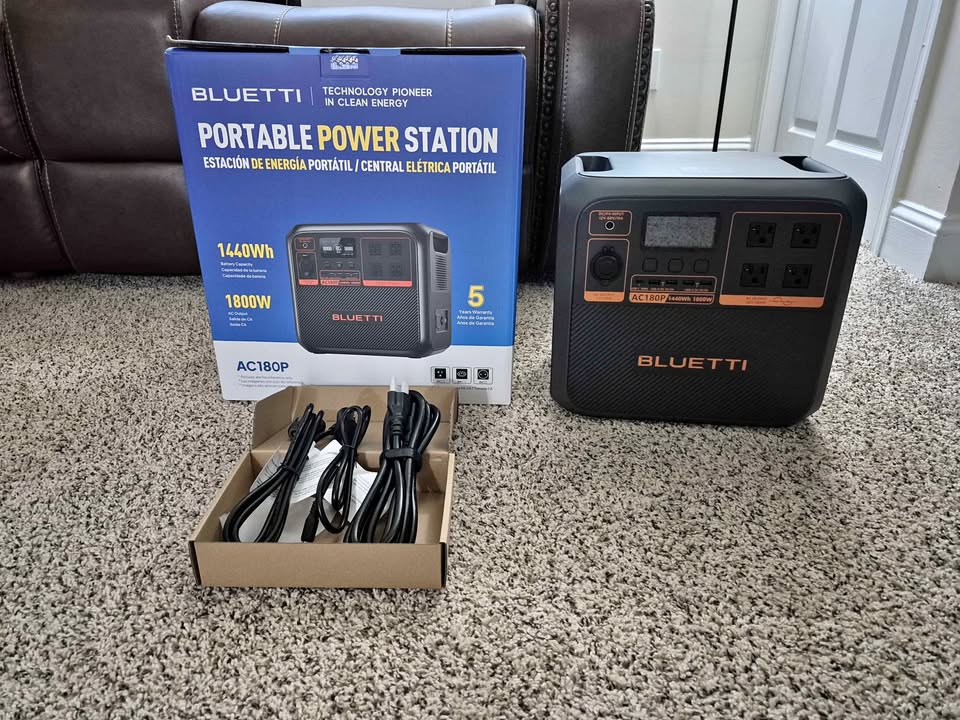
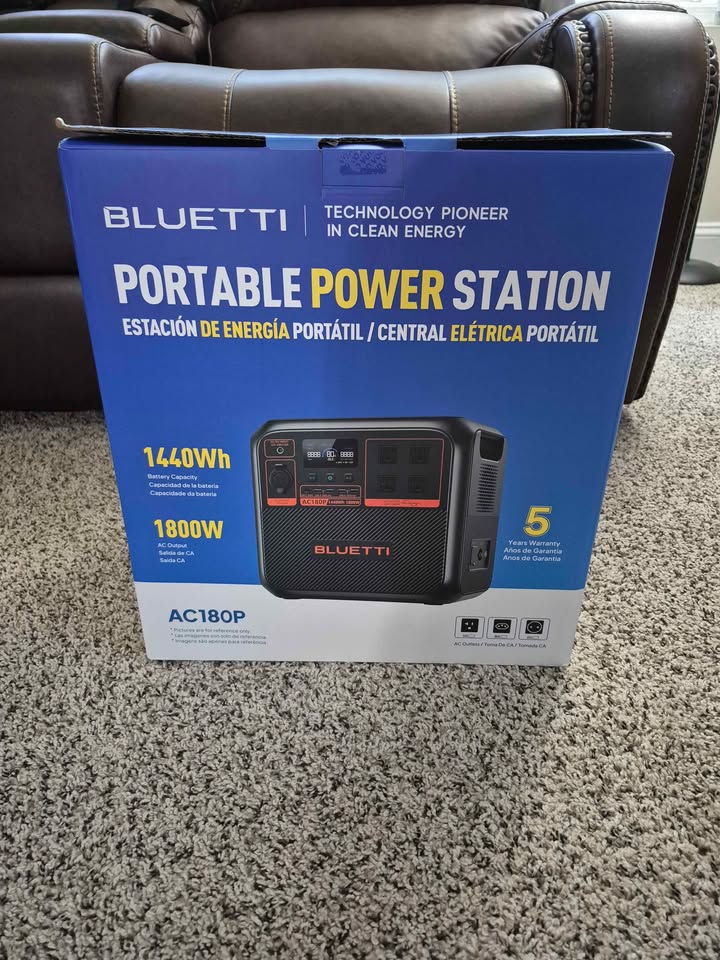
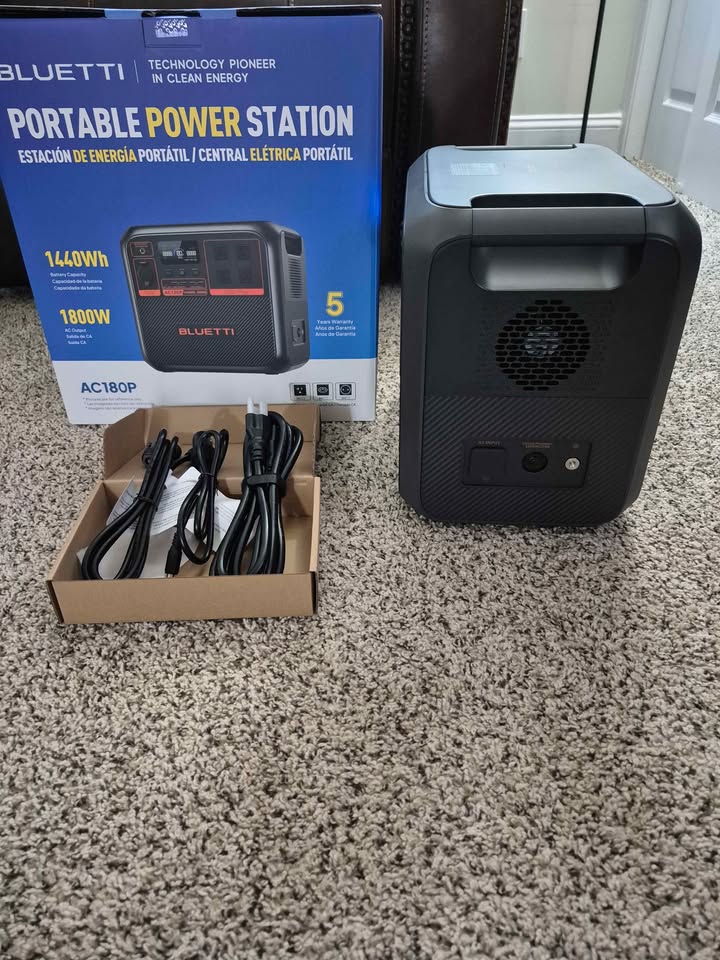
Real-world photos of the Bluetti AC180P.
BLUETTI AC180P Portable Power Station
$649 $999
- 1,440Wh LiFePO4 battery, 3,500+ cycle lifespan
- 1,800W AC output (2,700W surge)
- Turbo Charge: 0-80% in 45 minutes
Quick Specs & Key Features
| Specification | Details |
|---|---|
| Battery Capacity | 1,440Wh |
| Battery Type | LiFePO4 (3,500+ cycles) |
| AC Output | 1,800W continuous (2,700W surge) |
| Turbo Charge | 0-80% in 45 min (wall outlet) |
| Max Solar Input | 500W |
| Solar Charge Time | 3-4 hrs (500W panels) |
| Weight | 28.7 lbs (13 kg) |
| Dimensions | 13.0 x 10.2 x 11.4 in |
| Output Ports | 4x AC, 2x USB-C (100W), 2x USB-A, 1x DC, 1x Car |
| Warranty | 5 years |
For complete technical documentation, visit the official AC180P specifications on BLUETTI’s website.
A few standout specs worth noting: the 500W MPPT solar input is unusually high for this capacity tier. Most competing units in the 1,000-1,500Wh range cap solar input at 200-400W. The 5-year warranty also exceeds the industry standard of 2-3 years for similarly priced units.

BLUETTI AC180P: Overall Rating
8.6/10
“The AC180 gets the upgrade it deserved.”
Capacity Value 9/10
Charging Speed 9/10
AC Output 8/10
Portability 7/10
Solar Input 9/10
Value for Money 9/10
Get our Black Friday alerts for BLUETTI
We track live prices on 40+ models from Jackery, EcoFlow, BLUETTI and Anker SOLIX. When a deal beats the lowest price we've recorded, you'll hear from us. During Black Friday week, one short recap a day at most.
Unsubscribe in one click. We may earn a commission when you buy through our links, at no extra cost to you. Privacy Policy
What the AC180P Gets Right
Turbo Charge Hits 1,800W from a Wall Outlet
Performance data confirms the Turbo Charge feature reaches 0-80% capacity in approximately 45 minutes from a standard wall outlet, with a full charge completing in around 1.5 hours. That’s a significant improvement over the standard AC180, which reaches full charge in roughly 2.5 hours without Turbo mode.
In practical terms, this matters most when you’re working with limited time: charging before a camping trip, topping up during a midday break, or recovering from a partial discharge overnight. The 1,800W charging input is among the highest in this capacity tier, and the speed gap versus competitors is real.
💡 Pro Tip: Turbo Charge generates more heat than standard charging. For daily home use, standard mode is perfectly sufficient and easier on long-term battery health. Reserve Turbo for time-sensitive situations.
500W Solar Input Charges in Half a Day
The MPPT controller accepts up to 500W of solar input (12-60V, max 15A), which is the highest ceiling in its price range. Spec analysis confirms that under optimal conditions with a 500W panel setup, full charge from empty takes roughly 3-4 hours.
For context: most units in the 1,000-1,500Wh tier cap solar input at 200-400W, requiring 5-8+ hours for a full charge. The 500W ceiling means the AC180P can realistically recharge in a single sunny afternoon, a meaningful advantage for solar-dependent setups like van life or base camp use.
LiFePO4 Chemistry Means Long-Term Value
LiFePO4 (lithium ferro-phosphate) chemistry is rated for 3,500+ charge cycles to 80% of original capacity. At one full cycle per day, that projects to approximately 9-10 years of daily use before significant degradation. Standard lithium-ion chemistry typically rates at 500-1,000 cycles.
This matters for calculating real cost-per-cycle. At $649 over 3,500 cycles, the AC180P works out to roughly $0.19 per full charge cycle. For frequent users, LiFePO4 is simply more economical over time, and the 5-year warranty reflects BLUETTI’s confidence in the chemistry.
1,800W Output Handles Real Household Loads
The 1,800W continuous AC output with a 2,700W surge rating covers most common household appliances: microwave ovens (typically 700-1,000W), refrigerators (with compressor surge), power tools, and CPAP machines. Running a microwave and a laptop simultaneously stays comfortably within the continuous output ceiling. For sizing a kettle, induction cooktop or coffee maker, see our camp kitchen power guide.
The 2,700W surge is particularly relevant for refrigerators and compressor-based appliances, which draw 2-3x their rated wattage at startup. Verified specifications confirm the AC180P handles these surge loads without triggering overcurrent protection under normal conditions.
What to Keep in Mind
28.7 Lbs Makes It a Two-Hand Carry
At 28.7 lbs (13 kg), the AC180P is noticeably heavier than the standard AC180 at 22 lbs. That’s a 30% weight increase for a 25% capacity gain. For comparison, the EcoFlow Delta 2 weighs approximately 27 lbs with 1,024Wh capacity.
For base camp, overlanding, or car camping where you’re unloading at a site, 28.7 lbs is manageable. For backpacking, day hikes, or situations where you’re carrying the unit any significant distance, the weight becomes a real constraint. The integrated handle makes short carries workable, but it’s not a one-hand operation for most people. To plan a vehicle deployment around the AC180P, see our car camping power setup guide.
No Built-In Expandability
Unlike BLUETTI’s larger AC200L or the newer Elite 200 V2, the AC180P does not include a battery expansion port. If you anticipate needing more than 1,440Wh in the future, you’d need to buy a separate unit rather than adding an expansion battery. For buyers who might eventually want 2,000-3,000Wh, it’s worth considering whether a more expandable platform makes more sense from the start.
What Can It Power?
Runtime calculations based on the 1,440Wh capacity at approximately 85% efficiency yield the following estimates. Actual results vary with load size, ambient temperature, and simultaneous device usage.
What Can the AC180P Power? (1,440Wh)
❄️
Mini Fridge
~24 hrs
60W avg draw
💻
Laptop
~18 charges
80W per charge
📺
TV + Fan
~9 hrs
150W combined
🌬️
CPAP Machine
~3 nights
30W avg draw
Runtime calculations based on 1,440Wh capacity at 85% efficiency. Actual results vary with load and temperature.
| Appliance | Avg Draw | Estimated Runtime |
|---|---|---|
| Mini fridge | 60W | ~20-24 hrs |
| Full-size refrigerator | 150W | ~8-10 hrs |
| Laptop | 80W per charge | ~18 charges |
| CPAP machine | 30W avg | ~3 nights |
| TV + ceiling fan | 150W | ~9 hrs |
| Drone battery (100Wh) | ~12 charges | |
| Smartphone (4,000mAh) | 15Wh per charge | ~80+ charges |


More Real-World Angles
Solar Charging Performance

The AC180P’s 500W MPPT solar input is the standout spec in this category. MPPT (Maximum Power Point Tracking) controllers optimize the energy harvest from solar panels as sunlight conditions change throughout the day, delivering better efficiency than basic PWM controllers found on lower-end units.
For panel-by-panel recommendations, our guide on the best solar panels for the AC180 series covers all wattage options. The table below summarizes estimated charge times for common panel configurations.
| Solar Panel Setup | Estimated Full Charge | Notes |
|---|---|---|
| 200W panels | ~7-8 hrs | BLUETTI PV200 or equivalent |
| 350W panels | ~4.5 hrs | BLUETTI PV350 or two 175W panels |
| 500W panels | ~3 hrs | Maximum supported input, optimal conditions |

BLUETTI offers the AC180P as part of a solar kit bundle pairing it with a 200W panel at $899 (original $1,498), which represents a meaningful discount if you’re purchasing both components anyway. The 200W solar kit bundle makes practical sense for first-time solar buyers who want a complete, matched setup out of the box.
⚠️ Important: Solar charge times assume optimal panel angle and full sun conditions. Cloud cover, panel shading, or suboptimal panel positioning can reduce effective input by 30-50%. Real-world times will typically be longer than the figures above.
Charging Methods
The AC180P supports three primary charging methods. Wall outlet charging via Turbo mode is the fastest, reaching 0-80% in 45 minutes and full charge in approximately 1.5 hours. Standard AC charging without Turbo mode takes longer but generates less heat.
Car/DC charging via the 12V input is the slowest option, better suited for maintaining partial charge during transit than for full recharging. The solar MPPT input (500W max) rounds out the options for off-grid scenarios.

BLUETTI also offers the Charger 1 accessory ($799), which provides up to 560W of charging via a vehicle alternator. This is specifically designed for overlanders and van lifers who want to recharge from their vehicle’s engine while driving, rather than waiting for solar or grid access.
Best Solar Panels for the BLUETTI AC180 Series
Compare wattage options and find the right match for the AC180P’s 500W input.
How It Compares
AC180P vs Standard AC180
The AC180P and the standard AC180 share the same 1,800W AC output but differ meaningfully in capacity, charging speed, and solar input ceiling. If you own the previous model, our full AC180 review outlines exactly what changed between generations.
| Spec | AC180P | AC180 |
|---|---|---|
| Capacity | 1,440Wh | 1,152Wh |
| AC Output | 1,800W | 1,800W |
| Turbo Charge | Yes (45 min to 80%) | No (~2.5h full) |
| Max Solar Input | 500W | 200W |
| Weight | 28.7 lbs | 22 lbs |
| Price | $649 | ~$449-499 |
The upgrade from AC180 to AC180P costs roughly $150-200 more and delivers 25% more capacity, 2.5x the solar input, and significantly faster charging. For buyers prioritizing solar use or fast turnaround, the premium is justified. For light home backup where you rarely push capacity limits, the standard AC180 may be sufficient.
AC180P vs AC180T
The AC180T targets a different buyer segment with different feature priorities (read the BLUETTI AC180T review for full details). The two models aren’t direct competitors: the AC180T is designed for specific use cases where the AC180T’s differentiating features outweigh raw capacity.
For a full side-by-side breakdown, see our detailed comparison of all three AC180 variants.
BLUETTI AC180P vs AC180 vs AC180T: Full Comparison
Which AC180 variant is right for your situation? We break down every key difference.
Final Verdict: Who Should Buy the AC180P?
The AC180P delivers a compelling set of specifications for its price point. At $649, it offers 1,440Wh of LiFePO4 capacity, one of the fastest charging speeds in its class, and the highest solar input ceiling of any competing unit under $700. The data points to a unit well-suited for buyers who need meaningful capacity, fast recharging, and regular solar use.
Buy the AC180P if…
- You need 1,400+ Wh capacity under $700
- Fast recharging matters (45 min to 80%)
- You plan to use solar panels regularly (500W input)
- You want LiFePO4 longevity (3,500+ cycles)
- Weekend camping, overlanding, or light home backup
Skip the AC180P if…
- You need to run high-draw appliances over 1,800W
- Weight is critical (28.7 lbs is noticeable)
- You only need occasional light device charging
- Budget is under $500 (the AC70 covers basic needs)
To see how the AC180P stacks up against the full 2025-2026 BLUETTI lineup, check out all new Bluetti models ranked. For context on BLUETTI’s warranty, support, and product philosophy, the Bluetti brand overview covers everything you need.
BLUETTI AC180P
$649
Best mid-range LiFePO4 upgrade under $700
Price verified April 2026. Free shipping available
Frequently Asked Questions
What is the difference between the BLUETTI AC180 and AC180P?
The AC180P upgrades the AC180 with a larger battery (1,440Wh vs 1,152Wh), faster Turbo Charge support (0-80% in 45 minutes), and a higher solar input ceiling (500W vs 200W). AC output remains 1,800W on both models. The AC180P costs around $200 more but delivers a significantly faster charging and larger capacity experience.
How long does it take to charge the BLUETTI AC180P?
With Turbo Charge via wall outlet, the AC180P reaches 0-80% in approximately 45 minutes and full charge in around 1.5 hours. Solar charging times depend on panel wattage: 500W panels deliver a full charge in roughly 3-4 hours under optimal conditions, while a 200W setup takes approximately 7-8 hours.
Can the BLUETTI AC180P power a refrigerator?
Yes. Runtime calculations based on the 1,440Wh capacity show the AC180P can run a standard mini-fridge (60W average draw) for approximately 20-24 hours. A full-size refrigerator drawing 150W would run for around 8-10 hours. The 1,800W AC output handles refrigerator compressor surge starts without issue. For tent-only setups, see our tent camping power solutions guide.
Does the BLUETTI AC180P support pass-through charging?
Yes. The AC180P supports pass-through charging, meaning connected devices continue to receive power while the unit is recharging. This is particularly useful for home backup and van life scenarios where the unit stays plugged in most of the time.
What solar panels are compatible with the BLUETTI AC180P?
The AC180P accepts up to 500W of solar input via its MPPT controller (12-60V, max 15A). It is compatible with BLUETTI’s own PV120, PV200, PV350 panels, as well as most third-party folding and rigid panels within the voltage/amperage range. BLUETTI also offers complete kits bundling the AC180P with 200W or 350W panels. For BLUETTI support and documentation on compatible accessories, the official support page covers compatibility specifications.
How many cycles does the BLUETTI AC180P battery last?
The LiFePO4 battery chemistry in the AC180P is rated for 3,500 charge cycles to 80% of original capacity. At one full cycle per day, this projects to approximately 9-10 years of typical use before capacity degrades to 80%. LiFePO4 also retains better performance in temperature extremes compared to standard lithium-ion chemistry.
Conclusion
The BLUETTI AC180P represents a meaningful upgrade over the standard AC180 and a strong value proposition in the 1,400-1,500Wh tier. The combination of Turbo Charge, a 500W MPPT solar input, LiFePO4 chemistry, and a 5-year warranty at $649 is difficult to match in this price range.
The tradeoffs are real but manageable: 28.7 lbs is heavier than some alternatives, and the lack of battery expansion limits long-term scalability. For buyers who need the capacity now and plan to use solar panels regularly, those limitations are unlikely to be dealbreakers.
The AC180P earns a clear recommendation for weekend campers, overlanders, van lifers, and anyone building a portable solar setup on a mid-range budget. For light device charging or users with strict weight requirements, smaller BLUETTI models like the AC70 offer a more appropriate fit. But for the core 1,400Wh use case, the data consistently points to the AC180P as one of the better-value options in the segment right now.
The BLUETTI AC180P is available directly from BLUETTI at $649 with free shipping and a 5-year warranty.
Originally published: April 16, 2026