
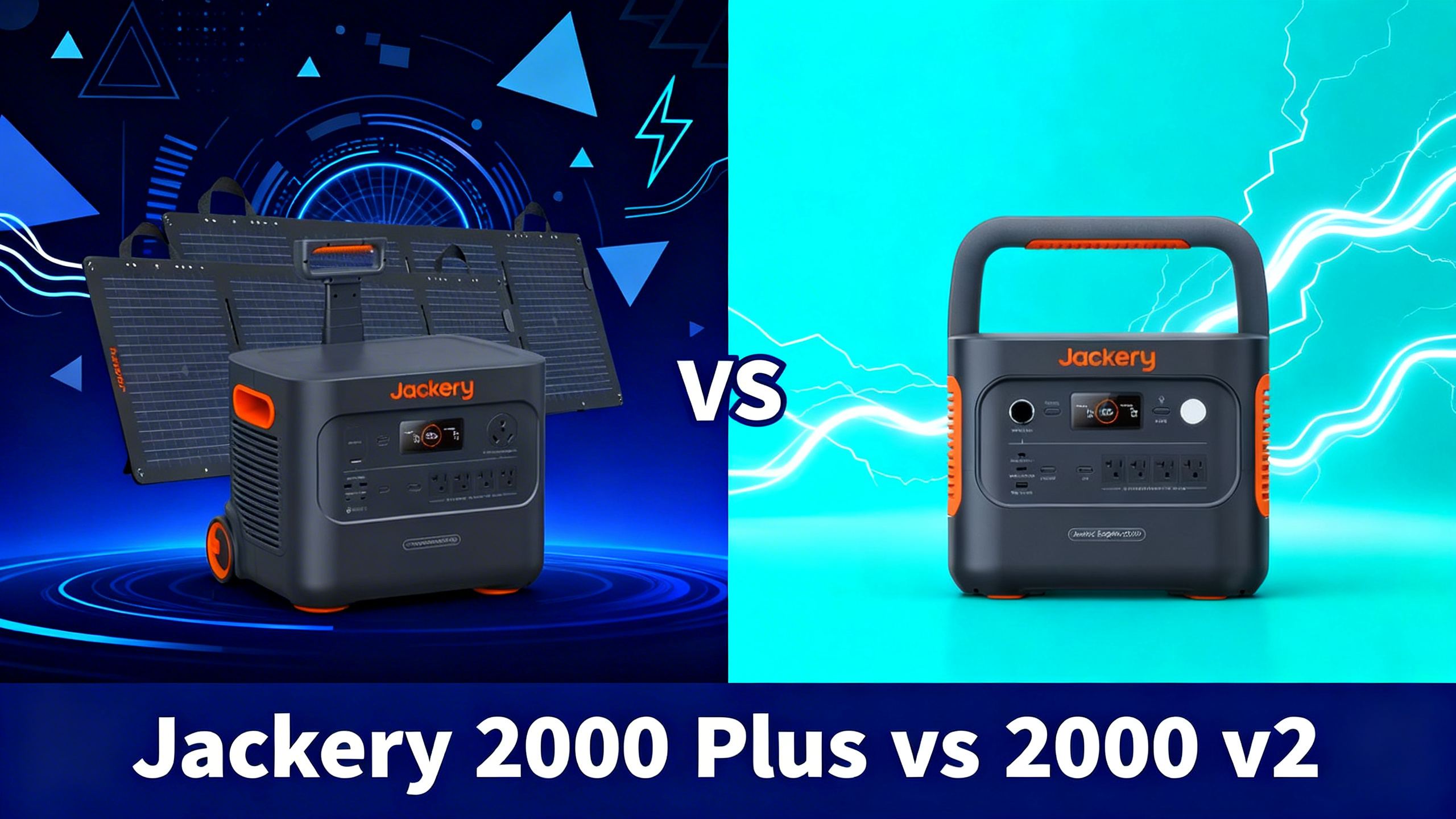
Choosing between the Jackery Explorer 2000 Plus and Explorer 2000 v2 feels straightforward at first glance: both carry roughly 2,042Wh of LiFePO4 capacity and both carry Jackery’s proven build quality. Yet the two units target fundamentally different buyers. The 2000 Plus is an expandable platform designed to grow with your energy needs, from 2kWh all the way to 24kWh. The 2000 v2 is a compact, near-silent home backup unit engineered for speed, portability, and quiet indoor operation. Spoiler: there’s no universal winner here. The right choice depends entirely on how you plan to use 2kWh of power.
Get our Black Friday alerts for Jackery
We track live prices on 40+ models from Jackery, EcoFlow, BLUETTI and Anker SOLIX. When a deal beats the lowest price we've recorded, you'll hear from us. During Black Friday week, one short recap a day at most.
Unsubscribe in one click. We may earn a commission when you buy through our links, at no extra cost to you. Privacy Policy
Quick Verdict: Which One Should You Buy?
Both models sell at steep discounts from their original prices: the 2000 Plus at $899 (down from $1,399) and the 2000 v2 at $799 (down from $1,499). The $100 price gap is real but secondary to the use-case split. Published performance data confirms the 2000 Plus wins on output power, solar capability, and future expandability. The 2000 v2 wins on weight, noise level, recharge speed, and UPS switchover time. Here’s the short answer for each buyer profile.
Head-to-Head Specs: Explorer 2000 Plus vs 2000 v2
On paper, these two units share the same headline number: approximately 2,042Wh of LiFePO4 capacity. That shared foundation means runtime estimates are nearly identical for equivalent loads. The differences emerge everywhere else: output wattage, solar input, expandability, weight, and noise. Let’s break down each dimension before diving into the individual model profiles.
| Specification | Explorer 2000 Plus | Explorer 2000 v2 |
|---|---|---|
| Price | $899 | $799 |
| Battery Capacity | 2,042.8Wh | 2,042Wh |
| Battery Type | LiFePO4 (LFP) | LiFePO4 (LFP) |
| AC Output (Continuous) | 3,000W standard / 6,000W parallel | 2,200W (4,400W surge) |
| Recharge Time (AC) | ~2h (0-100%) | ~1.7h (0-100%) |
| Max Solar Input | 2,000W (IBC panels) | 800W |
| Expandable Capacity | Yes: up to 24kWh | No |
| Weight | ~63 lbs (28.6 kg) | ~39.5 lbs (17.9 kg) |
| Noise Level | Standard fan | <30dB (near silent) |
| Voltage Output | 120V / 240V (parallel) | 120V |
| Battery Lifespan | 10 years / 3,000+ cycles | 3,000+ cycles LFP |
| Switchover Time | ~30ms | <20ms |
Source: official Explorer 2000 Plus product page and official Explorer 2000 v2 product page.
Battery, Capacity, and Chemistry
Both units use LiFePO4 (lithium ferro-phosphate) chemistry, which means excellent cycle life compared to older NMC cells. The 2000 Plus carries 2,042.8Wh and the 2000 v2 carries 2,042Wh: a negligible difference in actual runtime. Both are rated for 3,000+ cycles before significant degradation. The 2000 Plus additionally carries Jackery’s ChargeShield technology, a variable-speed charging algorithm claimed to extend battery life by 50%, backing the 10-year lifespan rating.
Output Power and Surge Ratings
This is where the split becomes significant. The 2000 Plus delivers 3,000W continuous AC output from a single unit, expandable to 6,000W via parallel connection with a second unit. The 2000 v2 delivers 2,200W continuous with a 4,400W surge. For most household appliances (refrigerators, microwaves, coffee makers), the 2,200W rating handles the load comfortably. For power tools, large AC units, or heavy-duty outdoor equipment, the 2000 Plus’s 6,000W parallel ceiling provides meaningful headroom.
Recharge Speed Compared
The 2000 v2 holds a genuine edge here. Its Emergency Super Charge feature restores from 0 to 100% in approximately 1.7 hours via AC. The 2000 Plus achieves a full AC charge in approximately 2 hours. The 18-minute difference is modest for a planned recharge overnight, but relevant if you’re rushing to top up before a storm hits. Both units support pass-through charging, meaning you can power devices while the unit recharges.


Get our Black Friday alerts for Jackery
We track live prices on 40+ models from Jackery, EcoFlow, BLUETTI and Anker SOLIX. When a deal beats the lowest price we've recorded, you'll hear from us. During Black Friday week, one short recap a day at most.
Unsubscribe in one click. We may earn a commission when you buy through our links, at no extra cost to you. Privacy Policy
Explorer 2000 Plus: The Expandable Powerhouse
The Explorer 2000 Plus is Jackery’s flagship expandable platform at the 2kWh tier. Spec analysis confirms it’s built for users who view their initial 2,042.8Wh as a starting point rather than a ceiling. For a deeper look at specs and performance, the full 2000 Plus review covers the complete feature set in detail.
Expandability from 2kWh to 24kWh
The 2000 Plus supports up to three Battery Pack 2000 Plus units, each adding 2kWh of capacity. One pack brings you to 4kWh, two packs to 6kWh, and three packs to the maximum 24kWh configuration (with additional compatible packs). Each Battery Pack 2000 Plus is priced at $899 at current rates. This modular architecture means you can start at 2kWh and scale as your energy independence goals evolve, rather than replacing the entire system when needs grow.

IBC Solar Technology and Charging Speed
The 2000 Plus uses Jackery’s Advanced IBC (Interdigitated Back Contact) solar technology, which extracts more power from the same panel area versus standard MPPT setups. Maximum solar input reaches 2,000W. With six SolarSaga 200W panels connected, verified specifications confirm a full solar charge in approximately 2 hours under ideal conditions. This is a meaningful distinction for off-grid users who depend on daily solar top-ups rather than grid access.

6,000W Output and 120/240V Capability
Running two 2000 Plus units in parallel raises continuous output to 6,000W and unlocks 240V operation. That’s the threshold needed for large air conditioning units, water pumps, and professional power tools. RV and van life setups that require simultaneous operation of multiple high-draw appliances will find the 2000 Plus’s parallel architecture genuinely useful. At 3,000W continuous from a single unit, it already handles most household essentials without requiring a second unit.
Explorer 2000 Plus — $899
2,042.8Wh expandable to 24kWh. Best price Jackery has offered on this model.
Explorer 2000 v2: Compact Home Backup Champion
The Explorer 2000 v2 represents a different design philosophy: maximum efficiency in minimum footprint. Capacity figures are nearly identical to the 2000 Plus, but the 2000 v2 achieves this in a package weighing 39.5 lbs (17.9 kg) versus the 2000 Plus’s 63 lbs (28.6 kg). The full 2000 v2 review examines how this lighter, more affordable unit handles real-world home backup scenarios.
Lightweight Design and Indoor-Friendly Operation
At 39.5 lbs, the 2000 v2 is light enough for a single person to carry between rooms or load into a car without assistance. The unit’s 40% smaller footprint compared to the previous-generation 2000 Pro makes it practical for apartment or condo storage. Crucially, it runs at under 30dB during operation, qualifying as near-silent by any reasonable standard. That makes overnight bedroom or living room placement viable during power outages without disrupting sleep.
Emergency Recharge: 0-100% in 1.7 Hours
The 2000 v2’s Emergency Super Charge feature is its standout spec for home backup scenarios. Charging data confirms a full 0-100% AC recharge in approximately 1.7 hours, the fastest in Jackery’s 2kWh class. This matters when a storm warning gives you two hours of grid power before potential disruption. The 2000 v2 can go from flat to fully charged in that window, giving you complete confidence heading into an outage.
20ms UPS Switchover for Always-On Devices
The 2000 v2’s UPS (uninterruptible power supply) function switches from grid to battery power in under 20ms. That’s fast enough to prevent most computers, routers, NAS drives, and CPAP machines from registering an interruption. The 2000 Plus switches in approximately 30ms, which is acceptable for most loads but may cause a brief flicker on sensitive electronics. For users running home office equipment or medical devices through outages, the 2000 v2’s 20ms switchover provides meaningful additional protection.
The Key Differentiator: Expandability
This is the central question of this comparison. The 2000 Plus is an expandable platform; the 2000 v2 is not. That distinction matters enormously over a 5-10 year ownership horizon.
Consider three scenarios based on published pricing. At launch capacity (2kWh), both units cost roughly the same. A user who adds one Battery Pack 2000 Plus ($899) reaches 4kWh for $1,798 total. Reaching 6kWh with two packs costs $2,697. The 2000 v2 user wanting more capacity must buy an entirely new unit. The 2000 Plus’s modular architecture is more expensive at higher capacity levels, but preserves the investment made in the base unit.

The practical implication: if you’re confident that 2kWh is sufficient now and for the foreseeable future, the 2000 v2’s non-expandable design is a non-issue. If you’re uncertain about future energy needs, or planning a progressive off-grid build, the 2000 Plus’s upgrade path offers flexibility the 2000 v2 simply cannot match.
Solar Charging: IBC vs Standard
The solar charging gap between these two models is substantial. The 2000 Plus’s IBC solar technology accepts up to 2,000W of solar input, enabling a full charge in approximately 2 hours with six SolarSaga 200W panels. The 2000 v2 maxes out at 800W solar input, which translates to roughly 3.5 hours for a full charge with four standard panels under similar conditions.
For home backup users who rely primarily on AC recharging and occasional solar top-ups, the 800W limit is perfectly adequate. For off-grid users who depend on solar as their primary charging source, such as van lifers, RV residents, or cabin owners, the 2,000W IBC architecture of the 2000 Plus delivers a decisive productivity advantage. More solar input means less time waiting for a full charge and more hours running appliances throughout the day.
Runtime Analysis: What Can They Power?
Since both units share approximately 2,042Wh of capacity, runtime estimates are nearly identical for equivalent loads. The meaningful variable is maximum output wattage: the 2000 Plus can run higher-draw appliances simultaneously that would exceed the 2000 v2’s 2,200W ceiling.
What Can 2,042Wh Power? (Runtime Estimates)
❄️
Mini Fridge
~68 hrs
30W avg
🏥
Full-Size Fridge
~14 hrs
150W avg
💡
LED Lights (10×)
~204 hrs
10W total
📲
Smartphone Charges
~170×
12Wh/charge
☕
Coffee Maker
~14 uses
140Wh/brew
Runtime calculations based on 2,042Wh capacity at 85% efficiency. Real-world results vary with load and temperature.
Capacity figures and efficiency ratings suggest both units deliver approximately 14 hours on a full-size refrigerator, around 68 hours running a mini fridge, and roughly 170 smartphone charges. The practical difference emerges when you stack multiple appliances: the 2000 Plus’s 3,000W output handles a refrigerator plus microwave plus several devices simultaneously, while the 2000 v2’s 2,200W ceiling may require careful load management for simultaneous high-draw combinations.
Who Should Buy Each Model?
The data points clearly to two distinct buyer profiles. These aren’t interchangeable units with minor differences. They address different use cases with different priority sets.
Which One Is Right For You?
✓ Choose the 2000 Plus if…
- You plan to expand capacity beyond 2kWh in the future
- You run RV, van life, or off-grid setups needing 6,000W output
- You want IBC solar tech for 2-hour full charge with 6× SolarSaga 200W
- You need 120/240V capability via parallel connection
- Long-term power investment is the priority (10-year rated lifespan)
✓ Choose the 2000 v2 if…
- Home backup is the primary use and portability matters
- You want the fastest AC recharge (1.7 hours 0-100%)
- Noise is a concern: under 30dB makes it suitable for bedrooms
- Budget is a priority: $100 less for nearly identical capacity
- Compact footprint is essential (40% smaller than previous generation)

Buy the 2000 Plus If…
Your energy needs are likely to grow. Van lifers building out a mobile living setup, off-grid homesteaders planning a phased installation, and RV owners who run air conditioning or high-draw appliances will find the 2000 Plus’s expandable architecture worth the $100 premium. The IBC solar charging capability and 240V parallel connection also target users who need more than simple home backup.
Buy the 2000 v2 If…
Your primary scenario is residential backup power. The 2000 v2 is purpose-built for apartment dwellers, suburban homeowners, and anyone who needs 2kWh of quiet, fast-charging emergency power without complexity. Its 39.5 lb weight makes it genuinely portable, and the sub-30dB noise floor means it won’t disrupt household routines during an outage. If the jackery 2000 plus solar generator ecosystem is more than you need, the 2000 v2 delivers equivalent runtime at a more focused price point. For users considering even more capacity, you can size up to 3000 Pro, though the price difference is substantial at $2,499.
How Do They Compare to Previous Generations?
Both the 2000 Plus and 2000 v2 represent meaningful advances over the previous 2kWh generation. The battery chemistry shift to LiFePO4 is the most significant upgrade: older NMC cells offered around 500 cycles before notable degradation, while LFP chemistry extends that to 3,000+ cycles with better thermal stability.
Both models represent a significant leap over the predecessor 2000 Pro, which defined Jackery’s 2kWh category before these new releases. The 2000 Pro used NMC chemistry, charged more slowly, and lacked the compact form factor that makes the 2000 v2 genuinely portable. The 2000 Plus inherits and improves on the expandable platform concept Jackery introduced in earlier flagship models, adding IBC solar compatibility and higher parallel output.
Quick Verdict
Spec-for-spec analysis confirms that the Explorer 2000 Plus and Explorer 2000 v2 are complementary products, not competing ones. The 2000 Plus is the right choice for expandable, high-output, solar-forward use cases: van life, RV, off-grid, and users planning a staged capacity build. The 2000 v2 is the right choice for compact, quiet, fast-charging home backup where 2kWh is the destination, not the starting point. At a $100 price gap, neither choice represents poor value. The decision comes down to whether expandability matters to your specific scenario. For the full picture of how these models fit into the current range, the guide to 2kWh Jackery options covers every new release in context.
Ready to Buy? Check Both Options
Prices verified April 2026. Free shipping on Jackery.com.
Frequently Asked Questions
Is the Jackery 2000 Plus worth $100 more than the 2000 v2?
The $100 premium makes sense if you plan to expand capacity or run high-draw appliances simultaneously via parallel connection. For simple home backup where you need 2kWh and nothing more, the 2000 v2 delivers equivalent runtime at a lower price. If expandability, higher solar input, or 240V capability matters to your use case, the 2000 Plus is worth the additional cost.
Can the Explorer 2000 v2 be expanded like the 2000 Plus?
No. The 2000 v2 is a fixed-capacity unit at 2,042Wh. Expansion is exclusive to the 2000 Plus platform, which supports up to three Battery Pack 2000 Plus units for a maximum of 24kWh. If future capacity growth is a consideration, the 2000 Plus is the only viable choice between these two models.
Which charges faster from solar?
The 2000 Plus charges significantly faster from solar thanks to its 2,000W IBC solar input versus the 2000 v2’s 800W limit. With six SolarSaga 200W panels, the 2000 Plus reaches full charge in approximately 2 hours. The 2000 v2 requires more panels and more time for equivalent solar performance, making it less efficient for off-grid or solar-primary charging scenarios.
Which is better for RV or van life?
The 2000 Plus is the better fit for RV and van life scenarios. Its expandable capacity (up to 24kWh), 6,000W parallel output, and 240V capability via dual-unit connection address the energy demands of mobile living more effectively than the 2000 v2’s fixed-capacity, 120V-only setup. The 2000 Plus’s IBC solar charging also aligns better with the daily solar-dependent charging cycles common in van life.
What is the noise difference between the two models?
The 2000 v2 runs at under 30dB, making it near-silent and suitable for overnight indoor use. The 2000 Plus produces more audible fan noise during high-load operation, which is relevant for bedroom placement or quiet camping environments. If you’re powering sensitive environments overnight, such as a bedroom with medical equipment or a quiet cabin setting, the 2000 v2’s noise advantage is meaningful.
Originally published: April 15, 2026