
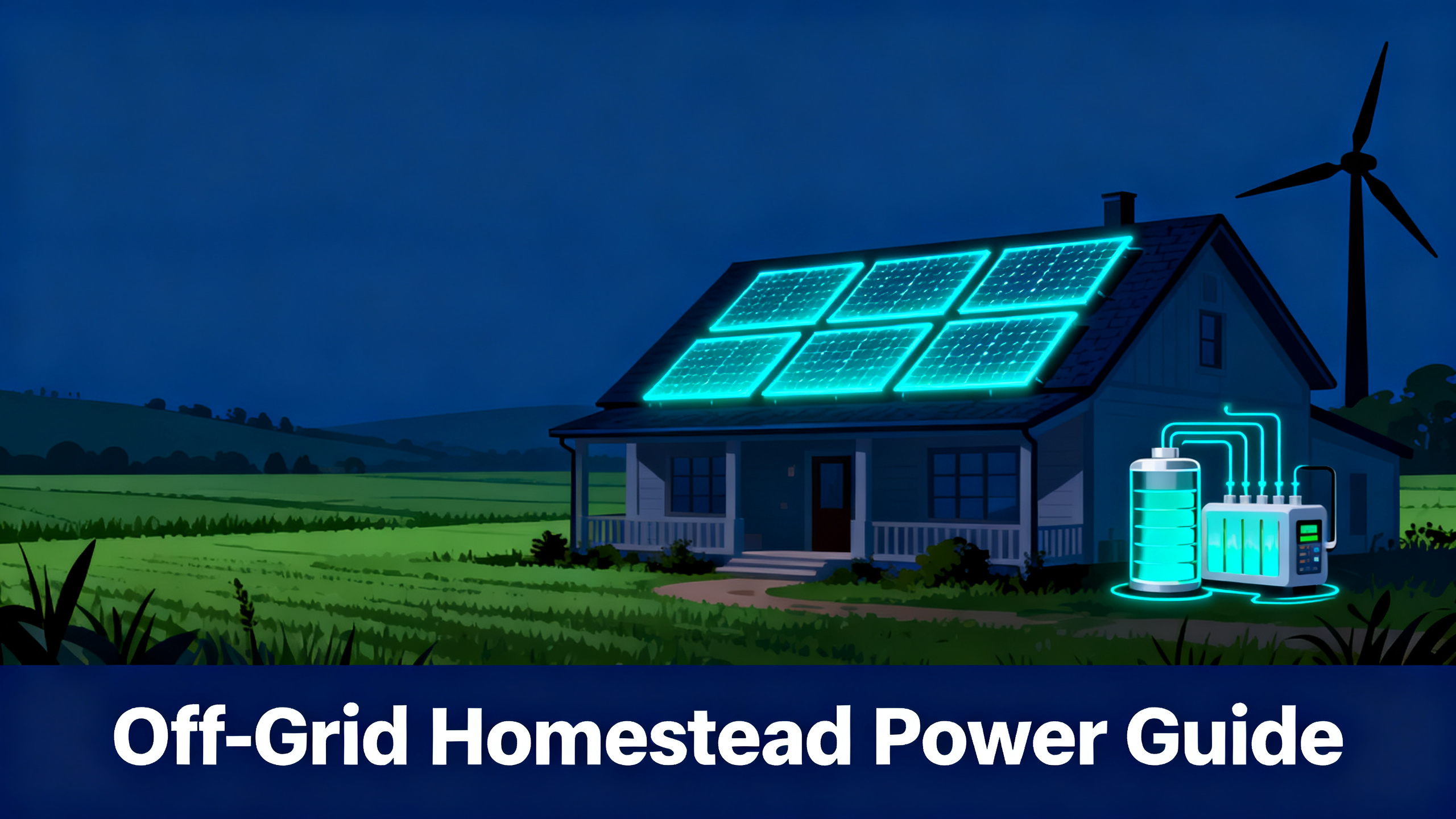
Looking for a power system that can keep your homestead running through outages, seasonal storms, and grid failures? Off-grid living has shifted from a fringe lifestyle to a practical response to rising utility rates and unreliable rural infrastructure. U.S. residential solar adoption data shows a steady climb in homeowners pairing storage with solar, and homesteads sit at the leading edge of that trend.
Here’s the practical reality: a working homestead needs to cover well pumps, freezers, power tools, lighting, and increasingly, electric vehicles or partial HVAC. That’s not a weekend campsite load. It’s a continuous, multi-kilowatt operation that runs every day of the year, not just during outages.
This guide breaks down what a real off-grid homestead system needs in 2026, how to size it for your actual loads, and which power station configuration handles the job without requiring a permit-heavy installation or contractor crew.

Anker SOLIX F3800
$1,799 , Base Unit
- 3,840Wh capacity, 6,000W AC output (120V/240V split-phase)
- Expandable to 26.9kWh with up to 6 BP3800 batteries
- Up to 2,400W solar input, charges in under 2 hours
Get our Black Friday alerts for power stations
We track live prices on 40+ models from Jackery, EcoFlow, BLUETTI and Anker SOLIX. When a deal beats the lowest price we've recorded, you'll hear from us. During Black Friday week, one short recap a day at most.
Unsubscribe in one click. We may earn a commission when you buy through our links, at no extra cost to you. Privacy Policy
What Does a Homestead Power System Actually Need?
A homestead power system is fundamentally different from a backup battery for the suburbs. Your loads are heavier, your runtime expectations are longer, and you can’t tolerate single points of failure when the nearest utility crew sits two hours away. Many properties on the homesteading edge of America still face rural electrification infrastructure gaps, with grid extensions costing $20,000 to $50,000 per mile.
Your system needs to handle three categories of load simultaneously: continuous draws (refrigeration, freezers, pumps cycling on and off), intermittent high-wattage tools (table saws, welders, well pump startups), and 24/7 baseline (lighting, internet, electronics). Each category has different requirements for capacity and surge handling.
💡 Pro Tip: Before sizing any system, log your daily loads for a week with a clamp meter or smart panel. Most homesteaders underestimate runtime needs by 30 to 40 percent, especially for freezer cycles and well pump frequency.
The math is unforgiving but predictable. Once you know your daily kWh draw, your storage and solar requirements become straightforward calculations rather than guesses.
Daily Power Audit for Homesteads
Before choosing any equipment, you need a realistic picture of what your homestead actually consumes. Most homesteads cluster between 4 and 7 kWh per day for core loads, climbing to 8 to 12 kWh when partial climate control or workshop tools enter the picture.
The biggest variables are your well pump cycle frequency, your freezer count, and whether you run an HVAC system at all. Performance data consistently shows that surge wattage matters more than continuous wattage for sizing decisions, since pump and compressor startups draw 2 to 3 times their rated load for a few seconds.
Typical Homestead Daily Power Loads
💧
Well Pump (1HP)
~800W
2,400W surge
❄️
Chest Freezer
~100W avg
2.4kWh/day
🔧
Power Tools
1,500 to 3,000W
intermittent
💡
Lighting + Devices
~200W
~1.6kWh/day
A typical active homestead draws 4 to 7 kWh/day without HVAC. With partial climate control, budget 8 to 12 kWh/day.
Logging your draws for a week reveals patterns you can’t predict from datasheets. You’ll likely find that your freezer cycles eat more energy than expected, while your power tools draw less in total than feared because their actual runtime is short.
Running a Well Pump Off-Grid
The well pump is typically the heaviest single load on a homestead. Surge wattage, runtime, and which stations handle the startup draw.
Get our Black Friday alerts for power stations
We track live prices on 40+ models from Jackery, EcoFlow, BLUETTI and Anker SOLIX. When a deal beats the lowest price we've recorded, you'll hear from us. During Black Friday week, one short recap a day at most.
Unsubscribe in one click. We may earn a commission when you buy through our links, at no extra cost to you. Privacy Policy
The Case for Scalable Power Stations Over Fixed Solar
Traditional fixed solar installations require permits, structural assessment, racking, conduit runs, and a licensed electrician for the inverter and battery cabinet. For a homestead investment of $15,000 to $30,000, that approach makes sense when you have a permanent property and don’t expect your needs to change.

Modular power stations flip this calculation. A unit like the Anker SOLIX BP3800 plugs into the F3800 base unit without tools and adds 3,840Wh of LFP storage rated for 3,000 lifetime cycles. You can start small, then scale as your needs grow.
This matters for homesteads because needs change. A young couple starts with a cabin and 3 kWh per day. Five years later they have kids, a freezer, a workshop, and 9 kWh per day. Modular storage absorbs that growth without scrapping the original investment.
Anker SOLIX F3800, Scalable Capacity Tiers
*Based on 4 to 7 kWh/day homestead draw. Solar replenishment not included.
The other advantage is mobility. If you sell the property or relocate, your power system goes with you. Fixed solar stays.
Off-Grid Solar Power Systems
A broader overview covering every component from panels to inverters, with sizing examples for different property types.
Best Power Stations for Full Homestead Use
For full homestead duty in 2026, the Anker SOLIX F3800 sits at the top of the practical recommendation list. Its 3,840Wh capacity, 6,000W AC output (split-phase 120V/240V), and expandability up to 26.9kWh address the actual load profile of an active property.
What sets the F3800 apart from competing 3kWh-class units is the split-phase 240V output. Most homesteads need at least one 240V appliance, whether that’s a deep well pump, a welder, or a future EV charger. Units that only deliver 120V force you into adapters and de-rated performance for those critical loads.
Spec analysis confirms the F3800 handles 6,000W continuous output and tolerates surge spikes for high-startup loads. Charging matches: up to 2,400W solar input via dual 60V ports brings the unit from empty to full in under 2 hours under optimal sun.

For most homesteads, the practical recommendation is the F3800 plus one BP3800 expansion battery, which delivers 7.68kWh of usable storage. That covers a typical family homestead for roughly 1.1 to 1.9 days without solar input, giving you a comfortable cushion for cloudy stretches and overnight loads when solar production drops to zero.
Anker SOLIX F3800 + Expansion Battery
7,680Wh | 6,000W, Best homestead starter kit
$6,498
For homesteads with heavier draws or larger families, scaling to 2 expansion batteries (11.52kWh) is the sweet spot. The architecture lets you add capacity later, so starting smaller and growing into the system is a valid budget strategy. The Anker SOLIX scalable expansion systems guide breaks down exactly how each tier changes your runtime and break-even calculations.
Buy the F3800 system if…
- You run a well pump, chest freezer, and power tools regularly
- You want to start at 3.84kWh and expand as your needs grow
- Your property lacks reliable grid access or has frequent outages
- You want 6,000W split-phase (120V/240V) for all appliance types
Consider alternatives if…
- Your daily load is under 1kWh (smaller unit will suffice)
- You need central AC as a primary load (grid-tied solar is more cost-effective)
- You have reliable grid power and only need occasional backup
Homesteaders who prefer Bluetti’s ecosystem can explore Bluetti expansion battery options for a comparable modular approach with similar 3,000-cycle LFP chemistry. The F3800’s split-phase native output remains a practical edge for 240V appliances.
Building a Hybrid System: Solar + Generator + Power Station
The most resilient homesteads run hybrid systems: solar as the primary source, the power station as the daily storage and load center, and a propane or gas generator as the deep-winter or extended-cloudy-week backup. Each layer covers the failure mode of the others.


Solar gives you free power, but it varies by season and weather. The power station smooths daily variability and provides instant inverter capacity for surge loads. The generator handles the rare 4-day blizzard or extended overcast week when solar production drops to 10 percent of summer peaks.
Sizing is the trick. For most homesteads, a 1,200 to 2,400W solar array charges the F3800 in normal conditions, and a 5,000 to 7,500W gas generator handles rapid recharge when needed. The pairing a generator with your power station guide explains exactly how to wire both without overloading your system.

Add a 10-circuit manual transfer switch to keep installation simple and avoid permitting headaches. The transfer switch isolates your essential circuits from the main panel and lets you power them from the F3800 directly, no electrician required for ongoing operation.
Seasonal Considerations: Winter Production and Summer Peaks
Solar production varies more than most buyers expect. In a temperate US climate, December production can drop to 30 to 50 percent of June peaks, depending on latitude and cloud cover. That’s not a small variance. It’s the difference between covering your daily loads and falling 4 kWh short every day for 8 weeks.
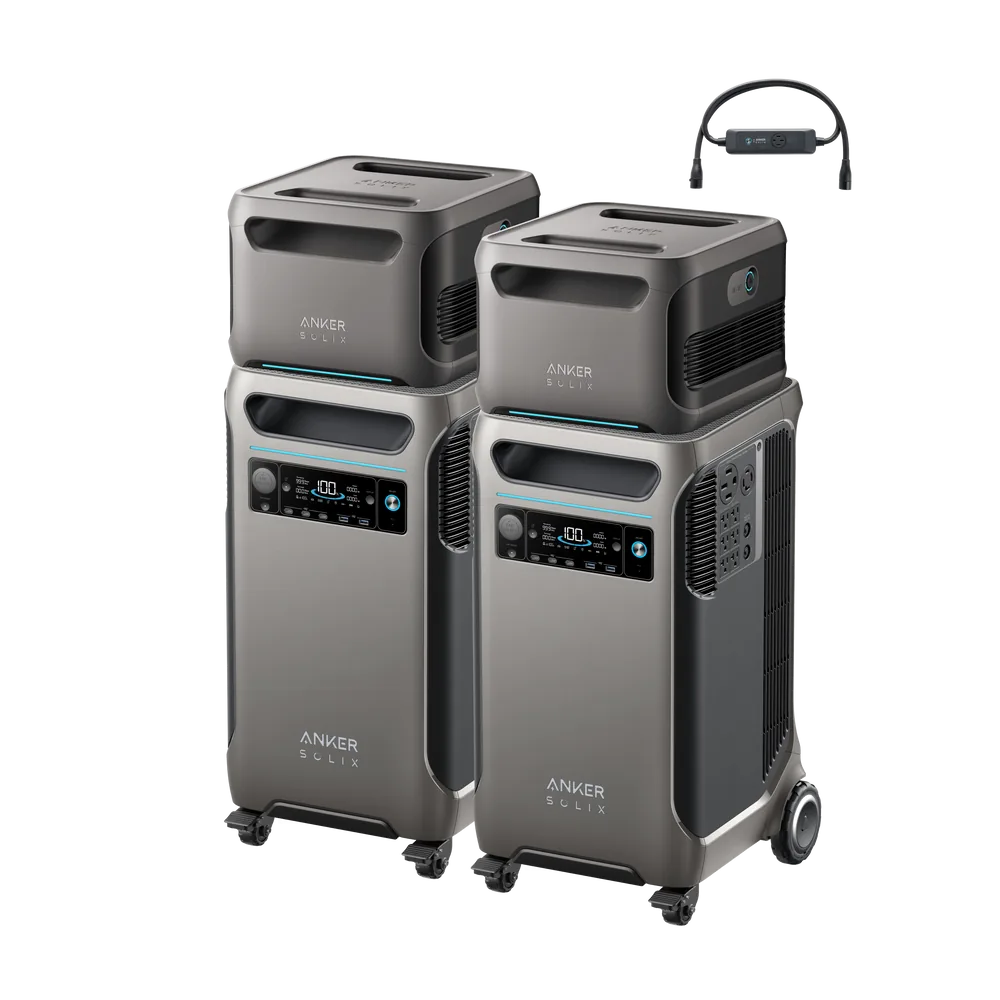

The practical solution is oversizing storage. Adding a second BP3800 (taking your total to 11.52kWh) gives you almost 2 days of buffer, which carries you through most cloudy stretches. For heavy-snow regions or northern latitudes, 3 expansion batteries plus a small gas generator is the standard configuration.
Summer brings the opposite problem: excess production. With 1,600W or more of panels, your batteries fill by mid-morning. The fix is using that surplus directly: scheduling water heating, well pumping, and EV charging during peak production hours.
Winter Solar Charging for Homesteads
Reduced daylight and panel angle matter more than buyers expect. Real production figures and storage sizing for winter months.
Frequently Asked Questions
Can the Anker SOLIX F3800 run a well pump?
Spec analysis confirms the F3800’s 6,000W AC output handles the steady draw of a 1HP well pump (approximately 800W running, up to 2,400W surge). The built-in surge protection accommodates the startup spike. With a BP3800 expansion, total capacity reaches 7.68kWh, supporting multiple pump cycles throughout the day without solar input.
How many solar panels do I need to keep a homestead running indefinitely?
Based on a 4 to 7 kWh per day homestead load, calculations indicate 1,200 to 2,400W of solar panels provide net-zero consumption in peak sunlight conditions. The F3800 accepts up to 2,400W solar input (dual 60V), which means six 400W panels can fully recharge the base unit in approximately 2 hours under optimal conditions.
What is the difference between the F3800 and the F3800 Plus for homestead use?
The F3800 Plus accepts up to 3,200W solar input (dual 165V vs. dual 60V on the base F3800) and supports 240V bypass charging from a wall outlet or generator. For homesteads with heavy winter cloudy periods or a gas generator as backup, the Plus model’s broader input compatibility gives it a meaningful advantage. The base F3800 remains the better value-per-kWh starting point for most buyers.
How much does a full off-grid homestead power system cost?
Entry-level configurations with the F3800 base unit start at $1,799. A practical family homestead setup (F3800 + 1 BP3800 + 2× 400W solar panels) runs approximately $5,000 to $6,500. A full independence setup (F3800 + 2 to 3 BP3800 + 4 to 6 panels + transfer switch) lands between $8,000 and $12,000 depending on configuration and accessories.
Can I expand the F3800 system later if my power needs grow?
Yes. The F3800 architecture supports up to 6 BP3800 expansion batteries, scaling from 3.84kWh to 26.9kWh without replacing the core unit. Two F3800 units linked via a Double Power Hub scale to 12kW output and 53.8kWh storage. This modular design is the primary reason it suits homesteads where energy needs evolve over time.
Does the Anker SOLIX F3800 qualify for the federal solar tax credit?
Not if it’s installed in 2026. The Residential Clean Energy Credit, which covered home energy storage like the F3800, ended for systems installed after December 31, 2025. A system installed by then can still be claimed on a 2025 return.
How do I size my system for winter months with less sunlight?
Winter solar production can drop 30 to 50 percent depending on latitude and cloud cover. The practical approach is to calculate your worst-case daily load, determine minimum daily solar production for your region in December and January, and size storage to bridge the gap. For most temperate US homesteads, 2 to 3 BP3800 expansion batteries provide sufficient buffer on low-production days. A gas generator backup remains the most reliable insurance for extended cloudy periods.
What can the F3800 NOT power on a homestead?
The F3800’s 6,000W AC ceiling means it handles most homestead loads individually, but running central AC (typically 3,000 to 5,000W steady draw plus 15,000W+ startup surge) simultaneously with a well pump, freezer, and tools exceeds realistic battery-only capacity. The data suggests treating central AC as a supplemental system (short cycles) or pairing two F3800 units for sustained HVAC coverage.
Conclusion
Off-grid homestead living in 2026 doesn’t require a $40,000 fixed solar installation or a battery shed. A scalable system built around the Anker SOLIX F3800 (starting at $1,799 and expanding to over 50kWh) handles real homestead loads with the flexibility to grow as your needs change. Pair it with solar panels and a small generator backup, and you have a system that pays for itself through avoided utility costs while delivering true energy independence.
Anker SOLIX F3800
From $1,799
Best scalable power station for homestead off-grid living
Price verified May 2026, Free shipping available
Originally published: May 7, 2026