
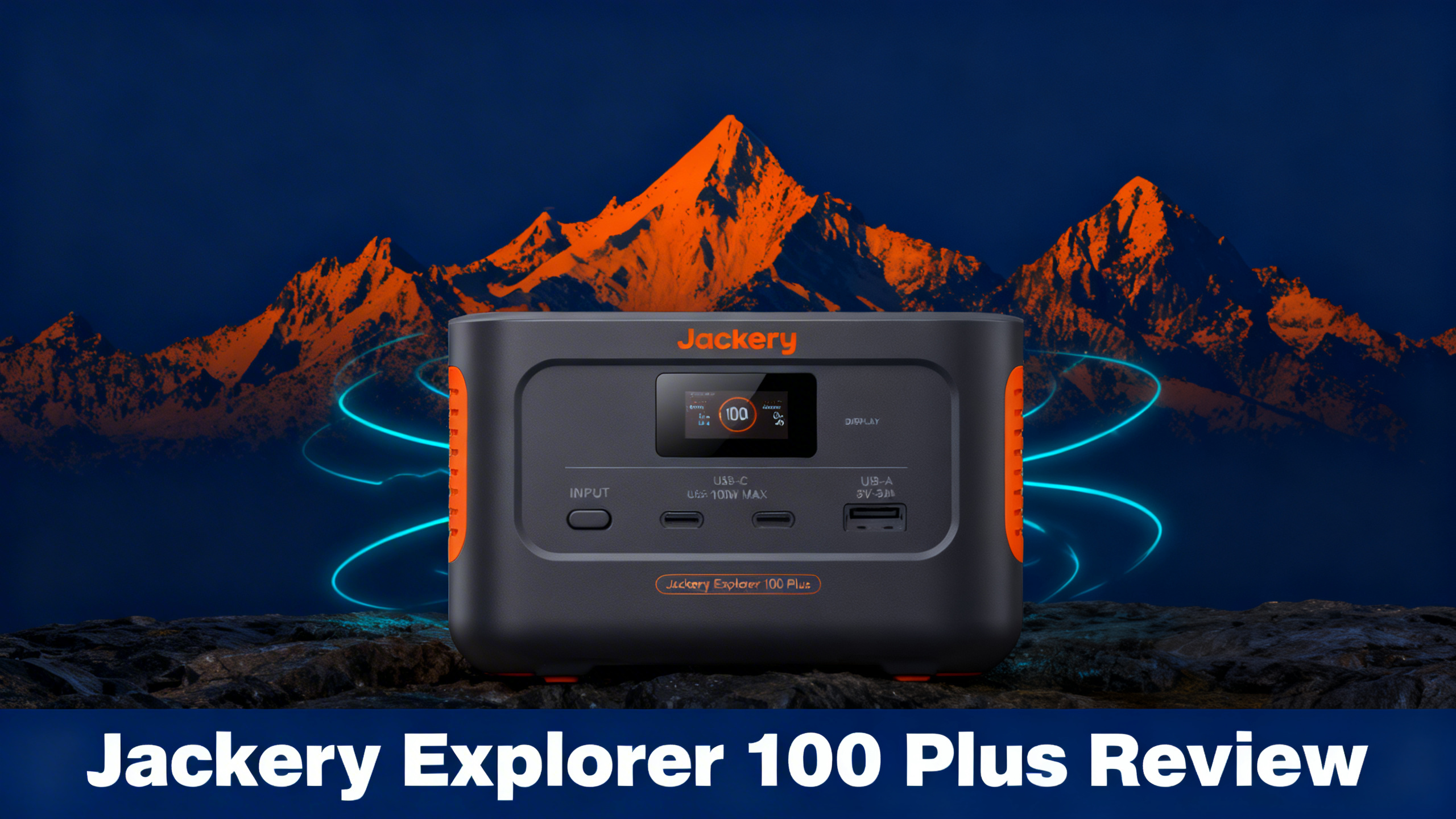
Looking for a sub-100Wh power station that won’t get flagged at airport security? The Explorer 100 Plus is Jackery’s smallest unit with LFP (lithium iron phosphate) chemistry, packing 99Wh into a 2.13 lb frame at $109. For travelers, digital nomads, and anyone who’s ever scrambled for an outlet between flights, that combination of specs is hard to ignore.
LFP batteries have become the standard worth comparing against in portable power. At this capacity class, most competitors still ship with NMC chemistry and its shorter cycle life. The Explorer 100 Plus bucks that trend. If you’re comparing against the full Jackery lineup, the 100 Plus occupies a very specific niche: maximum portability with genuine long-term durability, no AC, no bulk. Here’s what the data shows.
Update: the Explorer 100 Plus has been discontinued
Jackery no longer sells the Explorer 100 Plus. The closest current model is the Jackery Explorer 240D (256Wh LiFePO4, 300W AC output, from $209) — a larger step up with an AC outlet rather than a like-for-like replacement. The product links in this review now point to the Explorer 240D. We’ve kept the original review live for existing owners and for comparison research.

Jackery Explorer 100 Plus
$109 $149 -27% OFF
- 99Wh LFP battery, 2,000+ cycle lifespan
- 100W dual PD: charges and discharges simultaneously
- Under TSA 100Wh limit: airline-approved carry-on
See Successor: Jackery Explorer 240D →
Price checked April 2026 | Free shipping available
Get our Black Friday alerts for Jackery
We track live prices on 40+ models from Jackery, EcoFlow, BLUETTI and Anker SOLIX. When a deal beats the lowest price we've recorded, you'll hear from us. During Black Friday week, one short recap a day at most.
Unsubscribe in one click. We may earn a commission when you buy through our links, at no extra cost to you. Privacy Policy
Quick Verdict: What the Numbers Say About the Explorer 100 Plus
The Explorer 100 Plus is purpose-built for one user: the frequent traveler who needs reliable device power without checking a bag. At 99Wh, it clears the TSA carry-on threshold with 1Wh to spare. At 2.13 lbs, it’s lighter than most laptops. At $109 (down from $149), it delivers LFP chemistry and 100W dual PD at a price where most competitors are still shipping NMC.
The limitations are clear-cut, not deal-breakers: no AC outlet, 128W max output, and a solar adapter sold separately. For the audience this unit targets, those aren’t missing features. They’re intentional trade-offs that keep the weight and price where they are. Spec analysis confirms this is a strong value play for the digital carry segment.
BackupPowerHub Rating
Jackery Explorer 100 Plus
8.4/10
“The best value LFP power station under $150 for travelers”
Battery Longevity 9.5/10
Portability 9/10
Charging Speed 8/10
Value for Money 8.5/10
Output Power 6.5/10
Versatility 7/10
Bottom line: The 100 Plus delivers LFP longevity and true dual PD in a 2.13 lb package at $109. Output is limited to 128W, but for travelers and everyday digital carry, spec analysis confirms it punches well above its price class.
Explorer 100 Plus Specifications: A Detailed Breakdown
The Explorer 100 Plus carries a 99Wh LFP battery with a rated 2,000-cycle lifespan to 80% capacity. Maximum output is 128W across all ports combined, with no AC inverter. The primary output path is dual USB-C PD at up to 100W per port, making it a genuine high-speed charger for laptops, tablets, and smartphones.
Recharge time via DC is rated at 1.8 hours to full. Solar input requires the SolarSaga 40W Mini (or equivalent panel), but note that the DC7909-to-USB-C adapter ($19.90) is sold separately and required for solar connection. Weight is 2.13 lbs (0.97 kg). The unit ships in two color options: standard orange and Dune White.
| Specification | Jackery Explorer 100 Plus |
|---|---|
| Battery Capacity | 99Wh |
| Battery Chemistry | LFP (LiFePO₂) |
| Max Output | 128W |
| AC Output | None |
| USB-C PD (max) | 100W dual PD (charge and discharge simultaneously) |
| Cycle Life | 2,000 cycles to 80% capacity |
| DC Charge Time | 1.8 hours (full) |
| Solar Charge Time | ~2 hours (requires DC7909-to-USB-C adapter, sold separately) |
| Weight | 2.13 lbs (0.97 kg) |
| Airline Compliance | Yes: 99Wh is under the 100Wh TSA carry-on limit |
| Warranty | 2 years |
| Price | $109 (was $149) |
Full specs are available on the official Explorer 100 Plus product page.
Jackery Explorer 100 Plus
$109 $149
99Wh LFP, 2.13 lbs, Airline safe
Battery Chemistry: Why LFP Matters at This Price Point
LFP (lithium iron phosphate) batteries offer a fundamentally different longevity profile than NMC (nickel manganese cobalt) cells. Published cycle data for the Explorer 100 Plus confirms 2,000 cycles to 80% capacity. Typical NMC units at this price point rate around 500 cycles. At one full charge per day, that difference translates to roughly 5.5 years versus 1.4 years before capacity drops below 80%.
For a device you’ll carry on every trip and charge frequently, that distinction matters. The 12-layer BMS (Battery Management System) described in the published specifications adds another layer of protection against overcharge, over-discharge, and temperature extremes. The data points to a unit built for sustained daily use, not occasional emergency backup.
The Dual USB-C PD Feature: Charge and Discharge Simultaneously
Both USB-C ports on the Explorer 100 Plus support 100W PD input and output. In practice, that means you can charge the unit from a wall adapter through one port while simultaneously delivering power to a laptop through the other. This pass-through capability is uncommon at the sub-$150 price point in this capacity class.
For a traveler working in an airport lounge with one available outlet, that feature is genuinely useful. The unit charges itself and keeps your laptop running from a single wall plug.
Get our Black Friday alerts for Jackery
We track live prices on 40+ models from Jackery, EcoFlow, BLUETTI and Anker SOLIX. When a deal beats the lowest price we've recorded, you'll hear from us. During Black Friday week, one short recap a day at most.
Unsubscribe in one click. We may earn a commission when you buy through our links, at no extra cost to you. Privacy Policy
Design and Portability: How the 100 Plus Compares
The Explorer 100 Plus weighs 2.13 lbs and ships in two colorways: the standard Jackery orange and a Dune White variant. The build quality reflects the upgraded BMS described in Jackery’s published specs: the housing is solid, the ports are clearly labeled, and the unit has a compact footprint that fits in the front pocket of most travel backpacks.
Typical products in this capacity class weigh between 2.5 and 3.5 lbs, often with bulkier form factors. The 100 Plus stands out on the weight chart. The trade-off is the absence of AC: no inverter means no added heat, no fan noise, and no weight penalty from the transformer components. The Whisper Quiet designation in the published specs is accurate by design. For pack-weight comparisons against rivals, see our ultralight backpacking options roundup.
Airline Compliance: The 99Wh Advantage
Under TSA lithium battery regulations, lithium-ion batteries at or below 100Wh can be carried on aircraft without any airline approval. Batteries between 100Wh and 160Wh require the airline’s permission. Anything above 160Wh is prohibited in cabin baggage entirely.
At 99Wh, the Explorer 100 Plus clears the 100Wh threshold with a 1Wh margin. That’s not accidental: Jackery engineered this unit specifically to qualify as an unrestricted carry-on battery. You won’t need to call your airline, fill out a form, or worry at the gate. You pack it and bring it on board.
This is one of the few power stations with LFP chemistry that achieves this. Most LFP units targeting meaningful runtime start at 240Wh or higher, which disqualifies them for unrestricted cabin travel. The 100 Plus occupies a narrow but practical window: genuine LFP durability in a format the TSA allows without conditions.
Traveling with the 100 Plus
Full airline rules, carry-on tips, and real trip scenarios covered in detail.
Real-World Performance: What Runtime Data Shows
Runtime calculations based on the 99Wh capacity at 85% efficiency (a standard working estimate that accounts for conversion losses) give a clear picture of what this unit can and can’t do. The data shows strong performance for its intended use cases and honest limitations beyond them.
What Can the 100 Plus Power? (99Wh, Runtime Estimates at 85% Efficiency)
💻
Laptop (65W)
~1.3 hrs
65W draw
📱
Smartphone
~9 charges
~11Wh/charge
🎮
Switch / Tablet
~4-5 charges
~18Wh/charge
💡
LED Lamp (10W)
~8.5 hrs
10W draw
Runtime calculations based on 99Wh capacity at 85% efficiency. Actual results vary by device and temperature.
The 128W output ceiling is the main constraint. Devices drawing more than 128W won’t run at full power, and appliances requiring AC won’t run at all. Owner data consistently reports the 100 Plus as a capable travel companion for laptops and phones, and an unreliable choice for anything requiring a wall socket.
Charging the 100 Plus: DC vs Solar
DC charging via the included cable takes 1.8 hours to full capacity. That’s faster than most units in this class and practical for topping up before a flight. Solar charging via the SolarSaga 40W Mini takes approximately 2 hours under good conditions.
One important detail: solar connection requires the DC7909-to-USB-C adapter, sold separately at $19.90. The unit does not include this adapter in the box. If solar charging is part of your plan, factor that additional cost into your budget.
Who Is the Explorer 100 Plus For?
The data points clearly to one primary audience: travelers who fly frequently and need reliable device power in carry-on luggage. The 99Wh limit, 2.13 lb weight, and USB-C-only output profile are all calibrated for this use case. Secondary audiences include digital nomads working from cafes and co-working spaces, students who want portable power for long study sessions, and photographers or videographers who need to keep cameras and laptops charged during shoots.
Day campers and festival attendees can get solid value from the 100 Plus for phone and tablet charging. It’s not sized for multi-day off-grid use. Anyone who needs an AC outlet, plans to run power tools, or wants to keep a mini-fridge running should look at a larger unit instead. For a full breakdown of what Jackery Jackery entry-level options offer across the compact range, we have a dedicated comparison.
Explorer 100 Plus: Is It Right for You?
✅ Buy this if…
- You travel by plane and need sub-100Wh compliance
- Your primary devices are phones, tablets, and laptops
- You want LFP longevity (2,000 cycles) at under $150
- You need 100W PD to charge and discharge simultaneously
- Weight matters: 2.13 lbs is class-leading for this capacity
❌ Skip this if…
- You need AC outlets: the 100 Plus has none
- You plan to run appliances above 128W
- You need more than 1-2 hours of laptop runtime
- You need solar without buying the separate DC adapter
- You want a home backup or RV solution
Pros and Cons: An Honest Analysis
Published specifications and owner feedback patterns support a consistent picture of this unit’s strengths and limitations. No power station at $109 is perfect for every use case, and the 100 Plus has real trade-offs alongside its genuine advantages.
Pros
- LFP chemistry: 2,000 cycles to 80%
- 100W dual PD at this price is rare
- 99Wh: airline carry-on approved
- 2.13 lbs: class-leading portability
Cons
- No AC outlet
- 128W max limits appliance compatibility
- Solar adapter sold separately ($19.90)
- Currently out of stock on Jackery.com
⚠️ Stock Note: The Explorer 100 Plus is currently listed as out of stock on the official Jackery website. Check availability with authorized Amazon resellers or sign up for restock notifications on jackery.com before ordering.
Final Verdict: Is the Jackery Explorer 100 Plus Worth It?
For the right buyer, yes. Spec analysis of the sub-$150, sub-100Wh power station segment shows the Explorer 100 Plus is difficult to match on the combination of LFP chemistry, 100W dual PD, 2.13 lb weight, and airline compliance. Those four attributes together at $109 represent strong value in this category.
The absence of an AC outlet is the only feature gap that might rule it out, and it will for some users. If you need to plug in AC devices, the 100 Plus simply won’t help. But if your power needs are a laptop, a phone, and a tablet, this unit handles all three reliably, charges in under two hours, and has a cycle life that should last well beyond most of its competitors.
Shoppers on a tighter budget who want to compare the full compact range should check our best Jackery under $500 roundup before making a final call.
Jackery Explorer 100 Plus
$109
Best sub-$150 LFP travel power station
See Successor: Jackery Explorer 240D →
Price verified April 2026. Check availability before ordering
FAQ: Jackery Explorer 100 Plus
Can the Jackery Explorer 100 Plus be charged through either USB-C port?
Published specifications indicate both USB-C ports support PD input and output simultaneously. One port handles incoming charge while the other delivers power to a connected device. This dual-direction PD is a key differentiator at the $109 price point. You can top up the unit while it’s actively powering your laptop, using only one wall outlet.
Is the Jackery Explorer 100 Plus allowed on planes?
At 99Wh, the Explorer 100 Plus falls under the TSA’s 100Wh carry-on threshold for lithium batteries. Passengers can bring it in carry-on luggage without requiring airline approval. Batteries between 100Wh and 160Wh require carrier authorization. The 100 Plus avoids that requirement entirely, making it one of the few LFP power stations that qualifies as an unrestricted carry-on.
Does the Explorer 100 Plus have an AC outlet?
No. The Explorer 100 Plus does not include an AC inverter. Output is limited to DC and USB ports, with a maximum 128W combined output. It is designed specifically for charging USB-C and USB-A devices. If you need to run AC-powered appliances, a larger unit with an inverter (such as the Explorer 240 or 300 v2) is required.
How long does the Jackery Explorer 100 Plus take to charge?
Manufacturer data indicates a full DC charge in approximately 1.8 hours. Solar charging takes around 2 hours when using a compatible panel such as the SolarSaga 40W Mini. Note that solar charging requires the separate DC7909-to-USB-C adapter, sold at $19.90 and not included in the box.
What is the difference between the Explorer 100 Plus and the Explorer 240 or 300 v2?
The key difference is output capability and capacity. The 240 and 300 v2 both include AC outlets and higher wattage outputs, suitable for camping appliances and light home backup. The 100 Plus has no AC outlet, but its 99Wh capacity qualifies for airline carry-on without approval, while the 240Wh and 288Wh models exceed the TSA threshold. The 100 Plus is purpose-built for travel; the larger models target camping and light home backup use cases.
How many phone charges can the Explorer 100 Plus deliver?
Runtime calculations based on the 99Wh capacity at 85% efficiency and a typical 11Wh smartphone charge yield approximately 7 to 9 full charges. Real-world results vary depending on the phone model, cable quality, and ambient temperature. Larger flagship phones with 4,500mAh+ batteries will land toward the lower end of that range.
Originally published: April 15, 2026