
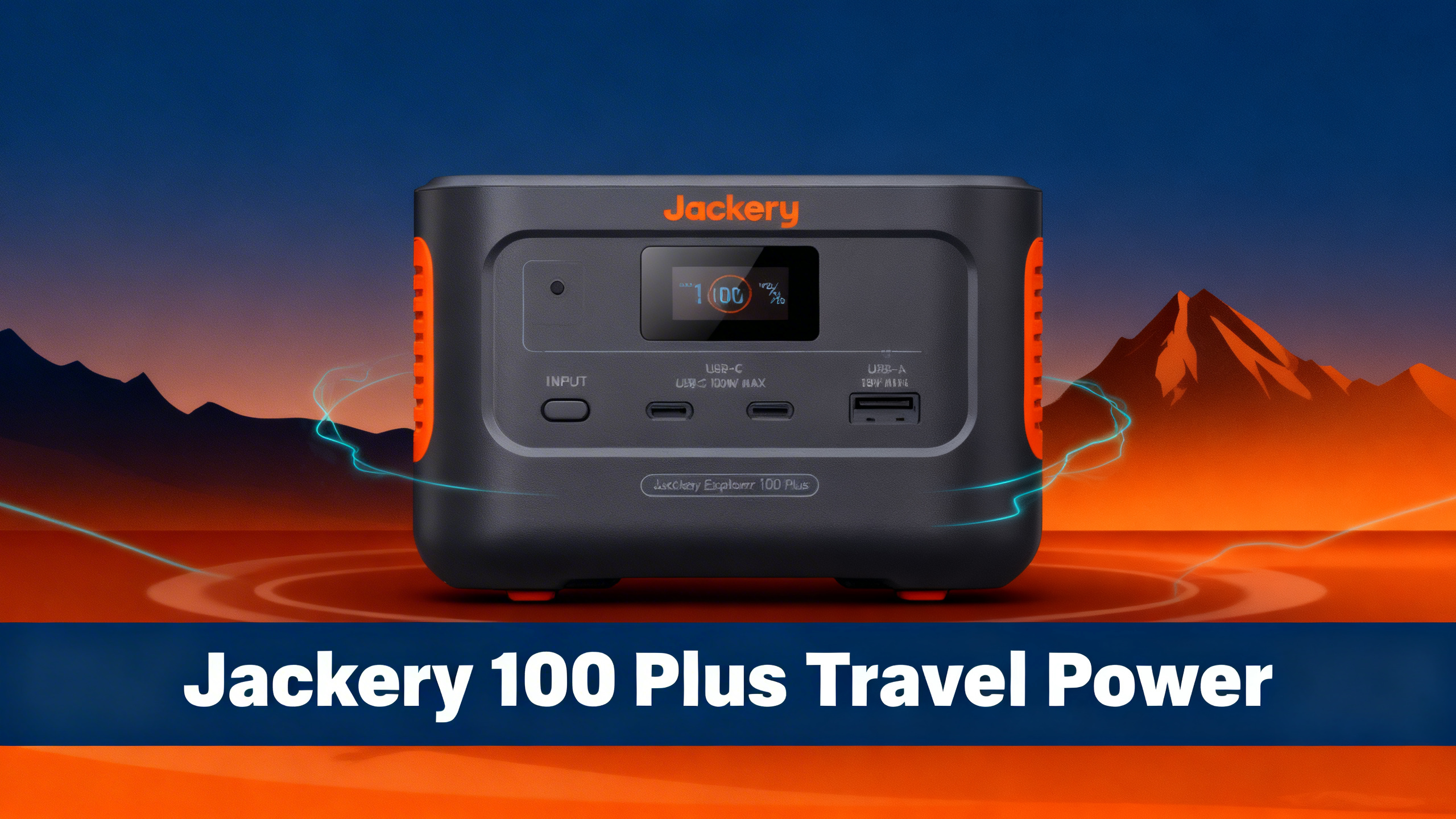
Flying with a portable power station sounds simple until you hit the security checkpoint. Most travelers only find out their power station is banned after an agent pulls it from their bag. The rules exist, they’re enforced, and the Wh rating on your unit is the number that decides everything.
The ultra-compact Jackery Explorer 100 Plus (99Wh) that once cleared carry-on limits without any conversation has been discontinued. Jackery’s closest current travel-oriented unit is the Explorer 240D, a 256Wh LiFePO4 power station. It carries far more capacity and a real 300W AC outlet, but at 256Wh it sits above the 160Wh cabin ceiling, so it is not a fly-with-you carry-on the way the 100 Plus was. Here’s what the data shows about whether it’s the right companion for travelers and digital nomads in 2026, and exactly how the airline rules apply to it.

Jackery Explorer 240D
$209
- 256Wh capacity: best for road trips, not cabin flights
- LiFePO4 battery: long cycle life, 5-year warranty
- 300W AC outlet plus USB-C PD ports
Get our Black Friday alerts for Jackery
We track live prices on 40+ models from Jackery, EcoFlow, BLUETTI and Anker SOLIX. When a deal beats the lowest price we've recorded, you'll hear from us. During Black Friday week, one short recap a day at most.
Unsubscribe in one click. We may earn a commission when you buy through our links, at no extra cost to you. Privacy Policy
Why Travelers Keep Getting Stopped at Security (And How to Avoid It)
Power station confiscations at airport security are more common than most people expect. The issue isn’t traveler negligence: it’s that the TSA/FAA capacity rules aren’t prominently communicated when you buy a portable power station for home or camping use. A unit that works perfectly for a weekend trip becomes airport contraband the moment you try to board a flight with it.
The core regulation is straightforward. The FAA and TSA classify lithium batteries by watt-hour (Wh) rating, which is the total energy capacity printed on the unit or in its manual. Under 100Wh, a battery is permitted in carry-on luggage without any airline pre-approval. Between 100Wh and 160Wh, the battery may fly carry-on with explicit airline permission, which most airlines grant but some deny. Above 160Wh, the battery is prohibited on all passenger flights, regardless of airline. And critically: portable power stations of any capacity are never permitted in checked bags.
This is where a unit like the Explorer 240D lands. At 256Wh it sits well above the 100Wh line, so it does not clear carry-on rules automatically the way a sub-100Wh power bank does. Larger units such as the EcoFlow River 2 (256Wh) and Jackery Explorer 300 Plus (288Wh) fall in the same territory. If you specifically need a battery that boards with zero airline conversation, you want something under 100Wh; the 240D trades that automatic clearance for far more usable capacity and a real 300W AC outlet.
What the TSA 100Wh Rule Actually Means for Power Stations
The 100Wh threshold was set by the FAA based on thermal runaway risk analysis for lithium batteries in aircraft environments. Batteries above 100Wh carry a statistically higher energy release potential in a failure event, which is why they require airline review. According to the TSA guidelines on lithium batteries, the under-100Wh category is treated as low-risk and approved without case-by-case review.
The FAA carry-on battery rules add one practical nuance: the rating must appear on the battery itself. The Explorer 240D displays “256Wh” on the unit label. That number is unambiguous, but it also puts the unit above the 160Wh ceiling, which means it is not permitted in the cabin on passenger flights. For the 240D, the label works against carry-on eligibility rather than for it.
Airline Policies That Go Beyond FAA Rules
The FAA sets the floor, not the ceiling. Some Asian carriers, including several Chinese and Japanese airlines, enforce a stricter 100Wh maximum with zero tolerance for the 100–160Wh range, even with formal airline approval. For a 256Wh unit like the Explorer 240D, none of that helps: it is above the 160Wh cabin ceiling under FAA rules, so it does not fly in the cabin regardless of carrier. If in-flight power is your priority, pair the 240D with a separate sub-100Wh power bank for the plane itself.
The recommendation before any trip is to verify your specific airline’s battery policy. But for the Explorer 240D, the 256Wh rating means it belongs in the car, the RV, the hotel room, or basecamp rather than in your carry-on.
What the Jackery Explorer 240D Delivers for Travelers
As a road-tripper or digital nomad, your power needs are distinct from home backup scenarios. You need something that charges fast, handles your laptop and phone simultaneously, and can also run a small AC device when a hotel or campsite outlet is out of reach. The specs on the Explorer 240D align closely with that profile once you accept it travels in the car rather than the cabin.
Capacity data confirms 256Wh at 300W continuous AC output. For context, that’s enough to run a MacBook Air M2 (52Wh battery) for roughly 4 full charges, or an iPhone 15 Pro (14.8Wh) for around 15 charges, accounting for the typical 85% efficiency factor in lithium cell discharge. The USB-C PD ports handle simultaneous laptop and smartphone charging, which is the typical mobile-work use case. For a complete technical breakdown of specs and performance, see our full compact-Jackery review covering charging speed, port options, and real-world output.
One feature that distinguishes this unit from standard USB power banks is the AC outlet delivering 300W. That opens up devices requiring a standard wall plug: camera battery chargers, portable monitors with barrel connectors, small fans, and travel-sized accessories that don’t have USB-C inputs. Most pocket “power banks” offer only USB output and top out at 65–100W PD. The 240D adds a genuinely useful AC layer on top of a much larger battery.
| Specification | Jackery Explorer 240D |
|---|---|
| Battery Capacity | 256Wh (over 160Wh: not cabin-eligible) |
| AC Output | 300W |
| Battery Type | LiFePO4 (LFP) |
| Cycle Life | Long LiFePO4 cycle life (5-year warranty) |
| AC Recharge Time | Fast ~1-hour AC charging |
| Solar Recharge Time | Supported via SolarSaga panels |
| USB-C PD (Input/Output) | USB-C PD (simultaneous charge + discharge) |
| Price | $209 |
Get our Black Friday alerts for Jackery
We track live prices on 40+ models from Jackery, EcoFlow, BLUETTI and Anker SOLIX. When a deal beats the lowest price we've recorded, you'll hear from us. During Black Friday week, one short recap a day at most.
Unsubscribe in one click. We may earn a commission when you buy through our links, at no extra cost to you. Privacy Policy
TSA Rules for Power Stations on Planes
The practical reality for the Explorer 240D is that it does not fly in the cabin. At 256Wh it is above the 160Wh ceiling, and no airline approval overrides that limit. Power stations of any size are also barred from checked bags. So the 240D is not a unit you pack for a flight, it is one you keep in the car, camper, or hotel you drive or ship it to.
If your trips involve flying, the honest split is to bring a sub-100Wh power bank on the plane for in-seat charging and treat the 240D as your basecamp power once you land and pick up your vehicle. TSA agents are familiar with the sub-100Wh rule for the small bank; the 240D simply belongs to the ground portion of the trip. International routes follow the same IATA-aligned watt-hour limits in most countries.
One practical note: solar charging on the Explorer 240D runs through Jackery’s SolarSaga panels and the matching charge cable, which are sold separately. If you plan to top the unit up off-grid, budget for a panel kit. For most trips you’ll recharge fastest from a wall outlet or a vehicle port at your basecamp.
Airline Policies That Go Beyond FAA Rules
It’s worth being blunt about where the 240D lands here. A handful of airlines, particularly in East Asia, apply a blanket 100Wh ceiling with no exceptions even for the 100–160Wh “approved” category. The Explorer 240D at 256Wh is well beyond all of these thresholds, so it is a ground-travel unit, not a carry-on. The predictable, no-conversation cabin slot belongs to a separate sub-100Wh power bank; the 240D earns its place once you’re off the plane.
Practical Travel Scenarios for the Jackery 240D
As a traveler, the use cases for a 256Wh power station are specific and well-defined. This isn’t a whole-home backup, but it comfortably bridges a weekend off-grid: hotel and Airbnb rooms with inconveniently placed outlets, coworking spaces with contested receptacles, van and car camping, and back-to-back shooting days for photographers.
Over a full day of mobile work away from wall power, capacity data shows the 240D can deliver roughly 4 MacBook Air M2 charges plus a stack of smartphone top-ups, or keep a laptop and phone going for the better part of a working day. That covers a day at a remote worksite or a night at a campsite without needing to hunt for an outlet.
For photographers, the 300W AC outlet changes the calculus significantly. Camera battery chargers (Sony NP-FZ100, Canon LP-E6NH) typically run on wall adapters rather than USB-C. With 256Wh on tap, the 240D can cycle roughly 20–30 camera batteries per full charge, which covers multiple days of shooting for most videographers and travel photographers. Combine that with phone and drone controller charging via the PD ports, and a single unit covers most of a location kit.
What Can It Power? (256Wh Capacity)
💻
MacBook Air M2
~4 charges
52Wh battery
📱
iPhone 15 Pro
~15 charges
14.8Wh battery
🎧
AirPods Pro
~60 charges
~4Wh
📷
Camera Battery
~20–30 charges
~8Wh each
Runtime estimates based on 256Wh capacity at ~85% efficiency. Actual results depend on device draw and temperature.
The roughly one-hour fast AC recharge is a practical differentiator for multi-stop travelers. A short stop somewhere with wall power is enough to bring the unit from depleted to nearly full, ready for the next leg of a road trip. Many units this size need 2–3 hours for comparable capacity. Taking your gear off-grid? Our outdoor power guide covers which Jackery models handle camping and off-grid adventures best.
Battery Technology: Why LFP Matters for Travelers
Most portable power stations use NMC (nickel manganese cobalt) lithium-ion chemistry, which offers high energy density but degrades faster and carries a higher thermal runaway risk than LFP. The Explorer 240D uses LiFePO4 (LFP), a chemistry originally developed for applications requiring stability under variable temperature and repeated charge-discharge cycling.
For a traveler charging the unit a few times a week, LFP chemistry translates to many years of service before capacity meaningfully drops, which is why Jackery backs the 240D with a 5-year warranty. A standard NMC unit at 300–500 cycles degrades noticeably within 1–2 years of the same usage pattern. Published specifications on the LFP chemistry confirm no significant capacity degradation from temperature swings typical of travel: cold overnight lows, hot afternoons, and long stints in a parked vehicle.
The thermal stability of LFP is also relevant from a safety standpoint. LFP cells have a significantly higher thermal runaway threshold than NMC cells (270°C vs 150–210°C), which is one reason airlines and regulators are incrementally more comfortable with LFP chemistry in passenger cabins. While this doesn’t change the regulatory threshold, it does explain why LFP units tend to pass airline inspections with fewer questions.
💡 Pro Tip: Recharge the Explorer 240D fully before you head out, not once you’re already off-grid. The fast ~1-hour AC charge works best from a standard wall outlet at home or in a hotel room the night before. Topping up from 50% rather than 0% gets you back to full in roughly half that time.
Who Should Buy the Jackery Explorer 240D
The Explorer 240D fits a specific traveler profile: someone who drives or camps, works on a laptop on the road, and needs more than a pocket power bank without stepping up to a heavy home-backup unit. Digital nomads, field journalists, van-lifers, and travel photographers all fall within this profile. The 256Wh capacity matched with a 300W AC outlet covers real device loads, and the LFP longevity makes the unit a multi-year investment rather than a disposable accessory.
If you need more capacity for longer trips, explore other compact Jackery options covering the full new lineup. If you’re considering alternatives for other price points, more budget options among the new Jackery lineup up to $499 are available for travelers who need more output than the 240D’s 300W.
✅ Buy this if…
- You travel by car, van, or RV and need real power
- You work remotely on laptops and phones
- You want LFP longevity with a 5-year warranty
- You need fast ~1-hour recharge between stops
- You want a 300W AC outlet, not just USB
❌ Skip this if…
- You need to power big appliances (300W max output)
- You need a battery you can carry onto a flight
- You need large expandable capacity for multi-day off-grid
- You want a whole-home backup unit
- Stock availability is critical right now
⚠️ Stock Note: Availability of the Jackery Explorer 240D on jackery.com can be intermittent. Check the current listing, look at Amazon resellers, or sign up for Jackery’s restock notifications before planning a purchase around a specific travel date.
FAQ: Jackery 240D for Travel
Can you bring the Jackery Explorer 240D on a plane?
No. At 256Wh, the Explorer 240D is above the 160Wh limit that the FAA/TSA set for passenger flights, so it is not permitted in the cabin, and power stations of any size are barred from checked bags. If you need in-flight power, carry a separate sub-100Wh power bank and use the 240D for the ground portion of your trip.
Can the Jackery Explorer 240D charge a laptop?
Yes. The USB-C PD output handles most modern laptops, including the MacBook Air M2 (roughly 4 full charges from 256Wh), Dell XPS 13, and similar thin-and-light devices, and the 300W AC outlet covers larger laptop bricks too. Simultaneous laptop and smartphone charging is supported.
How long does the Jackery Explorer 240D last on a single charge?
Runtime depends on the connected device. Capacity data shows approximately 15 smartphone charges (iPhone-class, 14–16Wh), 4 MacBook Air M2 charges, 20–30 camera battery cycles, or 60+ wireless earbud cases. At constant 30W draw (laptop on low power mode), runtime calculates to roughly 7–8 hours.
Does the Jackery Explorer 240D have an AC outlet?
Yes. It delivers 300W AC output, which differentiates it from standard power banks that offer only USB charging. This allows connecting devices that require a standard wall plug, including cameras, portable fans, small TVs, and many laptop chargers. Appliances requiring more than 300W will not operate correctly.
Is the Jackery Explorer 240D a good travel power station?
For ground travel, yes. Its 256Wh LiFePO4 battery, 300W AC outlet, fast ~1-hour recharge, and 5-year warranty make it a strong companion for road trips, van and car camping, hotel stays, and location photography. Its one limitation for flyers is capacity: at 256Wh it exceeds the 160Wh cabin ceiling, so it cannot travel in the cabin the way a sub-100Wh power bank can.
The Bottom Line on the Jackery 240D for Travel
The Explorer 240D makes a clear case for travelers who move by car, van, or RV and need real power on the road. The 300W AC outlet handles devices a pocket bank can’t, the fast ~1-hour recharge tops it up between stops, and the LFP battery with a 5-year warranty outlasts the typical replacement cycle of most travel accessories. At $209, the price aligns with its position as a genuine mid-size travel and off-grid unit rather than a scaled-down power bank.
The limitations are honest and predictable. At 300W, it won’t run the most power-hungry appliances. And critically, at 256Wh it exceeds the 160Wh cabin limit, so it is not a battery you carry onto a flight. Availability on jackery.com can also be intermittent: verify through resellers before committing to a travel date.
For the traveler it’s designed for, road-trippers, van-lifers, and photographers covering a location kit, the spec-to-use-case alignment is strong, as long as flying isn’t part of the plan.
Jackery Explorer 240D
$209
256Wh LFP power station with 300W AC for the road
Price verified April 2026. Check availability before ordering
Originally published: April 15, 2026