
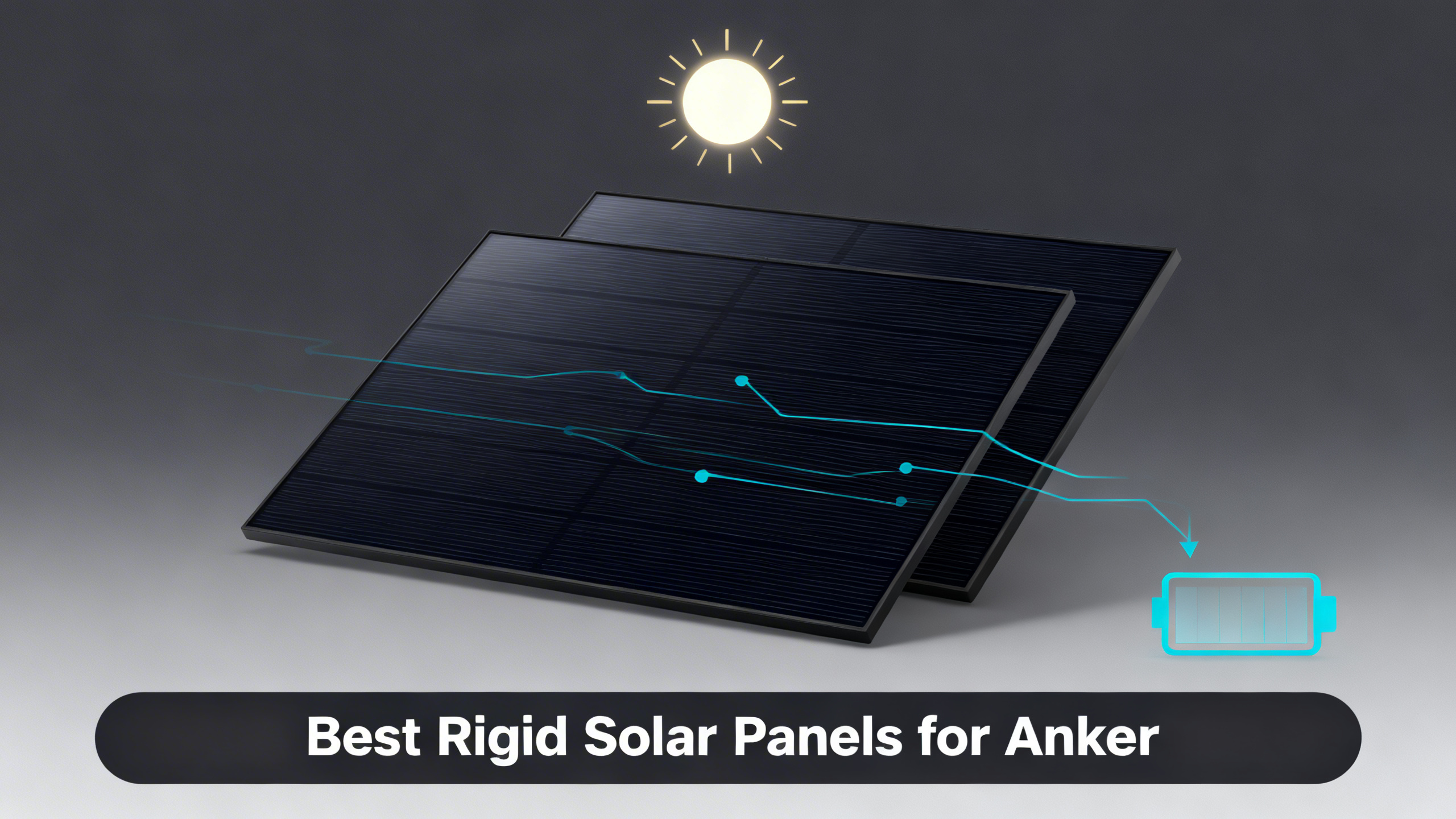
Before you buy solar panels for your Anker SOLIX station, here's what you need to know: not all panels are created equal, and the gap between a portable folder and a fixed rigid panel matters more at high-capacity setups than most buyers expect.
The Anker SOLIX F3800 and F3000 accept up to 2,400W of solar input. A single portable PS400 delivers 400W. To approach the station's actual ceiling, you need multiple panels in a fixed array, and that's exactly where the Anker SOLIX 440W rigid bifacial panel changes the math. At 25% conversion efficiency with bifacial rear harvesting, the 440W rigid model is engineered specifically for multi-panel home and RV rooftop arrays paired with high-capacity SOLIX stations.
This guide covers the key specifications, panel count recommendations by station, wiring configurations for home and RV installs, and the practical decision framework for choosing rigid over portable. Here's what the data shows.

Anker SOLIX 440W Rigid Solar Panel (2-pack)
$999.00 ($499.50/panel)
- Industry-leading 25% conversion efficiency
- Bifacial: captures 30% more rear-side energy
- IP68 waterproof, 10-yr panel / 30-yr performance warranty
Understanding Rigid vs Portable Solar Panels
The core difference is installation type. Rigid panels are mounted permanently on a roof, a ground mount, or RV roof rails. Portable panels fold for transport and deploy on a kickstand wherever the sun hits. Both connect via MC4 to your station's solar input, but the use case determines which makes sense for your setup.
Efficiency tells part of the story. The Anker SOLIX 440W rigid panel uses bifacial monocrystalline cells rated at up to 25% conversion efficiency. The portable PS400 uses standard monocrystalline cells rated at up to 23%. That 2-point gap compounds across a larger array: over six panels, the difference in harvested watts adds up to a meaningful daily charge advantage. Panel efficiency ratings are standardized under testing conditions defined by U.S. Department of Energy solar panel efficiency standards.
Durability splits the categories further. The 440W rigid panel carries an IP68 waterproof rating, covering sustained immersion scenarios (rain, snow, condensation over a 30-year lifespan). The PS400 is IP67, rated for temporary immersion. For a fixed home install or a full-time RV roof mount, IP68 represents meaningful long-term protection. For a full comparison of the Anker SOLIX lineup and how every model fits together, the full Anker SOLIX brand review covers compatibility and configuration in detail.
Choose Rigid 440W Panels if…
- You have a fixed install location (home roof or RV roof)
- You want maximum efficiency per square foot (25% vs 23%)
- You need bifacial rear harvesting for reflected light
- Your climate involves heavy rain or hail (IP68)
- You're building a multi-panel array for F3800, F3000, or E10
Skip rigid panels if…
- You move your setup frequently (camping, van life)
- You need adjustable angle positioning by hand
- You don't have mounting brackets or roof rails
- Weight is a constraint (portable panels weigh less)
- Your station input is below 600W (panels would be underutilized)
Anker SOLIX 440W Rigid Panel: Key Specifications
Technical Specs at a Glance
The 440W rigid panel ships as a 2-pack at $999.00 ($499.50 per panel), with the box including four MC4 cables and one MC4-to-XT-60i adapter for direct station connection. Published specifications confirm an industry-leading 25% conversion efficiency rating for a panel in this price category.
Bifacial Technology: What It Actually Means
Standard solar panels only harvest light from the front surface. Bifacial panels add photovoltaic cells to the rear side, capturing light reflected from the surface below: roofing material, concrete, grass, or even snow. Certified data for the Anker SOLIX 440W rigid model indicates potential rear-side gains of up to 30% under optimal albedo conditions, with actual gains varying by surface reflectivity and panel tilt angle.
For a rooftop home install or an RV parked on reflective concrete, that rear-side contribution is real and measurable. For an install over dark asphalt with no reflective surface, the rear gain is minimal. The key is understanding your specific environment before counting on the full 30% uplift in your sizing calculations.

IP68 vs IP67: Why the Extra Waterproof Rating Matters
IP67 covers submersion up to 1 meter for 30 minutes, sufficient for rain exposure in most conditions. IP68 goes further, covering sustained submersion depths specified by the manufacturer. For a panel mounted on a home roof or RV exterior that will face decades of weather cycles, IP68 provides the additional margin that matters over a 30-year performance warranty period.
Which Anker SOLIX Panels Are Available?
The 440W rigid panel is available in bundle packs sized for different array needs. The 2-pack at $999.00 is the entry point for a 880W array. The 4-pack at $1,998.00 builds a 1,760W configuration that works effectively with both the F3800 and F3000. Larger bundles extend to 6-pack and 8-pack configurations for those building out a maximum-capacity home solar setup.
Each bundle includes MC4 cables and the MC4-to-XT-60i adapter needed for station connection, so you're not sourcing cables separately. For a side-by-side breakdown of every panel in the lineup, including the PS100, PS200, and PS400, see the complete Anker SOLIX solar panel comparison. For a detailed comparison, see our 440W vs 410W panel breakdown.

Best Rigid Panel Setup for Home Backup (F3800 and E10)
F3800 + Rigid Panels: Optimal Configuration
The F3800's 2,400W maximum solar input is the benchmark that makes the 440W rigid panel's efficiency count. Spec analysis confirms that five panels in a properly wired series-parallel configuration produce approximately 2,200W under standard test conditions, close enough to the ceiling to be practical. Six panels push theoretical output to 2,640W, slightly over the input limit, which means the MPPT controller will regulate down to 2,400W at peak production. That's the recommended ceiling configuration for F3800 users who want to maximize harvest without leaving significant input capacity on the table. For full compatibility data and wiring diagrams specific to the F3800's MPPT input specs, the Anker SOLIX F3800 review covers this in detail.

F3000 + Rigid Panels: Dual MPPT Advantage
The F3000 uses a dual-MPPT input architecture: one port at 60V/800W and a second at 165V/1,600W. For rigid panel arrays, published specs indicate the 165V MPPT port is the high-capacity channel for series-wired panel strings. A 4-panel array wired as two series strings in parallel fits cleanly within the combined 2,400W input ceiling. For details on both stations' MPPT voltage windows and how they affect panel wiring choices, see F3800 vs F3000 rigid panel compatibility in the respective reviews.
E10 Whole-Home System + Rigid Panels
The E10 system supports rigid panel input at the individual battery module level. Published compatibility data confirms support for both 405W and 440W panel configurations per module. For whole-home setups scaling across multiple E10 battery modules, that per-module input stacks, making the 440W rigid panel the logical choice for maximizing per-module harvest across a larger installation.
RV Rooftop Rigid Panel Setup Guide
How Many Rigid Panels Fit on an RV Roof?
A single Anker SOLIX 440W rigid panel measures approximately 195 x 99 cm. Available roof area by RV class determines your practical panel ceiling before wiring even enters the picture. Class B vans (camper vans) typically offer 90 cm of usable width, fitting one panel per row. Class C motorhomes extend to around 150 cm, enabling two narrow panels side by side. Class A coaches with 200+ cm of roof width support two standard-orientation panels abreast, making 4-panel arrays practical within a single roof span.
Keep in mind that roof vents, AC units, and antenna mounts reduce usable area. A real-world Class A roof with obstructions often supports 3-4 panels comfortably rather than the geometric maximum. Weight is also a factor: at approximately 25 kg per panel, a 4-panel rigid array adds 100 kg to the roof load (relevant for Class B van conversions with lower roof load ratings).
Wiring for RV: Series vs Parallel
The wiring decision comes down to your station's MPPT voltage window. Wiring panels in series increases voltage while keeping current constant. Wiring in parallel does the reverse: current adds while voltage stays at a single panel's level. Spec analysis shows that for the F3800 and F3000, a 2-panel series string produces approximately 72V open-circuit, within the MPPT input window for both stations. That makes a 2-panel series string the recommended starting configuration for RV rooftop installs, with the option to add a second string in parallel for a 4-panel total.

440W Rigid Panel Array Configurations for Anker SOLIX Stations
⚡
2x 440W panels
880W
Series: ~72V / Parallel: ~36V
🏠
4x 440W panels
1,760W
F3800 / F3000 compatible
🔆
6x 440W panels
2,640W
Max for F3800 (2,400W input)
🏚️
2x 440W (E10)
880W
Per battery module input
Readers planning a stationary home install should also read the guide on solar charging for home backup for general sizing principles that apply across all brands.
How to Size Your Rigid Panel Array
Match Your Panel Count to Your Station's Solar Input
The key is understanding your station's maximum solar input before you decide on panel count. Buying more panels than your station can accept doesn't improve charge speed: the MPPT controller caps input at the rated ceiling. The table below maps recommended 440W panel counts to the most common Anker SOLIX stations.
| Station | Max Solar Input | Recommended 440W Panels | Array Output |
|---|---|---|---|
| F3800 | 2,400W | 5-6 panels | 2,200-2,640W |
| F3000 | 2,400W | 4-5 panels | 1,760-2,200W |
| F2600 | 1,000W | 2 panels | 880W |
| F2000 | 1,000W | 2 panels | 880W |
Budget Planning: 2-Pack, 4-Pack, or 8-Pack?
Cost-per-watt analysis across the bundle options shows consistent pricing: the 2-pack at $999.00 across 880W of capacity works out to $1.14/W. The 4-pack at $1,998.00 for 1,760W holds the same $1.14/W. Anker SOLIX maintains pricing parity across pack sizes rather than discounting volume purchases. The bundle choice is therefore a function of your target array output, not a cost optimization decision.
For the F3800 and F3000, the 4-pack at $1,998.00 covers the practical sweet spot: 1,760W output occupies 73% of the 2,400W input ceiling, leaving room for a third string addition later if you expand. If you're still deciding on which power station to pair with your rigid panels, the complete Anker SOLIX buying guide covers every model with capacity and solar input recommendations.

Rigid vs Portable: Which Panel Type Is Right for You?
The decision comes down to installation permanence. If your Anker SOLIX station lives in a fixed location (home garage, dedicated backup room, or RV with a permanent roof rack), rigid panels deliver higher efficiency, better weather durability, and a 30-year performance warranty that portable panels don't offer. If you move your station between locations, load it into a car for camping weekends, or need panels you can reposition by hand throughout the day, the PS400 portable at $899.00 is the more practical tool.

Final Recommendation
For fixed installations paired with high-capacity Anker SOLIX stations, spec analysis confirms the 440W rigid panel delivers the strongest watt-per-dollar value and the long-term durability profile that permanent installs require. The 2-pack at $999.00 is the right entry point for F2600 and F2000 users, or for RV setups limited by roof space. The 4-pack at $1,998.00 is the practical choice for F3800 and F3000 owners building toward a capable home backup array.
The 10-year panel warranty and 30-year linear performance guarantee separate the 440W rigid panel from portable alternatives in the same price range. For a mobile setup, the PS400 remains the better tool. For everything fixed, the data points clearly to the rigid 440W panel as the right anker solix solar panel investment. Full wiring diagrams and MC4 connector specifications are available on the official 440W Rigid Solar Panel product page.
Anker SOLIX 440W Rigid Panel (2-pack)
$999.00
Top pick for F3800, F3000, and E10 home solar setups
Price verified April 2026. Free shipping available
Frequently Asked Questions
Are the Anker SOLIX 440W rigid panels compatible with all SOLIX power stations?
Spec analysis confirms the 440W rigid panels are optimized for high-input stations including the F3800, F3000, and the E10 ecosystem. Lower-capacity stations such as the C1000 or C800X have solar inputs of 600W and 300W respectively, making a single 440W panel the practical maximum for those models. Published compatibility data recommends checking the MC4 connector voltage and current ratings against each station's MPPT specifications before configuring multi-panel arrays.
What is bifacial technology and does it actually improve output?
Bifacial solar panels feature photovoltaic cells on both the front and rear sides of the panel. The rear side captures light reflected from surrounding surfaces (rooftops, ground, snow) rather than direct sunlight. Manufacturer data for the Anker SOLIX 440W rigid model indicates potential rear-side gains of up to 30% under optimal conditions, though actual gains depend on albedo (reflectivity) of the installation surface and panel tilt angle.
Can I mix rigid 440W panels with the portable PS400 in the same array?
Mixing panel types within a single MPPT string is not recommended. Performance data from solar installation best practices shows that mismatched Voc (open-circuit voltage) and Isc (short-circuit current) values between panel types reduce overall array output to the lowest common denominator in a series string. For arrays with both panel types, connecting them to separate MPPT inputs (as available on the F3000's dual MPPT system) is the recommended configuration.
How many 440W rigid panels do I need to fully charge an F3800?
Published specifications for the F3800 indicate a 2,400W maximum solar input. Calculations based on 440W panels show that 5 panels produce approximately 2,200W under standard test conditions, approaching the F3800's input ceiling. In practice, efficiency losses from wiring and temperature mean a 6-panel array is often recommended for reaching close to the rated 2,400W input and achieving the published 1.5-hour charge time to 80%.
Are Anker SOLIX 440W rigid panels eligible for the federal tax credit?
The 30% Residential Clean Energy Credit (ITC) applies to solar panels installed as part of a qualifying home energy system. Certified data from IRS guidance indicates standalone solar panels paired with battery storage systems qualify when the battery is charged 100% from solar. Consulting a tax professional is recommended to confirm eligibility based on your specific installation configuration.
What is the warranty on the Anker SOLIX 440W rigid solar panels?
Published warranty terms for the 440W rigid panels include a 10-year product warranty covering defects in materials and workmanship, and a 30-year linear performance guarantee that specifies minimum output degradation thresholds over the panel's lifetime. This compares favorably to the portable PS400, which does not carry an equivalent long-term performance warranty. Browse our solar generator kits for pre-configured panel-and-station bundles.
Originally published: April 6, 2026