
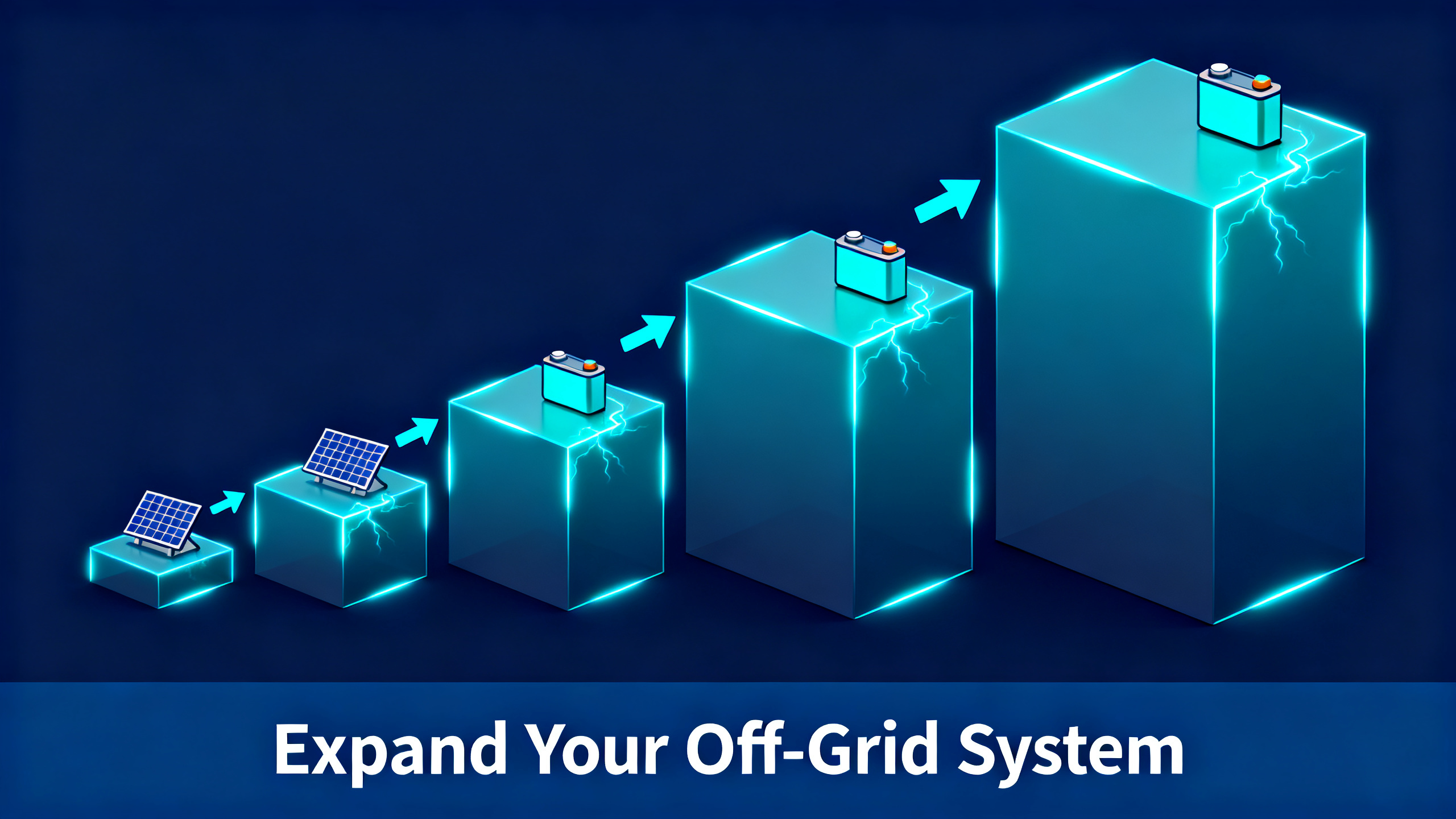
Most people buy a portable power station for today’s needs and regret it within twelve months. The mini-fridge they didn’t plan for, the CPAP they added, the second freezer in the garage: suddenly the unit that felt generous at purchase feels undersized. The good news is that a new generation of expandable solar generators lets you start with a manageable base and scale capacity as your needs grow.
Before diving into expansion hardware, it helps to understand the broader context of off-grid solar power systems, particularly how storage capacity requirements scale with energy demand. This guide compares the four ecosystems leading the market for scalable off-grid power: Anker SOLIX (F3800 + BP3800), Bluetti (AC300 + B300K), EcoFlow (DELTA Pro 3), and Jackery (Explorer 5000 Plus). Each takes a different architectural approach, and each has a different ceiling on how far you can grow.
If you’re trying to decide which system can actually carry you to true energy independence rather than topping out at the wrong moment, the answer comes down to architecture more than headline specs. The best expandable solar generator for a weekend cabin is not the same one a serious off-grid household should buy.

Anker SOLIX F3800 Portable Power Station
$1,799 3,840Wh | 6,000W | Expandable to 26.9kWh
- LFP battery: 3,840Wh base capacity
- Scales to 26.9kWh with up to 6 BP3800 batteries
- Up to 2,400W solar input, charges in under 2 hours
Get our Black Friday alerts for power stations
We track live prices on 40+ models from Jackery, EcoFlow, BLUETTI and Anker SOLIX. When a deal beats the lowest price we've recorded, you'll hear from us. During Black Friday week, one short recap a day at most.
Unsubscribe in one click. We may earn a commission when you buy through our links, at no extra cost to you. Privacy Policy
Why Off-Grid Expansion Matters: Start Small, Scale Smart
The traditional approach to off-grid power buying is binary. Either you over-buy a 10kWh+ system upfront, or you under-buy and replace the unit two years later. Neither is great. Over-buying ties up capital you don’t need yet and locks you into one generation of technology. Under-buying means dual-purchasing, since most non-modular units cannot be daisy-chained or expanded after the fact.
Modular LFP ecosystems solve this. The base unit handles your immediate load profile, and dedicated expansion batteries plug in as your needs grow. Same battery management system, same inverter, same display: just more capacity behind it. Capacity calculations based on published specs show that the cost-per-watt-hour of expansion batteries typically runs 20 to 30 percent below the equivalent in a new standalone unit, which is where the long-term savings come from.
The capacity math is straightforward. Multiply your daily kWh consumption by your target days of autonomy. Weekend campers might need 1 to 2kWh per day across two days. Full-time RV users typically run 3 to 5kWh per day. Whole-home backup planners with electric appliances can push past 15kWh per day. That number, multiplied by your autonomy goal, gives your target storage capacity. Once you know that figure, the right ecosystem becomes obvious.
Off-Grid Expansion Ecosystem Comparison
Understanding Battery Expansion Ecosystems
Off-grid expansion architectures fall into two broad categories. The first is “all-in-one expandable”, where a single power station includes the inverter and base battery, with extra batteries plugging in via dedicated ports. The Anker SOLIX F3800, EcoFlow DELTA Pro 3, and Jackery Explorer 5000 Plus all use this model. You can run the base unit standalone and add capacity later.
The second is “inverter plus separate batteries”, where the main unit is essentially an inverter with no usable storage on its own. Bluetti’s AC300 follows this pattern. The unit has 0Wh of internal capacity and requires at least one B300K battery to function. The advantage is full modularity, since you can swap and stack batteries independently. The trade-off is a higher entry cost to reach a working system.
The most important decision in either architecture is the ceiling. Every ecosystem has a maximum expanded capacity, and once you reach it, further growth means buying a second base unit or switching brands. Spec-for-spec comparison shows the gap between ecosystems is significant, from 10kWh on the Jackery to 48kWh on the EcoFlow. Choosing a system whose ceiling matches your eventual target, not just your current load, is the single highest-leverage decision in this category.
Which Expandable System Is Right for You?
Anker SOLIX F3800 if…
- You want to expand beyond 10kWh eventually
- InfiniPower smart home integration matters
- You prioritize the highest solar input speed
Bluetti AC300 if…
- You already own Bluetti batteries
- You want a modular inverter architecture
- Target capacity is under 12kWh
EcoFlow DELTA Pro 3 if…
- Maximum ceiling (48kWh) is the priority
- You need 120V and 240V output
- UL9540 certification is required
Jackery 5000 Plus if…
- You want a strong base unit with moderate expansion
- Portability and handle design matter
- 10kWh max is sufficient for your needs
Get our Black Friday alerts for power stations
We track live prices on 40+ models from Jackery, EcoFlow, BLUETTI and Anker SOLIX. When a deal beats the lowest price we've recorded, you'll hear from us. During Black Friday week, one short recap a day at most.
Unsubscribe in one click. We may earn a commission when you buy through our links, at no extra cost to you. Privacy Policy
Anker SOLIX: The Most Scalable Off-Grid System Available
The Anker SOLIX F3800 sits at the top of the consumer expandable market for one reason: ceiling. The base unit delivers 3,840Wh of LFP storage and 6,000W of continuous AC output, with a 12,000W surge for motor-start loads. Solar input tops out at 2,400W across dual 60V inputs, which means full recharge in under two hours under optimal sunlight. According to InfiniPower system specifications, the platform supports up to six BP3800 expansion batteries, each adding 3,840Wh.
Run the math: 3,840Wh base plus six times 3,840Wh equals 26,880Wh, or roughly 26.9kWh, all on one inverter. That’s enough capacity to bridge multi-day grid outages for a typical household running fridge, lights, internet, and HVAC fans. The InfiniPower architecture also integrates with Anker’s smart home power kit, which adds direct subpanel integration for users who want a permanent backup install. For a detailed breakdown of every add-on option, see our dedicated guide to Anker SOLIX expansion systems.
Anker SOLIX F3800 Specifications

Anker SOLIX BP3800 Expansion Battery
Add 3,840Wh per unit. Stack up to 6 for 26.9kWh total.
$1,599
The expansion economics work in Anker’s favor for users planning long-term growth. The F3800 base unit retails at $1,799, and each BP3800 adds capacity at roughly $0.42 per watt-hour. Stack three batteries on the base and you reach 15.4kWh for under $7,000, which compares favorably to dedicated whole-home installations that often run $15,000-plus before incentives. Owner feedback across multiple platforms consistently reports clean handoff between base and expansion modules with no manual configuration required.
Bluetti Expansion: B300K and Modular Architecture
The Bluetti AC300 takes a different design path. The unit ships as an inverter only: 3,000W AC output, multiple ports, full display, but zero internal battery capacity. To use it, you must pair at least one B300K battery, which delivers 2,764.8Wh per unit. The system supports up to four B300K modules per AC300 inverter, capping total capacity at 11,059.2Wh, or approximately 11kWh.
This architecture has clear advantages. Buying batteries separately means you can scale capacity in roughly $1,100 increments rather than committing to a $3,000-plus all-in-one upfront. It also means battery generations can evolve independently of the inverter. If Bluetti releases a higher-density module compatible with the AC300, you can upgrade storage without replacing the entire system. Architecture data indicates this is the most “future-proof” approach of the four ecosystems covered here, at least within the Bluetti lineup.
Bluetti B300K Specifications

The trade-offs are structural. The 11kWh ceiling sits well below Anker (26.9kWh) and EcoFlow (48kWh), which limits long-duration off-grid scenarios. The AC300 also lacks native 240V output, an issue for users running well pumps, electric water heaters, or split-phase appliances. For households whose capacity target falls under 12kWh and who already own Bluetti gear, the modular design remains attractive. For larger ambitions, the ceiling becomes a hard wall.
The B300K is currently available at $1,099, which puts cost-per-watt-hour at roughly $0.40, slightly better than the Anker BP3800 on a pure-Wh basis. That advantage is offset by the inverter cost: you still need the AC300 for the system to function, whereas the F3800 ships ready to use. Full compatibility details and pairing instructions are covered in our Bluetti B300K expansion battery guide.
Jackery and EcoFlow: Expansion Options and Limits
Jackery and EcoFlow take very different approaches to expansion, despite both falling in the all-in-one category. Jackery prioritizes a strong base unit with moderate expansion. EcoFlow targets the widest ceiling on the market.
Jackery Explorer 5000 Plus: Solid Foundation, Moderate Expansion
The Jackery Explorer 5000 Plus review covers the base unit’s specs and performance in detail; this section focuses on expansion architecture. The 5000 Plus ships with a 5,000Wh internal capacity and 7,200W rated AC output, which is a substantial standalone unit. Add up to two Battery Pack 2000 Plus modules and total capacity reaches approximately 10,000Wh.

The advantages: strong base capacity, integrated handle and wheels for portability, and a single-unit form factor that doesn’t require separate inverter shopping. The trade-off is the 10kWh ceiling, which puts Jackery’s expansion ceiling at roughly half of Anker’s and one-fifth of EcoFlow’s. For users whose target capacity sits in the 7 to 10kWh range, the Explorer 5000 Plus is currently available at $2,899 (down from $4,299), and the platform delivers without forcing a multi-unit setup.


EcoFlow DELTA Pro 3: The Widest Expansion Range
The DELTA Pro 3 starts at 4,000Wh per unit and supports up to two Smart Extra Batteries per unit. Beyond that, multiple DELTA Pro 3 units can be paralleled, pushing total system capacity to 48,000Wh. This is the widest expansion ceiling currently available in the consumer power station market, according to DELTA Pro 3 official specs.
The DELTA Pro 3 also delivers two technical features that matter for whole-home backup: native 120V and 240V output, and UL9540 certification for residential energy storage system installation. Combined with LFP chemistry and substantial AC output, the platform handles split-phase appliances that most competitors cannot. Spec analysis confirms that the DELTA Pro 3 is the only consumer-grade unit in this comparison capable of running a residential well pump or central air conditioner without external transfer equipment.

The DELTA Pro 3 currently runs $1,999, down from a $3,699 list price, which makes it competitive on a per-Wh basis even before factoring in the expansion headroom. Owner data consistently reports that the platform delivers as advertised on the 240V claim, which is the single most important differentiator for whole-home backup planning.
How to Plan Your Expansion Path
Planning expansion well is more about discipline than spec analysis. The temptation is to buy the biggest base unit you can afford and figure out the rest later, but that’s how people end up with a 10kWh system locked into an ecosystem with a 10kWh ceiling. For households targeting full energy independence, the progression from a portable power station to whole-home battery backup systems follows a predictable set of decision points.

The framework is simple. Audit current loads, set an autonomy goal, choose an ecosystem whose ceiling exceeds that goal, then start small and scale. Most planning errors trace back to skipping one of these four steps, usually the first.
Expansion Planning: 4-Step Framework
01
Audit Your Loads
List every appliance by wattage and daily hours of use. Calculate total daily Wh needed.
02
Define Autonomy Goal
How many days without sun or grid do you need to cover? 1 day is baseline. 3+ days is serious off-grid.
03
Choose Your Ecosystem
Match the system to your max target capacity. Don’t buy a ceiling you’ll hit in 12 months.
04
Start Small, Add Modules
Buy the base unit now. Add expansion batteries as budget allows. All LFP ecosystems support this.
Three common mistakes derail expansion plans. First, buying based on watts (instantaneous draw) rather than watt-hours (energy over time). A 6,000W inverter is meaningless if the battery only stores two hours of typical use. Second, ignoring the ceiling. Most users underestimate how their loads grow once an off-grid system is installed and reliable. Third, mixing brands or generations. None of the four ecosystems covered here support cross-brand expansion, and even within a brand, generational compatibility breaks at major model transitions.
Parallel vs Stacked Expansion: Technical Considerations
Battery expansion happens in one of two electrical configurations. In a stacked (series) configuration, batteries connect end-to-end and voltages add up. Two 24V/100Ah batteries in series become 48V/100Ah. The total capacity in watt-hours stays the same, but the operating voltage rises. Higher voltage means lower current for the same power, which reduces wiring losses and lets the system run thinner cables.
In a parallel configuration, batteries connect side by side and capacities add up. Two 24V/100Ah batteries in parallel become 24V/200Ah. Voltage stays constant, but available capacity (and current capability) doubles. Most consumer expansion ecosystems use parallel architecture for their expansion batteries, since it preserves compatibility with the inverter’s input voltage.
💡 Pro Tip: Despite the technical differences, both configurations are invisible to the end user in modern consumer ecosystems. The BMS handles balancing, current routing, and voltage regulation automatically. There is no manual setup required.
Practically speaking, this distinction is invisible to the end user in the four ecosystems covered here. The BMS (battery management system) of each ecosystem handles balancing, current routing, and voltage regulation automatically. You plug expansion batteries into dedicated ports, the system recognizes them, and total available capacity updates on the display. There is no manual configuration, no voltage matching, no fuse sizing. The complexity sits inside the box.
What this means for expansion planning: you don’t need to be an electrical engineer to scale these systems. The trade-offs that matter are practical, not electrical. Ceiling, cost-per-Wh, native voltage outputs, and ecosystem longevity drive the decision more than the parallel-versus-stacked distinction. Practical installation considerations for a permanent install are covered in the Anker SOLIX home backup setup guide.
Frequently Asked Questions
How many BP3800 expansion batteries can I add to the Anker SOLIX F3800?
Up to 6 BP3800 units can connect to a single F3800, bringing total system capacity to approximately 26.9kWh (3,840Wh base plus six 3,840Wh expansion batteries). The InfiniPower architecture handles connection and BMS coordination automatically. Beyond six modules, scaling further requires adding a second F3800 unit and parallelizing the systems.
Can I add expansion batteries to any solar generator?
No. Expansion compatibility is ecosystem-specific. The F3800 only accepts Anker’s BP3800. The EcoFlow DELTA Pro 3 only accepts the DELTA Pro 3 Smart Extra Battery. Mixing brands or generations is not supported and will void warranties. Always confirm the specific battery part number compatible with your model before purchase.
Is the Bluetti AC300 a good off-grid base unit?
The AC300 functions as an inverter only, requiring at least one B300K battery to operate. This architecture offers flexibility, since you buy batteries separately, but means a higher initial cost to reach a working system compared to all-in-one units. For users already invested in the Bluetti ecosystem or planning capacity under 12kWh, it remains a credible choice. For larger ambitions, the 11kWh ceiling is restrictive.
What is the maximum off-grid capacity I can reach with EcoFlow?
The EcoFlow DELTA Pro 3 can expand to 48kWh when fully configured with multiple units and Smart Extra Batteries. This represents the widest expansion ceiling in the consumer off-grid power station market. Reaching that ceiling requires multiple DELTA Pro 3 base units paralleled together, plus the Smart Extra Battery modules attached to each.
Is it better to buy one large system or start small and add batteries later?
Starting with a base unit and adding batteries over time is generally the more financially sound approach, assuming the ecosystem supports it. All four brands covered here use LFP chemistry with modular expansion. The key is choosing a base unit whose ecosystem ceiling exceeds your eventual target, not just your current needs. Buying a system that maxes out at exactly your current load profile leaves no room for growth.
What’s the difference between stacked and parallel battery expansion?
In a stacked (series) configuration, voltage increases while capacity in amp-hours stays constant. In a parallel configuration, voltage stays the same and capacity doubles. Most consumer off-grid ecosystems handle this configuration automatically at the BMS level, requiring no manual setup from the user. The user-facing experience is identical: plug in the expansion battery, and the system recognizes it.
Can I expand my system over time as my budget allows?
Yes. All four ecosystems featured in this guide support phased expansion. You can purchase the base unit today and add expansion batteries as budget permits. Verify that the expansion units you plan to buy are still in production and remain compatible with your model generation before committing to a specific ecosystem. Generational breaks happen, and a discontinued expansion battery can strand your system at its current capacity.
The Bottom Line
The best expandable solar generator depends on your eventual capacity target, not your current one. Anker SOLIX F3800 wins for users planning long-term growth past 15kWh, with the highest solar input speed and InfiniPower smart home integration. Bluetti AC300 makes sense for existing Bluetti owners or sub-12kWh targets. Jackery Explorer 5000 Plus suits users with a 7 to 10kWh ceiling and portability priorities. For maximum scalability and certified residential installation, EcoFlow DELTA Pro 3 leads the category.
EcoFlow DELTA Pro 3
$1,999 $3,699
Expands 4kWh to 48kWh. 120V and 240V outputs. UL9540 certified.
Price verified May 2026, free shipping available
Originally published: May 7, 2026