
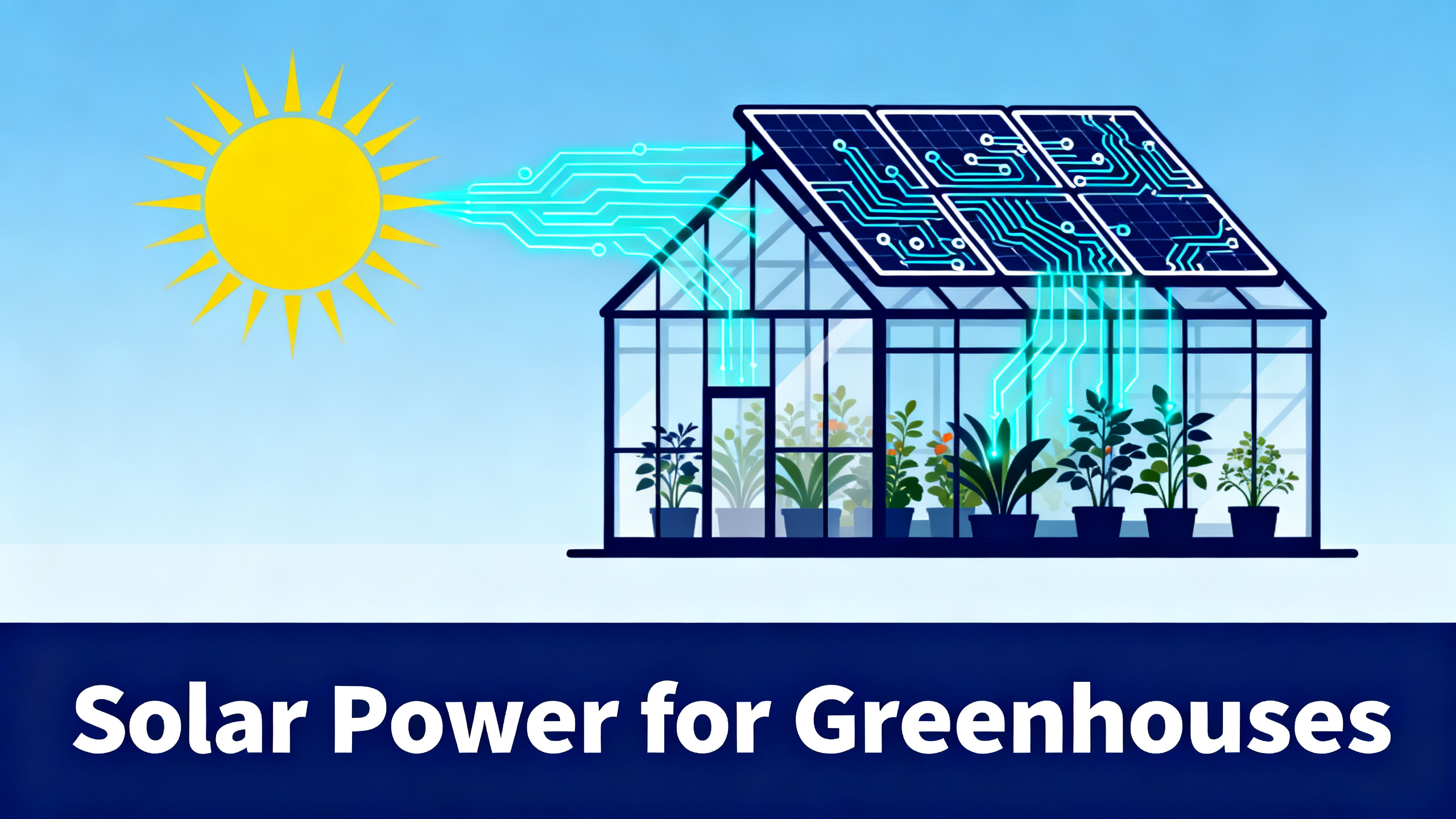
Running an off-grid greenhouse means dealing with a power challenge that most weekend campers never face: loads that run continuously, sometimes 24 hours a day, through every season. Grow lights, heat mats, ventilation fans, and irrigation pumps don’t pause when the sun sets, and they don’t take winters off. So how do you power all of that without grid access, without the noise of a constant generator, and without breaking your budget?
Solar power for greenhouse operations has matured significantly in the past three years. Modern LiFePO4 power stations paired with portable solar panels can now handle the kind of round-the-clock loads that used to require fuel-burning generators. The catch is sizing the system correctly, because greenhouse loads behave very differently from RV or camping loads. This guide breaks down what you actually need, which power stations make sense for greenhouse use, and how to handle the seasonal headaches that come with winter solar production.

EcoFlow DELTA 3 Max
$749 $1,899
- 2,048Wh capacity, expandable to 10kWh
- 2,400W AC output (4,800W surge)
- LiFePO4, 3,000+ cycles, 10-year lifespan
Get our Black Friday alerts for power stations
We track live prices on 40+ models from Jackery, EcoFlow, BLUETTI and Anker SOLIX. When a deal beats the lowest price we've recorded, you'll hear from us. During Black Friday week, one short recap a day at most.
Unsubscribe in one click. We may earn a commission when you buy through our links, at no extra cost to you. Privacy Policy
Why Off-Grid Greenhouses Have Unique Power Challenges
A greenhouse is not a campsite. It’s a closed environment where plants depend on consistent conditions, often around the clock. The power loads that keep that environment alive run on schedules that don’t match how most portable power solutions are designed. This mismatch is why many growers initially over-spend on the wrong equipment, then have to rebuild their setup once they understand what greenhouse loads really demand.
Common Electrical Loads in an Off-Grid Greenhouse
Greenhouse power consumption typically falls into a handful of categories, each with its own behavior pattern. Grow lights are the largest single draw: LED fixtures range from 100W to 400W, while older HPS lights can pull 250W to 1,000W. Heat mats sit at 20W to 45W each, but most setups run four to twelve mats at once, which adds up quickly.
Ventilation fans run between 25W and 150W, often in continuous duty cycles. Thermostats and environmental controllers add another 5W to 15W of always-on draw. Irrigation pumps pull 50W to 200W during their cyclic runs, with brief surge spikes when they kick on. And in winter, a backup space heater can push the system briefly to 750W or 1,500W.
The defining trait of these loads, and the reason camping-grade power stations often disappoint greenhouse owners, is that most of them run continuously or near-continuously rather than in short bursts. This is the distinction that drives every sizing decision.
Why Grid-Tied or Generator-Only Solutions Fall Short
For growers without grid access, the traditional fallback has been a gas or propane generator. The problems are familiar: noise that disturbs neighbors and wildlife, ongoing fuel costs, regular maintenance, and exhaust fumes that can damage plants if the generator sits too close to the structure. Extending grid power to a remote greenhouse can run $10,000 to $30,000 per quarter mile, depending on terrain and utility company rates.
Solar power stations solve all three issues at once. They’re silent, produce zero emissions at the point of use, and have minimal ongoing operational costs once the array is in place. For a comprehensive look at sizing and configuration options across different setups, our off-grid solar power systems guide walks through every scale from small sheds to full homesteads.
Understanding Your Greenhouse Power Requirements
Before picking a power station, you need a realistic estimate of what your greenhouse actually consumes. The difference between guessing and measuring can mean the difference between a system that runs reliably for years and one that struggles every cloudy week. The good news: greenhouse load math is more predictable than most off-grid scenarios, because the equipment list is finite and the duty cycles are well-documented.
Typical Daily Power Consumption by Greenhouse Size
Three rough categories cover most home and small-commercial setups. A micro-greenhouse under 50 square feet typically consumes 400Wh to 800Wh per day, running basic seedling heat mats, a small fan, and limited supplemental lighting. A mid-size greenhouse between 50 and 150 square feet draws 1,200Wh to 2,500Wh daily once you add LED grow lights and proper ventilation. Larger structures over 150 square feet can pull 3,000Wh to 6,000Wh per day with full-spectrum lighting, multiple fans, automated irrigation, and winter heating.
Always add a 20% to 30% buffer above your calculated total. Real-world efficiency losses, inverter overhead, and cloudy-day shortfalls mean the rated capacity of a power station never translates 1:1 to usable output. For load reference points, the greenhouse electrical load guidelines from agricultural extension services provide useful baselines.
What Can 2,048Wh Power in Your Greenhouse?
💡
LED Grow Lights
~8 hrs
250W fixture
🌡️
Heat Mats (x4)
~17 hrs
4 x 30W = 120W
💨
Circulation Fan
~68 hrs
30W continuous
💧
Irrigation Pump
~20 hrs
100W pump
Runtime calculations based on 2,048Wh capacity at 85% efficiency. Actual results vary by load cycling and temperature.
The 24/7 vs Daytime-Only Load Distinction
This is where greenhouse power planning differs from any other off-grid scenario. Heat mats, circulation fans, and environmental controllers run through the night just as much as during the day. Grow lights typically run 14 to 18 hours, often timed across early morning and late evening. Irrigation pumps cycle on schedule regardless of solar production.
The implication: your battery has to carry the night loads from dusk to dawn entirely on stored energy. A 2,048Wh power station can absolutely handle a micro-greenhouse if night loads stay modest, but anything beyond that needs careful load scheduling or expanded battery capacity.
Seasonal Variations and Winter Power Planning
Solar production drops sharply in winter, often by 50% to 70% depending on latitude and weather patterns. A 1,000W panel array that produces 5,000Wh on a clear summer day might generate only 1,500Wh to 2,500Wh on a typical December day, and substantially less during cloudy stretches.
Winter planning means either oversizing your panel array, adding battery capacity, or building in a backup AC charging path for cloudy weeks. Most experienced growers do all three.
Winter Solar Charging Strategies
Steeper panel tilt and morning-priority charging recover 15-25% of lost winter production.
Get our Black Friday alerts for power stations
We track live prices on 40+ models from Jackery, EcoFlow, BLUETTI and Anker SOLIX. When a deal beats the lowest price we've recorded, you'll hear from us. During Black Friday week, one short recap a day at most.
Unsubscribe in one click. We may earn a commission when you buy through our links, at no extra cost to you. Privacy Policy
Best Power Stations for Greenhouse Operations (2026)
The shortlist below is built around criteria that matter specifically for greenhouse use: LiFePO4 chemistry for long cycle life, high solar input rates to recover quickly between cloudy days, sufficient AC output to handle pump and heater surges, and expandable capacity so the system can grow with your operation. The picks below focus on greenhouse-specific criteria; for a broader shortlist, see our roundup of the best solar generators for off-grid power.
EcoFlow DELTA 3 Max, Best Mid-Range Choice
The DELTA 3 Max hits the sweet spot for most home and small-commercial greenhouse setups. Its 2,048Wh base capacity covers a full day of mid-size greenhouse loads, and the option to expand up to 10kWh with additional batteries means the system can scale as your operation grows. Real-world performance data confirms the 1,000W solar input rate fully recharges the unit in roughly 2.5 hours under good sun, which is critical for greenhouses that need to top off between cloudy stretches.
Quick specs: 2,048Wh capacity, 2,400W AC output (5,000W surge), LiFePO4 chemistry rated for 3,000+ cycles, four AC outlets plus dual USB-C, 49 lbs. The 10-year service life claim from EcoFlow holds up against the spec sheet, with a 4,500-cycle figure for 80% capacity retention. For a deeper look at this unit’s full capabilities, see the EcoFlow DELTA 3 Max specifications.
For greenhouse use specifically, the standout features are the 2,400W continuous AC output (enough to handle a 1,500W space heater plus other loads) and the silent operation. There’s no fan noise to disturb plants or wildlife, and the LiFePO4 cells handle the daily charge-discharge cycling that greenhouse use demands without significant degradation.
EcoFlow DELTA Pro, Best for Serious Commercial Growers

The DELTA Pro is the right answer when greenhouse loads outgrow the mid-range tier. With 3,600Wh of base capacity, a 1,600W solar input rate, and 3,600W of continuous AC output (7,200W surge), it handles the kind of demanding setups that include 1,000W+ grow light arrays, multiple high-capacity heat mats, and 240V heating equipment when paired with the Double Voltage Hub. Capacity expands all the way to 25kWh through battery stacking, which is enough for full commercial operations.
The DELTA Pro is heavier (99 lbs) and more expensive, but spec analysis shows it pays back the premium quickly for high-load operations. The 6,500W MultiCharge feature recharges from AC mains in 2.7 hours, and the LiFePO4 chemistry rated at 3,500 cycles means a decade-plus service life under daily greenhouse cycling.

Jackery Explorer 2000 Plus, Best Budget Option
The Jackery Explorer 2000 Plus delivers nearly identical capacity to the DELTA 3 Max at a slightly lower price point, with one specification that gives it a real edge for greenhouse use: 4,000 cycles to 80% capacity, the highest in this comparison. For a greenhouse running daily charge-discharge cycles year-round, that translates to roughly 11 years of service before noticeable degradation.
At 42 lbs it’s the lightest of the three, making it easier to relocate seasonally if your greenhouse moves between summer and winter configurations. Its 1,200W solar input keeps recharge times short, and the unit expands to 12kWh with additional battery packs. Owner data consistently reports stable performance through extended cold-weather use, which matters for unheated greenhouses in northern climates.

Quick Comparison: Which Model Fits Your Setup?
The matrix below maps each unit to a typical greenhouse profile. For micro-greenhouses on a tight budget, the Jackery wins on cycle life. For mid-size operations with room to grow, the DELTA 3 Max offers the best balance. For commercial-scale loads or anyone planning to add 240V heating, the DELTA Pro is the only realistic option.
✅ Solar power works best if…
- Your greenhouse runs 6-12 hours of loads per day (not 24/7 intensive)
- You have clear roof or southern exposure for panels
- Daytime-only loads dominate (most ventilation, supplemental lighting)
- You want to eliminate generator noise and fuel costs
❌ Consider a hybrid setup if…
- You run 1,000W+ grow lights for 16-18 hours daily
- Your site has heavy winter shading (trees, buildings)
- You need 240V for high-power heating equipment
- Budget is under $500 (single station won’t size correctly)
The Seasonal Challenge: Winter Power for Off-Grid Greenhouses
Winter is where most greenhouse solar setups either prove themselves or fail. Peak Sun Hours (PSH) drop dramatically as the sun arcs lower through the southern sky. Northern states that average 5 to 6 PSH in summer typically see only 2 to 3 PSH from December through February. A 1,000W panel array that produces 5,000Wh on a sunny July day might generate just 2,000Wh to 3,000Wh on a clear January day, and substantially less when overcast.
The math has practical consequences. A greenhouse that runs comfortably on solar from April through October may need supplemental charging from November through March. Three strategies help: increase panel count by 50% to 100% for winter operations, raise panel tilt to 60-70 degrees to capture low winter sun more effectively, and prioritize loading the battery early in the day so you reach 80% charge well before sunset.
💡 Pro Tip: LiFePO4 cells maintain stable discharge performance down to -4°F, which is a major advantage over standard lithium-ion chemistry that loses significant capacity below 32°F. This is one of the strongest practical reasons LiFePO4 dominates greenhouse applications.
Combining panel tilt optimization with effective winter solar charging strategies can recover 15-25% of otherwise lost production during December and January. The combined effect of better tilt, higher panel count, and smart charging timing often determines whether a system stays self-sufficient through winter or needs regular AC top-ups.
Solar Panel Setup for Greenhouses: Positioning and Shading Challenges
Greenhouse-specific panel setup follows different rules than standard rooftop solar. The greenhouse itself often creates shading patterns the structure wasn’t designed to account for. Glass and polycarbonate panels can refract or scatter light in ways that hurt panel output. And mounting solar directly on the greenhouse roof, while tempting, usually causes more problems than it solves.
The cleanest setup is a separate ground-mount or pole-mount frame placed south of the greenhouse with clear sky exposure. Aim for 30-45 degrees of tilt during summer months and 60-70 degrees in winter, adjusting seasonally if your mount allows it. Watch for shading from the greenhouse ridge, exhaust fan housings, or nearby trees that may have grown since the original site survey.
Cloudy Day Solar Charging
Overcast skies can cut solar input by 70-80%. Sizing for this matters more than peak performance.
Understanding solar performance on overcast days is critical when sizing a panel array. A cloudy winter sky can cut effective input by 70-80%, which means your sunny-day calculations need to be built with significant overhead. Plan for the worst typical week of the year, not the average day.
Backup Strategies: When Sun Isn’t Enough
Even a well-sized solar array will hit weeks where production simply can’t keep up. Three to five consecutive overcast days, an unexpected snowstorm covering panels, or a polar vortex pushing space heater loads beyond normal can all empty a battery faster than solar can refill it. Smart greenhouse setups have at least one backup path built in.
The simplest is AC wall charging if you have any utility power within reach, even in a nearby outbuilding. Modern power stations recharge from 0 to 80% in under three hours through standard outlets, so a long extension cord run from the house can save a battery during cloudy weeks. Schedule the charge for off-peak hours if your utility has time-of-use rates.
For fully off-grid sites with no utility access, a small fuel generator paired with the power station is the standard solution. A well-configured backup generator for off-grid operations can bridge multi-day cloudy stretches without depleting battery reserves. Run the generator just long enough to top off the battery, then let solar handle the rest. This approach uses 80-90% less fuel than running a generator continuously.
Final Verdict: The Right Match for Your Greenhouse
Solar power for greenhouses works, and works well, when the system is matched to actual loads rather than rated specifications alone. The DELTA 3 Max stands out as the best all-around pick for most home and small-commercial growers thanks to its balance of capacity, expandability, fast solar input, and cycle life. The DELTA Pro is the right call if you’re running serious commercial loads or planning to expand. The Jackery 2000 Plus wins on cycle life and price for budget-conscious setups.
Whichever you choose, plan for winter early. Oversizing the solar array, building in a backup charging path, and timing your loads around peak production hours separate setups that thrive year-round from those that limp through January. The data points clearly: invest the planning time upfront, and a properly sized solar power station can run an off-grid greenhouse for a decade with minimal maintenance.
EcoFlow DELTA 3 Max
$749
Best solar power station for greenhouse operations
Price verified May 2026, Free shipping available
FAQ
How much solar power does a greenhouse need?
Power requirements vary significantly by greenhouse size and load profile. A micro-greenhouse (under 50 sq ft) running basic grow lights and heat mats typically consumes 400-800Wh per day. A mid-size structure (50-150 sq ft) with full LED supplemental lighting and ventilation can draw 1,200-2,500Wh daily. For solar sizing, add 20-30% buffer above calculated needs to account for efficiency losses and cloudy-day shortfalls.
Can a portable power station run grow lights all night?
Yes, with the right capacity. A 250W LED grow light running 16 hours requires 4,000Wh. A DELTA 3 Max (2,048Wh) covers roughly 8 hours solo. Expanding with an extra battery to 4,096Wh gets close to a full 16-hour cycle. The practical solution for intensive setups is daytime solar charging paired with overnight battery draw, ensuring the system recharges fully each day.
What is the best battery type for an off-grid greenhouse?
LiFePO4 (lithium iron phosphate) is the clear choice for greenhouse applications. Its advantages over standard lithium-ion include: 3,000-4,000+ cycle lifespan (10 years of daily use), stable performance down to -4°F, no risk of thermal runaway, and consistent capacity across a wide temperature range. All three models reviewed here use LiFePO4 chemistry.
How many solar panels do I need for a greenhouse?
A useful rule: target 1.5x your daily Wh consumption in solar panel wattage, accounting for winter efficiency losses. For a 1,500Wh/day greenhouse in a northern climate, spec for 800-1,000W of panels. Peak Sun Hours in your region is the critical variable. Northern states average 3-4 PSH in winter vs 5-6 in summer, so winter sizing drives the calculation.
Will cold weather affect my power station’s performance?
LiFePO4 handles cold better than most battery chemistries. Discharge performance stays relatively stable down to 14°F (-10°C), though capacity drops slightly below 32°F. Charging in sub-freezing temperatures requires more care: most units throttle or pause charging below 32°F to protect cell integrity. Storing the unit inside the greenhouse (above freezing) and running cables outside to the solar array is a common workaround for northern growers.
Originally published: May 7, 2026