
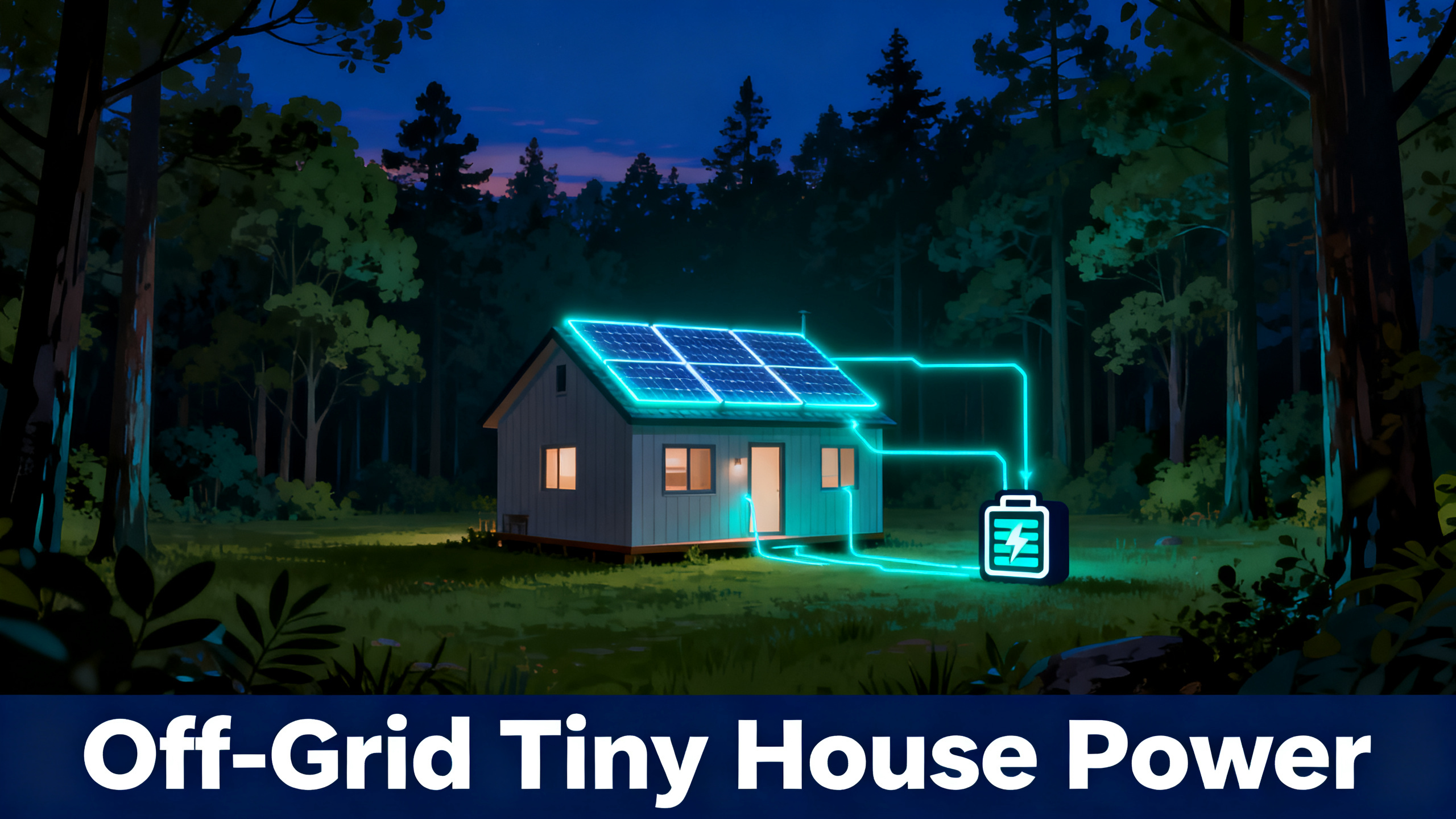
Powering a tiny house off grid sounds simple until you start reading the numbers. The 1,500 square feet of solar panels you’d put on a regular home? Not happening here. The 200-amp service panel? Overkill and impossible to sustain. A tiny house needs a power system designed around its actual constraints: limited roof space, weight budgets that matter (especially on wheels), and energy loads that swing wildly between a quiet weekend and a full work-from-home week.
This guide walks through what tiny house power actually requires in 2026, how to size a system based on your specific build (THOW or foundation), which solar panel approach fits your roof, and which portable power stations handle the workload reliably. The goal is a system that runs your daily life without constant micromanagement, recharges fast enough to keep up with cloudy stretches, and scales as your needs grow.
2026 Top Picks at a Glance
| Model | Capacity | AC Output | Expandable | Price | Best For |
|---|---|---|---|---|---|
| Jackery Explorer 2000 Plus | 2,042Wh | 3,000W | Up to 24kWh | $899 | THOW / Mobile |
| BLUETTI AC200L | 2,048Wh | 2,400W | Up to 7kWh | $899 | Foundation / Full-time |
| EcoFlow DELTA 3 Max | 2,048Wh | 2,400W | Up to 4kWh | $749 | Budget / Flexible |

Best for THOW
Jackery Explorer 2000 Plus
2,042Wh | 3,000W | LiFePO4
$899 $1,399
Get our Black Friday alerts for power stations
We track live prices on 40+ models from Jackery, EcoFlow, BLUETTI and Anker SOLIX. When a deal beats the lowest price we've recorded, you'll hear from us. During Black Friday week, one short recap a day at most.
Unsubscribe in one click. We may earn a commission when you buy through our links, at no extra cost to you. Privacy Policy
The Unique Power Challenges of a Tiny House
Tiny houses don’t behave like scaled-down regular homes when it comes to power. The constraints are categorical, not just smaller versions of normal household issues. A standard 2,500 sq ft home can absorb solar inefficiency by simply adding more panels. A tiny house cannot. Every choice cascades.
The first constraint is roof real estate. A typical THOW (tiny house on wheels) has 100 to 160 square feet of usable roof, which caps practical solar at roughly 400 to 800 watts. Foundation builds escape this limit by going to ground-mounted arrays, but THOW owners have to make peace with the ceiling. The second constraint is weight: a THOW operates within a strict gross trailer weight limit, and battery banks made of lead-acid simply aren’t viable. LiFePO4 changes the math by halving weight per kilowatt-hour. For a complete breakdown of system components, our off-grid solar power systems overview covers inverters, charge controllers, and wiring in detail.
The third challenge is electrical code compliance. Most tiny houses run on 120V single-phase rather than the 240V split-phase typical of stick-built homes, which limits high-draw appliance choices. Electric ranges, full-size dryers, and central HVAC are usually off the table. The good news: this constraint pushes toward DC-friendly appliances and propane alternatives, which match off-grid systems well. Local codes also vary widely between THOW (often classified as RVs) and foundation builds (subject to standard residential code).
Which Setup Fits Your Tiny House?
🚛 Tiny House on Wheels (THOW)
| Max panel size | 400-800W roof |
| Weight budget | Strict (trailer capacity) |
| Best system | 2kWh station + 400-600W solar |
| Shore power | Key backup option |
Top pick: Jackery Explorer 2000 Plus, expandable to 24kWh without major weight penalty
🏠 Foundation Tiny House
| Max panel size | Unlimited (ground array) |
| Weight budget | None (fixed structure) |
| Best system | 2-7kWh expandable stack |
| Grid tie option | Sometimes viable |
Top pick: BLUETTI AC200L, 45-min fast charge, up to 7kWh expandable capacity
How Much Power Does a Tiny House Actually Need?
Skip the generic answers. Every tiny house has a different load profile, and the gap between a minimal weekend setup and a full-time work-from-home build is enormous. Use our interactive tool to calculate your tiny house power needs based on your actual appliances and daily usage patterns. The general rule: most tiny houses fall between 1.5 and 5 kWh per day, with heavy outliers on either side.
The honest answer requires a load audit. List every device you’ll run, multiply its wattage by hours of daily use, and sum the results. Lights and electronics are surprisingly cheap on a daily budget. The expensive items are anything that produces heat or cold: electric water heaters, induction cooktops, mini split AC units, and electric space heaters can each consume more than your entire baseline combined. Most successful off-grid tiny houses pair electric for low-load items with propane for cooking, water heating, and supplemental heat.
Typical Tiny House Daily Energy Budget
💡
LED Lighting
~0.2 kWh
10 hrs / 20W avg
❄️
Mini Fridge
~0.5 kWh
~50W avg / 24 hrs
💻
Laptop + Phone
~0.3 kWh
8 hrs / ~40W
🌡️
Mini Split AC
2-4 kWh
~500W / 4-8 hrs
🚿
Water Pump
~0.1 kWh
Intermittent / 50W
Runtime calculations based on typical appliance draw ratings. AC/heat loads vary significantly by climate and insulation quality.
Here’s the practical math: a baseline tiny house with LED lighting, a 12V fridge, laptop charging, and a water pump runs around 1.1 kWh per day. Add a mini split for summer cooling, and you’re at 3 to 5 kWh. A 4-season build with electric supplemental heat in winter can push past 6 kWh. The 2,048Wh power stations covered below handle the baseline scenario for one to two days without solar input, and indefinitely with 600W of solar in good sun.
| Tiny House Profile | Daily Load | Recommended Capacity | Solar Input |
|---|---|---|---|
| Weekend / Part-time | ~1 kWh | 1,000-2,000 Wh | 200-400W |
| Full-time minimal | 2-3 kWh | 2,000-3,000 Wh | 400-600W |
| Full-time with AC | 4-6 kWh | 4,000-6,000 Wh | 600-1,000W |
| 4-season heavy load | 6-10 kWh | 6,000-10,000 Wh | 1,000W+ |
Get our Black Friday alerts for power stations
We track live prices on 40+ models from Jackery, EcoFlow, BLUETTI and Anker SOLIX. When a deal beats the lowest price we've recorded, you'll hear from us. During Black Friday week, one short recap a day at most.
Unsubscribe in one click. We may earn a commission when you buy through our links, at no extra cost to you. Privacy Policy
Solar Panel Options for Tiny Houses
Your panel strategy depends almost entirely on whether your build sits on wheels or on a foundation. The two scenarios have completely different physics, and conflating them leads to disappointing yields.
Roof-Mounted Panels on a THOW
Roof-mounted panels are the dominant choice for tiny houses on wheels because they require no separate footprint at the campsite. The realistic capacity sits between 400W and 800W, with most successful builds landing at 600W. Beyond that, you’re stacking panels in ways that create shading or wind-load problems.
The hard part isn’t installing the panels. It’s accepting that fixed-orientation roof panels never hit their rated wattage. A 600W array typically delivers 400 to 500W at peak sun, and significantly less when the trailer isn’t oriented optimally. Fixed-roof panels on a THOW face seasonal tilt challenges; read our dedicated guide on solar panel angle and placement to maximize year-round yield.
💡 Pro Tip: If your THOW spends most of its time parked at one site, supplement roof panels with a portable folding panel you can angle toward the sun. The combination outperforms a larger fixed array in real-world yield.
Ground-Mounted Arrays for Foundation Builds
Foundation tiny houses unlock the option that THOW owners can’t access: an unconstrained ground array. With proper southern exposure, a 1,000W to 2,000W ground-mounted system fits the larger battery banks foundation builds tend to use. Tilt can be adjusted seasonally, and shading from trees or structures is easier to plan around.
The trade-off is that you need actual yard space. A 1,000W array occupies roughly 50 to 60 square feet of unshaded ground, plus a buffer. For builders on small lots, this isn’t always practical, and a roof installation may still win even on a foundation home.
Portable Folding Panels as a Supplement
Portable folding panels in the 100W to 400W range serve two purposes: extending solar capacity beyond what your roof allows, and providing redundancy when shade or weather hits your fixed array. They plug directly into the solar input on power stations like the Jackery Explorer 2000 Plus, BLUETTI AC200L, and EcoFlow DELTA 3 Max without needing a separate charge controller.
For deeper background on solar and tiny home integration, the EnergySage tiny home solar guide covers permitting and grid-tie considerations specific to fixed builds.

Best Power Stations for Tiny House Living
Three units stand out for tiny house duty in 2026 based on the ratio of capacity to weight, expandability, solar input ceiling, and battery chemistry. Each fits a different profile.
Best for THOW: Jackery Explorer 2000 Plus
Spec-for-spec, the Explorer 2000 Plus offers the strongest weight-to-capacity ratio in its class for THOW use. The 2,042Wh LiFePO4 battery sits in a unit that weighs roughly 19 kg, which keeps within reasonable trailer weight budgets even when you account for the optional expansion battery. The 3,000W AC output (6,000W surge) is the highest of the three picks here, giving headroom for higher-draw appliances like induction cooktops or air fryers that other units would refuse outright.
The expandability ceiling is what makes this unit specifically interesting for tiny houses. Pairing the Explorer 2000 Plus with the Battery Pack 2000 Plus modules scales capacity to 24kWh, which covers even 4-season heavy-load builds without changing the core unit. Solar input maxes at 1,200W, enough to fully charge the base station in roughly 2 hours under optimal conditions.
Owner data consistently reports the LiFePO4 cells maintain capacity well past the 4,000-cycle rating Jackery publishes, which translates to roughly 10 years of daily use before noticeable degradation. The fan noise is moderate under load and effectively silent at idle. For THOW owners specifically, the Explorer 2000 Plus delivers the best combination of weight discipline and headroom available right now. Get current pricing on the Jackery Explorer 2000 Plus directly from Jackery.
Best Expandable: BLUETTI AC200L

The AC200L hits a different sweet spot. With 2,048Wh of LiFePO4 capacity and 2,400W AC output (4,800W surge), it’s slightly more conservative than the Jackery on raw output but matches it in capacity. Where it pulls ahead is recharge speed: data from the AC200L’s published specs confirms a 45-minute charge window from 0 to 80% via the AC turbo input, which materially changes how the unit fits into a tiny house workflow when shore power becomes available.
The expansion path is also distinct. Adding B300K or B500K external batteries scales the AC200L to 7kWh total, which handles foundation tiny house loads comfortably without requiring a complete system rebuild. The BLUETTI app integration is genuinely useful here, letting you monitor and control the unit remotely, which matters when the power station lives in a closet or under a bench.


The 3,500-cycle rating is a notch below the Jackery, but still translates to roughly 8 to 9 years of daily cycling. For foundation tiny houses where weight isn’t a concern and the goal is a system that scales with growing power needs, the BLUETTI AC200L is the most flexible pick of the three. For a deeper comparison across the lineup, see our full guide to the best Bluetti models for off-grid living.
Best Value: EcoFlow DELTA 3 Max

The DELTA 3 Max is the budget pick that doesn’t feel like a compromise. At $749 with 2,048Wh of LiFePO4 capacity and 2,400W AC output (X-Boost lifts that to 3,400W for resistive loads), it matches the BLUETTI on most spec lines while coming in at a slightly lower price point. The expansion ceiling tops out at 4kWh with a Smart Extra Battery, which suits most tiny house profiles.
What the DELTA 3 Max trades for the price is solar input ceiling: 1,000W max versus the 1,200W on the other two picks. In practice, this matters less than it sounds, because most tiny house roofs can’t physically host more than 600W to 800W of fixed panels anyway. Owner reports consistently note the DELTA 3 Max handles daily tiny house loads without visible capacity degradation across the first few years of regular cycling.
The automotive-grade LFP cells are rated for roughly 10 years of daily use before significant degradation. For tiny house owners who want the LiFePO4 reliability and expandability of the premium options without the premium price, the EcoFlow DELTA 3 Max is the most cost-effective entry point.
Setting Up Your Tiny House Power System
The setup process matters more than the gear list. A well-sized 2kWh system beats an oversized 6kWh system that’s wired badly. Walk through these four steps in order, and the result is a system that runs predictably for years.
Step 1: Sizing Your System
Start with your daily load total in kWh. Multiply by 1.5 to add a safety margin for cloudy days and capacity degradation over time. That number is your minimum usable storage. If your daily load is 2 kWh, you want at least 3 kWh of storage. The 2,048Wh stations covered above suit baseline loads but should pair with at least one expansion battery for full-time use.
If you’re still evaluating capacity ranges, our step-by-step guide on how to choose the right power station will help narrow the field before committing to a system.
Step 2: Choosing Solar Input
Solar should be sized to fully recharge your battery on a typical sunny day. The math: divide your daily load by 4 (peak sun hours in most US locations) to get the minimum continuous wattage needed. A 3 kWh daily load needs roughly 750W of solar input, accounting for system losses. Bring this up to 1,000W if your location averages fewer sun hours.
Match the solar input ceiling on your power station to your panel array. The Jackery and BLUETTI top out at 1,200W, the EcoFlow at 1,000W. Adding more panels than your station accepts is wasted money.
Step 3: Installing and Wiring Safely
Run your panel cables to the station’s solar input using the proper connectors (typically MC4 to XT60 or proprietary brand connectors). Keep cable runs short to minimize voltage drop, and use the wire gauge specified by the station’s manual. Mount panels with proper standoffs to allow airflow underneath, which improves yield in summer.
⚠️ Important: Never connect solar panels to the power station while the unit is on. Connect first, then power up. Reverse the order to disconnect: power off, then unplug panels. This protects the MPPT controller from voltage spikes.
Step 4: Configuring Shore Power Backup
Even off-grid tiny houses benefit from occasional shore power. THOW owners hit campgrounds with 30A or 50A hookups, and foundation builds may have a backup grid connection. Wire your power station so it can charge from shore power when available, then resume solar-only operation when you move on.
For an extended look at outdoor power workflows that overlap with tiny house living, the The Tiny Life community resource documents real-world setups across both THOW and foundation builds.
Real Tiny House Power Scenarios: What the Numbers Show
Generic recommendations only get you so far. Three scenarios illustrate how the math actually works for different tiny house lifestyles, with capacity figures and runtime calculations based on the published specs of the systems above.
Scenario A: THOW Nomad (Full-Time, No Shore Power)
A nomadic THOW owner moving every 1 to 2 weeks needs a system that recharges fully on solar within a single day. With a 2 kWh daily load (lights, fridge, laptop, water pump, modest device charging), the Jackery Explorer 2000 Plus paired with 600W of roof-mounted solar covers the scenario. Spec analysis indicates 3.5 to 4.5 hours of charging time on a sunny day to fully restore the battery.
Add a 200W portable folding panel for redundancy when the trailer is parked under partial shade, and the system runs indefinitely. The 19 kg weight of the base station fits comfortably within typical THOW weight budgets. THOW owners often overlap with the van-dwelling community: our guide to boondocking and off-grid power setup covers mobile-specific challenges like alternator charging and shore power hookups.
Scenario B: Foundation Tiny House (Grid Backup Available)
A foundation build with optional grid connection can run a more aggressive load profile because shore power is always 30 minutes away. The BLUETTI AC200L paired with one B300K expansion (3,072Wh added) creates a 5,120Wh system that handles 3 to 4 kWh daily loads with full overnight reserve. Pair with 1,000W of ground-mounted solar, and the system rarely touches grid power.
The 45-minute fast-charge capability matters here. If a multi-day cloudy stretch hits and the batteries drop low, the AC200L recharges to 80% in under an hour from a standard outlet. That recovery speed is what makes the unit work for foundation builds where convenience trumps strict off-grid purism.
Scenario C: 4-Season Build with Heavy Heating Load
A 4-season tiny house in a cold climate is the hardest scenario. Electric supplemental heating (1,500W space heater for 6 hours = 9 kWh) blows past the capacity of any single 2 kWh station. The realistic answer here is propane primary heat with electric backup, plus an expandable system at the top of its range.
The Jackery Explorer 2000 Plus stacked with multiple expansion batteries reaches 24kWh, which can sustain a heavy winter load for 2 to 3 days without solar input. Most owners in this profile pair the system with a wood stove or propane heater for primary heat and reserve electric for short-term boost during the coldest hours.
FAQ: Tiny House Off-Grid Power
How many solar panels does a tiny house need?
Most off-grid tiny houses operate well with 400-800W of solar for a THOW, or 1,000-2,000W for a fixed foundation build. The exact count depends on daily consumption (typically 1-4kWh), local sun hours, and whether grid or generator backup is available. A baseline THOW with a 2 kWh daily load works comfortably with 600W of roof-mounted panels in regions averaging 4 to 5 peak sun hours.
Can a 2,000Wh power station run a tiny house full-time?
A 2,000Wh unit covers lights, a mini fridge, phone and laptop charging, and a water pump for approximately 24 to 36 hours without solar input. With 600W of solar and 5 peak sun hours, the system can sustain indefinitely for modest loads. AC and electric cooking add significant demand and typically require either an expandable system or careful load management to extend runtime.
What is the difference between a THOW and foundation tiny house for power planning?
A THOW carries strict weight constraints (panel size is limited to roof area, typically 400-800W max) and often relies on shore power hookups at campsites. A foundation build has no weight ceiling, allowing ground-mounted arrays and larger battery banks. Foundation builds also follow standard residential code in most jurisdictions, while THOWs are often classified as RVs with different rules.
Can I run a mini split air conditioner off a solar power station?
A 9,000 BTU mini split draws 700-900W. A 2,048Wh station can run it for 2 to 3 hours without solar recharge. Sustained cooling requires either a larger expandable system (4-6kWh minimum) or consistent daytime solar input to offset the draw. For full-time AC use during summer, plan on at least 600W of solar input combined with 4kWh of battery capacity.
Is LiFePO4 the right battery chemistry for a tiny house?
Published data strongly favors LiFePO4 for permanent or semi-permanent off-grid installations. The chemistry delivers 3,000 to 4,000+ cycles (versus 500-800 for older NMC chemistries), better thermal stability, and consistent performance in cold conditions. All three picks in this guide use LiFePO4 cells, which is the right baseline for tiny house duty.
What is the best solar generator for a tiny house on wheels?
Analysis of available models points to the Jackery Explorer 2000 Plus as the strongest THOW option: 2,042Wh of LiFePO4 capacity, 1,200W solar input, and expandability to 24kWh without requiring structural mounting. It handles typical THOW loads reliably and keeps within trailer weight budgets even when paired with one expansion battery.
Do I need a transfer switch for a tiny house power station?
A standalone power station does not require a transfer switch for direct appliance connections via its AC outlets. A transfer switch becomes relevant only when integrating with a fixed home electrical panel, which is uncommon for THOW setups but may apply to foundation builds with hybrid grid connections. For most tiny houses, plugging appliances directly into the station works fine.
Final Take: Match the System to the Build
Tiny house power planning rewards matching the system to the build, not chasing maximum specs. THOW owners get the best results with the Jackery Explorer 2000 Plus and 600W of roof-mounted solar, scaling capacity with expansion batteries as needed. Foundation builds have more flexibility and benefit from the BLUETTI AC200L’s faster recharge and 7kWh expansion ceiling. Budget-conscious builders who still want LiFePO4 reliability find the EcoFlow DELTA 3 Max delivers nearly identical performance at a lower price.
The pattern across every successful tiny house off-grid setup: realistic load auditing, a battery sized at 1.5x daily consumption, solar input matched to peak sun hours, and a backup plan for cloudy stretches. Get those four pieces right, and the system runs predictably for a decade.
BLUETTI AC200L
$899
Best expandable system for foundation tiny houses
Price verified May 2026, free shipping available
Originally published: May 7, 2026