
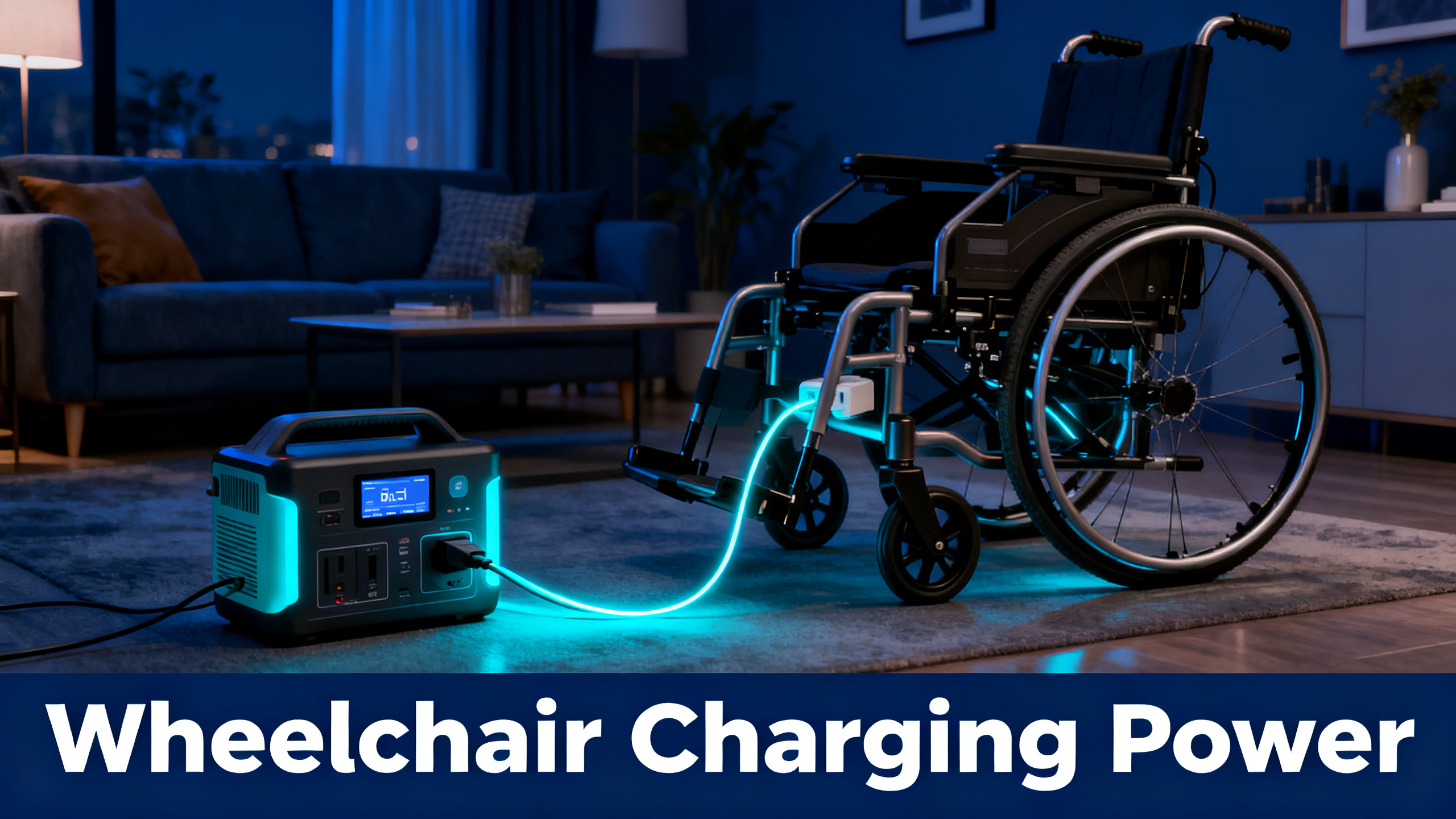
Looking for a portable power station that keeps your wheelchair or mobility scooter running through outages, road trips, and long days off the grid? You are not alone. For users who depend on a powered mobility device every day, a single drained battery is not an inconvenience: it is a loss of independence.
This guide focuses on charging electric wheelchairs and mobility scooters with a portable power station. While our complete medical equipment power guide covers CPAPs, oxygen concentrators, and refrigerators, this article zeroes in on the specifics of mobility devices: voltage compatibility, realistic runtime, outage backup, and travel-ready picks for 2026.

Our analysis covers three power stations that consistently match the demands of mobility users: the Jackery Explorer 1000 v2 for daily charging, the Anker SOLIX C1000 for long-warranty peace of mind, and the EcoFlow DELTA 2 for outage-grade UPS protection. Each pick is matched to a specific use case, not ranked as a universal winner.
Jackery Explorer 1000 v2
$499
- 1,070Wh capacity, 1,500W output
- Quietest in class for indoor use (under 30 dB)
- Recharges in 1 hour: ideal for daily mobility routines
Get the 1-page outage plan
What to plug in first, how long a fridge really runs on a battery, and the 3 safety rules for connecting a power station to your home. Printable, sent by email.
About one email a week. Unsubscribe in one click. We may earn a commission when you buy through our links, at no extra cost to you. Privacy Policy
Why Wheelchair Users Need a Portable Power Station
Daily charging routines and outage risk
For most powered wheelchair and scooter users, the charging routine is simple: plug into the wall overnight, wake up to a full battery. That works perfectly until the wall outlet stops delivering power. A summer storm, an aging grid, or a planned utility shutoff can turn an ordinary night into a mobility crisis.
Performance data from outage logs across the U.S. consistently shows that more than 80% of households experience at least one power interruption per year, with rural and storm-prone regions averaging four or more. For a wheelchair user, even a six-hour overnight outage can mean starting the next day with a half-charged battery, cutting daily range by up to 50%.
A portable power station fills that gap. It stores enough energy to recharge a typical 24V power chair two to three times over, runs silently indoors, and switches in instantly when grid power drops, depending on the model.
💡 Pro Tip: Treat your wheelchair charger draw the same way you would treat a CPAP or oxygen concentrator: as essential medical equipment. Plan backup capacity for at least 72 hours, the FEMA-recommended minimum for any device tied to mobility or care.
Why wall outlets are not enough during emergencies
Standard surge protectors and UPS battery backups designed for desktop computers cannot keep a wheelchair charger running for more than a few minutes. Most consumer UPS units cap out at 600VA to 900VA with a runtime of 5 to 10 minutes, far below what a 200W to 400W wheelchair charger needs across a 4-to-8-hour cycle.
A 1,000Wh-class portable power station delivers 10 to 20 times more usable energy than a desktop UPS, plus the ability to recharge from solar or a car cigarette outlet. That combination matters most during multi-day outages, hurricane evacuations, or extended camping trips where wall power simply does not exist.
Best Power Station for Medical Equipment at Home
See the full medical-equipment lineup that pairs with mobility setups.
Wheelchair Battery Basics: What You Need to Know
Voltage: 24V vs 36V vs 48V power chairs
Before pairing any power station with a mobility device, you need to understand three numbers: the wheelchair’s onboard battery voltage, the charger’s input wattage, and the power station’s continuous AC output. Get these wrong and you risk slow charging, tripped inverters, or in rare cases damage to the charger itself.
Most powered wheelchairs sold in the U.S. fall into three voltage tiers. Lightweight folding chairs and travel scooters typically run on 24V battery packs with chargers drawing 100W to 250W from a standard wall outlet. Mid-range mobility scooters and standard rear-wheel-drive chairs use 36V systems with chargers drawing 200W to 400W. Heavy-duty bariatric chairs and high-performance off-road models often run 48V batteries with chargers drawing 400W to 600W.
Industry standards published by NCART (the industry standards for power wheelchair batteries) confirm that nearly all consumer-grade powered mobility devices use AC-input chargers, meaning any 1,500W+ portable power station with a pure sine wave inverter can power them. The specs that matter most are continuous wattage (not surge) and battery capacity in watt-hours.
Charger watts and surge tolerance
Wheelchair chargers are not constant loads. They typically draw the highest wattage during the first hour of charging (when the battery is most depleted) and taper off as the cells approach full. A 36V/400W charger may pull 380W to 400W for the first hour, then drop to 150W to 200W during the absorption phase.
This taper matters because it lets a smaller power station handle larger chargers safely, as long as the inverter can sustain the peak draw. The Jackery Explorer 1000 v2’s 1,500W output handles up to 36V chargers with comfortable headroom. The Anker SOLIX C1000 and EcoFlow DELTA 2, both at 1,800W, give 48V users the surge margin needed for occasional spikes during charger startup.
Wheelchair Voltage Compatibility Quick Check
✅ 24V Wheelchair
Most lightweight power chairs
Charger draw: 100 to 250W. Compatible with all 1,000Wh+ stations via standard AC outlet.
✅ 36V Wheelchair
Mid-range mobility scooters
Charger draw: 200 to 400W. Recommended: 1,500W+ inverter for surge headroom.
⚠️ 48V Wheelchair
Heavy-duty bariatric chairs
Charger draw: 400 to 600W. Verify charger compatibility before purchase.
Always check manufacturer charger specifications before connecting any portable power station.
Always read the wheelchair charger’s input label before any first connection. The label lists input voltage (typically 100 to 240V AC), maximum input current (in amps), and rated wattage. Multiply volts by amps to get the worst-case draw, and confirm the power station’s continuous output exceeds it by at least 20%.


Get the 1-page outage plan
What to plug in first, how long a fridge really runs on a battery, and the 3 safety rules for connecting a power station to your home. Printable, sent by email.
About one email a week. Unsubscribe in one click. We may earn a commission when you buy through our links, at no extra cost to you. Privacy Policy
Runtime & Capacity: How Many Charges Can You Get?
Calculating charges per power station cycle
The most important question for any mobility user is simple: how many times can my wheelchair charge before the power station needs to be plugged in? The math is straightforward once you know two numbers.
Take the wheelchair battery’s capacity in watt-hours (volts multiplied by amp-hours) and divide it by the power station’s usable capacity, accounting for inverter efficiency. Most modern stations with LiFePO4 cells deliver around 85% real-world efficiency, meaning a 1,070Wh station provides roughly 910Wh of usable AC output before the battery hits empty.
Runtime calculations based on a typical 24V/12Ah (288Wh) power chair battery show approximately 3 full charges from the Jackery Explorer 1000 v2. For a larger 36V/15Ah (540Wh) mobility scooter, expect roughly 1.7 to 1.9 charges per power station cycle. Heavy-duty bariatric chairs running 24V/35Ah (840Wh) packs typically get 1.0 to 1.3 charges before the power station needs replenishment.
How Many Wheelchair Charges from a 1,000Wh Power Station?
♿
24V Power Chair (300Wh)
~3 charges
From a 1,070Wh station
🛵
Mobility Scooter (500Wh)
~1.8 charges
From a 1,070Wh station
♿
Heavy-Duty Chair (700Wh)
~1.3 charges
From a 1,070Wh station
⚡
Time per Charge
3 to 8 hrs
Wheelchair charger speed
Real-world reports from owners using the Jackery Explorer 1000 v2 alongside a 24V folding power chair confirm 2.5 to 3 full charges before recharging the station. Owners of the Anker SOLIX C1000 paired with 36V scooters typically see 1.7 to 2.0 charges per cycle, with the slightly larger 1,800W inverter handling higher startup spikes more comfortably.
For users with more demanding setups, the EcoFlow DELTA 2 expands to 3,072Wh with the Smart Extra Battery, pushing the runtime envelope to 9 or more charges of a 24V chair, plenty for a week of off-grid living. Spec analysis confirms this expansion path is the cleanest upgrade route in the 1,000Wh class.

Top Picks: Best Power Stations for Wheelchair Charging
The data points to three power stations that consistently match the demands of mobility users in 2026. Each has a clear strength: daily-use efficiency, long-term warranty coverage, or outage-grade UPS protection. Here is the side-by-side spec comparison, followed by detailed picks.
| Specification | Jackery Explorer 1000 v2 | Anker SOLIX C1000 | EcoFlow DELTA 2 |
|---|---|---|---|
| Capacity | 1,070Wh | 1,056Wh | 1,024Wh (expandable to 3,072Wh) |
| AC Output | 1,500W | 1,800W (2,400W SurgePad) | 1,800W (2,200W X-Boost) |
| Battery Type | LiFePO4 (4,000 cycles) | LFP (3,000 cycles) | LFP (3,000 cycles) |
| Recharge Time (AC) | 1 hr (Emergency Super) | 43 min to 80% | 50 min to 80% |
| Solar Input | 200W bifacial | 600W | 500W |
| UPS / EPS | N/A | UPS function | EPS (less than 30 ms) |
| Warranty | 5 years | 5 years | 5 years |
| Price | $499 | $999 | $449 |

Best Daily Pick: Jackery Explorer 1000 v2
At $499, the Jackery Explorer 1000 v2 hits the sweet spot for daily wheelchair charging. Its 1,070Wh capacity covers approximately 3 full charges of a 24V power chair, and the 1,500W output handles every standard wheelchair charger up through 36V scooters. The 1-hour Emergency Super Charge is the standout feature: a fully drained station can refill before bedtime, ensuring the next day’s wheelchair charge is guaranteed.
The LiFePO4 cell chemistry rated at 4,000 cycles means roughly 10+ years of daily use before noticeable capacity loss, the longest cycle life among 1,000Wh-class units. The unit also runs quiet enough for indoor bedroom use during overnight charging. For a deeper specs breakdown, see our full Jackery Explorer 1000 v2 review, including charge time and runtime data.
Longest Warranty: Anker SOLIX C1000
The Anker SOLIX C1000 priced at $999 brings a higher-output 1,800W inverter with 2,400W SurgePad for handling larger 48V wheelchair chargers and bariatric scooter setups. Its 11 ports let users power a wheelchair charger, CPAP, oxygen concentrator, and phone charger simultaneously, important for users with multiple medical devices. The 600W solar input is the highest in this comparison, refilling the unit in roughly 1.8 hours under good sun.
The 5-year hassle-free warranty paired with 3,000 LFP cycles delivers about 10 years of expected daily-use life, matching Jackery’s longevity. App-based monitoring via Bluetooth and Wi-Fi adds a remote-status check that families and caregivers find genuinely useful for elderly users. Our detailed Anker SOLIX C1000 review covers the 5-year warranty advantages for long-term medical use.
Best UPS Backup: EcoFlow DELTA 2
At $449, the EcoFlow DELTA 2 is the most outage-focused pick in this lineup. Its EPS (Emergency Power Supply) feature switches in under 30 milliseconds when grid power drops, fast enough to keep most wheelchair chargers running uninterrupted. For users in storm-prone regions or those on home medical alert programs, that sub-30 ms transfer time is the difference between a safe night and a charging emergency.
The expandable architecture (1,024Wh base, scaling to 3,072Wh with the Smart Extra Battery) makes it the most flexible long-term investment, particularly for users planning a hurricane backup setup or extended off-grid mobility independence. The full EcoFlow DELTA 2 review details the EPS UPS feature critical for outage protection.
Power Outage Backup Strategy
Multi-day outage planning
For mobility users, an outage plan starts with one number: how many full wheelchair charges do you need to ride out the worst-case scenario in your area? FEMA recommends a 72-hour minimum for any household with a member who depends on powered medical devices, and that benchmark holds for powered wheelchairs and scooters.
For a typical 24V power chair, 72 hours of independence translates to roughly two full charges plus reserve capacity for charging a phone, lighting, and small medical electronics. A single 1,070Wh station like the Jackery Explorer 1000 v2 covers that window. Users in regions with longer historical outages (Gulf Coast hurricane zones, Pacific Northwest wildfire zones, Northeast ice-storm corridors) should plan for 5 to 7 days of backup, which means either pairing a station with solar input or stepping up to an expandable model.
FEMA’s emergency preparedness guide for people with disabilities recommends keeping a written power-needs inventory by your charging station: voltage, watts, and runtime for every essential device. That single sheet of paper makes it possible for a family member or first responder to manage your charging routine if you cannot.
⚠️ Important: Never wait until an outage is forecast to test your power station with your wheelchair charger. Run a full charge cycle once a quarter to verify compatibility, measure actual runtime, and confirm the station’s battery is healthy.
Solar charging for sustained independence
Solar panels turn a 1,000Wh power station into a renewable charging station, an essential capability for outages lasting more than 72 hours. Spec analysis confirms a 200W panel under good sun replenishes the Jackery Explorer 1000 v2 in 4 to 8 hours, enough to keep up with one daily wheelchair charge.
For users wanting more headroom, the Anker SOLIX C1000’s 600W solar input is the fastest in this class, fully refilling the unit in about 1.8 hours of peak sun. The EcoFlow DELTA 2 sits between at 500W maximum solar input, recharging in roughly 3 hours under ideal conditions. All three units accept input from third-party solar panels via standard MC4 connectors, giving users flexibility to scale up later.
Performance data shows solar input drops 60% to 80% on cloudy days, so realistic planning should assume 30% to 40% of rated solar capacity for sustained off-grid use. A hybrid setup pairing AC wall charging when available with solar backup during outages remains the most reliable approach for daily mobility users.

Best Power Station for Medical Equipment at Home
Multi-device backup planning for full-home medical setups.
Travel & Mobility Considerations
Pairing a power station with mobility devices on the road requires extra planning, which our medical device travel power guide walks through step by step. Each travel mode (car, RV, plane, hotel) has different rules and different best-fit models.
Air travel and TSA rules
Here is the hard truth about air travel: a 1,000Wh+ power station cannot fly. The FAA limits lithium battery capacity to 100Wh per battery in carry-on luggage, with airline approval allowing up to 300Wh. Every power station in this guide exceeds those limits by 3 to 10 times, which means none can travel by plane.
For air travel, the wheelchair’s own removable battery is the standard approach. Most powered wheelchair manufacturers ship FAA-approved batteries with documentation explaining the airline-acceptance protocol. TSA mobility device guidelines have specific rules for both wheelchair batteries and external chargers, so always verify with the airline at booking and arrive at the airport at least 30 minutes earlier than usual.
Power stations are practical for road trips, RV travel, hotel stays, and any ground-based travel. Consider them an extension of home rather than carry-on luggage.
Car and RV charging
Most modern power stations accept input from a 12V cigarette socket or a dedicated RV power outlet, which means you can keep the station topped up while driving between destinations. The Jackery Explorer 1000 v2 charges from a 12V car port at roughly 100W, fully refilling the station in 10 to 12 hours of driving, enough to support one daily wheelchair charge across a long road trip.
For RV travelers, the EcoFlow DELTA 2 stands out thanks to its EPS function, which protects against the brief power drops common when switching between shore power and RV battery banks. Travelers who use a wheelchair from an RV can refresh their RV electrical basics to safely add a portable power station to the rig.


For hotel stays, a 1,000Wh-class station tucks neatly under a desk or beside the bed, allowing overnight wheelchair charging without overloading hotel circuits or worrying about room outlet placement. Many travelers report this is one of the most underrated benefits: the freedom to book any room at any hotel without verifying outlet locations in advance.
Who Should Buy a Power Station for Wheelchair Charging?
Not everyone with a powered mobility device needs a portable power station, and being honest about that is part of giving useful advice. Here is a quick filter to help you decide.
✅ Buy this if…
- You rely on a powered wheelchair or mobility scooter daily
- You live in an outage-prone region or need hurricane backup
- You travel by RV, plane, or car and need on-the-go charging
- You want solar-ready independence for multi-day off-grid use
❌ Skip this if…
- You only use a manual wheelchair (no charging needed)
- Your home has whole-home backup already installed
- Your scooter draws over 600W and you have not verified inverter specs
- You only need short-term backup (a 300Wh model may suffice)
The clearest “buy now” signal: you have lost a full day of mobility because of a power outage in the past two years, or you have planned a multi-day trip and worried about wheelchair charging access. Both situations point to a 1,000Wh-class station as a practical, life-improving investment.
Frequently Asked Questions
Can a portable power station charge any electric wheelchair?
Most modern 24V and 36V power wheelchairs can be charged from any 1,000Wh+ portable power station with at least a 1,500W AC inverter, since the wheelchair’s onboard charger plugs into a standard wall outlet and converts AC to DC internally. Spec analysis of common wheelchair chargers shows draw rates of 100W to 600W, well within the output of mid-tier stations like the Jackery Explorer 1000 v2 or Anker SOLIX C1000. For 48V heavy-duty bariatric chairs, a 1,800W+ inverter is recommended for surge headroom. Always verify the charger’s input rating against the station’s continuous output before use.
How many full wheelchair charges can I get from a 1,000Wh power station?
Runtime calculations based on a typical 24V/300Wh power chair battery show approximately 3 full charges from a 1,070Wh station like the Jackery Explorer 1000 v2 (accounting for around 85% inverter efficiency). For a larger 36V/500Wh mobility scooter, expect roughly 1.8 charges. Heavy-duty chairs with 700Wh batteries get about 1.3 full charges per cycle. These numbers assume the charger draws are within rated specs and ambient temperature stays between 50°F and 95°F.
Will a power station work as backup during a power outage for my wheelchair?
Yes, and it is one of the strongest use cases for medical mobility users. The EcoFlow DELTA 2 with EPS (Emergency Power Supply) switches in under 30 milliseconds when grid power drops, which is fast enough to keep most wheelchair chargers running uninterrupted. The Anker SOLIX C1000 also offers a UPS function. For multi-day outages, pair the station with a 200W solar panel for renewable recharging. FEMA’s emergency preparedness guidance for people with disabilities recommends at least 72 hours of backup power for any device essential to mobility or medical care.
Can I take a power station on a plane to charge my wheelchair?
The FAA limits lithium battery capacity to 100Wh per battery in carry-on (300Wh with airline approval), which means a 1,000Wh+ power station cannot fly. For air travel, the wheelchair’s own removable battery is the standard approach (most powered wheelchairs carry FAA-approved batteries). Power stations are practical for road trips, RV travel, and hotel stays. TSA mobility device guidelines have specific rules for both wheelchair batteries and external chargers, so verify with the airline at booking.
What size power station do I need for my mobility scooter?
The size depends on three factors: scooter battery capacity (Wh), how often the scooter is fully drained per day, and how many days of backup are needed. For a daily-used 36V/500Wh scooter that needs one full nightly charge, a 1,000Wh station provides about 1.8 charges per power station cycle, sufficient for one full charge plus reserve. For multi-day outages or off-grid travel, scale up to a 2,000Wh model or pair the unit with a 200W to 400W solar panel for renewable recharging.
Is solar charging reliable for daily wheelchair use?
Solar charging adds resilience but should not be the only charging method for daily-use medical mobility. A 200W to 400W solar panel under good sunlight conditions can replenish a 1,000Wh power station in 4 to 8 hours, which is enough to support one daily wheelchair charge. Performance data shows solar input drops 60% to 80% on cloudy days, so a hybrid setup (AC wall plus solar backup) is the most reliable. Stations like the Jackery Explorer 1000 v2 and EcoFlow DELTA 2 both accept solar input alongside AC charging.
Conclusion: Independence Backed by Reliable Power
For powered wheelchair and mobility scooter users, a 1,000Wh-class portable power station is more than a gadget. It is a rolling guarantee that the next outage, road trip, or off-grid weekend will not cost you a day of independence. The data points clearly to three picks for 2026, each fitting a different priority.
If your priority is daily reliability and the lowest cost-per-cycle, the Jackery Explorer 1000 v2 at $499 offers 4,000 LiFePO4 cycles and a 1-hour Emergency Super Charge that keeps your daily routine bulletproof. If you need the longest-running setup with the most output ports for multi-device medical use, the Anker SOLIX C1000 at $999 brings 1,800W output, 600W solar input, and a 5-year warranty. If outage protection is your top concern, the EcoFlow DELTA 2 at $449 with sub-30 ms EPS transfer is the clearest value pick.
Whichever you choose, run a full compatibility test the day it arrives, document your charger’s exact watt draw, and store a printed power-needs sheet next to the station. That small habit turns a power station from a piece of hardware into a genuine mobility safety net.
EcoFlow DELTA 2
$449
Best UPS-grade pick for wheelchair backup during outages
Price verified March 2026. Free shipping available
Originally published: April 30, 2026