
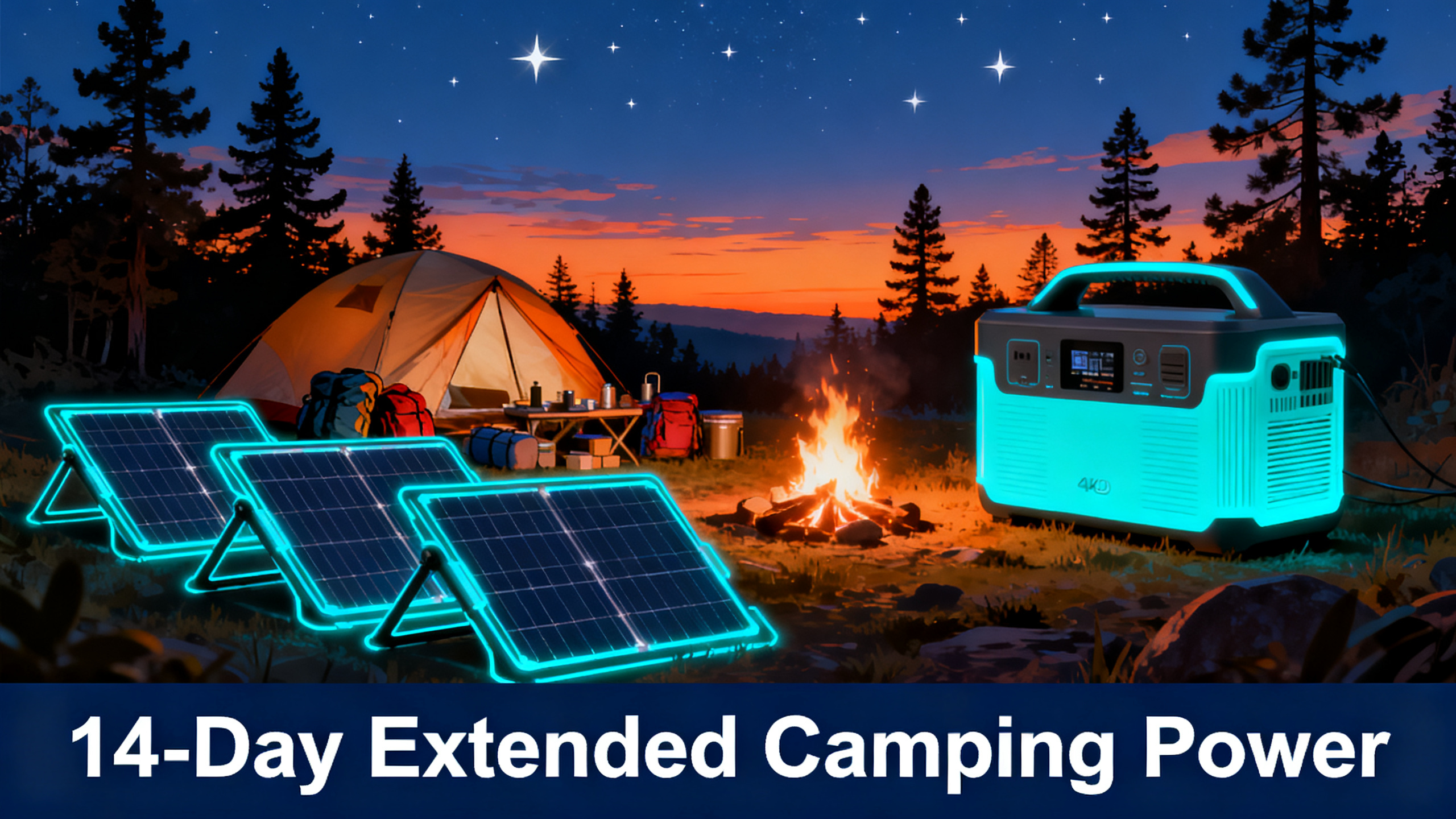
Planning a 14-day off-grid camping trip changes everything about how you think about power. A weekend camper can top off at a trailhead outlet or just tolerate a dead phone for a day. At two weeks, that margin disappears entirely. Your power station becomes life support for your campsite: food preservation, communication, lighting, sleep quality (if you run a CPAP), and the small daily comforts that make extended stays sustainable.
The math is brutally simple. An average camper running a 12V compressor fridge, laptop, phones, and LED lights consumes roughly 800 to 1,200 Wh per day. Multiply that by 14 and you’re looking at 11,200 to 16,800 Wh of total consumption over the trip. No single portable power station can store that. So the real question isn’t just “which unit should I buy” but “what system do I need to keep running for two weeks straight.”
If you’re planning a shorter stay, the breakdown in our weekend vs week-long power comparison may better match your needs. This guide focuses specifically on the 14-day scenario, where solar recharging stops being optional and becomes the core strategy.
The Problem with Bringing “Just Enough” Battery
The instinct for many campers is to calculate their daily need, multiply by 14, and buy a unit with that total capacity. The problem: no portable power station comes close to that number. A 2,000Wh unit covers 2 to 3 days of average consumption with no solar input. It doesn’t cover 14.
Bringing extra battery capacity helps buffer against cloudy days, but it doesn’t eliminate the recharge problem. A 6,000Wh system (achievable with the EcoFlow DELTA 3 Max expanded with extra batteries) buys you roughly 5 to 7 days of buffer. Still not 14. The only sustainable path for a true two-week off-grid stay is a daily recharge loop powered by solar panels.
⚠️ Common mistake: Buying a 2,000Wh unit and expecting it to “last the trip” without solar. At 1,000Wh/day average consumption, that’s two days of power. Solar recharging is not a bonus feature for extended camping. It’s the system.
Solar Recharging as the Only Sustainable Solution
With a properly sized solar array and a capable power station, a 14-day off-grid stay becomes mathematically viable. A 200W solar panel generating 800 to 1,000 Wh on a good day covers most or all of an average camper’s daily consumption. Two panels at 400W total can fully recharge a 2,000Wh unit in favorable conditions and provide a daily surplus on sunny stretches.
The key variables: panel wattage, daily peak sun hours at your location (typically 4 to 6 hours across most of the continental US in summer), and the maximum solar input your power station accepts. That last number matters more than most campers realize. A unit capped at 400W of solar input takes twice as long to recharge as one that accepts 800W or 1,000W, which directly affects how quickly you recover from cloudy days.
Use our power station capacity calculator to plug in your exact device list and get a precise Wh target before purchasing. The section below walks through the sizing math in detail.
Understanding Your 2-Week Power Requirements
Before looking at specific units, you need a realistic picture of what you’re actually consuming each day. Most campers significantly underestimate this number, especially when they factor in the compressor fridge running around the clock.
Daily Consumption Audit: What Are You Actually Running?
Start with your highest-draw continuous loads, then layer in intermittent devices. A 12V compressor fridge (45L size) draws 35 to 55 watts on average over 24 hours, which translates to 360 to 480 Wh per day. That single device often accounts for 40 to 50% of a typical camper’s total daily consumption.
Add a laptop (4 hours/day at 45 to 65W: 180 to 260 Wh), smartphone charging for two phones (40 to 60 Wh), LED camp lights (4 hours at 10 to 20W: 40 to 80 Wh), and a portable fan for 6 hours at night (120 to 300 Wh), and you’re already at 740 to 1,180 Wh before coffee or any other occasional-use devices. The full reference table is below.
The full formulas and tier breakdowns live in our capacity sizing reference if you want to build a more detailed daily load audit.
Light vs Average vs Heavy Camper: Three Scenarios
Campers don’t all consume the same. The three scenarios below bracket the realistic range for a 14-day off-grid stay, with total trip consumption calculated at each tier. This is the number you’ll use to size your solar array, not just your battery capacity.
Daily Power Budget: 14-Day Camping Scenarios
Light Camper
400–600 Wh/day
14-day need: ~6,000–8,400 Wh
- Phone + laptop charges
- LED lanterns
- Small fan (night only)
Average Camper
800–1,200 Wh/day
14-day need: ~11,200–16,800 Wh
- 12V compressor fridge
- Devices + lights
- Coffee maker (occasional)
Heavy Camper
1,500–2,500 Wh/day
14-day need: ~21,000–35,000 Wh
- Full-size fridge + AC
- Induction cooktop
- Multiple devices, TV
Note: These figures assume solar recharging contributes 500–1,200 Wh/day depending on panel wattage and sun exposure. Without solar, multiply daily consumption by 14 and add a 25% buffer.
Sizing Math: From Daily Wh to Unit Capacity
The formula for extended camping isn’t “how much can the battery store.” It’s “how much can the system recover each day.” If your daily consumption equals or falls below your daily solar harvest, you can camp indefinitely. The battery just bridges the overnight gap.
For an average camper at 1,000 Wh/day with a 200W panel generating 800 Wh/day on average: you need roughly 200 Wh more than you’re generating each day. A 2,000Wh battery handles that shortfall for 10 days before depletion, assuming zero cloudy days. Add a 25% buffer for cloud cover and you want 2,000Wh minimum, preferably 2,500Wh+. Similar capacity rules apply if you’re coordinating power across several tents; see our guide to group camping high-capacity systems for that scenario.
Not sure how much capacity you need?
Run your exact device list through our interactive calculator for a precise Wh target.
The Best Power Stations for Extended 14-Day Camping [2026]
Three units stand out for 2-week off-grid stays in 2026: the Jackery Explorer 2000 v2 at $799, the EcoFlow DELTA 3 Max at $799, and the BLUETTI AC180P at $649. All three use LiFePO4 (lithium ferro-phosphate) battery chemistry, which handles the deep daily cycling that extended camping demands. None are perfect for every camper. Here’s how to match each one to your specific setup.
Jackery Explorer 2000 v2: Best Overall for Most 2-Week Campers

The Jackery Explorer 2000 v2 hits the capacity target most two-week campers need: 2,042Wh with a 2,200W continuous AC output (4,400W surge). At $799 (down from $1,499), it delivers the best price-per-Wh ratio of the three units here. For a solo camper or a couple running an average daily load, this unit combined with 200 to 400W of solar panels covers a 14-day stay with margin to spare.
AC recharge performance is a standout: 0 to 100% in approximately 1.7 hours. That matters if you’re near grid power at the trailhead before departure or have access to a generator on a single cloudy day. The unit operates at under 30dB, which matters for quiet campsites where noise restrictions apply. Weight is 39.5 lbs: manageable for car camping, less so for long carry-ins.

One limitation worth noting: the 2000 v2 is not expandable. The 2,042Wh you buy is the ceiling. If your consumption grows (adding a partner, running a CPAP, or extending the trip), the EcoFlow DELTA 3 Max’s expandable architecture becomes relevant. The Jackery Explorer 2000 v2 specifications confirm 800W maximum solar input, which allows a full recharge from a 400W panel array in roughly 3 to 4 hours on a peak-sun day.
Jackery Explorer 2000 v2
$799 $1,499
- 2042Wh LiFePO4 — 14 days of essential power
- 2200W output, 0-100% in ~1.7 hrs AC
- Under 30dB — quiet for campsite use

EcoFlow DELTA 3 Max: Best Expandable Option for Group Stays

The EcoFlow DELTA 3 Max starts at 2,048Wh and can expand to 10kWh with Smart Extra Batteries. That expandability is its defining advantage for extended camping. A family of four with high daily consumption, or a solo camper preparing for a worst-case cloudy stretch, has a clear upgrade path without buying a new unit.
High solar input keeps recharge times short, so a large panel array can top the base 2,048Wh unit back up in a single good-sun day. X-Boost technology allows the unit to power devices rated up to 3,400W (like induction cooktops drawing 1,600W) by regulating output within safe limits. It uses automotive-grade LFP cells rated for a 10-year service life and carries up to a 5-year warranty. See the official EcoFlow DELTA 3 Max product page for full specs and current bundle options.
The trade-off: the DELTA 3 Max is heavier than the Jackery, and the expandability premium means you’re paying for potential you may not need. At $799 for the base unit (down from $1,899), the value is strong, but it’s best suited to campers who either run heavy daily loads or want the option to scale capacity later.
BLUETTI AC180P: Best Lightweight Option for Weight-Conscious Campers

The BLUETTI AC180P serves a specific camper: someone with light to moderate daily consumption who needs to physically carry the unit to their campsite. At approximately 15.4 lbs with 1,440Wh capacity, it delivers the best weight-to-Wh ratio in this comparison. A light camper at 400 to 600 Wh/day, paired with a 200W solar panel, can sustain a 14-day stay without difficulty.
Specs confirm: 1,800W AC output, 700W MPPT solar input, compatible with panels rated 12 to 60V, and AC recharge to full in approximately 1.5 hours. At $649 (down from $999), it’s the most budget-accessible option. The limitation is capacity ceiling: 1,440Wh won’t support a 12V fridge plus full device load without reliable daily solar. It’s not the right unit for average or heavy campers planning a two-week stay.
Quick Comparison: Which One Fits Your Setup?
2-Week Camping: Which Power Station Fits Your Setup?
Jackery Explorer 2000 v2: What it does best…
- Best price-to-Wh ratio under $800
- Silent operation (under 30dB)
- Fast AC recharge: 0-100% in 1.7 hrs
- Simple solo or couple camping use
EcoFlow DELTA 3 Max: What it does best…
- Expandable to 10kWh with extra batteries
- High solar input for fast solar recharge
- Group camping or family with high-draw devices
- App-based energy management
BLUETTI AC180P: What it does best…
- Lightest option with 1,440Wh capacity
- Best for backpack-accessible campsites
- Budget: under $650 with 35% savings
- Light-to-average daily consumption
Solar Recharging Strategy for Extended Camping
The solar math is straightforward, but most campers skip it and end up with panels too small to offset their daily consumption. Here’s how to size your solar array properly, pair it with the right unit, and manage the system through variable sun conditions.
How Much Solar Do You Actually Need?
The baseline formula: divide your daily Wh consumption by your expected peak sun hours, then add 20% for real-world efficiency losses (panel temperature, shading, wire resistance). For an average camper at 1,000 Wh/day in a location with 5 peak sun hours: 1,000 / 5 = 200W of panels, plus 20% = 240W effective minimum. Two 120W or 200W panels give you that target with redundancy.
If your location averages only 4 peak sun hours (Pacific Northwest, heavily forested sites), recalculate with 4 as the divisor. The math changes significantly. 1,000 Wh / 4 hours = 250W minimum before the efficiency buffer. At 3 peak sun hours, a 200W setup produces under 500 Wh/day and won’t cover an average camper’s load without drawing down the battery each day.
Planning a solar setup for your camping trip?
The Jackery solar charge time calculator lets you model real recharge windows based on panel wattage and daily sun hours.
Panel Pairing Recommendations by Unit
Each power station has a different solar input ceiling, which determines how many panels you can connect effectively. Connecting panels beyond that ceiling wastes potential capacity, though it won’t damage the unit (the MPPT controller simply caps the incoming wattage). The practical recommendation: size your panel array to reach 60 to 80% of the unit’s maximum solar input.
BLUETTI-compatible panels and bundles designed for the AC180P are covered in our best Bluetti solar generator kits guide. For EcoFlow configurations, panel options and compatibility details are in our best EcoFlow solar generator kits roundup.
Jackery Solar Math: Daily Recharge Windows
The Jackery Explorer 2000 v2 accepts up to 800W of solar input. A 400W panel array (two 200W panels in series) delivers roughly 1,600 to 2,000 Wh on a 4 to 5 peak-sun-hour day, with real-world efficiency bringing that to 1,280 to 1,600 Wh after losses. That comfortably covers an average camper’s 800 to 1,000 Wh daily consumption while rebuilding any deficit from the previous night.
The Jackery solar charge time calculator lets you model real recharge windows based on panel wattage and daily sun hours. For a depleted 2042Wh unit: at 400W solar input under optimal conditions, full recharge takes approximately 6 to 7 hours. Under 5 hours of peak sun, that means you typically leave the site still a bit short on a day of heavier-than-usual consumption, which is normal.
EcoFlow Solar Math: Faster Recovery with 1,000W Input
The DELTA 3 Max’s 1,000W solar input ceiling is its clearest technical advantage for extended camping. A 500W panel array recharges the 2,048Wh base unit in roughly 4 to 5 hours under good conditions. More importantly, 1,000W of input during a 5-hour solar window delivers up to 5,000 Wh of potential energy, more than double the base unit’s capacity. For campers with expanded battery configurations (up to 10kWh), this faster input is what makes multi-day recovery from a cloudy stretch actually viable.
For EcoFlow units, the EcoFlow solar charge time calculator runs the same math for DELTA 3 Max configurations. MPPT controller efficiency is rated at 99%, which means virtually no harvest loss at the controller level. The main real-world losses come from panel temperature (output drops 0.4% per degree Celsius above 25°C) and shading.
Comparing all solar generator options for camping?
Our full overview ranks every option by camping style and budget across all major brands.
Essential Features to Prioritize for Long Camping Stays
Beyond raw capacity and solar input, three features consistently separate units that hold up for 14 days from those that become a problem by day four or five.
Battery Chemistry: Why LiFePO4 Matters for Extended Use
All three units in this guide use LiFePO4 (LFP) chemistry, which is the right choice for extended camping applications. LFP cells handle deep discharge cycles better than lithium-ion NMC, maintain stable capacity across a wider temperature range (critical for summer camping when unit temperatures rise), and carry no thermal runaway risk. The chemistry trades some energy density for durability: LFP cells are physically larger for the same Wh than NMC, which is why 2,000Wh LFP units weigh more than equivalent NMC units from earlier generations.
For 14-day camping with daily cycling, the cycle count accumulates quickly: 14 full cycles per trip, potentially 50 to 100+ cycles per year for active campers. NMC chemistry at 500 cycles would degrade noticeably within a few seasons. LFP at 3,000+ cycles (EcoFlow DELTA 3 Max) remains at full capacity well past a decade of regular use at this cadence.
Output Capacity and Simultaneous Device Support
A common planning error: checking total AC wattage but not the number of simultaneous devices supported. Running a fridge, laptop, fan, and phone charger at the same time is normal on a campsite. The DELTA 3 Max handles up to 15 devices simultaneously. The Jackery 2000 v2’s 2,200W continuous output handles most concurrent loads without issue. The AC180P at 1,800W is the tightest of the three, though still capable of running all typical camping devices unless you add a high-draw item like an induction cooktop.
💡 Pro Tip: The EcoFlow DELTA 3 Max’s X-Boost feature allows it to power devices rated up to 3,400W by managing output intelligently. An induction cooktop rated at 1,600W that would exceed some units’ output can run safely on the DELTA 3 Max via X-Boost, making it the most flexible for varied cooking setups.
Weight vs Capacity Trade-off for Pack-In Campsites
If you’re driving to a campsite and unloading from a vehicle, the 39.5 lbs of the Jackery 2000 v2 is manageable. If you’re carrying gear from a parking area to a dispersed campsite, that number matters. The BLUETTI AC180P at approximately 15.4 lbs is in a different category for portability. The trade-off is capacity: you’re giving up 600Wh compared to the Jackery (1,440 vs 2,042Wh) for that weight savings.
For pack-in campsites with any meaningful carry distance, a light camper profile (400 to 600 Wh/day) with the AC180P and a 200W foldable solar panel is likely more practical than hauling a heavier 2,000Wh unit. Average and heavy campers at pack-in sites face a harder trade-off that often resolves toward accepting the weight or reducing their device load.
Frequently Asked Questions
Can a 2,000Wh power station last 14 days of camping?
Alone, no. A 2,000Wh unit covers 3 to 5 days for an average camper running a 12V fridge, laptop, and lights. For 14 days, the key is pairing the unit with a 200W or larger solar panel to recharge daily. With 500 to 800Wh of daily solar input and 800 to 1,000Wh of daily consumption, a 2,000Wh unit becomes sustainable indefinitely.
How many solar panels do I need for a 2-week camping trip?
For most setups, 200 to 400W of panel capacity is the effective target. A 200W panel generates roughly 800 to 1,000Wh on a sunny day with 4 to 5 peak sun hours. Two 100W panels in series give you redundancy and flexible positioning. Units like the EcoFlow DELTA 3 Max accept up to 1,000W of solar input and can fully recover from a full-day discharge overnight into the next day.
What is the minimum Wh capacity for 2 weeks off-grid?
The minimum depends entirely on daily consumption and solar availability. A light camper at 400Wh/day with a 200W panel in a sunny location can sustain indefinitely with as little as 1,000Wh on-board. A heavy camper at 1,500Wh/day without reliable sun needs 3,000Wh or more just to bridge cloudy days. A 2,000Wh unit covers the sweet spot for most 2-person setups with moderate solar recharging.
Is LiFePO4 necessary for extended camping use?
LiFePO4 is strongly preferred for extended camping. The chemistry tolerates deep discharge cycles better than lithium-ion NMC, maintains stable capacity in high-temperature environments relevant for summer camping, and poses no thermal runaway risk. All three units in this guide use LFP cells. For 14-day trips with daily cycling, the difference in longevity over 300 to 500 cycles is measurable.
Can I leave a power station plugged into solar panels overnight?
Most modern power stations, including all units featured here, include Battery Management Systems (BMS) that stop charging once the unit reaches 100%. Leaving panels connected overnight is generally safe, though some units slow-charge or enter a maintenance mode. Consult the specific unit’s manual for overnight solar protocols. The EcoFlow DELTA 3 Max and Jackery 2000 v2 both handle this automatically.
How do I manage power if I have several cloudy days in a row?
This is the core risk for solar-dependent extended camping. Mitigation strategies include: (1) build a 25 to 30% capacity buffer above your daily minimum, (2) reduce non-essential consumption during cloudy stretches (skip coffee maker, reduce fan use), (3) carry a small 12V car-battery adapter as emergency backup, and (4) plan arrival with a full charge. The EcoFlow DELTA 3 Max’s expandable capacity to 10kWh provides the largest buffer for extended cloudy stretches.
Conclusion
Planning power for a 14-day off-grid camping trip comes down to three decisions: how much you consume daily, how much solar you can generate, and which unit best fits the gap between those two numbers. The three units here cover the realistic range of 2-week camper profiles.
The Jackery Explorer 2000 v2 is the right starting point for most solo and couples setups: 2,042Wh, fast recharge, quiet operation, and the strongest price-to-Wh value in this comparison. The EcoFlow DELTA 3 Max earns its premium for expandable capacity and highest solar input. The BLUETTI AC180P serves weight-conscious campers with lighter daily loads who need to carry the unit any distance.
For a full overview of every option by camping style, our guide to the best solar generators for camping covers the complete picture.
Jackery Explorer 2000 v2
$799
Top pick for 2-week camping power planning
Price verified April 2026 — Free shipping available
Originally published: April 28, 2026