
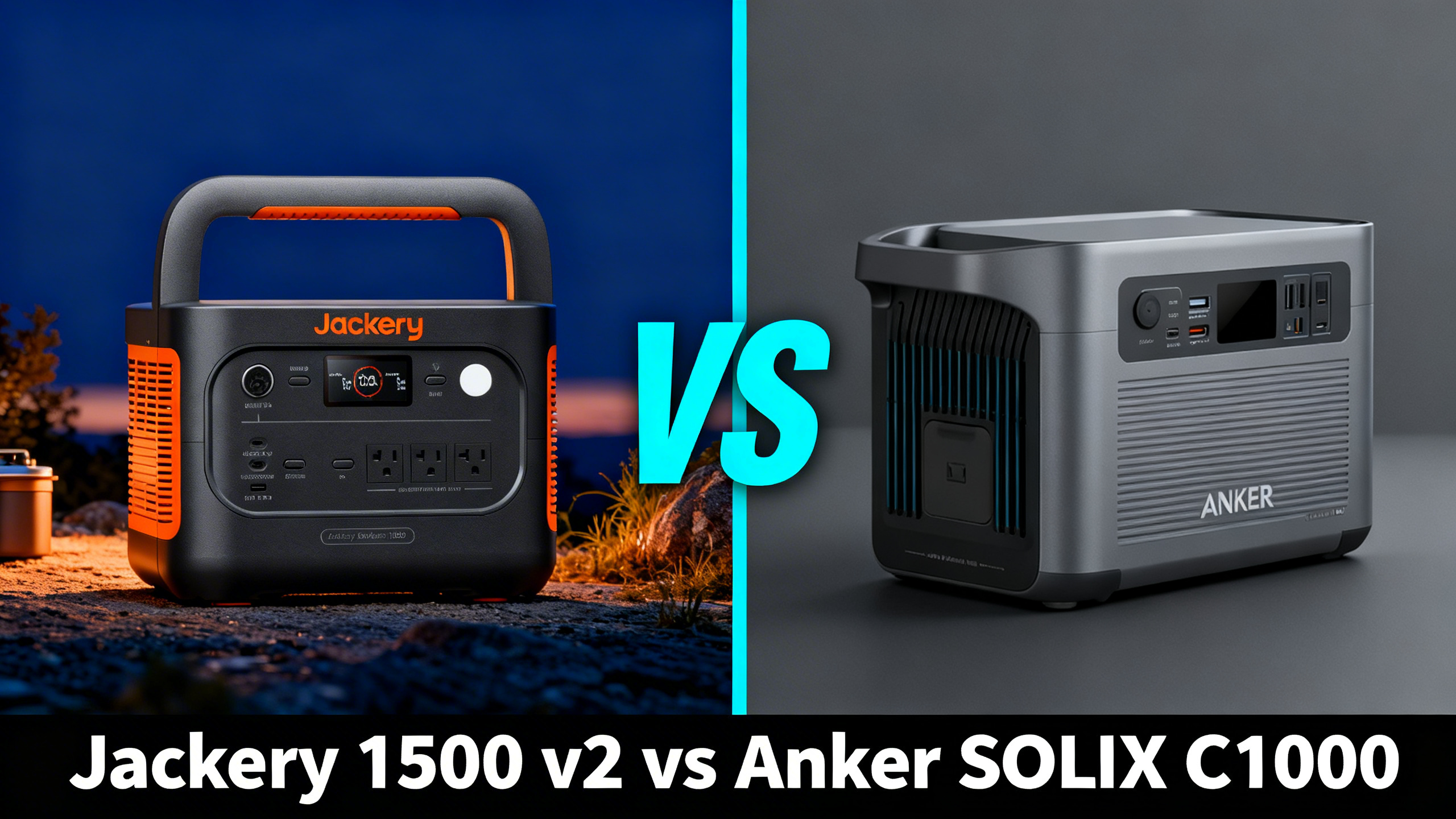
Choosing between the Jackery Explorer 1500 v2 and the Anker SOLIX C1000 seems straightforward at first glance: both are LFP-powered stations with sub-hour AC recharge. But the data tells a more interesting story. The 1500 v2 arrives at $699 with 1,536Wh and a 2,000W inverter. The C1000 sits at $999 with 1,056Wh and a 1,800W inverter. Same category, very different engineering priorities.
The real question isn’t which is better overall. It’s which one fits your specific use case. Spec-for-spec analysis reveals two machines designed with entirely different buyers in mind.

Jackery Explorer 1500 v2
$699 $999
- 1536Wh LFP, 2000W output (4000W surge)
- World’s lightest 1.5kWh station: only 31.97 lbs
- 64-min full recharge, 6,000+ cycles
Get our Black Friday alerts for power stations
We track live prices on 40+ models from Jackery, EcoFlow, BLUETTI and Anker SOLIX. When a deal beats the lowest price we've recorded, you'll hear from us. During Black Friday week, one short recap a day at most.
Unsubscribe in one click. We may earn a commission when you buy through our links, at no extra cost to you. Privacy Policy
At a Glance: Key Differences
Jackery Explorer 1500 v2: Overview

The Jackery Explorer 1500 v2 is currently priced at $699 (down from $999), making it one of the most cost-effective 1.5kWh LFP stations on the market today. At $0.45 per Wh, the capacity-to-price ratio is difficult to match in this class. The Explorer 1500 v2 product page confirms the key specs: 1,536Wh capacity, 2,000W continuous AC output with a 4,000W surge, and a claimed 64-minute full recharge from AC.
What makes this unit stand out is its form factor. At 31.97 lbs, Jackery positions it as the world’s smallest and lightest 1.5kWh LFP power station. That’s a meaningful claim for anyone who needs to carry it between a vehicle and a campsite. The LiFePO4 (lithium iron phosphate) chemistry brings 6,000+ rated cycles, which translates to a 10-year lifespan under regular use.
For the complete spec breakdown and runtime data, see our full 1500 v2 review before diving into the head-to-head.

Get our Black Friday alerts for power stations
We track live prices on 40+ models from Jackery, EcoFlow, BLUETTI and Anker SOLIX. When a deal beats the lowest price we've recorded, you'll hear from us. During Black Friday week, one short recap a day at most.
Unsubscribe in one click. We may earn a commission when you buy through our links, at no extra cost to you. Privacy Policy
Anker SOLIX C1000: Overview


The Anker SOLIX C1000 (original, $999) carries 1,056Wh of LFP capacity with a 1,800W continuous output and a 2,400W SurgePad rating. The official C1000 specifications confirm an 80% charge in just 43 minutes, reaching full capacity in approximately one hour. That charging speed, combined with a 600W max solar input, is one of the C1000’s strongest arguments.
Where the C1000 clearly differentiates itself is in connectivity and home backup features. The unit supports UPS (Uninterruptible Power Supply) mode, switching to battery power in milliseconds during an outage. It also connects via both Bluetooth and Wi-Fi for app monitoring. Anker backs it with an 11-port output array and a 5-year warranty, nearly double Jackery’s 3-year coverage.
Worth noting: Anker has since launched the C1000 Gen 2 (SKU A17631A1) at $499.99, with 1,024Wh, 2,000W output, and a 14% smaller footprint. If the original C1000 at $999 feels hard to justify against the 1500 v2 at $699, the Gen 2 is worth evaluating as a third option in your decision.
How They Compare on Specs
Capacity is where the data diverges most sharply. The 1500 v2 delivers 1,536Wh vs the C1000’s 1,056Wh, a 45% capacity advantage. For users who prioritize runtime over everything else, that gap is hard to ignore. Both units use LFP chemistry, but the cycle life data is notably different: 6,000+ cycles for the Jackery vs 3,000 for the Anker.
On output, the 1500 v2 edges ahead as well: 2,000W continuous with a 4,000W surge vs the C1000’s 1,800W continuous and 2,400W SurgePad. The practical implication: the Jackery handles demanding tools and appliances that approach or exceed 2,000W draw, while the Anker’s SurgePad technology enables it to push brief peaks up to 2,400W for motor-start loads.

Weight data shows the C1000 lighter at approximately 27.5 lbs vs 31.97 lbs for the 1500 v2, which matters for frequent carry scenarios. This matchup is also part of a broader 1kWh-class battle that includes Bluetti and other competitors worth considering.
Charging Speed: Which Refills Faster?
AC recharge speed is close between the two. The 1500 v2 reaches full charge in 64 minutes from AC. The C1000 hits 80% in 43 minutes and completes a full charge in approximately 60 minutes. Both deliver genuinely fast turnaround, and for most users the difference is negligible in practice.
Solar is where the C1000 pulls ahead. With a 600W max solar input, it can complete a full solar recharge in approximately 1.8 hours under optimal conditions. The 1500 v2 accepts up to 500W solar: recharging its larger 1,536Wh battery takes roughly 3 to 4 hours depending on panel efficiency and sunlight angle. The C1000 recharges a smaller battery faster from solar, which is a real advantage for off-grid solar setups where panel hours are limited.

⚠️ Keep in mind: Solar input specs reflect maximum rated intake. Actual solar recharge times depend on panel wattage, ambient temperature, and sunlight angle. Budget for 20-30% longer in real-world conditions.
Real-World Runtime
What Can the Jackery 1500 v2 Power? (1,536Wh)
❄️
Mini Fridge
~38 hrs
40W avg
💻
Laptop
~25 hrs
60W avg
📺
65″ TV
~15 hrs
100W avg
🌀
Box Fan
~85 hrs
18W avg
Runtime calculations based on 1,536Wh capacity at ~90% efficiency. Actual results vary by load and temperature.
The capacity gap translates directly to runtime. The 1500 v2’s 1,536Wh can sustain a mini-fridge averaging 40W for approximately 38 hours. The C1000’s 1,056Wh capacity at the same load delivers around 24 hours. For a CPAP machine averaging 30W, the 1500 v2 provides roughly 46 hours vs approximately 32 hours for the C1000. Laptop users averaging 60W can expect 25 hours from the Jackery vs 17 hours from the Anker.
For multi-day camping trips, the runtime difference matters significantly. A 38-hour fridge runtime means you can run cold storage continuously across a 2-day weekend without touching a solar panel. The C1000’s 24 hours is comfortable for one day but requires solar top-up for anything longer.
Ports, Features, and App Control
The C1000 has the more comprehensive output array: 11 ports covering multiple AC outlets, USB-A, USB-C, and DC options. The addition of Wi-Fi connectivity (alongside Bluetooth) enables app monitoring from anywhere on your home network, not just within Bluetooth range. UPS mode is the standout feature here: millisecond switchover during a grid outage makes the C1000 suitable for desktop computers, home routers, and medical equipment that can’t tolerate interruption.
The 1500 v2 offers 7 ports including dual USB-C fast charge and 3 AC outlets. That covers most camping and light home backup scenarios without issue. What’s absent is UPS mode and Wi-Fi: if smart home integration or seamless power switchover are requirements, the Jackery doesn’t deliver those features.

Who Should Buy Each?
✅ Buy the Jackery 1500 v2 if…
- You need more Wh per dollar (1536Wh at $699 = $0.45/Wh)
- High surge capacity matters (4000W handles heavy appliances)
- Long battery lifespan is a priority (6,000 cycles vs 3,000)
- You want the lightest 1.5kWh option available
✅ Buy the Anker SOLIX C1000 if…
- UPS mode for sensitive electronics is required
- Wi-Fi app control and smart monitoring matter to you
- You prioritize the fastest solar recharge (600W input)
- A 5-year warranty provides the peace of mind you need
Buyers considering other brands alongside these two will find useful context in a full three-brand comparison covering Jackery, Anker SOLIX, and Bluetti side by side.
Jackery vs Anker SOLIX vs Bluetti: Complete Comparison
All three brands compared across capacity, price, and features in one guide.
The Verdict
The data points to two genuinely different products that happen to share a category. The Jackery Explorer 1500 v2 is the stronger value play: more capacity, higher surge output, longer cycle life, and a lower price. If your primary use cases are camping, van life, or extended outages where runtime and Wh-per-dollar matter most, the 1500 v2 is the cleaner choice at $699.
The Anker SOLIX C1000 targets a different buyer: someone who needs UPS functionality for home electronics, values Wi-Fi-connected app monitoring, and wants faster solar recharge for smaller capacity. At $999, it’s harder to recommend purely on value grounds. However, if the newer C1000 Gen 2 at $499.99 is available, it changes the calculus considerably, offering UPS and Wi-Fi at a significantly lower entry point.
Spoiler: there’s no universal winner here. The 1500 v2 wins on capacity and value; the C1000 wins on smart features and solar speed. Your use case determines the right answer.
To explore all new Jackery options for 2025-2026 across every capacity tier, the full lineup guide covers each model in detail.
Jackery Explorer 1500 v2
$699
Best value in the 1.5kWh class
Price verified April 2026 – Free shipping available
Frequently Asked Questions
Is the Jackery 1500 v2 worth $300 more than the Anker SOLIX C1000 Gen 2?
The comparison depends on what you prioritize. Capacity data shows the 1500 v2 delivers 1,536Wh vs 1,024Wh on the C1000 Gen 2, a 50% difference. For runtime-heavy use cases (camping, extended outages), that extra capacity is significant. The C1000 Gen 2 counters with faster charging and UPS mode. For pure Wh-per-dollar value, the 1500 v2 at $699 leads. For smart home integration and speed, the Gen 2 at $499.99 competes well.
Does the Anker SOLIX C1000 have UPS mode?
Published specifications confirm the C1000 includes UPS (Uninterruptible Power Supply) mode, switching to battery power in milliseconds during an outage. This makes it suitable for desktop computers, routers, and medical equipment that cannot tolerate any power interruption. The Jackery 1500 v2 does not list a comparable UPS function in its spec sheet.
Which power station charges faster from solar?
Solar input specs favor the C1000, with a 600W max solar input that enables a full recharge in approximately 1.8 hours under optimal conditions. The 1500 v2 accepts up to 500W solar. For a 1,536Wh battery at 500W, solar recharge time is approximately 3 to 4 hours depending on panel efficiency and sunlight conditions.
Can the Jackery 1500 v2 run a refrigerator?
Runtime calculations based on the 1,536Wh capacity show the 1500 v2 can power a standard household mini-fridge averaging 40W for approximately 30 to 38 hours. A full-size refrigerator averaging 150W would run for 8 to 10 hours. The 2,000W output handles most modern refrigerators without issue, including models with compressor surge requirements.
Is the Anker SOLIX C1000 or Jackery 1500 v2 better for camping?
Use-case analysis points to different winners depending on trip type. For multi-day off-grid camping, the 1500 v2’s larger 1,536Wh capacity provides more total energy per charge cycle, and its 6,000-cycle lifespan means longer equipment life. For car camping with frequent outlet access, the C1000’s faster recharge and Wi-Fi app monitoring offer practical convenience advantages.
Originally published: April 15, 2026