
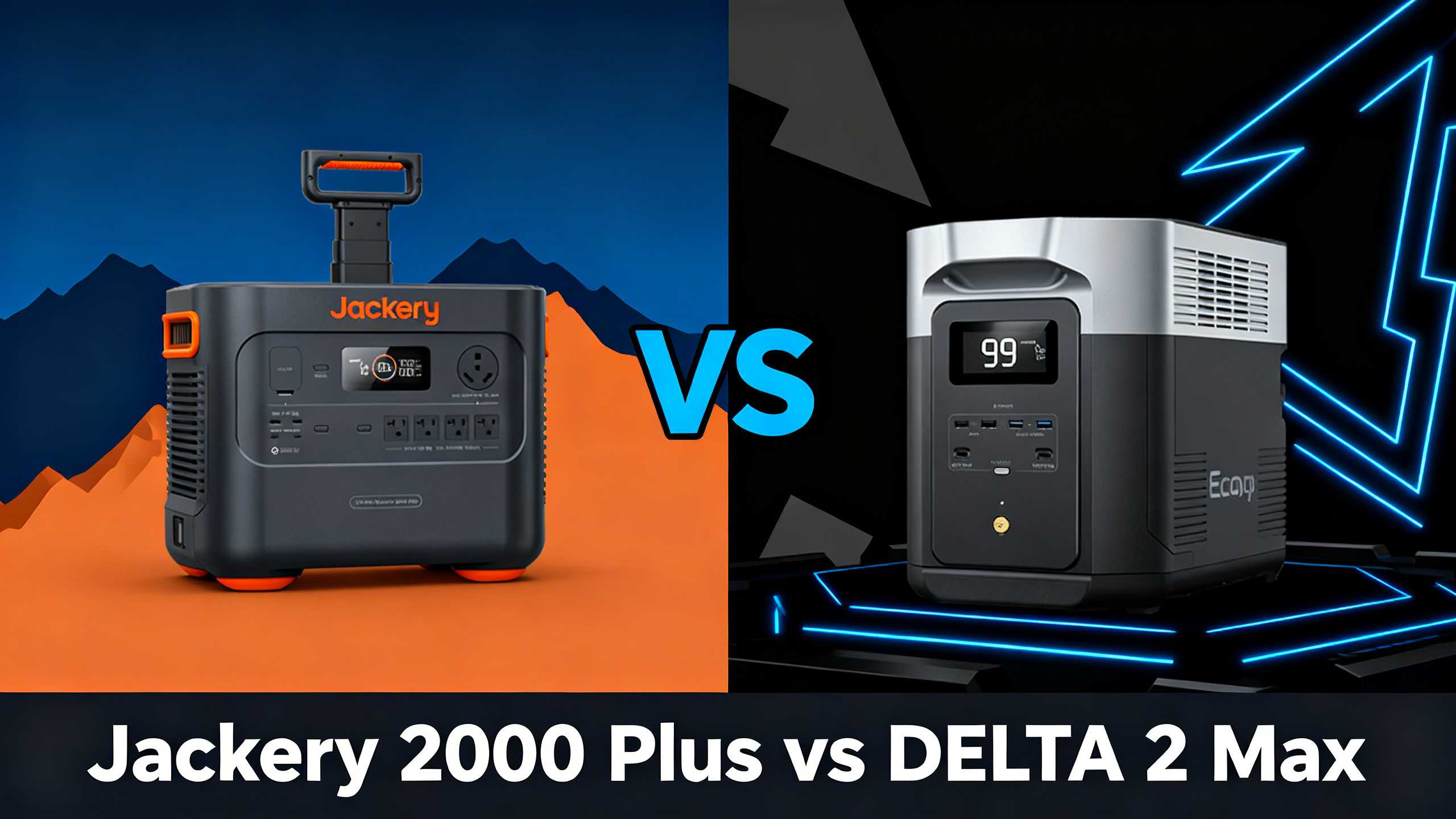
Choosing between the Jackery Explorer 2000 Plus and the EcoFlow DELTA 2 Max puts you in a genuinely difficult spot. Both pack roughly 2kWh of LiFePO4 capacity, both use the same battery chemistry, and both land within $50 of each other at current sale prices. On paper, they look nearly identical. In practice, the decision hinges entirely on what you plan to do with the unit.
The Jackery 2000 Plus is built around raw output and scalability: 6,000W continuous AC, expandable capacity up to 24kWh, and IBC solar technology that can recharge from solar in as little as 2 hours. The EcoFlow DELTA 2 Max takes a different path: a mature app ecosystem, X-Boost technology that intelligently powers devices beyond its rated 2,400W, and a 5-year warranty that covers twice as long as Jackery’s standard coverage.
This comparison breaks down five key dimensions: specs, runtime, solar charging, expandability, and connectivity. At the end, you’ll know exactly which station fits your situation.
Update (July 2026): The EcoFlow DELTA 2 Max has been discontinued and is no longer sold by EcoFlow. The purchase links for it on this page now lead to its direct successor, the EcoFlow DELTA 3 Max (2,048Wh, 3,000W continuous / 6,000W surge with X-Boost, from $749). We’re keeping this comparison live to help existing DELTA 2 Max owners and anyone weighing remaining stock against the Jackery 2000 Plus; the specs below describe the original DELTA 2 Max.

Best for Expandability
Jackery Explorer 2000 Plus
$899 $1,399
2,042Wh | 6,000W | Expandable to 24kWh

Best for App Control
EcoFlow DELTA 2 Max
$849 $1,899
2,048Wh | 3,400W X-Boost | 5-Year Warranty
Get our Black Friday alerts for power stations
We track live prices on 40+ models from Jackery, EcoFlow, BLUETTI and Anker SOLIX. When a deal beats the lowest price we've recorded, you'll hear from us. During Black Friday week, one short recap a day at most.
Unsubscribe in one click. We may earn a commission when you buy through our links, at no extra cost to you. Privacy Policy
Quick Verdict: Two Different Philosophies
Spec analysis of both units confirms they share the same DNA: LiFePO4 chemistry, 3,000+ cycle life, roughly 2kWh of usable capacity, and fast AC recharging under 2.5 hours. The similarities end there.
The Jackery 2000 Plus is built for users who think in systems. Its 6,000W output handles heavy loads that most competitors can’t touch, and the expandability pathway to 24kWh makes it a genuine long-term infrastructure investment. The EcoFlow DELTA 2 Max prioritizes a different kind of power: smarter energy management, more output ports, X-Boost for difficult appliances, and a 5-year warranty that signals EcoFlow’s confidence in long-term reliability.
For a broader look at every new Jackery released since 2024, our full Jackery new lineup guide breaks down every model. For readers comparing multiple brands, our broader brand comparison covers Jackery vs Bluetti in depth.
Jackery Explorer 2000 Plus: Key Specs and Features
The Explorer 2000 Plus carries a 2,042.8Wh LiFePO4 battery rated at 3,000+ cycles. At those cycle counts, the unit is designed for roughly 10 years of daily use before capacity degrades meaningfully. Published specifications confirm a 6,000W continuous AC output, which puts this station in a different class from most competitors in its price range.
Solar charging is where the 2000 Plus earns a genuine advantage. Jackery’s IBC (Interdigitated Back Contact) technology allows up to 1,200W of solar input, enabling a full recharge in approximately 2 hours using six SolarSaga 200W panels. AC wall recharging takes roughly 2 hours as well. For a complete breakdown of the 2000 Plus in isolation, see our full Jackery 2000 Plus review. Jackery’s official specifications are also available on Jackery’s Explorer 2000 Plus product page.
What the 6,000W Output Means for Real-World Use
Most 2kWh stations top out at 2,000W to 2,400W continuous. The Jackery 2000 Plus’s 6,000W ceiling changes what you can run. Power tools commonly drawing 1,800W to 3,000W (circular saws, air compressors, angle grinders) fall comfortably within range. RV air conditioners rated at 2,800W to 3,500W become feasible without workarounds. Multiple circuits running simultaneously, such as a refrigerator plus lighting plus device charging, stay well below the 6,000W ceiling.
For off-grid builders, RV owners, and anyone running a home workshop from stored power, this output headroom is the primary reason to choose the Jackery over a same-capacity competitor. The Jackery Explorer 2000 Plus is currently priced at $899 (down from $1,399).
Get our Black Friday alerts for power stations
We track live prices on 40+ models from Jackery, EcoFlow, BLUETTI and Anker SOLIX. When a deal beats the lowest price we've recorded, you'll hear from us. During Black Friday week, one short recap a day at most.
Unsubscribe in one click. We may earn a commission when you buy through our links, at no extra cost to you. Privacy Policy
EcoFlow DELTA 2 Max: Key Specs and Features
The DELTA 2 Max holds 2,048Wh of LiFePO4 capacity, essentially matching the Jackery on raw storage. Its standard continuous AC output sits at 2,400W, rising to 3,400W with X-Boost active. EcoFlow rates the battery at 3,000+ cycles and backs the unit with a 5-year warranty, one of the longer coverage windows available in this segment.
Port count is a clear advantage: the DELTA 2 Max ships with 15 output connections, including 6 AC outlets. AC recharging via X-Stream reaches approximately 2.3 hours to full. Solar input accepts up to 1,000W, with dual AC and solar simultaneous charging available. Full specifications are available on EcoFlow’s official DELTA 2 Max specs page.
What X-Boost Actually Does
X-Boost is EcoFlow’s solution to a common problem: appliances with high wattage ratings that don’t actually require full rated power to operate. The technology uses an algorithm to manage power delivery, allowing devices that nominally draw more than 2,400W to run within the station’s output range.
In practice, this means a 1,200W microwave runs normally. A hair dryer rated at 1,800W operates without tripping the output limit. A space heater at 1,500W functions without issue. The algorithm calculates actual required draw versus rated draw and bridges the gap. Keep in mind that devices requiring their full rated wattage at startup (motors, compressors) still need to stay within the 2,400W continuous ceiling for reliable operation.
Head-to-Head Specs Comparison
Three differences stand out immediately from the data. First, the Jackery’s 6,000W output ceiling dwarfs the EcoFlow’s 2,400W standard (and 3,400W X-Boost ceiling). Second, the Jackery’s IBC solar system accepts 200W more solar input per hour, which matters if you’re doing serious solar recharging. Third, the EcoFlow counters with three more output ports, a more capable app, and a warranty that covers two additional years.
Runtime Comparison: How Long Will They Last?
With capacities separated by just 5Wh, runtime data confirms what the specs suggest: these two stations are essentially tied on endurance. The published capacity figures translate to nearly identical durations across common appliances.
What Can Each Power? (2,042Wh vs 2,048Wh)
Runtime estimates based on published capacity and typical appliance draw. Individual results vary with efficiency losses (~15-20%).
❄
Fridge (150W)
2000 Plus
~11.5 hrs
DELTA 2 Max
~11.6 hrs
🌀
AC Unit (1,000W)
2000 Plus
~1.7 hrs
DELTA 2 Max
~1.7 hrs
💻
Laptop (65W)
2000 Plus
~26.5 hrs
DELTA 2 Max
~26.6 hrs
🔧
Sump Pump (800W)
2000 Plus
~2.1 hrs
DELTA 2 Max
~2.2 hrs
The more meaningful distinction appears at higher wattage loads. If your appliance draws more than 2,400W continuously, the EcoFlow requires X-Boost to manage it, while the Jackery 2000 Plus powers it natively at full rated output. For a circular saw drawing 2,800W, a 3,000W water heater element, or an RV AC unit at 3,500W, the Jackery’s 6,000W ceiling is the deciding factor.
Portable Power Station Runtime Calculator
Use our interactive tool to compare runtimes yourself based on your specific appliances.
Solar Charging and Recharge Speed

Solar recharge data gives the Jackery a clear edge here. With IBC panel technology and a 1,200W solar input ceiling, performance data indicates a full recharge is achievable in approximately 2 hours under optimal conditions with six SolarSaga 200W panels. IBC panels are more efficient at converting diffuse or indirect light, which matters on partly cloudy days where conventional panels lose significant output.
The EcoFlow DELTA 2 Max accepts up to 1,000W of solar input, putting full solar recharge at roughly 2.5 to 3 hours depending on conditions. EcoFlow’s MPPT controller optimizes solar harvesting and is rated at 99% efficiency. The DELTA 2 Max also supports simultaneous AC and solar charging, allowing both input sources to run in parallel for faster combined recharge speeds.
For users building a solar-primary setup, the Jackery’s 200W solar input advantage compounds over time. Across 300 charge cycles, that extra capacity represents meaningful additional stored energy during daylight hours. For occasional solar use as a supplement to AC charging, the practical difference is minor.
💡 Pro Tip: If you’re combining solar panels with either station, tilt your panels every 2 to 3 hours to track the sun and capture significantly more energy throughout the day. Fixed-mount panels lose 20 to 30% of daily potential from suboptimal angles.
Expandability: Who Wins?

Expandability analysis makes the Jackery 2000 Plus the straightforward winner for users planning to scale capacity over time. Published specifications confirm expandability from 2kWh up to 24kWh using Battery Pack 2000 Plus modules. Each module adds 2,042Wh and is priced at $899. The system supports up to 11 additional battery packs, making this one of the most scalable solutions available without moving to dedicated home battery storage.
The EcoFlow DELTA 2 Max expands to a maximum of 6,144Wh using two additional Smart Extra Batteries. That’s a meaningful 3x increase from the base unit, but it represents a hard ceiling. Once you’re at 6kWh with EcoFlow, the system doesn’t grow further within the DELTA 2 Max ecosystem.
For weekend campers and occasional home backup users, 6kWh is likely more than enough. For full-time RV residents, off-grid homesteaders, or anyone planning for extended grid outages measured in days rather than hours, the Jackery’s 24kWh ceiling fundamentally changes the conversation.
Ports, Connectivity and App Control
The EcoFlow DELTA 2 Max ships with 15 output connections: 6 AC outlets, 4 USB-A ports, 2 USB-C PD ports, 2 DC5521 ports, and 1 car port. For users powering multiple devices simultaneously, those 6 AC outlets are genuinely useful. Running two appliances from separate circuits, a device charger, and two USB devices at once is straightforward without requiring power strips or adapters.
The EcoFlow app is a standout feature. Real-time monitoring shows current draw by port, remaining runtime at active load, charging status, and scheduling. Remote management via Wi-Fi lets you monitor the unit from anywhere. For home backup scenarios where the station might be running in a utility room while you’re elsewhere in the house, app visibility is a practical advantage.
The Jackery 2000 Plus app provides connectivity but operates at a more basic level: battery status, input/output monitoring, and basic settings. Users who want deep energy analytics or remote scheduling will find the Jackery’s app limiting by comparison.
Design, Weight and Portability
Both stations fall into the category of portable but not lightweight. At this capacity class, you’re looking at units that move via handle and rolling, not units you carry comfortably over any distance. Plan on placing either station at a fixed location, then moving it only when needed.
Neither unit is designed for backpacking or casual portability. For vehicle transport, camping trips, or indoor-to-outdoor movement, both are manageable. For anything requiring frequent physical relocation, consider whether the weight and bulk works for your setup before committing.
Price and Value Analysis
Current pricing puts the Jackery 2000 Plus at $899 (reduced from $1,399) and the EcoFlow DELTA 2 Max at $849 (reduced from $1,899). The $50 difference is negligible for a unit in this price class. What matters is value relative to use case.
At $899, the Jackery delivers 6,000W output and a 24kWh expansion pathway. That’s a unique combination at this price point. At $849, the EcoFlow delivers a 5-year warranty, more output ports, a superior app, and X-Boost compatibility. Both represent substantial discounts from their original retail pricing.
Who Should Buy Each?
Choose the Jackery 2000 Plus if…
- You need massive output capacity (6,000W for power tools, RV appliances)
- You plan to expand capacity over time (up to 24kWh)
- IBC solar charging for 2-hour full recharges is a priority
- You’re building a long-term off-grid or RV energy system
Choose the EcoFlow DELTA 2 Max if…
- App-based energy monitoring and scheduling matters to you
- You want X-Boost to run high-wattage devices that would otherwise be incompatible
- A 5-year warranty provides important peace of mind
- Home backup with smart energy management is the primary use case
RV owners and off-grid builders who need to handle high-wattage loads natively will find the Jackery 2000 Plus difficult to beat. The 6,000W output ceiling means no workarounds, no algorithms, no uncertainty about whether your appliance will run. Pair it with expansion battery packs and you have a system capable of handling most residential power needs for hours.
Home backup users who want smart energy management, remote monitoring, and reliable coverage on their investment will find the EcoFlow DELTA 2 Max more aligned with their needs. The 5-year warranty, superior app, 15-port connectivity, and X-Boost all point toward a product designed for users who want control and visibility over their power supply. For a wider comparison including Anker SOLIX and Bluetti, check out our guide to Jackery vs other brands.
Jackery vs Other Brands Comparison
See how Jackery stacks up against Anker SOLIX, Bluetti, and EcoFlow across the full product range.
Final Verdict
Both the Jackery 2000 Plus and the EcoFlow DELTA 2 Max are capable, well-built units that represent strong value at their current sale prices. The decision comes down to which set of strengths matters more for your situation.
The Jackery 2000 Plus wins on raw capability: 6,000W output, 24kWh expandability, and faster solar charging. If you’re building a system that needs to grow, or if you regularly run heavy loads that most stations can’t handle, the Jackery is the logical choice. The EcoFlow DELTA 2 Max wins on ecosystem and peace of mind: a 5-year warranty, more ports, X-Boost compatibility, and a considerably more capable app. For home backup users and anyone who wants detailed energy monitoring, the DELTA 2 Max is the stronger fit. Note that the DELTA 2 Max has been discontinued as of July 2026, so buying one now means remaining or secondhand stock; its links here point to the successor EcoFlow DELTA 3 Max.
Spoiler: there’s no universal winner here. Both stations are priced within $50 of each other and deliver genuinely excellent performance for different buyer profiles.

Jackery Explorer 2000 Plus
$899
Best for: expandable capacity, high-wattage loads, IBC solar
EcoFlow DELTA 2 Max
$849
Best for: app management, home backup, X-Boost power
Frequently Asked Questions
Is the Jackery 2000 Plus worth buying over the EcoFlow DELTA 2 Max?
It depends on your priorities. If expandability and raw output are what you need, the Jackery 2000 Plus leads with its 6,000W ceiling and 24kWh expansion pathway. If you value app-based energy management, a 5-year warranty, and X-Boost compatibility for high-wattage appliances, the DELTA 2 Max is the stronger choice. For long-term RV or off-grid systems, the Jackery’s expansion capability makes it the clear pick. For home backup with smart monitoring, the EcoFlow fits better.
Can the EcoFlow DELTA 2 Max run a central air conditioner?
A standard window AC unit around 5,000 BTU (approximately 1,200W) can run on the DELTA 2 Max for around 1.5 to 2 hours based on the 2,048Wh published capacity and typical efficiency losses. X-Boost allows the station to handle certain high-wattage appliances up to the algorithm’s defined limit. Central AC units drawing above 2,000W continuously are beyond the DELTA 2 Max’s practical range. For those loads, the Jackery 2000 Plus’s 6,000W output is a more appropriate fit.
How large can the Jackery 2000 Plus expand to?
The Jackery Explorer 2000 Plus is expandable from 2kWh up to 24kWh using Battery Pack 2000 Plus modules. Each module adds 2,042Wh and is available at $899. The system supports up to 11 additional battery packs, and each pack also supports IBC solar charging independently. This makes it one of the most scalable power station solutions on the market, suitable for permanent off-grid installations and large RV setups.
Does the EcoFlow DELTA 2 Max have a better warranty than the Jackery 2000 Plus?
Yes. The EcoFlow DELTA 2 Max includes a 5-year warranty compared to the Jackery Explorer 2000 Plus’s standard 3-year coverage. For a station in the $849 to $899 price range, that additional two years of coverage represents a meaningful advantage for buyers planning intensive daily use or long-term home backup deployment.
What is the difference between the EcoFlow DELTA 2 and DELTA 2 Max?
The EcoFlow DELTA 2 offers 1,024Wh of capacity and 1,800W continuous AC output. The DELTA 2 Max doubles the capacity to 2,048Wh, raises output to 2,400W standard (3,400W with X-Boost), adds X-Stream dual AC and solar charging, and supports expansion up to 6,144Wh with two extra batteries. The Max is positioned as the heavy-duty version for demanding home backup, RV use, and multi-day power scenarios where the base DELTA 2 would run short on both capacity and output headroom.
Originally published: April 15, 2026