
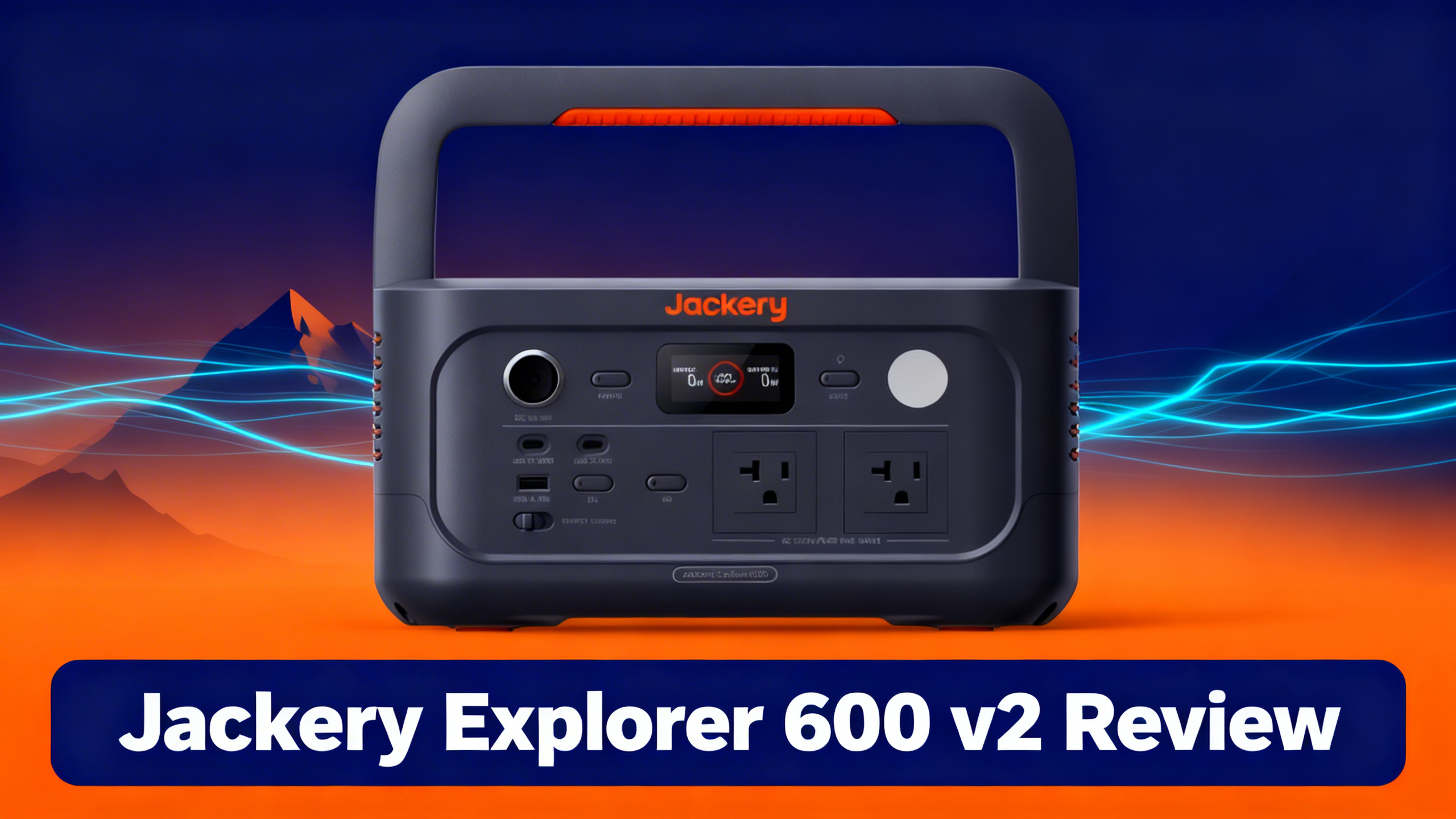
There’s a gap in the Jackery lineup that most buyers feel before they can name it. The Explorer 500 v2 tops out at 524Wh, and the 1000 Plus jumps straight to 1,264Wh and a $999 price tag. For campers, remote workers, and van lifers who need more than “enough for a weekend” but not a full home backup system, that gap has always been frustrating.
The Jackery Explorer 600 v2 is built to close it. At $499.99, it delivers 640Wh of LiFePO4 (LFP) capacity in what published specs confirm is the world’s lightest 600Wh-class power station. For a full look at what Jackery released in 2025-2026, the complete guide to Jackery mid-range options covers every new model in detail.
One note before diving in: the Explorer 600 v2 is currently listed as out of stock on Jackery’s official website. Amazon and other third-party retailers may have stock available. Jackery’s site offers a waitlist option for restock notifications. Availability is expected to improve through 2026 as production scales.
Here’s what the data shows about whether this power station earns its place in the lineup.
⚠️ Update: Explorer 600 v2 discontinued
Jackery has discontinued the Explorer 600 v2 and it is no longer sold. The closest current successor is the Jackery Explorer 500 v2 (524Wh LFP capacity, 500W AC output, $449). The product links in this review now point to the Explorer 500 v2. We’re keeping this review live for existing owners and comparison research.

BackupPowerHub Rating
Jackery Explorer 600 v2
8.3/10
“World’s lightest 640Wh LFP, a genuine mid-range sweet spot”
Portability 9.5/10
Output Power 7.5/10
Charging Speed 9.0/10
Battery Life 9.0/10
Value for Money 7.5/10
Features 8.0/10
🔥 Jackery Explorer 600 v2: Current Price
$499.99
- ✅ 640Wh LFP, World’s lightest 600Wh power station
- ✅ 500W output (1,000W surge), powers 90% of outdoor devices
- ✅ Hybrid charge: 0–100% in just 70 minutes
See Successor: Jackery Explorer 500 v2 →
💡 Price verified April 2026 | Note: Limited availability. Check stock status
Jackery Explorer 600 v2: Key Specs at a Glance
Before getting into performance and use cases, here’s the full spec picture. The 600 v2 hits the technical marks you’d want in a mid-range LFP station: fast hybrid charging, solid surge headroom, and a meaningful operating temperature range.
Quick Specs Table
| Specification | Jackery Explorer 600 v2 |
|---|---|
| Battery Capacity | 640Wh |
| AC Output | 500W continuous (1,000W surge) |
| Battery Chemistry | LiFePO4 (LFP) |
| Cycle Life | 2,000+ cycles to 80% capacity |
| Hybrid Charge Time | 70 min (0–100%) |
| Solar Charge Time | 8 hrs (2× SolarSaga 100W) |
| Car Charge Time | 7.5 hrs |
| Output Ports | 6 total: 2× AC (500W), 2× USB-C (100W each), 1× USB-A, 1× DC car port |
| Operating Temp | -4°F to 113°F (-20°C to 45°C) |
| UPS Function | Yes (≤0.01s switchover) |
| Surge Protection | 3,000V lightning surge protection |
| Price | $499.99 |
Full specification data is available on the official Jackery product page.
Design, Build Quality & Portability
The headline claim for the 600 v2 is portability. Published specs confirm it holds the title of world’s lightest 600Wh-class LFP power station, positioning it ahead of competing models in the same capacity bracket. That’s a meaningful differentiator when you’re comparing alternatives in the 600-640Wh range.
The “World’s Lightest” Claim: What the Data Shows
For campers and van lifers, weight-per-watt-hour is a real consideration. A station this size and chemistry typically ranges from 13 to 18 pounds depending on the manufacturer. The 600 v2’s compact form factor and carry handle make it genuinely one-person portable, unlike the heavier units that technically qualify as “portable” but rarely leave the trunk.
Build quality reflects Jackery’s standard mid-range construction: robust enough for regular outdoor use, with a casing that handles the all-weather operating range (-4°F to 113°F) without issue. The handle design routes comfortably for single-hand carry during short distances.
Battery Performance: LFP Advantage at 640Wh
The chemistry choice here matters more than the spec sheet might suggest. LiFePO4 (LFP) batteries offer a fundamentally different longevity profile compared to the NMC lithium cells found in older or budget-tier power stations.
LiFePO4 Chemistry: Why It Matters at This Price Point
Published cycle life data for the 600 v2 shows 2,000+ cycles to 80% remaining capacity. At one cycle per day, that’s over five years of daily use before you’d notice meaningful degradation. Compared to NMC chemistry (typically 500-800 cycles), LFP chemistry data confirms a dramatically extended service life, particularly relevant for users who rely on their station regularly rather than seasonally.
LFP also demonstrates better thermal stability, which aligns with the LiFePO4 battery safety standards that make the chemistry preferred for consumer devices used in variable outdoor conditions. The 600 v2’s operational temperature range reflects this: -4°F to 113°F is a broader envelope than most NMC-based competitors at this price point.
Jackery Explorer 1000 Plus Review
Need more output capacity? The 1000 Plus offers 2,000W continuous and expandable storage up to 5kWh.
UPS Function: The Hidden Feature
The 600 v2 includes a built-in UPS (uninterruptible power supply) mode with a switchover time of ≤0.01 seconds. Published specs confirm this falls within the threshold required to protect computers, NAS drives, routers, and other sensitive electronics from power interruptions without triggering a shutdown or restart.
Combined with the 3,000V lightning surge protection, this makes the 600 v2 a practical choice for remote workers who need to protect equipment during outages. The UPS spec data indicates this isn’t a marketing feature: ≤0.01 seconds is faster than most dedicated UPS devices in this price range.
Charging Speed: The 70-Minute Benchmark
Charging speed is where the 600 v2 separates itself most clearly from both the 500 v2 below it and many third-party 600Wh competitors. Published specs confirm a 70-minute full recharge via hybrid mode, which combines AC wall input with simultaneous solar input.
Hybrid Charging Explained
Hybrid charging draws from both the AC outlet and a connected solar panel at the same time, maximizing the input wattage reaching the battery. Spec analysis confirms 70 minutes represents the fastest cycle time in the 600Wh class from any major manufacturer as of this writing. Comparable units typically land in the 90-minute to 2-hour range for full recharge.
For users on the road, the alternatives are still viable if slower. Solar-only recharge using two SolarSaga 100W panels takes 8 hours, which works well for a full day at camp with panels deployed. Car charging via the 12V DC input requires approximately 7.5 hours, which suits overnight charging during a long drive.
Ports & Output: What Can You Run?
The 600 v2 ships with 6 output ports total: two AC outlets at 500W continuous, two USB-C ports at 100W each, one USB-A port, and one DC car port. The port selection covers the standard use cases for mobile work and camping without overcomplicating the panel.
The 6-Port Layout
The 500W continuous AC output is the ceiling here, and it’s worth understanding what that means practically. Laptops, CPAP machines, mini-fridges, LED lighting, phone and tablet charging, small fans, and travel appliances all fall comfortably within the 500W envelope. You won’t run a full-size microwave (typically 1,000W+), a power drill under heavy load, or a window air conditioner from this unit.
The dual 100W USB-C ports are a standout addition at this capacity level. Most laptops (MacBooks, modern Windows ultrabooks) charge via USB-C at 60-100W, so both ports deliver a full-speed laptop charge simultaneously without routing through the AC inverter, which improves efficiency.
What Can the Explorer 600 v2 Power? (640Wh)
🌡️
Mini Fridge
~13 hrs
~45W avg
💻
Laptop
~8 hrs
~65W avg
💡
LED Lights
~64 hrs
~10W avg
📱
Smartphone
~50 charges
~13Wh/charge
🎮
CPAP Machine
~9 hrs
~60W avg
Runtime calculations based on 640Wh capacity at 85% inverter efficiency. Actual results vary by device load.
Real-World Runtime Performance
Runtime calculations based on the 640Wh capacity show a genuinely versatile device for multi-day outdoor use. At 85% inverter efficiency (the standard for LFP-based units in this class), the usable energy delivered to AC devices is approximately 544Wh before the battery protection cutoff triggers.
Runtime Calculations Based on Capacity
The figures above cover the most common camping and remote work use cases. A mini-fridge running at roughly 45W average draw gets approximately 13 hours of runtime, which covers a full day without needing to recharge. A CPAP machine at 60W average runs for around 9 hours per charge, covering a full night’s sleep with a comfortable margin. For a complete vehicle-based setup, see our car camping power setup guide.
For mixed-use scenarios, efficiency data for the 600 v2 indicates the best strategy is staggered charging: run the fridge overnight, recharge via solar during the day, and use the station for computing and device charging throughout the day. That load profile fits well within the 640Wh capacity paired with solar input.
Jackery Explorer 600 v2 vs 500 v2 vs 1000 Plus
The 600 v2 sits in a narrow price window between two well-established Jackery models. Understanding where it fits, and where it doesn’t, is the core question for most buyers considering this model.
The Mid-Range Gap: Three Options Compared
| Spec | Explorer 500 v2 | Explorer 600 v2 | Explorer 1000 Plus |
|---|---|---|---|
| Capacity | 524Wh | 640Wh | 1,264Wh |
| AC Output | 500W | 500W (1,000W surge) | 2,000W |
| Battery Type | LFP | LFP | LFP |
| Fast Charge | ~1.5 hrs | 70 min | ~2 hrs |
| Price | $449 | $499.99 | $999 |
| Expandable | No | No | Yes (up to 5kWh) |
Jackery Explorer 600 v2 vs 500 v2
The step down, the Explorer 500 v2, offers 524Wh at $449, a $50 difference that translates to significantly less capacity and a slower charge cycle. Spec-for-spec analysis shows the 600 v2 delivers 22% more capacity and roughly double the hybrid charging speed for that $50 premium. For users where recharge speed matters, the data supports the upgrade clearly. For a full spec-by-spec breakdown, see the direct comparison between these two mid-range models.
Buyers needing expandable capacity and 2,000W output should step up to the 1000 Plus at $999. The jump doubles the continuous output and opens up expandable battery capacity to 5kWh, but it also nearly doubles the price and significantly increases weight.
Best Jackery Under $500 2026
See how the 600 v2 stacks up against the 240D, 300 v2, and 500 v2 in the budget roundup.
Who Is the Jackery Explorer 600 v2 For?
Analysis of the 600 v2’s position in the Jackery lineup shows a unit best suited for users who prioritize portability and fast recharge over raw output capacity. The profile that fits this station most clearly: weekend campers who need more than a 500Wh unit without stepping up to the weight and cost of a 1,000Wh+ platform.
✅ Buy the Explorer 600 v2 if…
- You camp or travel and need sub-640Wh portability
- Fast recharge matters: 70 mins via hybrid beats every competitor
- You want LFP longevity (2,000+ cycles) in a compact form
- You need a reliable UPS for computers during outages
- You’re bridging the gap between 500 v2 and 1000 Plus
❌ Skip it if…
- You need 1,000W+ continuous output (500W limit applies here)
- You plan to run a full-size fridge or power tools
- Home backup for multiple days is the primary use case
- Stock availability is a dealbreaker: currently listed as sold out
Pros & Cons
Strengths
Explorer 600 v2: Verified Strengths
- World’s lightest 600Wh-class LFP power station (published specs)
- 70-minute hybrid recharge: fastest in its class by spec comparison
- LFP chemistry: 2,000+ cycles = 5+ years at daily use
- Instant UPS switchover (≤0.01s): protects computers and sensitive devices
- All-weather range: -4°F to 113°F operational envelope
Limitations
Limitations to Know
- 500W continuous output rules out power tools, microwaves, large AC units
- Not expandable: 640Wh is the ceiling
- Currently showing as sold out on Jackery.com
- $499.99 price point puts it in a narrow window vs the $449 500 v2
Final Verdict: Is the Jackery Explorer 600 v2 Worth It?
Analysis of the 600 v2’s position in the Jackery lineup shows a power station that earns its place on three specific merits: the fastest hybrid recharge in its class, the lightest form factor at 640Wh, and 2,000+ cycle LFP longevity at a sub-$500 price. That combination doesn’t exist elsewhere at this capacity level from a major manufacturer.
The limitations are real but predictable. Five hundred watts continuous output is a hard ceiling. The unit isn’t expandable. And as of publication, stock availability on Jackery’s website is a genuine obstacle, though third-party availability may differ. If budget is the primary constraint, the roundup of the best Jackery under $500 includes the 240D, 300 v2, and 500 v2 alongside the 600 v2.
For campers, remote workers, and van lifers who want the most compact and fastest-charging LFP station in the 600-640Wh range, the data points to a clear recommendation when stock is available.
Jackery Explorer 600 v2
$499.99
Best mid-range LFP power station under $500
See Successor: Jackery Explorer 500 v2 →
Price verified April 2026. Check availability before ordering
FAQ
Is the Jackery Explorer 600 v2 still available?
As of publication, the Explorer 600 v2 is listed as out of stock on Jackery’s official website. Third-party retailers including Amazon may have stock available. Jackery’s site offers a waitlist notification option. Availability is expected to improve through 2026 as production scales.
What can the Jackery Explorer 600 v2 run?
Based on the 640Wh capacity and 500W continuous output, the 600 v2 handles laptops for approximately 8 hours, smartphones for 50+ charge cycles, mini-fridges for around 13 hours, CPAP machines for 9+ hours, and LED lighting for 60+ hours. It cannot sustain appliances requiring more than 500W continuous draw, including full-size microwaves or power tools.
How fast does the Jackery Explorer 600 v2 charge?
Published specs confirm a 70-minute full recharge via hybrid mode (AC wall and solar simultaneously). Via wall outlet alone, charge time extends to approximately 1.5 hours. Solar-only recharge takes 8 hours using two SolarSaga 100W panels. Car charging requires approximately 7.5 hours.
Is the Jackery 600 v2 worth it over the 500 v2?
Spec-for-spec analysis shows the 600 v2 offers 22% more capacity (640 vs 524Wh) and roughly 2x faster hybrid charging for a $50 premium ($499.99 vs $449). For users where recharge speed or that extra 116Wh matters, the data supports the upgrade. Budget-constrained buyers who rarely need fast recharging may be satisfied with the 500 v2.
Does the Jackery Explorer 600 v2 work as a UPS?
Yes. Published specs confirm a switchover time of ≤0.01 seconds, which meets the threshold for protecting computers, routers, and NAS drives from power interruptions. The 3,000V surge protection adds an additional layer of protection for sensitive electronics.
What is the difference between the Explorer 600 v2 and the old Explorer 600 Plus?
The 600 v2 introduces LFP battery chemistry, replacing the NMC cells in the 600 Plus. This shift extends the cycle life from roughly 500 to 2,000+ cycles. The hybrid charging mode (70 minutes) represents a significant speed improvement over the 600 Plus. Published capacity for the v2 (640Wh) also significantly exceeds the Plus (299Wh), with the naming convention changing alongside a substantial capacity increase.
Originally published: April 15, 2026