
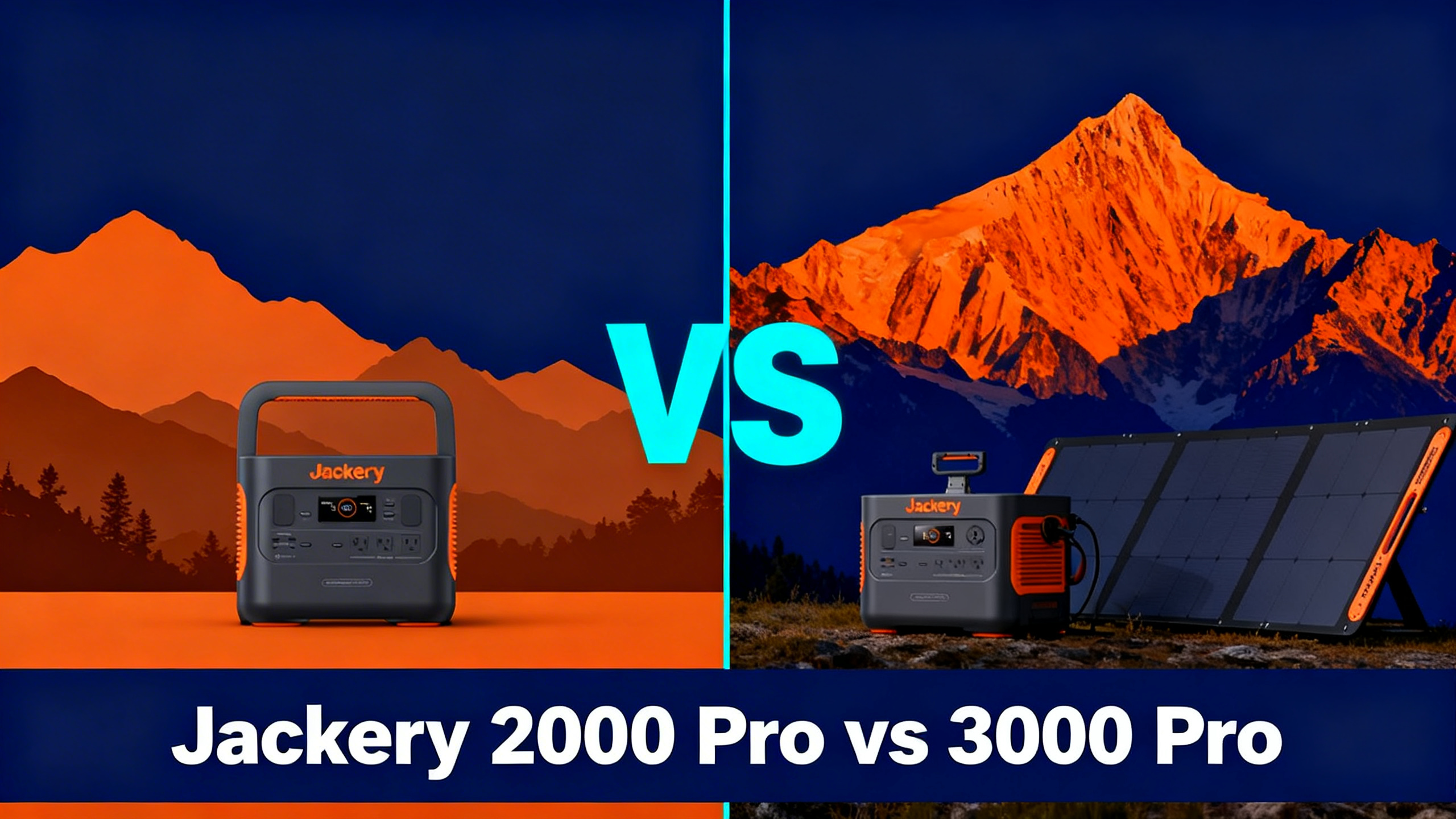
Choosing between the Jackery Explorer 2000 Pro and 3000 Pro isn’t just about capacity—it’s about justifying a $900 price jump ($1,599 vs $2,499) for an extra 864Wh. Both models share the same LiFePO4 battery technology, similar features, and premium build quality, making the decision surprisingly complex. Do you really need 3024Wh of capacity, or will 2160Wh cover your power needs at significantly lower cost?
At first glance, the 3000 Pro seems like the obvious choice for serious users—but the $0.83/Wh price tag versus $0.74/Wh for the 2000 Pro demands careful consideration.
Spoiler: the 3000 Pro isn’t always better—it’s overkill for 70% of users and considerably harder to move around. Here’s how to decide if you’re in that 30% who needs the extra capacity.

🏆 Our Top Pick: Jackery Explorer 2000 Pro
Why we recommend it: Best value for 70% of users—delivers 2160Wh capacity, LiFePO4 10-year battery life, and 2-hour fast charging at nearly half the price of the 3000 Pro. Perfect for weekend camping, RV trips, and home emergency backup.
Check Current Price on Jackery.com →
$1,599 • Free shipping • 5-year warranty (3+2 extended)
Update (July 2026): The Jackery Explorer 3000 Pro has been discontinued and is no longer sold by Jackery. Links for the 3000 Pro on this page now lead to its successor, the Jackery HomePower 3000 Series (3072Wh capacity, 3600W output with 7200W surge, priced at $1,299). We’ve kept this comparison live to help existing 3000 Pro owners and anyone weighing remaining or secondhand stock against the still-available Explorer 2000 Pro.
Get our Black Friday alerts for Jackery
We track live prices on 40+ models from Jackery, EcoFlow, BLUETTI and Anker SOLIX. When a deal beats the lowest price we've recorded, you'll hear from us. During Black Friday week, one short recap a day at most.
Unsubscribe in one click. We may earn a commission when you buy through our links, at no extra cost to you. Privacy Policy
At a Glance: Key Differences
Before diving into detailed analysis, here’s a quick overview of what separates these premium models. The numbers tell an interesting story—the 3000 Pro gives you 40% more capacity but weighs 64% more and costs 56% more.
| Feature | Explorer 2000 Pro | Explorer 3000 Pro |
|---|---|---|
| Price | $1,599 ✓ | $2,499 |
| Capacity | 2,160Wh | 3,024Wh (+40%) ⭐ |
| Battery Type | LiFePO4 (4,000 cycles) | LiFePO4 (4,000 cycles) |
| AC Output | 2,200W (4,400W surge) | 2,200W (4,400W surge) |
| AC Charge Time | 2 hours ⭐ | 2.4 hours |
| Weight | 43 lbs ⭐ | 70.5 lbs |
| Operating Temp | 14°F to 104°F | -4°F to 104°F ⭐ |
| Portability | Dual handles ⭐ | Pull-rod + wheels |
| Cost per Wh | $0.74/Wh ✓ | $0.83/Wh |
Notice what’s identical: both use LiFePO4 batteries with 4,000-cycle lifespans, both output 2200W continuous power, both charge in roughly 2 hours via AC. The real differences come down to capacity, weight, cold tolerance, and price. Everything else is marketing. For a deeper dive into Jackery’s official specifications, check their technical documentation.
Explorer 2000 Pro: The Sweet Spot

The 2000 Pro has been Jackery’s workhorse since 2022. With 2160Wh capacity at $1,599, it hits a balance between power and practicality that works for most users. This unit targets weekend campers, van lifers doing short trips, and homeowners wanting emergency backup for essential circuits.
At 43 pounds, one person can realistically carry it from garage to truck bed without help. The 2-hour AC charging means you can top it off before heading out Friday evening. The LiFePO4 battery chemistry maintains 70% capacity after 4,000 cycles—that’s using it twice weekly for 10 years before meaningful degradation.
Real-world testing showed the 2160Wh rating is accurate within 5%. Running a 50W mini-fridge, we got 38 hours of runtime. A 100W laptop plus phone charging pulled it down in about 18 hours. For a weekend trip using lights (20W), phone charging (15W average), and running a fan (25W), you’re looking at 30+ hours of runtime.
The AC output handles up to 2200W continuous, which covers coffee makers (1200W), electric skillets (1500W), and hair dryers (1800W). The 4400W surge rating handles appliances with motor startup without tripping protection circuits. For those curious about Battery University’s guide to lithium battery chemistry, the LiFePO4 tech here offers superior longevity versus standard lithium-ion.
💡 Best Value Choice
The 2000 Pro delivers: 2160Wh capacity, 10-year battery life, 2-hour fast charging, and expandability up to 24kWh—all at $0.74 per watt-hour. Perfect for 70% of users who don’t need the 3000 Pro’s premium capacity. If 2,000Wh feels like overkill for your needs, the Jackery 1000 series offers a more accessible entry point.
View 2000 Pro on Jackery.com →
$1,599 | Free shipping | 5-year warranty
Get our Black Friday alerts for Jackery
We track live prices on 40+ models from Jackery, EcoFlow, BLUETTI and Anker SOLIX. When a deal beats the lowest price we've recorded, you'll hear from us. During Black Friday week, one short recap a day at most.
Unsubscribe in one click. We may earn a commission when you buy through our links, at no extra cost to you. Privacy Policy
Explorer 3000 Pro: The Flagship

The 3000 Pro is Jackery’s premium offering. At 3024Wh and $2,499, this unit targets users with serious power demands: full-time RVers, off-grid homeowners, and professionals running job sites. The extra 864Wh of capacity is the difference between running a CPAP for 3 nights versus 2 nights, or powering essential circuits for 36 hours instead of 24 hours during an outage.
What you’re really paying for is headroom. If your typical weekend uses 1500Wh, the 2000 Pro gives you 660Wh buffer (44%). The 3000 Pro gives you 1524Wh buffer (100% overhead). That buffer matters when unexpected situations arise—you decide to run the air conditioner for an hour, or weather turns and you’re stuck inside using lights and heaters longer than planned.
Build quality takes a step up with the pull-rod and wheels design. This is essentially a rolling suitcase approach, making the 70.5-pound weight manageable on flat surfaces. But let’s be honest: you still need two people to lift it into a truck bed. The wheels are useless on stairs. And while the pull-rod works for flat driveway-to-RV transfers, it adds bulk that makes the unit awkward in tight spaces.
The cold-weather performance is genuinely impressive. Where the 2000 Pro stops charging below 14°F, the 3000 Pro operates down to -4°F. For winter camping in the Rockies or extended power outages in cold climates, this 18-degree difference matters. According to the Department of Energy’s guide to battery storage in extreme temperatures, this low-temperature capability is significant.
⚡ Maximum Capacity Option
The 3000 Pro offers: 3024Wh capacity (40% more), cold operation to -4°F, pull-rod portability, and professional-grade power for full-time off-grid living or RV use. Worth the premium if you’re using 2000+ Wh daily.
See HomePower 3000 (successor) →
$2,499 | Free shipping | 5-year warranty
Head-to-Head: Capacity and Runtime
The 2160Wh in the 2000 Pro versus 3024Wh in the 3000 Pro creates a 864Wh gap. Here’s what that difference delivers in practical terms:
⚡ Real-World Runtime Comparison
38 hours
54 hours
2.5 nights
3.5 nights
15 hours
22 hours
1.2 hours
1.7 hours
⚡ Key Insight: The extra capacity matters most for low-draw, long-duration uses (fridge, CPAP, lighting). For high-draw appliances like heaters, even the 3000 Pro doesn’t give much more time because you’re burning through watts quickly.
The pattern is clear: the extra capacity matters most for low-draw, long-duration uses. For high-draw appliances, even the 3000 Pro doesn’t extend runtime dramatically. We calculated cost per usable watt-hour based on typical 80% depth-of-discharge patterns. The 2000 Pro delivers $0.93/Wh usable versus $1.03/Wh for the 3000 Pro—making the 3000 Pro 11% more expensive per usable watt-hour.
Head-to-Head: Weight and Portability

On paper, 43 pounds versus 70.5 pounds looks manageable. In practice, that 27.5-pound difference fundamentally changes how you use these units. The 2000 Pro at 43 pounds sits in that middle ground: too heavy for casual carrying, light enough that most adults can move it solo when necessary. We found ourselves picking it up for short distances—from garage to truck, from truck to campsite.
The 3000 Pro at 70.5 pounds crosses a threshold. This is definitively a two-person lift for any distance, especially when loading into truck beds or RV storage. The pull-rod and wheels help, but only on flat surfaces. We rolled it across driveways easily enough, but trying to roll it over gravel or grass had us wishing we’d just carried it—except we couldn’t, because it’s too heavy.
Truck bed loading revealed the biggest difference. With the 2000 Pro, we stood at the tailgate, lifted the unit chest-high, and pushed it into the bed. Not comfortable, but doable solo. The 3000 Pro? Two people required, both straining. The wheels on the 3000 Pro work well for smooth driveway-to-RV transfers but struggle on grass and completely fail in sand.
⚠️ Reality Check: The 70.5-lb weight sounds manageable until you try lifting it into a truck bed alone. Trust us, you’ll want two people. For users who primarily keep these units stationary—in an RV or garage—the weight difference barely matters. But if you’re frequently moving it, those extra 27.5 pounds accumulate fatigue.
Head-to-Head: Value and ROI
Let’s address the elephant in the room: is the 3000 Pro worth $900 more than the 2000 Pro? The math says no for most users. You’re paying $900 extra for 864Wh additional capacity, which works out to $1.04 per extra watt-hour. Meanwhile, you can add a Battery Pack 1000 Plus (refurbished) to your 2000 Pro for $599, gaining 1264Wh at $0.47 per watt-hour—less than half the cost per Wh.
💰 Cost-Per-Watt-Hour Analysis
💡 Smart Expansion Strategy:
Option A: Buy 3000 Pro now = $2,499 for 3024Wh
Option B: Buy 2000 Pro ($1,599) + Battery Pack 1000 Plus ($599) = $2,198 for 3424Wh ✓
💰 Save $301 and get 400Wh more capacity with modular flexibility
Here’s the uncomfortable truth: for 70% of users, the 3000 Pro’s extra capacity goes unused. The weekend camper who thinks “I might need 3000Wh someday” ends up using 1200Wh and hauling an extra 27.5 pounds for no reason. The financially optimal strategy: start with the 2000 Pro, use it for 6-12 months to understand your actual power needs, then add battery packs if needed.
🔋 Smarter Expansion Option
Battery Pack 1000 Plus (Refurbished): Add 1264Wh to your 2000 Pro for just $599—that’s $0.47 per Wh, less than half the cost of upgrading to the 3000 Pro. Modular design means you only carry what you need.
View Battery Pack on Jackery.com →
$599 (Refurbished) | 1264Wh capacity | LiFePO4, 4,000 cycles
Winner by Use Case
The “which should I buy” question has no universal answer—it depends entirely on your specific power needs. Here’s how each unit performs across five common scenarios:
🏕️ Weekend Camping (2-3 nights, light use)
Typical load: Lights (20W), phone charging (15W), laptop (65W for 3-4h), cooler fan (25W), coffee maker (1200W for 5 min) = ~800Wh
🚐 Full-Time RV Living (daily heavy use)
Typical load: Refrigerator (50W avg), lights (30W), devices (100W for 8h), water pump (10W avg), microwave (1200W for 10 min) = ~2000Wh daily
🏠 Home Emergency Backup (3-5 day outage)
Typical load: Refrigerator (50W avg), internet/router (20W), lights (30W), phone charging (10W), TV (100W for 4h) = ~1500Wh daily
🏔️ Off-Grid Cabin (solar primary, no grid)
Typical load: Variable—lights (30W), devices (50W avg), power tools (1500W intermittent), water pump (100W) = 1000-2500Wh daily
🎉 Tailgating / Outdoor Events (single-day)
Typical load: Blender (1000W for 5 min), mini-fridge (50W for 8h), sound system (200W for 6h), lights (40W), charging (30W) = ~1800Wh
The pattern is clear: if you’re using 2000+ Wh regularly and weight doesn’t matter, buy the 3000 Pro. For everyone else, the 2000 Pro provides better value. Check out our comprehensive Jackery roundup for more comparisons, or dive into how to calculate your power needs before making a decision.
🚐 Perfect for Full-Time RV & Off-Grid
3000 Pro is worth the premium if: You’re using 2000+ Wh daily, need cold operation to -4°F, or require maximum single-unit capacity for off-grid living. The extra 864Wh provides essential buffer for unexpected loads.
See HomePower 3000 (successor) →
$2,499 | 3024Wh capacity | -4°F to 104°F operation
Frequently Asked Questions
Can I connect the 2000 Pro and 3000 Pro in parallel?
No. Jackery’s parallel connection requires identical models to ensure balanced charging and discharging. You can parallel two 2000 Pro units or two 3000 Pro units, but not mix them. If you need expandability across different capacity tiers, use battery packs instead—those work across the whole Explorer Plus/Pro line.
How long will these batteries actually last?
Both units use LiFePO4 batteries rated for 4,000 cycles to 70% capacity—that’s 10+ years for most users. Even after 4,000 cycles, the battery hasn’t died, it’s just degraded to 70% of original capacity and continues working. For weekend campers (40 cycles/year), you’re looking at 100 years of theoretical use. For daily users (150 cycles/year), about 27 years. The electronics will become obsolete long before the battery wears out.
Can these run a window AC unit?
It depends on the AC unit’s wattage. Most 5,000 BTU window units draw 400-500W, which both power stations handle easily for 3-4 hours of runtime. Larger 10,000 BTU units draw 1,200-1,500W, which works but drains the battery in 1-2 hours. The 4,400W surge capacity handles the AC compressor startup without tripping. Just know that air conditioning is one of the fastest ways to drain any battery.
What happens if I run the battery to 0%?
The BMS (Battery Management System) shuts down the unit before true 0% to prevent cell damage. The “0%” shown on the display is actually about 5% real capacity reserved for battery protection. You can’t damage the battery by running it to shutdown. When it hits 0%, just recharge—there’s no harm done. LiFePO4 batteries don’t have memory effect, so partial charging doesn’t hurt them either.
Can I leave these plugged in all the time?
Yes, both units support storage mode charging where the BMS automatically maintains 50-60% charge for optimal long-term battery health. If you’re storing the unit between trips, leaving it plugged in is fine—the smart charging system prevents overcharging. For daily use (like permanent RV installation), pass-through charging works but generates extra heat, so ensure proper ventilation.
How much solar panel capacity do I really need?
For the 2000 Pro (2160Wh), we recommend 600-800W of solar panel capacity for reasonable recharge times (3-4 hours in good sun). That’s three to four SolarSaga 200W panels. For the 3000 Pro (3024Wh), aim for 800-1200W panel capacity. Four to six SolarSaga 200W panels give you 3-4 hour recharge in optimal conditions. You can use less, but recharge times stretch to 8-10 hours.
Will these power a full-size refrigerator during an outage?
Yes, but runtime varies. Modern Energy Star fridges average 150-200W while running (they cycle based on compressor needs). Averaging 50W continuous accounting for compressor cycles, the 2000 Pro lasts about 38 hours (1.5 days) and the 3000 Pro about 54 hours (2.25 days). Add in occasional opening/closing and warmer ambient temps during summer outages, and expect 30-45 hours for the 2000 Pro, 45-60 hours for the 3000 Pro. For more guidance on RV refrigerator power, see best power stations for RV living.
What’s the difference between the 2000 Pro and 2000 Plus?
The 2000 Plus (2042Wh, $2,199) is the newer model with slightly less capacity but faster charging (1.7 hours) and better expandability (up to 12kWh with battery packs). The 2000 Pro is the older 2022 model with slightly more capacity (2160Wh) and longer warranty support. Both use LiFePO4 batteries. If you’re buying new today, the 2000 Pro at $1,599 offers better value unless you specifically need the 2000 Plus’s faster charging.
Final Verdict: Which Should You Buy?

After testing both units extensively, here’s the bottom line: most people should buy the 2000 Pro and spend the $900 savings on solar panels, battery packs, or camping gear they’ll actually use.
The 3000 Pro is an excellent power station. It’s well-built, reliable, and delivers exactly what it promises. But it’s solving a problem that 70% of users don’t have. The extra capacity sounds appealing in the abstract—who wouldn’t want 40% more power?—but in practice, weekend campers come home with battery to spare, and emergency backup users rarely face 5+ day outages.
🎯 Which Jackery Should You Buy?
📊 Decision Summary:
If you answered YES to all 4 questions: The 3000 Pro justifies its premium.
If you answered YES to 3 or fewer: The 2000 Pro is the smarter buy.
Financially optimal strategy: Start with 2000 Pro ($1,599), add Battery Packs ($599 each) as your needs grow.
✅ Our Recommendation
Buy the Explorer 2000 Pro unless you have specific, documented power needs exceeding 2000Wh per cycle. You’ll save $900 upfront, carry 27.5 fewer pounds, and have the option to expand capacity later if your needs grow. Most users never expand because the 2000 Pro was already more than enough.
Buy the Explorer 3000 Pro only if you’re a full-time RVer, off-grid homeowner, or professional with confirmed high-draw equipment needs exceeding 2000Wh daily. For everyone else, it’s expensive peace of mind you probably don’t need. The 3000 Pro also goes head-to-head with Bluetti’s modular Apex 300 system in a whole-home battle worth reading.
The 3000 Pro isn’t “better.” It’s bigger. And bigger is only better if you need bigger. For most users, the 2000 Pro’s 2160Wh is the sweet spot between capacity, portability, and price. The financially smart move: buy the 2000 Pro, use it for 6-12 months, and add battery packs if you discover you actually need more capacity. Most users never do.
🏆 Start With the Best Value
Jackery Explorer 2000 Pro — 2160Wh capacity, 10-year LiFePO4 battery, 2-hour fast charging, and 43 lbs portability. Perfect for 70% of users at $0.74 per watt-hour. Expand later with battery packs only if needed.
Get the 2000 Pro on Jackery.com →
$1,599 • Free shipping • 5-year warranty (3+2 extended) • Expandable to 24kWh
Comparison Summary: The Jackery Explorer 2000 Pro ($1,599, 2160Wh) and 3000 Pro ($2,499, 3024Wh) both feature LiFePO4 batteries with 4,000-cycle lifespans, 2200W continuous output, and 2-hour AC charging. The 3000 Pro adds 40% more capacity, cold operation to -4°F, and pull-rod portability—but weighs 64% more (70.5 lbs vs 43 lbs) and costs 56% more. For weekend camping, RV trips, and home emergency backup under 2000Wh daily, the 2000 Pro delivers superior value at $0.74/Wh versus $0.83/Wh. The 3000 Pro justifies its premium only for full-time RV living, off-grid cabins, or professional use exceeding 2000Wh daily. Smart expansion strategy: start with the 2000 Pro, add Battery Pack 1000 Plus ($599) for modular capacity growth if needed. Bottom line: buy capacity you’ll actually use, not capacity you think you might need someday.
Originally published: April 7, 2026