
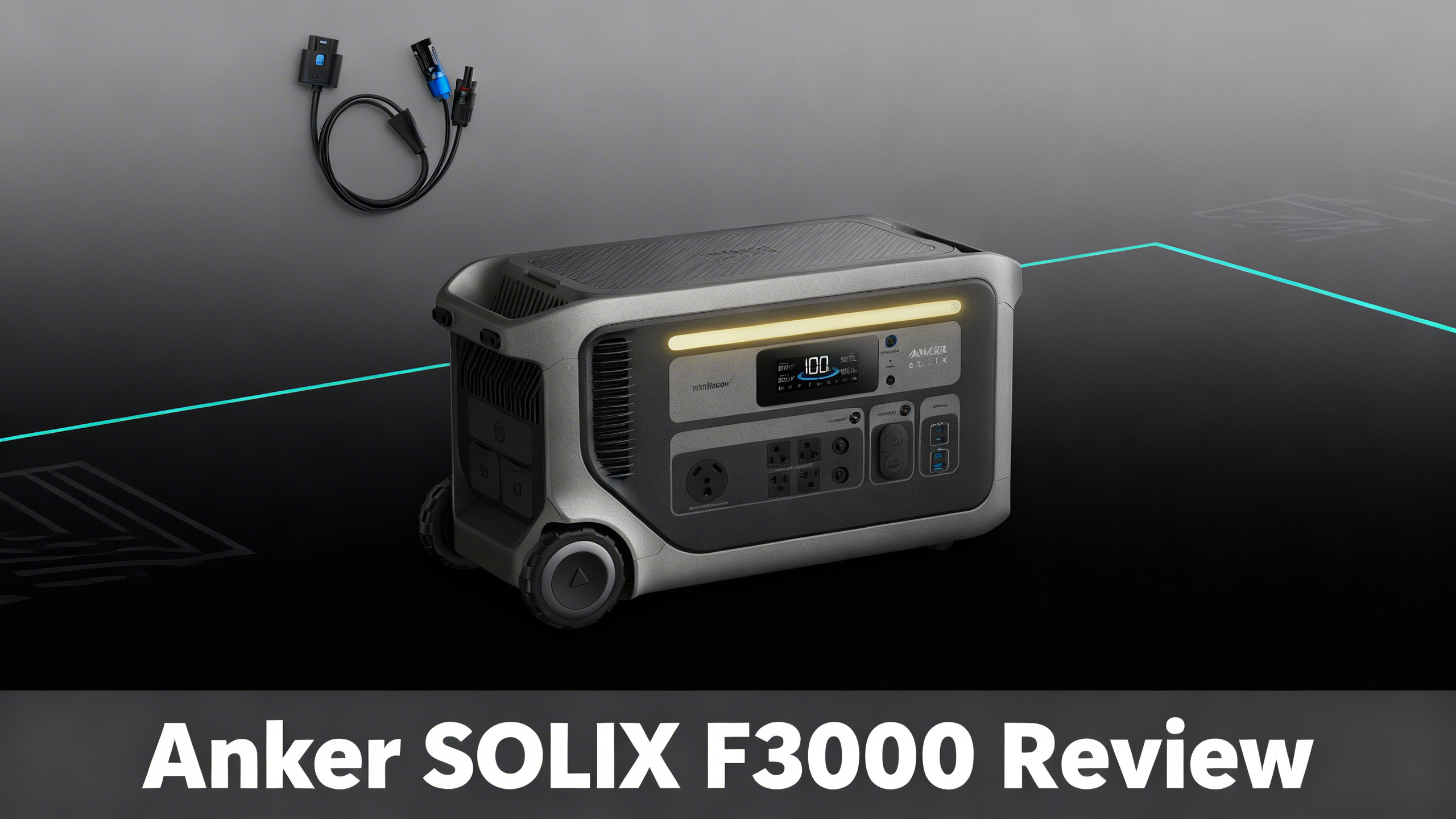
Looking for a portable power station that bridges the gap between mid-range convenience and whole-home ambition? The Anker SOLIX F3000 enters 2026 as one of the most capable portable units on the market, packing 3,072Wh of LFP capacity, dual MPPT solar input, and a 120/240V output pathway that most competitors at this price point simply cannot match.
At $1,399.99, the F3000 is a serious investment. The central question is whether it justifies that price against the pricier F3800, and whether its 240V limitation (requiring two units) matters for your specific use case. The F3000 earns a spot in our list of top Anker SOLIX models ranked for 2026, sitting between the mid-range C2000 Gen 2 and the flagship F3800.
This analysis covers full specifications, runtime data, solar input performance, expandability, and a direct comparison with the F3800. Here is what the data shows.

Get our Black Friday alerts for Anker SOLIX
We track live prices on 40+ models from Jackery, EcoFlow, BLUETTI and Anker SOLIX. When a deal beats the lowest price we've recorded, you'll hear from us. During Black Friday week, one short recap a day at most.
Unsubscribe in one click. We may earn a commission when you buy through our links, at no extra cost to you. Privacy Policy
Real-World Look: The Anker SOLIX F3000 in Use
Studio renders only tell part of the story. Here is the Anker SOLIX F3000 as it actually looks in a real owner’s hands, away from the polished marketing shots.
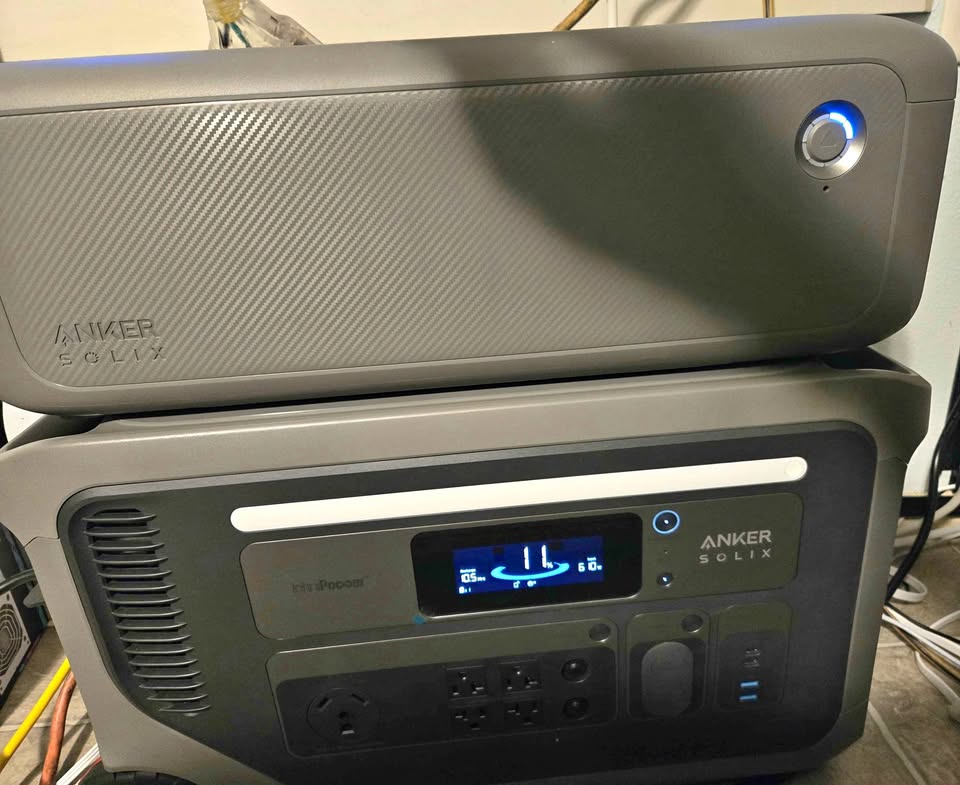
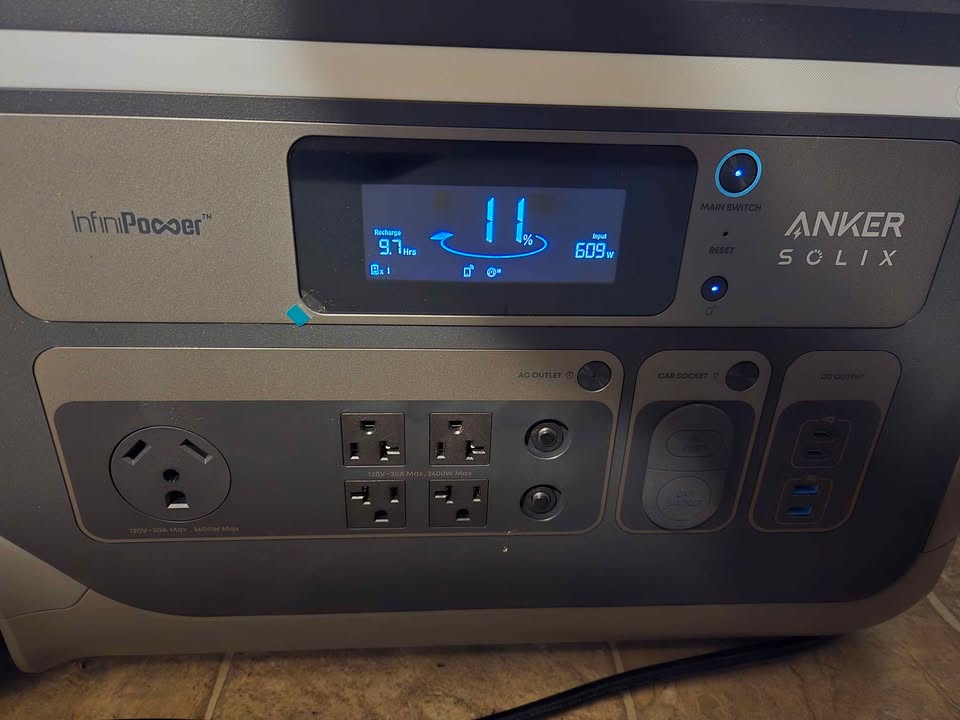
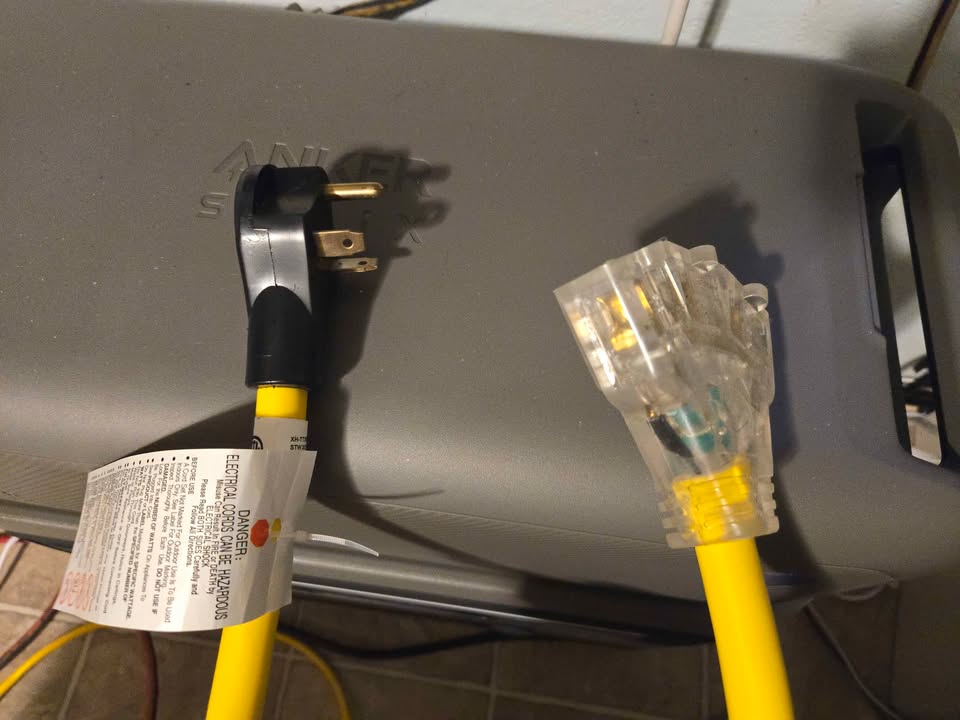
Real-world photos of the Anker SOLIX F3000.
Anker SOLIX F3000: Overall Rating
8.6/10
“A true flagship portable with whole-home ambitions”
Capacity & Power 9.2/10
Solar Input 9.0/10
Recharge Speed 8.8/10
Expandability 9.5/10
Value for Price 7.8/10
Portability 6.5/10
Anker SOLIX F3000
$1,399.99
- 3,072Wh LFP battery, expandable to 24kWh
- 120V output (240V with two units), 3,600W pass-through charging
- 2,400W solar input (dual MPPT)
F3000 Specifications at a Glance
The F3000 is built around a 3,072Wh LFP (Lithium Iron Phosphate) battery, a chemistry choice that prioritizes longevity and thermal stability over raw energy density. Published specs place it at 3,500+ cycle life before reaching 80% capacity, which translates to roughly a decade of daily use for most backup scenarios.
Key output figures: 120V native AC output, 120/240V when two F3000 units are paired via the Double Voltage Hub, and a pass-through charging ceiling of 3,600W via generator. The Anker SOLIX F3000 currently sells for $1,399.99. The 30% federal tax credit for home batteries ended for systems installed after December 31, 2025, so budget for the full price.
Full technical specifications available on the official F3000 product page.

Get our Black Friday alerts for Anker SOLIX
We track live prices on 40+ models from Jackery, EcoFlow, BLUETTI and Anker SOLIX. When a deal beats the lowest price we've recorded, you'll hear from us. During Black Friday week, one short recap a day at most.
Unsubscribe in one click. We may earn a commission when you buy through our links, at no extra cost to you. Privacy Policy
What Can the F3000 Power?
Runtime calculations based on the 3,072Wh capacity confirm this unit belongs in a different class from 1,000-2,000Wh alternatives. At a 300W average household draw (lights, refrigerator, phones, router), the F3000 delivers approximately 10 hours of home essential coverage, accounting for a ~15% efficiency loss typical of LFP inverters at moderate loads.
What Can It Power? (3,072Wh)
❄️
Mini Fridge
~42 hrs
~60W avg
💡
LED Lights + Laptop
~40 hrs
~75W combined
🏠
Home Essentials
~10 hrs
~300W avg load
📺
TV + Router + Lights
~25 hrs
~120W avg
⛺
Camp Setup (all devices)
~3-5 days
~60-100W avg
Runtime calculations based on 3,072Wh capacity at typical appliance draws. Actual results vary with efficiency losses (~15%) and load profiles.
For camping, the math is even more favorable. A moderate camp setup drawing 60-100W averages 3 to 5 days of continuous operation, enough for a full week-long trip with occasional recharging. The ultra-low idle draw (125 hours of AC standby) also means leaving the unit on overnight costs minimal capacity, a detail that matters for multi-day deployments.
Solar Charging Performance
The dual MPPT architecture is one of the F3000’s strongest differentiators. Two independent controllers handle distinct panel profiles: a 60V/800W input optimized for portable folding panels like the PS400, and a 165V/1,600W input designed for rigid high-voltage panels. Running both simultaneously delivers the full 2,400W solar ceiling.
Recharge time calculations based on capacity and solar input show a theoretical minimum of approximately 1.3 hours (3,072 ÷ 2,400). In realistic conditions, accounting for MPPT efficiency losses and variable irradiance, a 2-3 hour charge window from flat to full is a reliable planning figure. That is a meaningful advantage for any setup where grid access is unavailable for extended periods.

Panel configuration, MPPT wiring, and seasonal output data are covered in detail in our dedicated F3000 solar setup guide. For buyers planning a solar-first strategy, the two-MPPT design gives considerably more flexibility than single-input competitors at this price.
Battery Chemistry & Lifespan
The F3000 uses LFP (Lithium Iron Phosphate) chemistry, a deliberate choice over NMC for users prioritizing longevity over peak energy density. Published cycle ratings place LFP at 3,500+ charge cycles before hitting 80% capacity, versus 500-800 cycles for typical NMC cells. For daily backup use, that translates to roughly 10 years of usable life from a single battery pack. According to LFP battery chemistry explained by the U.S. Department of Energy, LFP cells also exhibit superior thermal stability, reducing risk of thermal runaway in high-temperature environments.
The practical tradeoff is weight and slightly lower energy density compared to NMC. For a stationary or semi-stationary deployment (home backup, RV, base camp), that tradeoff strongly favors LFP. For users who genuinely need to carry this unit frequently, portability data should be a primary evaluation criterion.
120/240V Output: What It Means in Practice
The F3000 delivers 120V natively from a single unit. Reaching 240V requires two F3000 units connected via the Double Voltage Hub (sold separately, $289.99 as of October 2026). This is the most important spec distinction versus the F3800, which provides native 240V output from a single unit without additional accessories.
For most homeowners and RV users, 120V output covers the majority of loads: refrigerators, CPAP machines, lights, electronics, fans, and most power tools. The 240V pathway becomes relevant for heat pumps, central AC units, well pumps, EV charging circuits, and large compressors. If those appliances are part of your backup plan, factor in the Double Voltage Hub cost and the requirement to own two F3000 units, which roughly brings the system to F3800 territory in total spend.

Pass-Through & Generator Integration
Pass-through charging at 3,600W via a 120V generator is a standout capability for extended outage scenarios. The logic: the generator powers connected appliances simultaneously while charging the F3000 battery, eliminating the need to choose between running devices and building reserve capacity. The 120V Generator Input Adapter (sold separately) is the required interface.
The 6,000W maximum recharge rate refers to a combined input scenario: generator plus solar panels, with an expansion battery connected. Under those conditions, a depleted system can recover remarkably quickly. This hybrid recharge architecture makes the F3000 particularly well-suited for rural properties, job sites, or RV setups where a generator is already part of the equipment inventory.
Expandability & Ecosystem
The F3000’s expandability story is one of its strongest selling points. The BP3000 Expansion Battery adds 3,072Wh per unit at $999.99. Each F3000 takes up to three, for 12,288Wh, and two fully expanded F3000 systems reach about 24kWh. At that scale, coverage extends to approximately 80 hours of home essential loads, enough to handle a multi-day outage without any solar input at all.

Beyond raw capacity, the SOLIX ecosystem includes two notable accessories. The Power Saver Kit (sold separately) bundles the Smart Meter and Bi-Directional Inlet Box for grid-integrated energy management: the system can draw from solar, battery, and the grid intelligently to minimize utility costs. The Home Backup Kit bundle pairs the F3000 with a 6-circuit manual transfer switch for critical circuit backup.


Homeowners weighing portable vs. fixed backup will find a full breakdown in our guide to Anker SOLIX for home backup. The short answer: the F3000’s ecosystem is purpose-built for users who want both portability and home integration, not one or the other.
F3000 vs F3800: Which Is Right for You?
Spec-for-spec analysis puts the F3000 in direct competition with our F3800 flagship comparison for capacity-hungry home users. The core differences are native capacity (768Wh less on the F3000) and 240V output approach (paired units vs. native solo). Where the models converge: identical 2,400W solar input ceiling, identical 6,000W maximum recharge rate, and overlapping expandability ranges.
The decision framework is straightforward. If native 240V output from a single unit is non-negotiable, the F3800 is the correct choice. If 120V is sufficient or you plan to run two units anyway, the F3000 costs less and is the better value.
Who Should Buy the F3000?
For buyers comparing across brands, our roundup of the best power stations 2026 benchmarks the F3000 against EcoFlow, Jackery, and Bluetti equivalents. Within the Anker SOLIX lineup specifically, the F3000’s positioning is clear: it is the expandable flagship for users who prioritize solar integration and ecosystem depth over raw single-unit capacity.
✅ Buy the F3000 if…
- You need 120/240V output without buying the F3800
- You want to expand capacity over time (up to 24kWh)
- RV or home backup is the primary use case
- You plan to pair with a gas generator via pass-through
- Solar is a major part of your charging strategy (2,400W input)
❌ Skip the F3000 if…
- Portability and weight matter most (this is a heavy unit)
- You need a smaller, cheaper solution (look at the C2000 Gen 2)
- Your appliances only need 120V (the 240V feature costs a premium)
- You want a fixed home system (the E10 is more appropriate)

For a complete look at Anker’s full portable lineup and how the F3000 fits within it, consult our full Anker SOLIX brand review.
Verdict: Is the Anker SOLIX F3000 Worth It?
Analysis of the F3000’s full specification profile confirms it occupies a well-defined niche: the most capable expandable portable in the Anker SOLIX lineup short of the F3800.
The F3000 is not a unit for everyone. It is heavy, expensive at face value, and requires additional accessories to unlock 240V output. But for RV owners, homeowners building a scalable backup system, or solar-first users who want the flexibility to grow from 3kWh to 24kWh over time, it is a logical choice. The dual MPPT solar architecture and 3,600W generator pass-through add real-world flexibility that cheaper units simply cannot match.
The short answer: if your use case is portable-first with serious backup ambitions, the F3000 earns its price. If native 240V output from a single unit is the priority, the F3800 is a better fit.
Anker SOLIX F3000
$1,399.99
Best portable 3,072Wh station, 240V with two units
Price checked automatically on Anker SOLIX’s US store
Frequently Asked Questions
How much does the Anker SOLIX F3000 cost?
The F3000 currently sells for $1,399.99 on Anker’s US store. Anker also sells it in bundles, for example with a 400W Bifacial solar panel, a 6-circuit manual transfer switch or the Power Saver Kit; bundle prices change often, so check the current offer. The 30% federal tax credit for home batteries ended for systems installed after December 31, 2025.
What is the difference between the Anker SOLIX F3000 and F3800?
The F3800 offers a larger native capacity (3,840Wh vs 3,072Wh) and native 240V output without requiring a second unit or accessories. The F3000 delivers 240V only when two units are connected via the Double Voltage Hub. Solar input is identical at 2,400W. For users who do not need 240V from a single unit, the F3000 represents a meaningful cost reduction.
Can the Anker SOLIX F3000 be expanded?
Yes. The F3000 supports expansion via the BP3000 Expansion Battery (3,072Wh, $999.99 per unit). Each F3000 takes up to three, and two fully expanded F3000 systems reach about 24kWh, which provides approximately 80 hours of home essential coverage at a 30% average load.
How fast does the F3000 charge via solar?
The F3000 features dual MPPT inputs: one for portable panels (60V/800W) and one for rigid/high-voltage panels (165V/1,600W). Combined, the maximum solar input is 2,400W. Under ideal conditions, published specs indicate a charge time of approximately 1.5 to 2 hours using 2,400W of panel capacity.
Does the Anker SOLIX F3000 work with a gas generator?
Yes. The F3000 supports pass-through charging from a 120V gas generator at up to 3,600W via the 120V Generator Input Adapter (sold separately). This allows simultaneous appliance operation and battery recharging. Combined with solar input, the system can accept up to 6,000W of total recharge power when an expansion battery is connected.
Is the Anker SOLIX F3000 worth it over the E10 for home backup?
The E10 (from $4,299 list) is a fixed residential system designed for permanent wall installation with automatic grid integration. The F3000 is portable and can serve home backup with the Power Saver Kit, but requires more manual involvement. For homeowners wanting a set-and-forget backup system, the E10 offers more automation. For users who want both portability and home backup capability, the F3000 is the more versatile option.
Originally published: April 6, 2026